
BuddhistCatholicContemplativeEvangelicalGeneral ChristianHinduJewishLatter-day SaintMuslimNew VisionsProgressive Christian
Beliefs
- Buddhist
- Catholic
- Contemplative
- Evangelical
- General Christian
- Hindu
- Jewish
- Latter-day Saint
- More Voices
- Muslim
- New Visions
- Pagan
- Progressive Christian
Topics
- Religion News
- Food and Religion
- Sports and Religion
- Religious Art
- Religious Music and Entertainment
- Religious Events
- History and Religion
- Style and Religion
- Politics and Religion
- Women in Religion
- Recreation Outdoors and Religion
- Business Finance and Religion
- Careers Workplace and Religion
- Education and Religion
- Family Parenting and Religion
- Health Fitness and Religion
- Home and Religion
- Relationships and Religion
- Technology and Religion
- Travel and Religion
Columnists
- Buddhist Columnists
- Business Finance and Religion Columnists
- Careers Workplace and Religion Columnists
- Catholic Columnists
- Contemplative Columnists
- Education and Religion Columnists
- Evangelists Columnists
- Family Parenting and Religion Columnists
- General Christian Columnists
- Health Fitness and Religion Columnists
- Hindu Columnists
- History and Religion Columnists
- Home and Religion Columnists
- Jewish Columnists
- More Voices Columnists
- Latter Day Columnists
- Muslim Columnists
- New Visions Columnists
- Nonreligious Columnists
- Pagan Columnists
- Politics and Religion Columnists
- Progressive Columnists
- Recreation Outdoors and Religion Columnists
- Relationships and Religion Columnists
- Religion News Columnists
- Religious Art Columnists
- Religious Events Columnists
- Religious Music and Entertainment Columnists
- Sports and Religion Columnists
- Style and Religion Columnists
- Technology and Religion Columnists
- Travel and Religion Columnists
- Women in Religion Columnists
Resource Library
- 2026 Calendar
- Library of World Religions
- The 100 Most Holy Places on Earth
- Patheos Answers
- Podcasts
- Videos
- Faith Leaders Database
- Anglican Episcopalian
- Bahai
- Baptist
- Buddhism
- Christianity
- Confucianism
- Eastern Orthodoxy
- Hinduism
- Holiness and Pentecostal
- ISKCON
- Islam
- Judaism
- Lutheran
- Methodist
- The Church of Jesus Christ of Latter-day Saints
- New Age
- Paganism
- Presbytarian and Reformed
- Protestantism
- Religion Behind the Scenes
- Roman Catholic
- Scientology
- Shia Islam
- Sikhism
- Sufism
- Sunni Islam
- Taoism
- Zen
- See all religions
Research Tools
 Ad-Free & Subscriber Log-In Subscription Support
Ad-Free & Subscriber Log-In Subscription Support
Follow Patheos 

- Trending:
- Forgiveness
- |
- Marriage
- |
- Consciousness
- |
- Death Penalty
- |
- Election
- |
- Halloween

-
Categories
- Home
- Progressive Christian
- Relationships and Religion
- No, the Rainbow is Not a Christian Trademark
No, the Rainbow is Not a Christian Trademark
Last updated on: June 10, 2026 at 6:37 pm by Gregory T. Smith
No, the Rainbow is Not a Christian Trademark 2026-06-10T18:37:53-08:00 Gregory T. Smith
Patheos Explore the world's faith through different perspectives on religion and spirituality! Patheos has the views of the prevalent religions and spiritualities of the world.
Christians can find meaning in the rainbow. The problem begins when we act like no one else is allowed to see it too.
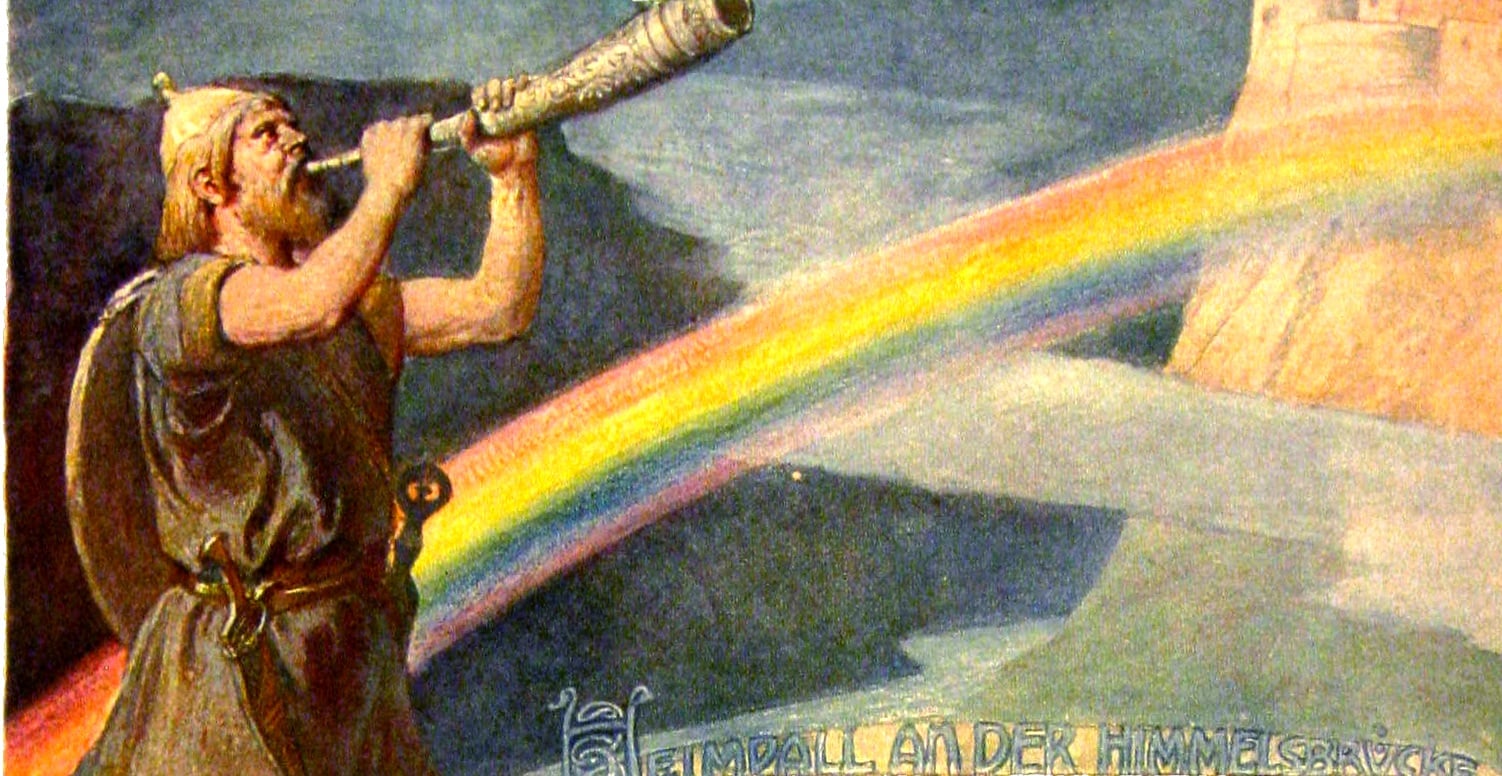
Across religions and cultures, the rainbow does not appear as a fence. Instead, it appears as a bridge, a message, a promise, a connection, and a sign of sacred power. (Doepler, Emil. ca. 1905. Walhall, die Götterwelt der Germanen. Martin Oldenbourg, Berlin. Page 54. Photographed by User:Haukurth, cropped by User:Skadinaujo.)

The first article in this Pride Month series addressed the question, “Did Gay People Steal the Rainbow from Christians?” I looked at the rainbow in the Bible—as a sign of covenant in Genesis, divine glory in Ezekiel, and heavenly majesty in Revelation. I also argued that Christians should be careful about calling the rainbow “ours,” especially when the strongest biblical rainbow images come from the Hebrew Bible—the Jewish Tanakh.
In today’s article, let’s look beyond Judaism and Christianity and see the spectrum of meaning that rainbows have had for many religions and cultures. Rainbows have been seen as bridges, bows, messengers, signs of divine presence, symbols of creation, warnings, blessings, serpents, and pathways between worlds.
The rainbow never belonged to Christianity alone. It has always belonged to sky and storm, light and human imagination. Beyond the Jewish and Christian context mentioned in the first article, let’s shed light on the rainbow’s other meanings.
Greek Mythology: Iris, Messenger of the Gods
Ever look into someone’s eyes and notice the wide variety of colors, beyond one simple hue? The colored part of the eye is called the iris, which gets its name from the Greek word for rainbow. In fact, Iris is the name of the Greek rainbow goddess, who was also a divine messenger.
While Greek and Hebrew cosmologies differed greatly, they overlap in the sense that the rainbow is a connection between heaven and earth. More than color in the sky, the rainbow is divine communication.
Long before modern Pride flags, and long before American evangelicals started treating the rainbow as if they owned it, people were already seeing it as a way humans can connect to the divine.
Norse Mythology: Bifröst, the Rainbow Bridge
If you’re a fan of the Marvel Cinematic Universe, then you’re familiar with Bifröst, the bridge between the nine realms of Norse mythology. In Thor, Thor: Ragnarok, Avengers: Infinity War, and Thor: Love and Thunder, we meet Heimdall as the bridge’s gatekeeper and see how heroes and villains travel between worlds. It’s probably the most well-known example of the rainbow bridge that animal-lovers sometimes refer to when explaining pet deaths to children.
In Norse mythology, the bridge is a connector. It doesn’t divide—it unites. Stretching from heaven to earth, it brings together those who seem divided. It crosses the gap between those who are scared, and that which is sacred.
That is almost the opposite of how some Christians talk about the rainbow during Pride Month. They turn it into a fence, a boundary marker, a line in the sand that shouldn’t be crossed. They treat it as a symbol of who’s in and who’s out, who may claim a connection to God and who’s denied blessing.
But across cultures, the rainbow keeps showing up differently. It joins what we thought was separate.
Hindu Traditions: Indra’s Bow
In some Hindu traditions, the rainbow is linked to Indra, the god of storms, rain, thunder, and the sky. According to Religion Media Centre, the rainbow is also known as Indra’s Bow.
Christian readers will immediately make the connection: Indra and the Hebrew God both have bows. In both cases, the rainbow is more than a celestial decoration. It is something powerful. But the meanings are not the same.
In Hinduism, Indra’s Bow is associated with storm, rain, sky, divine power, and beauty. Judaism gives it similar meaning, but notes that God’s bow is not pointed at the earth. This represents not a weapon ready to fire, but one that has been hung on its peg, set aside and not in use. The rainbow represents that divine destruction has been restrained.
In either case, the rainbow played a sacred role long before Christianity emerged onto the world scene.
Buddhist Traditions: Radiance and Transformation
We should be careful here, because, like Hinduism, Buddhism is not one single thing. So, I do not want to say, “Buddhism teaches that the rainbow means such-and-such,” as if a whole world of thought could be summed up in one sentence.
But in some Tibetan Buddhist contexts, rainbows are associated with deep spiritual transformation. Lion’s Roar discusses the Tibetan term jalu, which means “rainbow body,” in connection with physical bodies of devotees dissolving into light. Seen as saintlike figures, those who undergo this transformation are described as evaporating into the various lights of the color spectrum.
This is quite different from the rainbow as seen in Genesis, Revelation, Greek or Norse mythology. But it is another example of humans seeing rainbow symbolism in something sacred. Here, the rainbow indicates luminosity and transformation. And, for many in the queer community who leave one way of being behind and step into a truer one, the rainbow becomes an apt symbol.
Aboriginal Australian Traditions: The Rainbow Serpent
As with Hindu and Buddhist traditions, we must be careful because one cannot claim that all Aboriginal Australian traditions are the same. They differ according to place, people, and language.
Many Aboriginal Australian traditions speak of the Rainbow Serpent, a powerful sacred being connected with water, land, creation, rain, fertility, life, and danger. The Australian Museum shares Uncle Badger Bates’s teaching that the Ngatyi, or Rainbow Serpents, are still with his people, make rain, “blow the rainbow after the rain,” and created water and country as they travelled.
For those who believe, these are not quaint tales but sacred beliefs that connect land, water, memory, and the identity of a people.
If someone says, “Gay people stole the rainbow from Christians,” we must answer with another question: Which rainbow? The rainbow of Genesis? Of Iris? Heimdall’s Bifröst? Indra’s Bow? The rainbow body? The Rainbow Serpent? The rainbow has been doing sacred work far longer than Christians have supposed they owned it.
The Rainbow Is Not a Fence
Across religions and cultures, the rainbow does not appear as a fence. Instead, it appears as a bridge, a message, a promise, a connection, and a sign of sacred power. That’s why the conservative Christian claim that queer people “stole” the rainbow from Christians looks ridiculously small. It imagines it can shrink a massive, ancient, global symbol into one sub-culture’s pocket so it can claim it as its own.
The problem comes when one group that claims the rainbow uses it as a weapon against another group that also identifies with it. The rainbow should not be a weapon of culture-war. Instead, it should be a symbol of divine presence big enough to include everyone.
In my next article, we’ll look at how the rainbow became a Pride symbol—not because someone stole or appropriated it, but because people needed an emblem of visibility, survival, and joy.
If this article helped you see the rainbow as something larger, older, and more beautiful than a culture-war argument, I’d love your support on Patreon. Your support helps me keep writing about faith, justice, grace, and the stubborn hope that God’s love is wider than our fences.
For related reading on Patheos, check out my other articles:
- What If the Church Valued Diversity?
- What if the Church Focused on Justice Instead of Just-Us?
- He Called Me a Zen Baptist
General Christian
Relationships and Religion
History and Religion
Previous Post

June 1, 2026
Did Gay People Steal the Rainbow from Christians?
Next Post

June 15, 2026 Why the Rainbow Became a Pride Symbol
Recent Comments
"Absolutely, Glen! That's a great example! And the Roman centurion who trusted Jesus. I've heard ..."
“Can You Follow Jesus and Still ..."
"Captian of the Syrian military, Naaman in 2 Kings 5 might be considered."
“Can You Follow Jesus and Still ..."
"Hi, Bob. Not sure why it's doing that...I've been having problems with my comments settings. ..."
"OMG, who CARES?!?!"
“Can You Follow Jesus and Still ..."
Browse Our Archives
Select a Category Challenging the Church Deconstruction For Pastors Heathen Christianity Holidays and special days Mental Health Social Justice Spirituality Taoism Theology Uncategorized
Select a Month October 2026 September 2026 August 2026 July 2026 June 2026 May 2026 April 2026 March 2026 February 2026 January 2026 December 2025 November 2025 October 2025 September 2025 August 2025 July 2025 June 2025 May 2025 April 2025 March 2025 February 2025 January 2025 December 2024 November 2024 October 2024 September 2024 August 2024 July 2024 June 2024 May 2024 April 2024 March 2024 February 2024 January 2024 December 2023 November 2023 October 2023 September 2023 August 2023 July 2023 June 2023 May 2023 April 2023 March 2023 February 2023 January 2023 December 2022 November 2022 October 2022 September 2022 August 2022 July 2022 June 2022 May 2022 April 2022 March 2022 February 2022 January 2022
Follow Us!
TAKE THE
Religious Wisdom Quiz
How beautiful on the mountains are the feet of those who bring good news and proclaim what?
Select your answer to see how you score.
Deliverance Salvation Peace Victory
Related posts from Breathing Space

All the Colors of the Rainbow Testify to...

Holy Water Isn’t Acid. Stop Weaponizing Faith.


How Household Shrines Create Breathing Space in Your...
TRENDING AT PATHEOS Progressive Christian

What Being a Modern-Day Apostle Means to Me
In my last column, I discussed the ins and outs of modern-day...

Did Ancient China Once Worship the God of...
Across human history, a common thread weaves through the origins of the...

Love Your Neighbor – Including Earth-Kin: Lev. 19,...
God’s command to love your neighbor means acting in an ethical and...

Lead a Church Study of “Jesus and Lao...
Guest writer Jack Thomas (The Irreverent Reverend) reflects on leading his church...

Pastoral Wisdom for Responding to Sermon Pushback
Getting sermon pushback on your social justice sermon? Learn practical, Proverbs-based strategies...

Principles for Understanding the Apostolic Ministry Today
Whenever people discover that my formal ministry title is "apostle," as in...
view all Progressive Christian blogs
What Are Your Thoughts?leave a comment
Ad-Free & Subscriber Log-In Subscription Support
- About Us
- 2026 Calendar
- Videos
- Podcasts
- Library of World Religions
- Faith In Media Tracker
- Advertise With Us
- Write for Us
- Privacy Policy
- Terms of Service
- Do Not Sell My Data
- Contact Us
- Radiant Digital
- Manage Newsletter Subscriptions
- Unsubscribe From Notifications
- Sitemap
Copyright 2008-2026, Patheos. All rights reserved.
Subscription Support Ad-Free & Subscriber Log-In
Follow Patheos