
BuddhistCatholicContemplativeEvangelicalGeneral ChristianHinduJewishLatter-day SaintMuslimNew VisionsProgressive Christian
Beliefs
- Buddhist
- Catholic
- Contemplative
- Evangelical
- General Christian
- Hindu
- Jewish
- Latter-day Saint
- More Voices
- Muslim
- New Visions
- Pagan
- Progressive Christian
Topics
- Religion News
- Food and Religion
- Sports and Religion
- Religious Art
- Religious Music and Entertainment
- Religious Events
- History and Religion
- Style and Religion
- Politics and Religion
- Women in Religion
- Recreation Outdoors and Religion
- Business Finance and Religion
- Careers Workplace and Religion
- Education and Religion
- Family Parenting and Religion
- Health Fitness and Religion
- Home and Religion
- Relationships and Religion
- Technology and Religion
- Travel and Religion
Columnists
- Buddhist Columnists
- Business Finance and Religion Columnists
- Careers Workplace and Religion Columnists
- Catholic Columnists
- Contemplative Columnists
- Education and Religion Columnists
- Evangelists Columnists
- Family Parenting and Religion Columnists
- General Christian Columnists
- Health Fitness and Religion Columnists
- Hindu Columnists
- History and Religion Columnists
- Home and Religion Columnists
- Jewish Columnists
- More Voices Columnists
- Latter Day Columnists
- Muslim Columnists
- New Visions Columnists
- Nonreligious Columnists
- Pagan Columnists
- Politics and Religion Columnists
- Progressive Columnists
- Recreation Outdoors and Religion Columnists
- Relationships and Religion Columnists
- Religion News Columnists
- Religious Art Columnists
- Religious Events Columnists
- Religious Music and Entertainment Columnists
- Sports and Religion Columnists
- Style and Religion Columnists
- Technology and Religion Columnists
- Travel and Religion Columnists
- Women in Religion Columnists
Resource Library
- 2026 Calendar
- Library of World Religions
- The 100 Most Holy Places on Earth
- Patheos Answers
- Podcasts
- Videos
- Faith Leaders Database
- Anglican Episcopalian
- Bahai
- Baptist
- Buddhism
- Christianity
- Confucianism
- Eastern Orthodoxy
- Hinduism
- Holiness and Pentecostal
- ISKCON
- Islam
- Judaism
- Lutheran
- Methodist
- The Church of Jesus Christ of Latter-day Saints
- New Age
- Paganism
- Presbytarian and Reformed
- Protestantism
- Religion Behind the Scenes
- Roman Catholic
- Scientology
- Shia Islam
- Sikhism
- Sufism
- Sunni Islam
- Taoism
- Zen
- See all religions
Research Tools
 Ad-Free & Subscriber Log-In Subscription Support
Ad-Free & Subscriber Log-In Subscription Support
Follow Patheos 

- Trending:
- Forgiveness
- |
- Marriage
- |
- Consciousness
- |
- Death Penalty
- |
- Election
- |
- Halloween

-
Categories
- Home
- Progressive Christian
- Home and Religion
- Called to Be a Pastor? Consider Bivocational Ministry
Called to Be a Pastor? Consider Bivocational Ministry
Last updated on: March 30, 2026 at 3:30 am by Gregory T. Smith
Called to Be a Pastor? Consider Bivocational Ministry 2026-03-15T10:43:33-08:00 Gregory T. Smith
Patheos Explore the world's faith through different perspectives on religion and spirituality! Patheos has the views of the prevalent religions and spiritualities of the world.
Most who feel called to ministry dream of big churches. But have you considered the benefits of bivocational ministry in a small congregation?
I know, I know—the thought of bivocational ministry gives aspiring megachurch pastors more than a touch of indigestion. I feel this deeply. When I was in seminary, I had similar dreams of glory. To me, becoming full-time clergy was the only “real” way to be a pastor. So, that’s what I did—and for most of my twenty-six years in the pulpit, it was full-time. That’s why I’m no longer convinced that full-time clergy is the healthiest norm for the church.
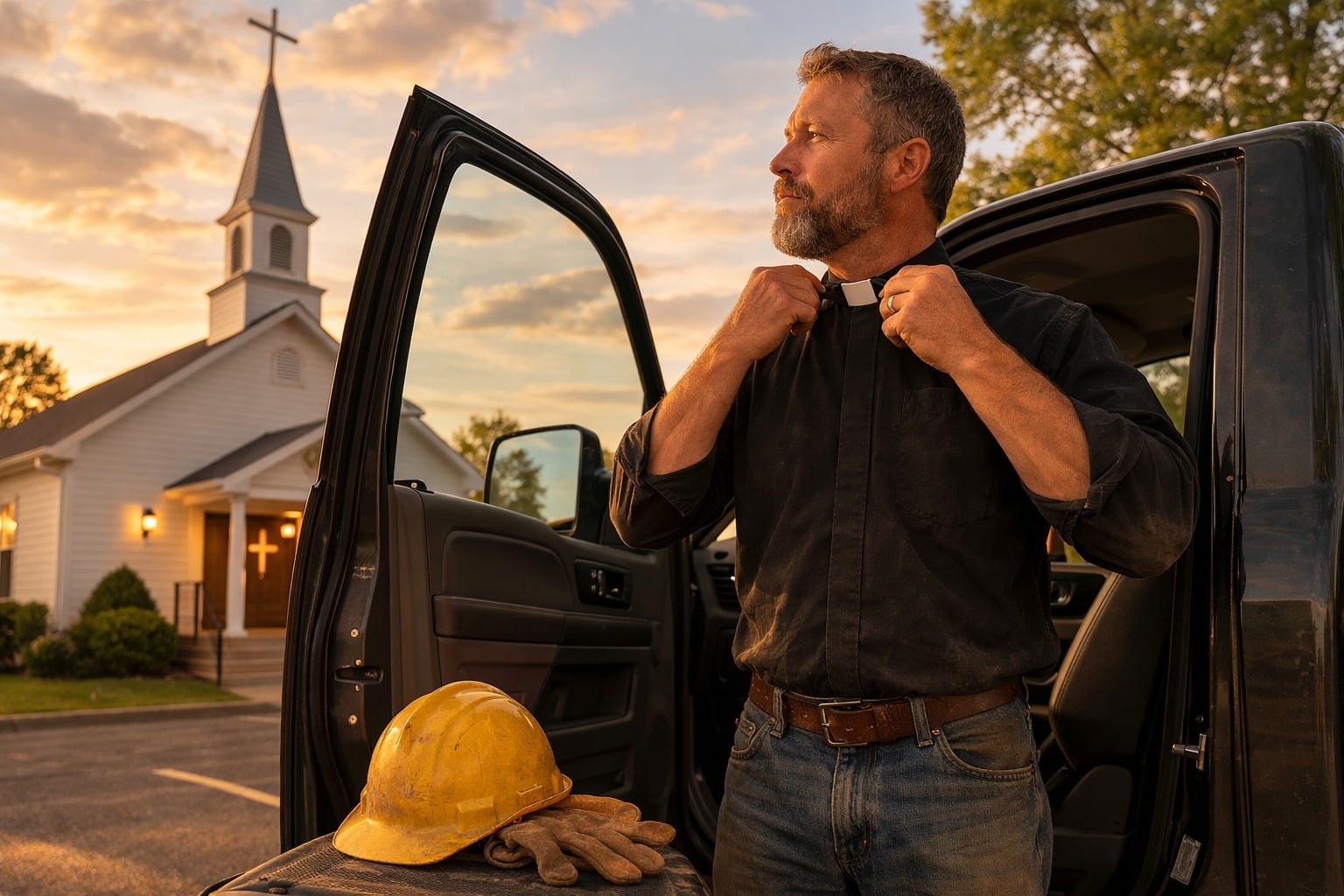
Bivocational ministry is not a magic fix, but it does offer some real advantages. (Image created by Gregory T. Smith on Open AI)
Bivocational Ministry—the Healthier Choice
To be clear, I still believe in pastoral calling. Some people are genuinely called and gifted to preach, teach, shepherd, counsel, and help communities follow Jesus more faithfully. I’m not arguing that churches don’t need pastors. I’m arguing against the assumption that the standard for ministry must be a full-time paid profession.
More and more, I think bivocational ministry may often be the better path. This isn’t because ministry is only worth part-time attention, but because it may help pastors and churches to stay focused on the things that really matter. Full-time ministry can create pressures and distortions that pastors might not even recognize themselves. Bivocational ministry is not a magic fix, but it does offer some real advantages.
Here are a dozen reasons why more people called to ministry should seriously consider going bivocational. (I wish somebody had told me sooner.)
1. It keeps pastors connected to ordinary life.
Any pastor will tell you that ministry sometimes feels like living in a bubble. Your life revolves around church culture, congregational problems, and that esoteric language, “Christianese.” As someone who has now worked both inside the church and outside it, I can tell you—they are two different worlds! Bivocational ministry helps pastors stay connected to the real-world pressures their people actually face.
2. It makes ministry more grounded.
A pastor who also works outside the church may preach and lead from a more human and less insulated place. Their teaching may be less abstract, less “churchy,” and more down to earth because it is rooted in everyday experience.
3. It reduces financial pressure and fear.
When a pastor’s entire income depends on the congregation, honesty can get expensive. Even good pastors can feel pressure to avoid conflict, soften hard truths, or keep the wrong people happy. Especially if you have a family to care for, the choice between “telling it like it is” and feeding your kids can be a hard one. Pastors whose main income is from another source enjoy a lot more freedom in their calling.
4. It keeps the churches smaller—and that may be a good thing.
Sure, bivocational ministry may limit growth. No church is going to take over their community if they have a part-time pastor. But who says bigger is always better? In smaller churches, people can actually know one another. Care can be personal. Community can be real. Bivocational pastors have a small enough flock to be able to keep up with them.
5. It pushes back against the corporate model of ministry.
Pastors aren’t called to be CEOs. They’re called to be caretakers of souls. Once pastors get large enough, pastors often stop functioning like shepherds and start functioning like executives. They spend more time managing staff, programs, budgets, and systems than actually caring for people. Bivocational ministry pushes back against that obsession with growth, efficiency, and control.
6. It helps keep clergy ego in check.
Let’s be clear—many pastors are humble people. But there’s something about being the center of attention that can turn even the humblest person into an egotist. When someone is paid to be “the spiritual person in the room,” it can distort their identity. Ministry can become status or performance. Bivocational ministry can help pastors remember that they are not a sacred class. They are ordinary human beings with a calling, not religious celebrities.
7. It resists celebrity Christianity.
The more ministry becomes a career, the more temptation there is to build a platform, grow a brand, and create a polished religious product. That can turn pastors into performers and ministry into image management. Part-time ministry makes that harder, which is probably a blessing.
8. It forces the church to share ministry.
In churches with full-time clergy, people often outsource ministry to the professional. Need care? Call the pastor. Need leadership? Ask the pastor. Need prayer? Let the pastor handle it. Bivocational ministry disrupts that pattern and reminds the congregation that they are there to take responsibility for one another.
9. It recovers the idea that ministry belongs to the whole church.
Many Christians talk a lot about the priesthood of all believers, but full-time clergy can undermine that in practice. No matter how much you give lip service to the equality of all Christians, you are functionally creating a clergy/laity divide. Bivocational ministry reminds the church that ministry is not just the job of the paid professional. It belongs to the whole body.
10. It challenges consumer Christianity.
When a pastor is seen mainly as a paid provider of spiritual goods and services, church members can begin to act like customers. Bivocational ministry can help reframe the church as a community of shared life and mutual care, not a religious business serving clients. Does that mean your church won’t be as attractive to potential parishioners with a consumer mentality? Yep—and I’ll refer you to my above statement, that small churches are a good thing.
11. It affirms the dignity of ordinary work.
A pastor who also teaches school, drives a truck, stocks shelves, works construction, or nurses patients is living proof that God is present in those places too. Bivocational ministry pushes back against the false divide between “sacred” work and “secular” work.
12. It may reveal what a church really is.
If a congregation cannot function without one full-time paid professional holding everything together, that may expose a deeper problem. Is it really a community, or just a weekly production? Bivocational ministry can force healthier questions.
The Pitfalls of Part-Time Ministry
So, there you go. Twelve reasons those who feel called to serve as pastors should consider bivocational ministry. I’m sure you could add a few more to my list. But are there no downsides to bivocational ministry? I’ll explore those in my next article, “What are the Pitfalls of Part-Time Ministry?”
This blog will remain here on Patheos. Patreon is simply a way to support my writing and access optional bonus material (practices, audio, and project notes). Join here: [https://www.patreon.com/cw/GregoryTSmith]
For related reading, check out my other articles:
- “Pastors Under Pressure”
- “Take Our Children to Work Day: Bad for Pastor’s Kids”
- “Pastors, Should You Hang Up Your Robes?”
General Christian
Home and Religion
Careers, Workplace and Religion

About Gregory T. Smith
I live in the beautiful Fraser Valley of British Columbia and work in northern Washington State as a behavioral health specialist with people experiencing homelessness and those who are overly involved in the criminal justice system. Before that, I spent over a quarter-century as lead pastor of several Virginia churches. My newspaper column, “Spirit and Truth” ran in Virginia newspapers for fifteen years. I am one of fourteen contributing authors of the Patheos/Quoir Publishing book “Sitting in the Shade of another Tree: What We Learn by Listening to Other Faiths.” I hold a degree in Religious Studies from Virginia Commonwealth University, and also studied at Baptist Theological Seminary at Richmond. My wife Christina and I have seven children between us, and we are still collecting grandchildren. You can read more about the author here. You can read more about the author here. You can read more about the author here.
Previous Post

March 23, 2026
6 Things MAGA Christians Should Love (But Somehow Don’t)
Next Post

April 6, 2026 What are the Pitfalls of Part-Time Ministry?
Recent Comments
"Absolutely, Glen! That's a great example! And the Roman centurion who trusted Jesus. I've heard ..."
“Can You Follow Jesus and Still ..."
"Captian of the Syrian military, Naaman in 2 Kings 5 might be considered."
“Can You Follow Jesus and Still ..."
"Hi, Bob. Not sure why it's doing that...I've been having problems with my comments settings. ..."
"OMG, who CARES?!?!"
“Can You Follow Jesus and Still ..."
Browse Our Archives
Select a Category Challenging the Church Deconstruction For Pastors Heathen Christianity Holidays and special days Mental Health Social Justice Spirituality Taoism Theology Uncategorized
Select a Month October 2026 September 2026 August 2026 July 2026 June 2026 May 2026 April 2026 March 2026 February 2026 January 2026 December 2025 November 2025 October 2025 September 2025 August 2025 July 2025 June 2025 May 2025 April 2025 March 2025 February 2025 January 2025 December 2024 November 2024 October 2024 September 2024 August 2024 July 2024 June 2024 May 2024 April 2024 March 2024 February 2024 January 2024 December 2023 November 2023 October 2023 September 2023 August 2023 July 2023 June 2023 May 2023 April 2023 March 2023 February 2023 January 2023 December 2022 November 2022 October 2022 September 2022 August 2022 July 2022 June 2022 May 2022 April 2022 March 2022 February 2022 January 2022
Follow Us!
TAKE THE
Religious Wisdom Quiz
What does "Barnabas" mean?
Select your answer to see how you score.
Faithful one Son of encouragement Gifted one Son of thunder
Related posts from Breathing Space

“Can You Follow Jesus and Still Practice Smudging?”

Lead a Church Study of “Jesus and Lao...

The Guest Who Stayed at an Unfriendly Table

When Being a Good Guest Is Better than...
TRENDING AT PATHEOS Progressive Christian

What Being a Modern-Day Apostle Means to Me
In my last column, I discussed the ins and outs of modern-day...

Did Ancient China Once Worship the God of...
Across human history, a common thread weaves through the origins of the...

Love Your Neighbor – Including Earth-Kin: Lev. 19,...
God’s command to love your neighbor means acting in an ethical and...

Lead a Church Study of “Jesus and Lao...
Guest writer Jack Thomas (The Irreverent Reverend) reflects on leading his church...

Pastoral Wisdom for Responding to Sermon Pushback
Getting sermon pushback on your social justice sermon? Learn practical, Proverbs-based strategies...

Principles for Understanding the Apostolic Ministry Today
Whenever people discover that my formal ministry title is "apostle," as in...
view all Progressive Christian blogs
What Are Your Thoughts?leave a comment
Ad-Free & Subscriber Log-In Subscription Support
- About Us
- 2026 Calendar
- Videos
- Podcasts
- Library of World Religions
- Faith In Media Tracker
- Advertise With Us
- Write for Us
- Privacy Policy
- Terms of Service
- Do Not Sell My Data
- Contact Us
- Radiant Digital
- Manage Newsletter Subscriptions
- Unsubscribe From Notifications
- Sitemap
Copyright 2008-2026, Patheos. All rights reserved.
Subscription Support Ad-Free & Subscriber Log-In
Follow Patheos