
BuddhistCatholicContemplativeEvangelicalGeneral ChristianHinduJewishLatter-day SaintMuslimNew VisionsProgressive Christian
Beliefs
- Buddhist
- Catholic
- Contemplative
- Evangelical
- General Christian
- Hindu
- Jewish
- Latter-day Saint
- More Voices
- Muslim
- New Visions
- Pagan
- Progressive Christian
Topics
- Religion News
- Food and Religion
- Sports and Religion
- Religious Art
- Religious Music and Entertainment
- Religious Events
- History and Religion
- Style and Religion
- Politics and Religion
- Women in Religion
- Recreation Outdoors and Religion
- Business Finance and Religion
- Careers Workplace and Religion
- Education and Religion
- Family Parenting and Religion
- Health Fitness and Religion
- Home and Religion
- Relationships and Religion
- Technology and Religion
- Travel and Religion
Columnists
- Buddhist Columnists
- Business Finance and Religion Columnists
- Careers Workplace and Religion Columnists
- Catholic Columnists
- Contemplative Columnists
- Education and Religion Columnists
- Evangelists Columnists
- Family Parenting and Religion Columnists
- General Christian Columnists
- Health Fitness and Religion Columnists
- Hindu Columnists
- History and Religion Columnists
- Home and Religion Columnists
- Jewish Columnists
- More Voices Columnists
- Latter Day Columnists
- Muslim Columnists
- New Visions Columnists
- Nonreligious Columnists
- Pagan Columnists
- Politics and Religion Columnists
- Progressive Columnists
- Recreation Outdoors and Religion Columnists
- Relationships and Religion Columnists
- Religion News Columnists
- Religious Art Columnists
- Religious Events Columnists
- Religious Music and Entertainment Columnists
- Sports and Religion Columnists
- Style and Religion Columnists
- Technology and Religion Columnists
- Travel and Religion Columnists
- Women in Religion Columnists
Resource Library
- 2026 Calendar
- Library of World Religions
- The 100 Most Holy Places on Earth
- Patheos Answers
- Podcasts
- Videos
- Faith Leaders Database
- Anglican Episcopalian
- Bahai
- Baptist
- Buddhism
- Christianity
- Confucianism
- Eastern Orthodoxy
- Hinduism
- Holiness and Pentecostal
- ISKCON
- Islam
- Judaism
- Lutheran
- Methodist
- The Church of Jesus Christ of Latter-day Saints
- New Age
- Paganism
- Presbytarian and Reformed
- Protestantism
- Religion Behind the Scenes
- Roman Catholic
- Scientology
- Shia Islam
- Sikhism
- Sufism
- Sunni Islam
- Taoism
- Zen
- See all religions
Research Tools
 Ad-Free & Subscriber Log-In Subscription Support
Ad-Free & Subscriber Log-In Subscription Support
Follow Patheos 

- Trending:
- Forgiveness
- |
- Marriage
- |
- Consciousness
- |
- Death Penalty
- |
- Election
- |
- Halloween

-
Categories
- Home
- Progressive Christian
- Education and Religion
- Renaming God: The Unmoved Mover and The Center
Renaming God: The Unmoved Mover and The Center
Last updated on: October 20, 2025 at 3:11 am by Gregory T. Smith
Renaming God: The Unmoved Mover and The Center 2025-10-17T19:28:44-08:00 Gregory T. Smith
Patheos Explore the world's faith through different perspectives on religion and spirituality! Patheos has the views of the prevalent religions and spiritualities of the world.
Renaming God as the Unmoved Mover and the Center displays the Divine as stillness in motion—where Greek, Christian, and Taoist wisdom meet.
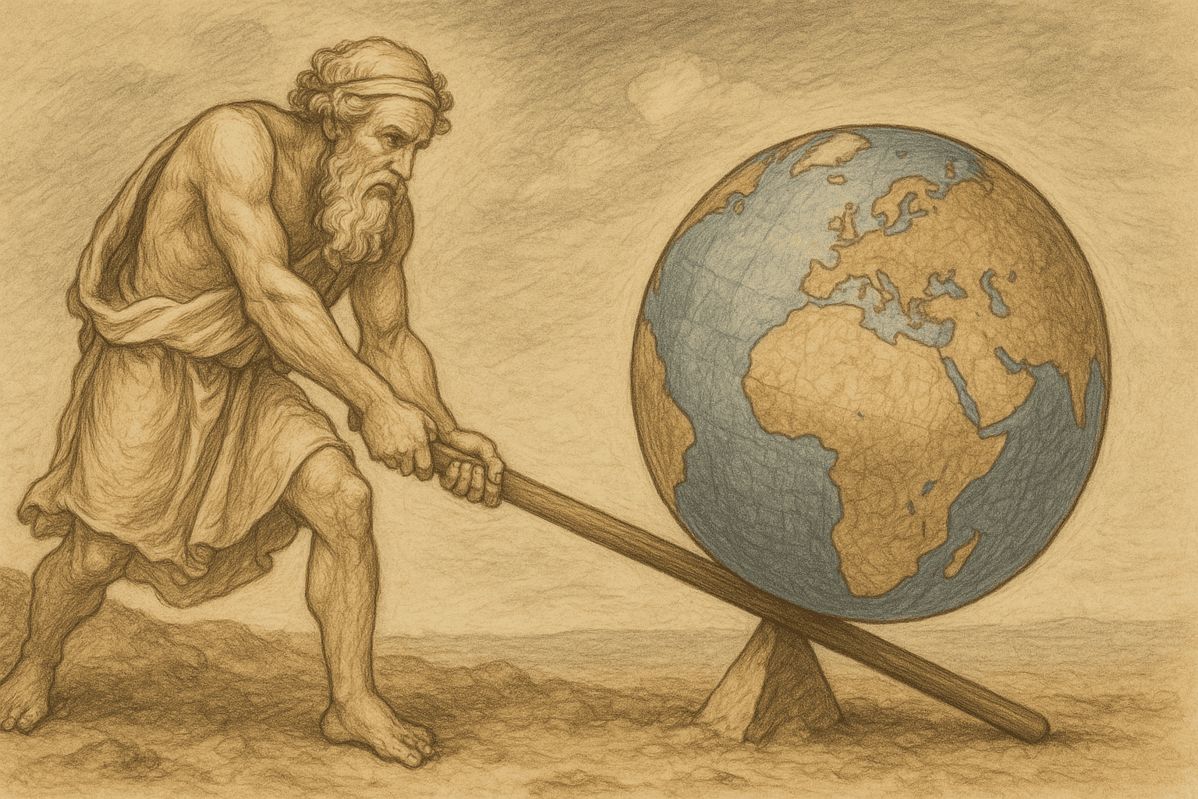
If the Unmoved Mover is the divine lever that moves all things, the Center is the place for Archimedes to stand. [AI-generated image via DALL·E (OpenAI)]
Last night in my living room, four generations discussed language meaningful to each but unrecognizable to the others. One group might not understand “the bee’s knees,” while another can make no sense out of “skibidi rizz.” What’s meaningful to one group might sound like nonsense to another. That’s why generations must learn each other’s language if they are to understand each other.
Renaming God
In the same way, certain divine designations resonate with one group of people, while others make sense to a different set. If we limit the names of God to the traditional terms, we risk losing generations who abandon a sense of ineffable wonder altogether. Stale names for God shrink the horizon of our imagination, making faith seem out of touch. By exploring new names for the Divine, we keep God relevant and honorable, rather than skibidi-rizz. (Did I say that right?)
In the series “Renaming God,” I have discussed many divine titles. Some appear in the Bible, and others arise from culture or imagination. Some you won’t. Here are just a few that we’ve explored:
- Light and Life
- God of My Understanding, Higher Power
- Father, Son, Holy Spirit
- Redeemer, Shepherd, King, Judge, Potter
- Mother, Nurturing Woman
- Way, Tao
- Source, Wellspring, Living Water
- Dove, Hen, Eagle, Bear
- Tree of Life, Root, Vine, Nature
- The Host, The Husband
- El Elyon (God in the Highest), Yahweh Yireh (God who Provides)
- Yahweh Nissi (Lord is My Banner), Yahweh Shalom (Lord is My Peace)
Today, I’ll explore two names for God: The Unmoved (Prime) Mover and The Center. The first comes from Western philosophy and theology. The second derives from Chinese Taoism, with its emphasis on balance and belonging. Together, these two names reveal a God who is not a micromanager in the sky, but the still source of all motion—the cosmic gravity around which life turns.
Aristotle’s “Unmoved Mover”
Aristotle gave us the term The Unmoved Mover, reasoning that every motion have a cause. The stone moving through the air was caused by someone’s hand. The hand was caused by desire. The desire was caused by imagination. You can stretch this chain of causation indefinitely—like a child playing the game of “Why?” until an exasperated parent blurts, “Just because!”
The Greek philosopher’s “Because” was the Unmoved Mover. In Metaphysics, Aristotle said that there must be a first cause that moves all things without itself being moved—a being of pure actuality that needs nothing, never changes, and is complete in itself.
Aristotle said the Prime Mover is pure actuality (energeia), without potentiality, change, or lack. It is perfect, eternal, and immaterial. Imagine it as a kind of spiritual Gravity, drawing all things to their proper place. Think of this as roughly equivalent to Paul Tillich’s term for God, the Ground of All Being.
Aquinas’s “Prime Mover”
In his Summa Theologica, medieval theologian Thomas Aquinas adopted Aristotle’s concept as the first of his “Five Ways” of proving God’s existence. For Aquinas, the Prime Mover is no cosmic clockmaker who creates the universe, sets it, and forgets it. Instead, as the Prime Mover, God is both the Creator and Sustainer that holds all things together by sheer divine presence.
Theological Implications of the “Unmoved (Prime) Mover”
Theologically, this means the Unmoved Mover is transcendent. This divine primal essence dwells beyond the world’s constant change, untouched by its storms, yet the very reason time flows at all.
The universe, therefore, is eternally dependent upon this Prime Mover for its eternal motion. Archimedes reportedly said, “If you give me a lever and a place to stand, I can move the world.” You might say that the Prime Mover is the lever that motivates all things.
Finally, the Unmoved Mover remains a divine mystery. It cannot be bribed or persuaded. It is not a personality to placate but a mystery to contemplate—a truth that invites wonder rather than transaction.
The Center: God as the Still Point
If the Unmoved Mover reveals God’s transcendence, the Center reveals God’s immanence—the sacred stillness within all motion. Chinese philosopher Lao Tzu described it beautifully in chapter 11 of the Tao Te Ching:
Thirty spokes are joined together in a wheel,
but it is the center hole
that allows the wheel to function.
The Center is the hollow through which the wheel turns, the musical pauses that make song possible, the pause between breaths that gives rhythm to life. It does not force movement; it allows it. Lao Tzu describes the Tao—the unseen unifying force of the universe—as the center that holds all things together. While the cosmos spins in constant motion, the Center is always empty, always still, and never disturbed.
Multiple Meanings of “Center”
It helps to recognize the multiple meanings of the Center (or Centre, if you’re from outside the United States). Each sheds light on why I suggest this as an alternative name for God.
The center is where life gathers. Think of the city center, the marketplace, the meeting place. The center is the crowded intersection of human stories. God as the Center is the pulse of community—the point where diverse lives converge and find belonging. Calling God the Center reminds us that we can find the Sacred best when we are among community.
Of course, Center is also a verb (as is God, but that’s another article). In mindfulness, to “center” means to return to what is true. God as the Center is the inviting pull that welcomes us home when we are scattered. Centering ourselves means attuning to the voice of alignment and peace that brings us balance. By naming God the Center, we turn to this holy presence to find rest for our souls.
The Axis and Void
God as the Axis of the Universe. My hometown, Ashland, Virginia, takes pride in being “the center of the universe.” Except, nope—we’ll give that one to God. Cosmically, the Center is the fulcrum of order. God as the Center is the harmony beneath chaos, the balance that allows life to exist. If the Unmoved Mover is the divine lever that moves all things, the Center is the place for Archimedes to stand. When we call God the Center, we recognize the pivotal role God plays as the axis of the universe.
Tao as the Sacred Void. In Taoist thought, the empty center is not meaningless vacuity but pregnant presence. It is an openness in which the divine can dwell, unlimited and unconfined. The sacred void is not something dark and fearful. Rather, it is the openness inside that gives the cup its meaning, the hole in the hub around which the wheel spins, and the sacred space within the womb where life grows. When we call God the Center, we recognize the value of emptiness, the holiness of the hurricane’s eye.
Theological Implications
Theologically, renaming God as the Center highlights the divine non-coercive presence. The Center does not manipulate or command. It allows, supports, and invites. This is a God of influence, not domination.
This name for God also emphasizes Inclusivity. The Center is not “out there” but “right here,” available in the breathing space we create within ourselves and our world. As the Center, God exists within all people and all things.
Calling God the Center also spotlights the paradox of God’s dynamic stillness. The Center is not frozen—it is the still point in motion itself, the mystery of a God who is both unchanging and endlessly creative.
In this age of division and noise, it’s easy to lose our center. We get so caught up in the hurricane’s spin that we neglect to center ourselves in the Divine. The Center calls us home. This name reminds us that peace is not found in the wind, fire, and earthquake, but in the still small voice that speaks from within. This is the stillness that does not deny movement but gives it coherence. It is holiness as equilibrium, rest as revelation.
Bringing the Names Together
These two names, The Unmoved Mover and the Center speak with one voice. Both offer nonanthropomorphic titles for God that recognize the holy and transcendent source from which all movement springs. They depict God as the immanent stillness through which all movement flows. Together, they describe a paradox both philosophers and mystics have tried to express for millennia: the motion of the world rooted in a changeless peace.
When the wheel of life spins too fast, these two names remind us that the power that moves the world is never in distress. The still point holds. The Center remains.
Perhaps renaming God is not about correcting the names we have given God in the past but widening our perception of the present. The Unmoved Mover and the Center are not final titles but doorways—ways of stepping through language into mystery. At the heart of all things, beneath every name, the same truth awaits: motion rooted in stillness, change held by love, the universe circling quietly around the One who never turns.
For related reading, check out my other articles:
- Renaming God: The Way, The Tao, & New Perspectives
- Renaming God: Finding the God of My Understanding
- Can Christians Rename God as “The Universe” and as “Nature”?
General Christian
Education and Religion
History and Religion
Ashland Virginia Center of the Universe

About Gregory T. Smith
I live in the beautiful Fraser Valley of British Columbia and work in northern Washington State as a behavioral health specialist with people experiencing homelessness and those who are overly involved in the criminal justice system. Before that, I spent over a quarter-century as lead pastor of several Virginia churches. My newspaper column, “Spirit and Truth” ran in Virginia newspapers for fifteen years. I am one of fourteen contributing authors of the Patheos/Quoir Publishing book “Sitting in the Shade of another Tree: What We Learn by Listening to Other Faiths.” I hold a degree in Religious Studies from Virginia Commonwealth University, and also studied at Baptist Theological Seminary at Richmond. My wife Christina and I have seven children between us, and we are still collecting grandchildren. You can read more about the author here.
Previous Post

October 13, 2025
Retrain Your Brain: 7 Steps from Outrage to Inner Peace
Next Post

October 27, 2025 Jesus & Lao Tzu: Winnie the Pooh and the Serenity Prayer
Recent Comments
"Absolutely, Glen! That's a great example! And the Roman centurion who trusted Jesus. I've heard ..."
“Can You Follow Jesus and Still ..."
"Captian of the Syrian military, Naaman in 2 Kings 5 might be considered."
“Can You Follow Jesus and Still ..."
"Hi, Bob. Not sure why it's doing that...I've been having problems with my comments settings. ..."
"OMG, who CARES?!?!"
“Can You Follow Jesus and Still ..."
Browse Our Archives
Select a Category Challenging the Church Deconstruction For Pastors Heathen Christianity Holidays and special days Mental Health Social Justice Spirituality Taoism Theology Uncategorized
Select a Month October 2026 September 2026 August 2026 July 2026 June 2026 May 2026 April 2026 March 2026 February 2026 January 2026 December 2025 November 2025 October 2025 September 2025 August 2025 July 2025 June 2025 May 2025 April 2025 March 2025 February 2025 January 2025 December 2024 November 2024 October 2024 September 2024 August 2024 July 2024 June 2024 May 2024 April 2024 March 2024 February 2024 January 2024 December 2023 November 2023 October 2023 September 2023 August 2023 July 2023 June 2023 May 2023 April 2023 March 2023 February 2023 January 2023 December 2022 November 2022 October 2022 September 2022 August 2022 July 2022 June 2022 May 2022 April 2022 March 2022 February 2022 January 2022
Follow Us!
TAKE THE
Religious Wisdom Quiz
What woman followed Naomi to Bethlehem and later married Boaz?
Select your answer to see how you score.
Esther Sarah Hannah Ruth
Related posts from Breathing Space

“Can You Follow Jesus and Still Practice Smudging?”

Lead a Church Study of “Jesus and Lao...

Jesus and Lao Tzu: Seven Striking Parallels

Mo Thomas: Book Review from a Black Hole
TRENDING AT PATHEOS Progressive Christian

Why Christians Have a Sacred Duty to Vote:...
The Bible offers strong support for the sacred duty to vote. Here...

What Being a Modern-Day Apostle Means to Me
In my last column, I discussed the ins and outs of modern-day...

Did Ancient China Once Worship the God of...
Across human history, a common thread weaves through the origins of the...

Love Your Neighbor – Including Earth-Kin: Lev. 19,...
God’s command to love your neighbor means acting in an ethical and...

Lead a Church Study of “Jesus and Lao...
Guest writer Jack Thomas (The Irreverent Reverend) reflects on leading his church...

Principles for Understanding the Apostolic Ministry Today
Whenever people discover that my formal ministry title is "apostle," as in...
view all Progressive Christian blogs
What Are Your Thoughts?leave a comment
Ad-Free & Subscriber Log-In Subscription Support
- About Us
- 2026 Calendar
- Videos
- Podcasts
- Library of World Religions
- Faith In Media Tracker
- Advertise With Us
- Write for Us
- Privacy Policy
- Terms of Service
- Do Not Sell My Data
- Contact Us
- Radiant Digital
- Manage Newsletter Subscriptions
- Unsubscribe From Notifications
- Sitemap
Copyright 2008-2026, Patheos. All rights reserved.
Subscription Support Ad-Free & Subscriber Log-In
Follow Patheos