
BuddhistCatholicContemplativeEvangelicalGeneral ChristianHinduJewishLatter-day SaintMuslimNew VisionsProgressive Christian
Beliefs
- Buddhist
- Catholic
- Contemplative
- Evangelical
- General Christian
- Hindu
- Jewish
- Latter-day Saint
- More Voices
- Muslim
- New Visions
- Pagan
- Progressive Christian
Topics
- Religion News
- Food and Religion
- Sports and Religion
- Religious Art
- Religious Music and Entertainment
- Religious Events
- History and Religion
- Style and Religion
- Politics and Religion
- Women in Religion
- Recreation Outdoors and Religion
- Business Finance and Religion
- Careers Workplace and Religion
- Education and Religion
- Family Parenting and Religion
- Health Fitness and Religion
- Home and Religion
- Relationships and Religion
- Technology and Religion
- Travel and Religion
Columnists
- Buddhist Columnists
- Business Finance and Religion Columnists
- Careers Workplace and Religion Columnists
- Catholic Columnists
- Contemplative Columnists
- Education and Religion Columnists
- Evangelists Columnists
- Family Parenting and Religion Columnists
- General Christian Columnists
- Health Fitness and Religion Columnists
- Hindu Columnists
- History and Religion Columnists
- Home and Religion Columnists
- Jewish Columnists
- More Voices Columnists
- Latter Day Columnists
- Muslim Columnists
- New Visions Columnists
- Nonreligious Columnists
- Pagan Columnists
- Politics and Religion Columnists
- Progressive Columnists
- Recreation Outdoors and Religion Columnists
- Relationships and Religion Columnists
- Religion News Columnists
- Religious Art Columnists
- Religious Events Columnists
- Religious Music and Entertainment Columnists
- Sports and Religion Columnists
- Style and Religion Columnists
- Technology and Religion Columnists
- Travel and Religion Columnists
- Women in Religion Columnists
Resource Library
- 2026 Calendar
- Library of World Religions
- The 100 Most Holy Places on Earth
- Patheos Answers
- Podcasts
- Videos
- Faith Leaders Database
- Anglican Episcopalian
- Bahai
- Baptist
- Buddhism
- Christianity
- Confucianism
- Eastern Orthodoxy
- Hinduism
- Holiness and Pentecostal
- ISKCON
- Islam
- Judaism
- Lutheran
- Methodist
- The Church of Jesus Christ of Latter-day Saints
- New Age
- Paganism
- Presbytarian and Reformed
- Protestantism
- Religion Behind the Scenes
- Roman Catholic
- Scientology
- Shia Islam
- Sikhism
- Sufism
- Sunni Islam
- Taoism
- Zen
- See all religions
Research Tools
 Ad-Free & Subscriber Log-In Subscription Support
Ad-Free & Subscriber Log-In Subscription Support
Follow Patheos 

- Trending:
- Forgiveness
- |
- Marriage
- |
- Consciousness
- |
- Death Penalty
- |
- Election
- |
- Halloween

-
Categories
- Home
- Progressive Christian
- Religious Events
- Forgiving the Mess: How Jesus Redefines Homecoming
Forgiving the Mess: How Jesus Redefines Homecoming
Last updated on: October 16, 2024 at 3:46 am by Gregory T. Smith
Forgiving the Mess: How Jesus Redefines Homecoming 2024-10-12T18:52:03-08:00 Gregory T. Smith
Patheos Explore the world's faith through different perspectives on religion and spirituality! Patheos has the views of the prevalent religions and spiritualities of the world.
This time of year, many churches in the southern US open their doors for homecoming services. What was it like at Jesus’s homecoming?
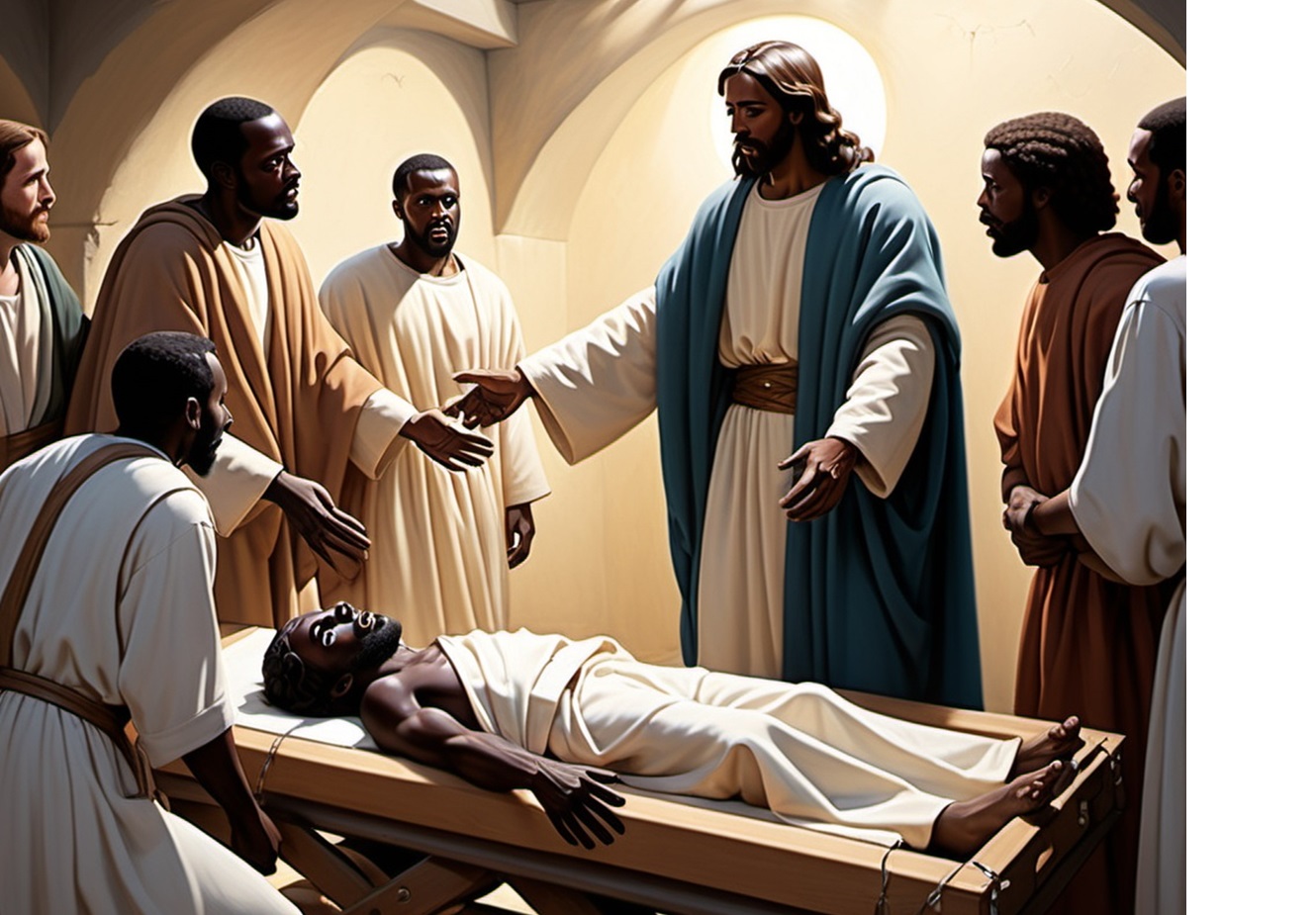
“We want Jesus in the house, but we don’t want things messy.” Image created by author on openart.ai
Homing services are a traditional Southern practice, where churches invite former pastors and evangelists to speak. They also invite people who have connections to the church yet have not attended in years. Coupled with lavish potluck meals, these special times are sort of like a combination of Back to Church Sunday and a good old family reunion.
One New Testament story hints at what homecoming was like at Jesus’ house.
Jesus’s Homecoming
Mark 2:3-12 tells the story of Jesus coming home to his house in Capernaum. Verse 1 (emphasis added) says:
When he returned to Capernaum after some days, it was reported that HE WAS AT HOME.
Many people think that Jesus was homeless. But he had a home in Capernaum. It’s just that during his three-year itinerant ministry, he didn’t spend a lot of time there. When Jesus returned home, his friends and family must have done everything they could to make him feel comfortable. Maybe your church is that way. It’s a place of comfort and peace, where you can truly feel at rest. I imagine Jesus must have felt that kind of welcome when he arrived at his homeplace.
No Longer Any Room
Things start to get a little uncomfortable in the next verse.
So many gathered around that there was no longer room for them, not even in front of the door, and he was speaking the word to them.
Have you noticed that whenever Jesus is in the house, things start to get uncomfortable? This isn’t the way “good Christians” expect things to be, though. We’ve been taught that whenever Jesus is around, everything is beautiful. We can’t wait to go to church on Sundays because that’s our place of comfort. We love the fellowship and the music and the sermons (well, some of the sermons). When the entire world is changing around us, church is the one place where we can find normalcy.
When Jesus is in the House
But it isn’t that way in the Bible. Instead, we find that whenever Jesus is in the house, things start to get uncomfortable. When God is really doing something, it attracts people. And those people bring their messy lives with them. Those messy lives get in the way of our agenda, our plans, our comfort. And sometimes the church doesn’t like it.
One of the churches I served went through a big remodeling project. The old basement downstairs wasn’t use for anything but storage. So, we spent a lot of time and money fixing everything up. When the remodeled church building was beautiful, I started talking about what we could do to attract young families. They said, “We’ve spent so much time and money getting everything just right—the last thing we want is a bunch of kids getting their fingerprints all over the walls.”
What they were really saying was, “We want Jesus in the house, but we don’t want things messy. We want Jesus in the house, but we don’t want it to get crowded.” But it doesn’t work like that. You can’t have it both ways. Either you welcome the crowds and the mess, or you don’t have Jesus. The two go hand in hand.
People with Needs
When Jesus is in the house, people with needs are going to start to arrive. Verses 3-4 show just how messy it can get.
Then some people came, bringing to him a paralyzed man, carried by four of them. And when they could not bring him to Jesus because of the crowd, they removed the roof above him, and after having dug through it, they let down the mat on which the paralytic lay.
Now, that’s messy! Yet, for some reason, churches think they can have Jesus in the house, and it won’t get messy. Other times, they know things would get messy, so they make decisions to avoid the mess. Another church I served (don’t worry—it wasn’t Antioch) had a phone but no answering machine. When I first arrived at the church, I thought that was strange. So, I said to the deacon chair, “Why don’t we get an answering machine?”
He said to me, “We don’t want an answering machine. Because people will just start calling the church, leaving messages, asking for stuff. If we don’t have an answering machine, they’ll still have needs—but what we don’t know won’t hurt us.” Yes, he actually said that. He knew that when Jesus is in the house, people with needs will start showing up, and he wanted to avoid that.
Your Sins are Forgiven!
So, these four friends knock a hole in Jesus’ roof and lower their friend down. Verse 5 says:
When Jesus saw their faith, he said to the paralytic, “Child, your sins are forgiven.”
I hope you can see the humor in this. Jesus has been traveling for a while. It’s still early in Mark’s Gospel, but Jesus has been busy already. He got baptized, went into the desert where the devil tempted him, and he called his first disciples. Then, he healed a man with an unclean spirit and cured Peter’s mother-in-law as well. He started a preaching tour in Galilee. He cleansed a man with a skin disease.
Now, Jesus must be dead tired as he returns home to Capernaum for a little R&R. His family and friends are trying to make him comfortable, but when Jesus is in the house, things get messy. Jesus is just in the middle of a sermon when he hears footsteps and scuffling on the roof. Imagine the racket and the dust and the roofing materials everywhere—then this man comes down through the hole on a stretcher. Jesus looks at the mess they’ve made of his home, his sanctuary. He thinks of the carpenter’s tools he’s going to need to use again to repair the damage and he says, “Oh, man—I forgive you!”
Forgive the Mess
If we’re going to be like Jesus, we’re going to have to learn to forgive the people who come into our churches and bring their mess with them. We’re going to need to forgive the mess in their lives when they don’t meet our expectations. And we’re going to need to forgive the mess they make in our churches when their life situations disrupt our comfort with a cloud of dust. Because when Jesus is in the house, he shows us how to forgive the mess.
If your congregation opens its doors for Homecoming services this time of year, make sure yours is a church worth coming home to. Be the church that welcomes people to come as they are. Forgive their mess. Only then can you offer them healing.
For related reading, check out my other articles:
- Is It the Church’s Mission to Do Social Work?
- Tipping Your Church’s Sacred Cows While Avoiding Cow Pies
- What If the Church Preferred the Path of Jesus to Theology?
General Christian
Religious Events
Home and Religion

About Gregory T. Smith
I live in the beautiful Fraser Valley of British Columbia and work in northern Washington State as a behavioral health specialist with people experiencing homelessness and those who are overly involved in the criminal justice system. Before that, I spent over a quarter-century as lead pastor of several Virginia churches. My newspaper column, “Spirit and Truth” ran in Virginia newspapers for fifteen years. I am one of fourteen contributing authors of the Patheos/Quoir Publishing book “Sitting in the Shade of another Tree: What We Learn by Listening to Other Faiths.” I hold a degree in Religious Studies from Virginia Commonwealth University, and also studied at Baptist Theological Seminary at Richmond. My wife Christina and I have seven children between us, and we are still collecting grandchildren. You can read more about the author here.
Previous Post
September 15, 2024
Christian & Pagan Holidays: Michaelmas, Mabon, & Matthew
Next Post

November 13, 2024 Home for the Holidays: A Place for Everyone
Recent Comments
"Absolutely, Glen! That's a great example! And the Roman centurion who trusted Jesus. I've heard ..."
“Can You Follow Jesus and Still ..."
"Captian of the Syrian military, Naaman in 2 Kings 5 might be considered."
“Can You Follow Jesus and Still ..."
"Hi, Bob. Not sure why it's doing that...I've been having problems with my comments settings. ..."
"OMG, who CARES?!?!"
“Can You Follow Jesus and Still ..."
Browse Our Archives
Select a Category Challenging the Church Deconstruction For Pastors Heathen Christianity Holidays and special days Mental Health Social Justice Spirituality Taoism Theology Uncategorized
Select a Month October 2026 September 2026 August 2026 July 2026 June 2026 May 2026 April 2026 March 2026 February 2026 January 2026 December 2025 November 2025 October 2025 September 2025 August 2025 July 2025 June 2025 May 2025 April 2025 March 2025 February 2025 January 2025 December 2024 November 2024 October 2024 September 2024 August 2024 July 2024 June 2024 May 2024 April 2024 March 2024 February 2024 January 2024 December 2023 November 2023 October 2023 September 2023 August 2023 July 2023 June 2023 May 2023 April 2023 March 2023 February 2023 January 2023 December 2022 November 2022 October 2022 September 2022 August 2022 July 2022 June 2022 May 2022 April 2022 March 2022 February 2022 January 2022
Follow Us!
TAKE THE
Religious Wisdom Quiz
What does "Genesis" mean?
Select your answer to see how you score.
Poetry Origin or Beginning Wisdom Law
Related posts from Breathing Space

“Can You Follow Jesus and Still Practice Smudging?”

Lead a Church Study of “Jesus and Lao...

I Met Papa Before I Read The Shack

The Guest Who Stayed at an Unfriendly Table
TRENDING AT PATHEOS Progressive Christian

What Being a Modern-Day Apostle Means to Me
In my last column, I discussed the ins and outs of modern-day...

Did Ancient China Once Worship the God of...
Across human history, a common thread weaves through the origins of the...

Love Your Neighbor – Including Earth-Kin: Lev. 19,...
God’s command to love your neighbor means acting in an ethical and...

Lead a Church Study of “Jesus and Lao...
Guest writer Jack Thomas (The Irreverent Reverend) reflects on leading his church...

Pastoral Wisdom for Responding to Sermon Pushback
Getting sermon pushback on your social justice sermon? Learn practical, Proverbs-based strategies...

Principles for Understanding the Apostolic Ministry Today
Whenever people discover that my formal ministry title is "apostle," as in...
view all Progressive Christian blogs
What Are Your Thoughts?leave a comment
Ad-Free & Subscriber Log-In Subscription Support
- About Us
- 2026 Calendar
- Videos
- Podcasts
- Library of World Religions
- Faith In Media Tracker
- Advertise With Us
- Write for Us
- Privacy Policy
- Terms of Service
- Do Not Sell My Data
- Contact Us
- Radiant Digital
- Manage Newsletter Subscriptions
- Unsubscribe From Notifications
- Sitemap
Copyright 2008-2026, Patheos. All rights reserved.
Subscription Support Ad-Free & Subscriber Log-In
Follow Patheos