
BuddhistCatholicContemplativeEvangelicalGeneral ChristianHinduJewishLatter-day SaintMuslimNew VisionsProgressive Christian
Beliefs
- Buddhist
- Catholic
- Contemplative
- Evangelical
- General Christian
- Hindu
- Jewish
- Latter-day Saint
- More Voices
- Muslim
- New Visions
- Pagan
- Progressive Christian
Topics
- Religion News
- Food and Religion
- Sports and Religion
- Religious Art
- Religious Music and Entertainment
- Religious Events
- History and Religion
- Style and Religion
- Politics and Religion
- Women in Religion
- Recreation Outdoors and Religion
- Business Finance and Religion
- Careers Workplace and Religion
- Education and Religion
- Family Parenting and Religion
- Health Fitness and Religion
- Home and Religion
- Relationships and Religion
- Technology and Religion
- Travel and Religion
Columnists
- Buddhist Columnists
- Business Finance and Religion Columnists
- Careers Workplace and Religion Columnists
- Catholic Columnists
- Contemplative Columnists
- Education and Religion Columnists
- Evangelists Columnists
- Family Parenting and Religion Columnists
- General Christian Columnists
- Health Fitness and Religion Columnists
- Hindu Columnists
- History and Religion Columnists
- Home and Religion Columnists
- Jewish Columnists
- More Voices Columnists
- Latter Day Columnists
- Muslim Columnists
- New Visions Columnists
- Nonreligious Columnists
- Pagan Columnists
- Politics and Religion Columnists
- Progressive Columnists
- Recreation Outdoors and Religion Columnists
- Relationships and Religion Columnists
- Religion News Columnists
- Religious Art Columnists
- Religious Events Columnists
- Religious Music and Entertainment Columnists
- Sports and Religion Columnists
- Style and Religion Columnists
- Technology and Religion Columnists
- Travel and Religion Columnists
- Women in Religion Columnists
Resource Library
- 2026 Calendar
- Library of World Religions
- The 100 Most Holy Places on Earth
- Patheos Answers
- Podcasts
- Videos
- Faith Leaders Database
- Anglican Episcopalian
- Bahai
- Baptist
- Buddhism
- Christianity
- Confucianism
- Eastern Orthodoxy
- Hinduism
- Holiness and Pentecostal
- ISKCON
- Islam
- Judaism
- Lutheran
- Methodist
- The Church of Jesus Christ of Latter-day Saints
- New Age
- Paganism
- Presbytarian and Reformed
- Protestantism
- Religion Behind the Scenes
- Roman Catholic
- Scientology
- Shia Islam
- Sikhism
- Sufism
- Sunni Islam
- Taoism
- Zen
- See all religions
Research Tools
 Ad-Free & Subscriber Log-In Subscription Support
Ad-Free & Subscriber Log-In Subscription Support
Follow Patheos 

- Trending:
- Forgiveness
- |
- Marriage
- |
- Consciousness
- |
- Death Penalty
- |
- Election
- |
- Halloween

-
Categories
- Home
- Progressive Christian
- Religious Events
- Christian & Pagan Holidays: Michaelmas, Mabon, & Matthew
Christian & Pagan Holidays: Michaelmas, Mabon, & Matthew
Last updated on: September 20, 2024 at 11:41 am by Gregory T. Smith
Christian & Pagan Holidays: Michaelmas, Mabon, & Matthew 2024-09-20T11:41:05-08:00 Gregory T. Smith
Patheos Explore the world's faith through different perspectives on religion and spirituality! Patheos has the views of the prevalent religions and spiritualities of the world.
This year, the Fall Equinox is September 22. Neopagans observe it as Mabon. Christians also observe Michaelmas and the Feast of St. Matthew the Apostle.
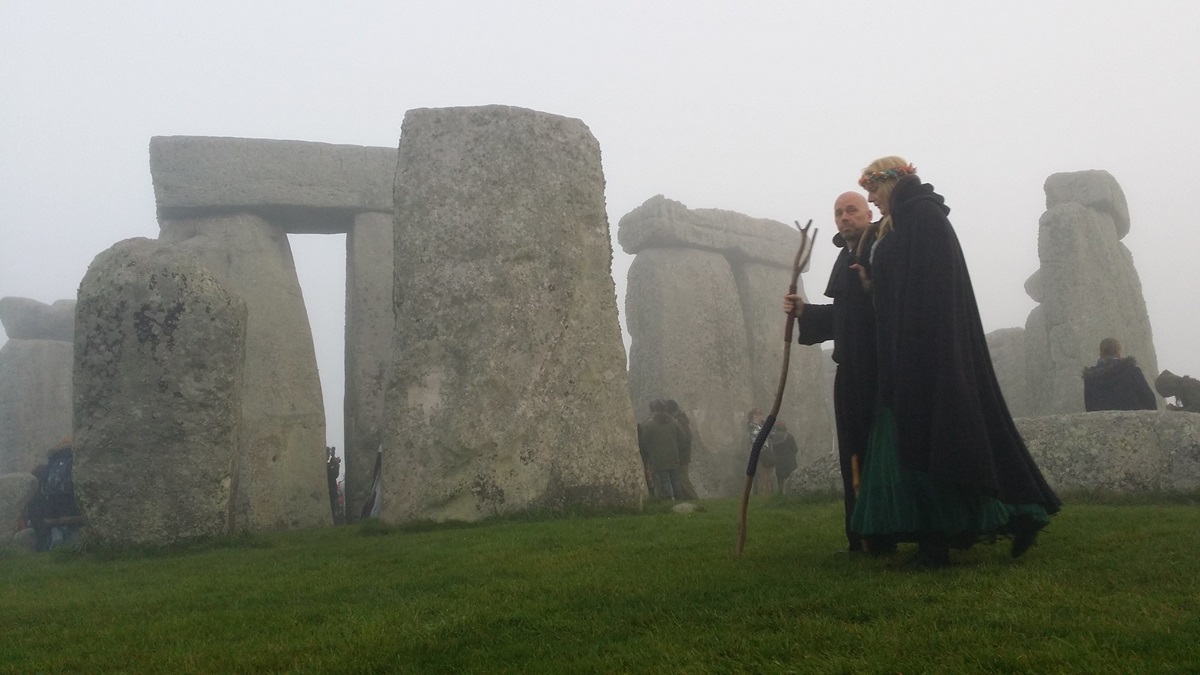
Stonehenge Autumn Equinox (Mabon) Celebrations. Image by Stonehenge Stone Circle on Flickr
Breathe deeply this time of year, and you might just catch the scent of Autumn. Crisp morning air invites the mist to linger longer than it did in Summer’s heat. Borne on the fog, a hint of hearth fire reminds you of cozy days to come. But by midday the gloom has gone, shying away from the shining sun.
The Equinox
It’s the Equinox, when the Earth keeps one foot in Summer and the other in Fall. Day and night are of equal lengths. From here onward, it only gets darker until mid-winter. At this time, the year turns another corner, and we turn up our collars against the coming chill.
Balancing between Summer and Fall, Christians observe the Feasts of St. Matthew the Evangelist and St. Michael the Archangel. These days straddle the Neopagan holiday of Mabon. As the wheel of the year turns, it reminds Christians not to distance ourselves too far from our Pagan roots.
The Liturgical Calendar
Many Christian denominations observe a liturgical calendar. This begins with the season of Advent, which leads into Christmas and then Epiphany. From the stories of Jesus’ birth and infancy, the Church moves to narratives of his death and resurrection, with Lent, Holy Week, Easter, and Pentecost. The other half of the year is Ordinary Time.
The Wheel of the Year
In the same way, Neopagans follow a cycle, called the Wheel of the Year. In Christian & Pagan Holidays: Groundhogs, Candlemas & Imbolc, I write about this wheel:
Pre-Christian Celts divided the year into eight equal portions, called “The Wheel of the Year.” The quarters fall at the summer solstice (Litha, on or around June 21), the winter solstice (Yule, on or around December 21), spring equinox (Ostara, on or around March 21), and fall equinox (Mabon, on or around September 21). The cross-quarters lie at the midpoints in each season. The midpoint of spring is Beltane, on or around May 1. The middle of summer is Lughnasadh, on or around August 1. Halfway through fall is Samhain, on or around November 1. The midpoint of winter is Imbolc, on or around February 1. (These dates are inverted for those who celebrate in the southern hemisphere.) Each of these quarters and cross-quarters represents a different phase in the agricultural year and carries with it a spiritual significance.
When Roman Catholicism entered the unchurched lands of Western Europe, it Christianized the indigenous festivals to facilitate the conversion of Pagans. Ostara was renamed Easter. Beltane was transformed into May Day with its fertility pole. Litha corresponds to the Roman Catholic Solemnity of the Birth of John the Baptist. Lughnasadh, the festival of first harvest, became Lammas, or the Loaf Mass. Mabon, the feast of the second harvest, became the Feast of Matthew the Apostle. The Church turned Samhain into All Saints’ Day. We are more familiar with the day before—All Hallows Eve, or Halloween. Christmas eclipsed Yule to such an extent that many think they are synonymous. And finally, Candlemas replaced Imbolc.
While it’s true that Christians appropriated indigenous European holidays and practices, learning to share can be a beautiful thing. What can Christians and Pagans learn from one another?
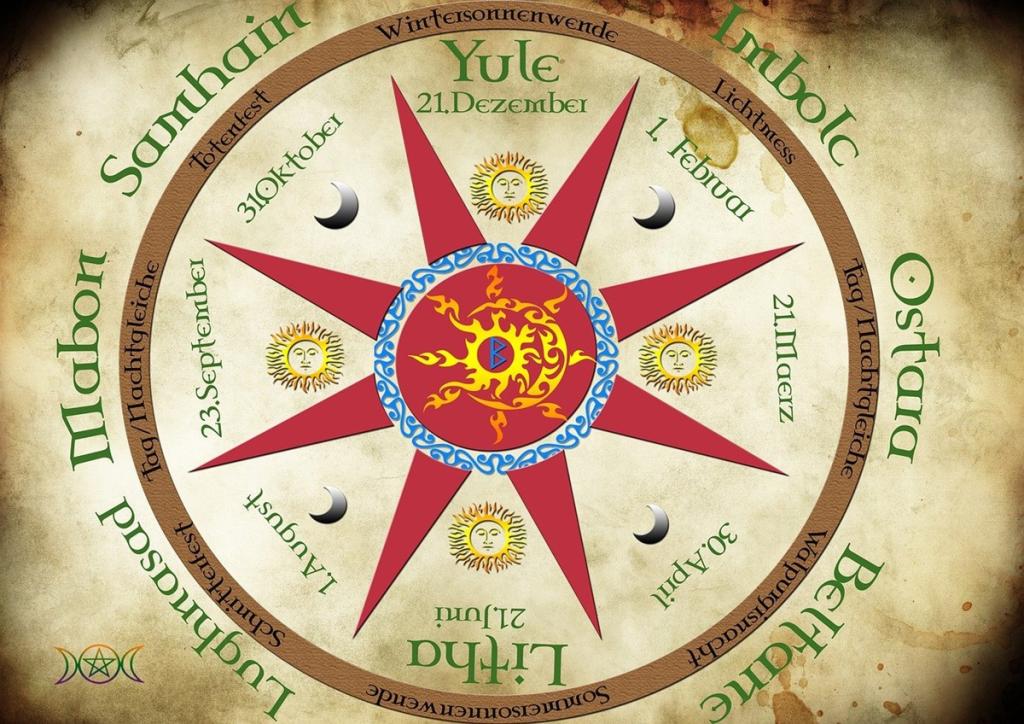
The Wheel of the Pagan Year. Image by Katuschka from Pixabay
St. Matthew
Matthew (also known as Levi) was a tax collector whom Jesus called as a disciple. Here’s the account of this event, as told in the Gospel of Matthew:
As Jesus was walking along, he saw a man called Matthew sitting at the tax-collection station, and he said to him, “Follow me.” And he got up and followed him.
And as he sat at dinner in the house, many tax collectors and sinners came and were sitting with Jesus and his disciples. When the Pharisees saw this, they said to his disciples, “Why does your teacher eat with tax collectors and sinners?” But when he heard this, he said, “Those who are well have no need of a physician, but those who are sick. Go and learn what this means, ‘I desire mercy, not sacrifice.’ For I have not come to call the righteous but sinners.”
Jesus’s selection of the outcast tax collector, whom the other disciples would have branded a traitor, demonstrates the mercy that Jesus wants for all people. Matthew overcame the stigma of his early years by becoming one of the four canonical evangelists. He carried the Good News, perhaps to Persia and/or Ethiopia. It is rumored that he died as a martyr, but there is no historical evidence surrounding his death. He is the patron saint of bankers, actors, accountants, and bookkeepers. The Roman Catholic Church celebrates his feast day on September 21.
Michaelmas
Historically, Michaelmas (September 29) is a more significant observance than the Feast of St. Matthew. This day honors more than one archangel. It is also known as the Feast of Saints Michael, Gabriel, and Raphael. Let’s take a brief look at each of these celestial beings.
· Michael
In Daniel 10, an angel appears to the prophet, who has been praying for divine assistance. The angel refers to Michael as “one of the chief princes” in the heavenly realms. Revelation 12 and Joshua 5 depict Michael as the leader of God’s armies. In Jude 1:9, Michael contends with the devil over the body of Moses. (Click here to read more about Michael.)
· Gabriel
If Michael is the prototypical warrior angel, Gabriel represents God’s divine messengers. In Daniel 8, the heavenly courier appears in human form to help the prophet understand a vision. Luke 1 has Gabriel announcing the conception of John the Baptizer. Luke 2 depicts Gabriel announcing the conception of Jesus. (Click here to read more about Gabriel.)
· Raphael
Of the multiple archangels, the Protestant canon only mentions Michael and Gabriel. The Book of Tobit, in the Roman Catholic Bible, mentions Raphael as a binder of demons and as a healer. According to New Advent, there are three additional archangels, from the book of Enoch. They are Uriel, Raguel, Sariel, and Jerahmeel. But these do not share the feast day of September 29.
Traditionally, Michaelmas was related to the Autumn Equinox. As such, it was a time for people to gather, feast, and engage in commerce. This gathering is why Fall is a popular time for elections in Western countries.
The Week of Matthew and Michaelmas
As the Feast of Saints Michael, Gabriel, and Raphael, Michaelmas celebrates the archangels who lead the heavenly host. This feast day recognizes the invisible heavenly realms beyond mortal ken. It calls to mind the words of Shakespeare, “There are more things in heaven and earth, Horatio, than are dreamt of in your philosophy” (Hamlet, 1.5. 165–66).” September 29 reminds us of ethereal planes, planting one foot in angelic territory.
September 21 places the other foot squarely on the ground of earth. Matthew reminds us of mundane things like going to work, filling out ledgers, and handling money. He is the saint of “nose to the grindstone” types of people. Matthew begins a time of reflection on the everyday. A week and a day later, we contemplate the heavenlies. You might say that the Week of Matthew and Michaelmas allows us to keep one foot on earth, and the other in heaven. This is a season of balance.
What, or Who, is Mabon?
Balance is important, as Matthew’s Feast and Michaelmas stand astride the Neopagan celebration of Mabon, the Autumnal Equinox. Days and nights find equilibrium. Temperatures have begun to moderate. Summer is gone, and winter is coming. But Fall holds wonders of its own.
Patheos columnist Sorita D’Este offers an article entitled, “Did Mabon Steal the Autumn Equinox?” De’Este recognizes that until the 1970s, Pagans simply called this holiday the Autumn Equinox. When Neopagan author Aiden Kelly dubbed the holiday by the name of the Welsh deity Mabon ap Modron. De’Este writes, “There is some evidence that Mabon may have been a different name for the god Maponus, as they were sometimes equated.” Maponus, in turn, shares much in common with the Roman sun god Apollo.
Other deities come into play as well. Mabon House reports:
“The Greek goddess Demeter is more closely associated with the Autumn harvest, as her grief over losing her daughter, Persephone, turned the earth from lush abundance to barren cold. These myths of loss and renewal are at the heart of Mabon, symbolizing the balance between light and dark, life and death, and the ongoing cycle of the seasons.”
So, when we call the holiday by its modern name of Mabon, we recognize a layer of otherworldly complexity.
Mabon Celebrations
Yet, despite its complicated divine history, many Neopagans celebrate the Autumn Equinox with down-to-earth traditions. Mabon is a time to adorn your home with fall colors and natural elements such as pumpkins, gourds, acorns, pinecones, and other harvest decorations. As a harvest celebration, it’s a time to feast with family and friends, enjoy a bonfire, or go for a hayride.
Related to the harvest, Mabon is a time to practice gratitude. For this reason, the holiday is often called Pagan Thanksgiving. Kerry Ward and Erica Smith suggest keeping a gratitude journal or giving to charity at this time of year. Dhruti Bhagat says that American Thanksgiving was originally celebrated on October 3, closer to Mabon and Michaelmas celebrations.
A Foot in Each World
Just as Matthew’s Feast and Michaelmas plant one foot on the earth and the other in heaven, Mabon celebrations remind us of balance. Theologically, Mabon is complex, drawing influences from multiple cultures and pantheons. But practically, Autumn Equinox celebrations are down to earth. This balance between celestial and terrestrial realms seems appropriate for a time when dark and light have reached equilibrium. Christian and Pagan holidays remind us to keep a foot in each world if we want to maintain stability.
Unfortunately, Christians and Neopagans historically have withdrawn from each other, like the feet of a person involuntarily doing the splits. To be fair, Christians started the whole thing by persecuting Pagans, burning them as witches, and promoting the Satanic Panic. The onus is on Christians to straighten up and pull those two feet together, so we can stand with stability.
We’ve got to realize that it’s good for Christians and Pagans to befriend each other. Whether we like it or not, the two faiths are connected by history and by blood. The Equinox is a time of balance, of realizing the need to have a foot in each world. By linking arms and standing together, we can find stability.
For related reading, check out my other articles:
- Is It Ok to Be Friends with People of Other Faiths?
- How Neo paganismHas Made Me a Better Christian
- World Religion Day: How Christians Can Honor Other Faiths
New Visions
Religious Events
History and Religion

About Gregory T. Smith
I live in the beautiful Fraser Valley of British Columbia and work in northern Washington State as a behavioral health specialist with people experiencing homelessness and those who are overly involved in the criminal justice system. Before that, I spent over a quarter-century as lead pastor of several Virginia churches. My newspaper column, “Spirit and Truth” ran in Virginia newspapers for fifteen years. I am one of fourteen contributing authors of the Patheos/Quoir Publishing book “Sitting in the Shade of another Tree: What We Learn by Listening to Other Faiths.” I hold a degree in Religious Studies from Virginia Commonwealth University, and also studied at Baptist Theological Seminary at Richmond. My wife Christina and I have seven children between us, and we are still collecting grandchildren. You can read more about the author here.
Previous Post

September 12, 2024
Is It the Church’s Mission to Do Social Work?
Next Post
October 16, 2024 Forgiving the Mess: How Jesus Redefines Homecoming
Recent Comments
"Absolutely, Glen! That's a great example! And the Roman centurion who trusted Jesus. I've heard ..."
“Can You Follow Jesus and Still ..."
"Captian of the Syrian military, Naaman in 2 Kings 5 might be considered."
“Can You Follow Jesus and Still ..."
"Hi, Bob. Not sure why it's doing that...I've been having problems with my comments settings. ..."
"OMG, who CARES?!?!"
“Can You Follow Jesus and Still ..."
Browse Our Archives
Select a Category Challenging the Church Deconstruction For Pastors Heathen Christianity Holidays and special days Mental Health Social Justice Spirituality Taoism Theology Uncategorized
Select a Month October 2026 September 2026 August 2026 July 2026 June 2026 May 2026 April 2026 March 2026 February 2026 January 2026 December 2025 November 2025 October 2025 September 2025 August 2025 July 2025 June 2025 May 2025 April 2025 March 2025 February 2025 January 2025 December 2024 November 2024 October 2024 September 2024 August 2024 July 2024 June 2024 May 2024 April 2024 March 2024 February 2024 January 2024 December 2023 November 2023 October 2023 September 2023 August 2023 July 2023 June 2023 May 2023 April 2023 March 2023 February 2023 January 2023 December 2022 November 2022 October 2022 September 2022 August 2022 July 2022 June 2022 May 2022 April 2022 March 2022 February 2022 January 2022
Follow Us!
TAKE THE
Religious Wisdom Quiz
What does "Barnabas" mean?
Select your answer to see how you score.
Faithful one Son of encouragement Gifted one Son of thunder
Related posts from Breathing Space
Outdoor Worship: What if the Church Never Had...
Pope: Tree Hugging Animist New Agers "Close to...
Christian & Pagan Holidays: We’re Not Too Cool...
Bread & Games: Linking Lammas, Lughnasadh, & the...
TRENDING AT PATHEOS Progressive Christian

What Being a Modern-Day Apostle Means to Me
In my last column, I discussed the ins and outs of modern-day...

Did Ancient China Once Worship the God of...
Across human history, a common thread weaves through the origins of the...

Love Your Neighbor – Including Earth-Kin: Lev. 19,...
God’s command to love your neighbor means acting in an ethical and...

Lead a Church Study of “Jesus and Lao...
Guest writer Jack Thomas (The Irreverent Reverend) reflects on leading his church...

Pastoral Wisdom for Responding to Sermon Pushback
Getting sermon pushback on your social justice sermon? Learn practical, Proverbs-based strategies...

Principles for Understanding the Apostolic Ministry Today
Whenever people discover that my formal ministry title is "apostle," as in...
view all Progressive Christian blogs
What Are Your Thoughts?leave a comment
Ad-Free & Subscriber Log-In Subscription Support
- About Us
- 2026 Calendar
- Videos
- Podcasts
- Library of World Religions
- Faith In Media Tracker
- Advertise With Us
- Write for Us
- Privacy Policy
- Terms of Service
- Do Not Sell My Data
- Contact Us
- Radiant Digital
- Manage Newsletter Subscriptions
- Unsubscribe From Notifications
- Sitemap
Copyright 2008-2026, Patheos. All rights reserved.
Subscription Support Ad-Free & Subscriber Log-In
Follow Patheos