
BuddhistCatholicContemplativeEvangelicalGeneral ChristianHinduJewishLatter-day SaintMuslimNew VisionsProgressive Christian
Beliefs
- Buddhist
- Catholic
- Contemplative
- Evangelical
- General Christian
- Hindu
- Jewish
- Latter-day Saint
- More Voices
- Muslim
- New Visions
- Pagan
- Progressive Christian
Topics
- Religion News
- Food and Religion
- Sports and Religion
- Religious Art
- Religious Music and Entertainment
- Religious Events
- History and Religion
- Style and Religion
- Politics and Religion
- Women in Religion
- Recreation Outdoors and Religion
- Business Finance and Religion
- Careers Workplace and Religion
- Education and Religion
- Family Parenting and Religion
- Health Fitness and Religion
- Home and Religion
- Relationships and Religion
- Technology and Religion
- Travel and Religion
Columnists
- Buddhist Columnists
- Business Finance and Religion Columnists
- Careers Workplace and Religion Columnists
- Catholic Columnists
- Contemplative Columnists
- Education and Religion Columnists
- Evangelists Columnists
- Family Parenting and Religion Columnists
- General Christian Columnists
- Health Fitness and Religion Columnists
- Hindu Columnists
- History and Religion Columnists
- Home and Religion Columnists
- Jewish Columnists
- More Voices Columnists
- Latter Day Columnists
- Muslim Columnists
- New Visions Columnists
- Nonreligious Columnists
- Pagan Columnists
- Politics and Religion Columnists
- Progressive Columnists
- Recreation Outdoors and Religion Columnists
- Relationships and Religion Columnists
- Religion News Columnists
- Religious Art Columnists
- Religious Events Columnists
- Religious Music and Entertainment Columnists
- Sports and Religion Columnists
- Style and Religion Columnists
- Technology and Religion Columnists
- Travel and Religion Columnists
- Women in Religion Columnists
Resource Library
- 2026 Calendar
- Library of World Religions
- The 100 Most Holy Places on Earth
- Patheos Answers
- Podcasts
- Videos
- Faith Leaders Database
- Anglican Episcopalian
- Bahai
- Baptist
- Buddhism
- Christianity
- Confucianism
- Eastern Orthodoxy
- Hinduism
- Holiness and Pentecostal
- ISKCON
- Islam
- Judaism
- Lutheran
- Methodist
- The Church of Jesus Christ of Latter-day Saints
- New Age
- Paganism
- Presbytarian and Reformed
- Protestantism
- Religion Behind the Scenes
- Roman Catholic
- Scientology
- Shia Islam
- Sikhism
- Sufism
- Sunni Islam
- Taoism
- Zen
- See all religions
Research Tools
 Ad-Free & Subscriber Log-In Subscription Support
Ad-Free & Subscriber Log-In Subscription Support
Follow Patheos 

- Trending:
- Forgiveness
- |
- Marriage
- |
- Consciousness
- |
- Death Penalty
- |
- Election
- |
- Halloween

-
Categories
- Home
- Progressive Christian
- Religious Events
- Bread & Games: Linking Lammas, Lughnasadh, & the Olympics
Bread & Games: Linking Lammas, Lughnasadh, & the Olympics
Last updated on: July 31, 2024 at 1:30 pm by Gregory T. Smith
Bread & Games: Linking Lammas, Lughnasadh, & the Olympics 2024-07-31T13:30:32-08:00 Gregory T. Smith
Patheos Explore the world's faith through different perspectives on religion and spirituality! Patheos has the views of the prevalent religions and spiritualities of the world.
What do the Olympics have in common with the Christian observance of Lammas (Loaf Mass) and the Neopagan celebration of Lughnasadh?
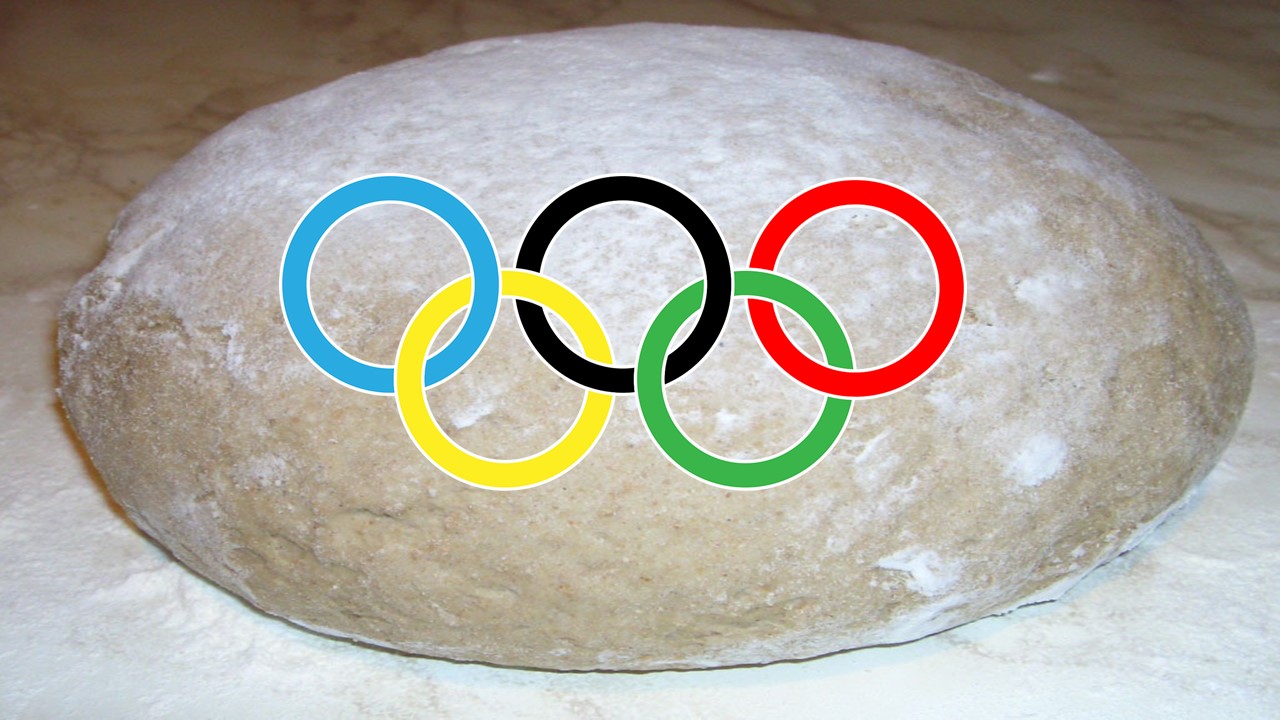
Composite image created by Gregory Smith. Original images by Jolie Mowrey on Pixy.org and YazanMRihan on Pexels.com. Used with permission.
At the beginning of August, the summer Olympics are in full swing. It’s also time for the first harvest, as evidenced by roadside produce stands in many neighborhoods. This is a time-between-times, when it still feels like Summer, but you know it won’t be long before the first leaves change. Pagans and Christians both mark this time with the celebration of harvest and bread.
Like the Olympics, Christian Lammas and Pagan Lughnasadh are a time for coming together as a community. What if we took this as a sign that nations and religions aren’t so different? What if sitting at table and sharing a meal together became a pathway to peace?
The Wheel of the Year
In the first article of this series, I wrote about the Church’s appropriation of European Pagan festivals:
Pre-Christian Celts divided the year into eight equal portions, called “The Wheel of the Year.” The quarters fall at the summer solstice (Litha, on or around June 21), the winter solstice (Yule, on or around December 21), spring equinox (Ostara, on or around March 21), and fall equinox (Mabon, on or around September 21).
The cross-quarters lie at the midpoints in each season. The midpoint of spring is Beltane, on or around May 1. The middle of summer is Lughnasadh, on or around August 1. Halfway through fall is Samhain, on or around November 1. The midpoint of winter is Imbolc, on or around February 1. (These dates are inverted for those who celebrate in the southern hemisphere.) Each of these quarters and cross-quarters represents a different phase in the agricultural year and carries with it a spiritual significance.
When Roman Catholicism entered the unchurched lands of Western Europe, it Christianized the indigenous festivals to facilitate the conversion of Pagans. Ostara was renamed Easter. Beltane was transformed into May Day with its fertility pole. Litha corresponds to the Roman Catholic Solemnity of the Birth of John the Baptist.
Lughnasadh, the festival of first harvest, became Lammas, or the Loaf Mass. Mabon, the feast of the second harvest, became the Feast of Matthew the Apostle. The Church turned Samhain into All Saints’ Day. We are more familiar with the day before—All Hallows Eve, or Halloween. Christmas eclipsed Yule to such an extent that many think they are synonymous. And finally, Candlemas replaced Imbolc.
For centuries, Christians and Pagans have had a contentious relationship. But when we see how our holidays overlap and interrelate, it gives hope that we can learn from one another, and share the same table.
Lughnasadh
Since hunter-gatherers settled into agricultural communities, harvest has been a time of celebration. In ancient Europe, the first harvest marked the beginning of bounty. Pre-Christian Celts called this festival Lughnasadh (spellings are various, but the word is pronounced “loo-nah-sah”), in honor of the sun god Lugh. Harvesting grain was a community-wide event. So, harvesters celebrated together as well.
The First Sheaf
The first sheaf is an important aspect of Lughnasadh celebrations. According to Moonfall Metaphysical:
As the first sheaf is harvested, it symbolizes the sacrifice of the Corn King or the spirit of the grain. This sacrifice represents the cycle of life, death, and rebirth, as the grain will be replanted in the following year.
To celebrate this sacrifice, communities gathered to bake bread, make barley soup, brew beer, and share other seasonal foods.
John Barleycorn
Grain was an important harvest, because of bread’s importance to the European diet. But just as important were the alcoholic beverages such as beer and whiskey made from these grains. Fermentation wasn’t all about the production of intoxicant. It also purified dangerous drinking water. In addition, distillation allowed for sanitary storage of grain products. Alcohol proved an excellent trade resource, as it was more economical to transport fermented or distilled grain than to transport the grain itself.
“John Barleycorn” is an old folk song from England and Scotland, celebrating the importance of grain. Robert Burns wrote a version in 1782, making the ballad famous. In 1970, Steve Winwood’s version revived the tune. The song personifies grain as “John Barleycorn.” It depicts the harvest as bearded Barleycorn’s murder by sickle and scythe, scourge and flail. By this personification, John Barleycorn becomes a sacrifice to sustain human life. This ballad might be considered an appropriate theme song for Lughnasadh.
Craft Fairs
Not just god of the sun, Lugh was also god of crafters. As neighbors gathered to help each other with harvest, they also engaged in commerce. They sold fruits and vegetables, along with handmade goods. Today too, August marks the beginning of modern harvest festivals, with crafters and vendors of all kinds bringing their wares to market.
Lughnasadh Traditions
Neopagans continue the traditions of their Pagan ancestors, adapting Lughnasadh to modern times. Of course, homemade bread is an important aspect of this celebration. Grain isn’t the only significant harvest, though. Modern witches celebrate Lughnasadh by harvesting, preparing, and storing all seasonal crops for winter. Canning, drying, and freezing produce is a great way to observe the holiday. Besides this, seasonal observances often involve gathering at bonfires and decorating with produce and symbols of harvest.
Lughnasadh and the Olympics
This year, the Olympic Games fall during Lughnasadh. This is fitting, as Luna Crowwing points out:
Lughnasadh is traditionally a time for community gatherings that included athletic contests, storytelling, matchmaking, and ritual ceremonies. It was not just about the agricultural harvest but also about celebrating skills and craftsmanship, reflecting the attributes of the god Lugh himself. The focus on community and the mythological roots of the festival give Lughnasadh a distinct cultural and spiritual flavor, celebrating more than just the harvest—it’s about the endurance and spirit of the community.
Lughnasadh celebrants often remember the sun god Lugh with bonfires and other fires**. So, the Olympic torch seems a fitting symbol for this festive time.** The Olympics are a time for the world to come together in community, compete and collaborate, and share national stories. Olympic Village is even a time for international matchmaking and love. It’s probably a coincidence that the Summer Olympics fall during Lughnasadh, but it is quite fitting.
Lammas
The Christian celebration of Lammas (Loaf Mass) emerged out of Pagan Lughnasadh traditions. The Church simply “baptized” indigenous European harvest customs to give them ecclesiastical significance. However, as time progressed, Lammas took on a meaning of its own. Similar to the Hebrew harvest celebrations in the Bible, the Church encouraged adherents to express thanks for their bounty. Catholic Culture says:
This feast day was also called “Lammas Day” or “Loaf Mass Day” because this day was offered as thanksgiving for the wheat harvest, used for the bread that becomes the Eucharist.
This website goes on to discuss Scotch Highlander Quarter Cakes traditionally baked at Imbolc, Beltane, Lughnasadh, and Samhain. On August 1, celebrants brought these Quarter Bannocks to the Catholic priest to have them blessed and transformed into the bread of the Lord’s Supper at the Loaf Mass.
A Mixture of Paganism and Christianity
Lammas truly is a mixture of Paganism and Christianity. This is evidenced by an Anglo-Saxon Lammas ritual, related by A Clerk of Oxford:
[Take two] long pieces of four-edged wood, and on each piece write a Pater noster, on each side down to the end. Lay one on the floor of the barn, and lay the other across it, so that they form the sign of the cross. And take four pieces of the hallowed bread which is blessed on Lammas day, and crumble them at the four corners of the barn. This is the blessing for that; so that mice do not harm these sheaves, say prayers over the sheaves and do not cease from saying them. ‘City of Jerusalem, where mice do not live they cannot have power, and cannot gather the grain, nor rejoice with the harvest.’ This is the second blessing: ‘Lord God Almighty, who made heaven and earth, bless these fruits in the name of the Father and the Holy Spirit.’ Amen. And [then say] a Pater Noster.
(Quoted from Karen Louise Jolly, ‘Tapping the Power of the Cross: Who and For Whom?’, in The Place of the Cross in Anglo-Saxon England, ed. Catherine E. Karkov, Sarah Larratt Keefer, and Karen Louise Jolly (Woodbridge: The Boydell Press), p. 79; my translation.)
These days, you don’t hear much about Lammas in the Church. Perhaps because of its pagan origins, the Protestant church has abandoned it altogether.
Some Lammas Suggestions
It’s time we revive the celebration of Lammas. This would be a good day for songs like “Bringing in the Sheaves,” “Come, Ye Thankful People, Come,” “We Gather Together,” and other harvest songs. It is a good day to celebrate the Lord’s Supper with homemade bread instead of Communion wafers. Your church might offer a craft fair or field day. Come to think of it, Vacation Bible School may be a modern descendant of Lammas—a summertime harvest of children, the “sheaves,” brought into the storehouse. Complete with daisy-shaped cookies instead of loaves.
Feasting Together
Jesus, who described himself as the Bread of Life, always made sure there was room for everyone at the table. He shared the loaf with observant Jews along with “sinners and tax collectors.” Just as the Pagan priest Melchizedek made peace with Abraham, so Pagans and Christians today can feast together. As Jewish/Christian Peter ate with the Pagan Roman Cornelius, so people of all faiths can break bread with one another.
Repeatedly, Jesus likened the Kingdom of God to a huge harvest and a fantastic feast. He is the host—both in the sense of the Lammas bread and as the benefactor of the feast itself. It’s time Christians and Pagans realize that we’re all from the same grain. It’s time we sat down together and shared the same feast.
The Olympic Spirit
Perhaps there’s no better time than the Olympics to celebrate Lammas/Lughnasadh, to maximize our similarities, and to minimize our differences. In the spirit of the Olympics, let’s put aside our differences and celebrate one world community.
The Church indeed appropriated Pagan practices in an attempt to assimilate indigenous Europeans. But Christianity would not have adopted so many Pagan traditions if it didn’t see much value in them. It seems Oscar Wilde was right when he said**, “Imitation is the sincerest form of flattery that mediocrity can pay to greatness.”**
In fact, the Church found these Pagan practices so valuable that they became indispensable. When we sit down and feast together, let’s look at what’s valuable about one another, rather than what we want to throw away. Let’s find aspects of each other’s practices that are worth emulating. Because, in the end, there’s only one table. And if we’re going to share it together, we’d better learn to make friends.
For related reading, check out my other articles:
- Is It Ok to Be Friends with People of Other Faiths?
- World Religion Day: How Christians Can Honor Other Faiths
- How Neo paganismHas Made Me A Better Christian
Pagan
Religious Events
History and Religion

About Gregory T. Smith
I live in the beautiful Fraser Valley of British Columbia and work in northern Washington State as a behavioral health specialist with people experiencing homelessness and those who are overly involved in the criminal justice system. Before that, I spent over a quarter-century as lead pastor of several Virginia churches. My newspaper column, “Spirit and Truth” ran in Virginia newspapers for fifteen years. I am one of fourteen contributing authors of the Patheos/Quoir Publishing book “Sitting in the Shade of another Tree: What We Learn by Listening to Other Faiths.” I hold a degree in Religious Studies from Virginia Commonwealth University, and also studied at Baptist Theological Seminary at Richmond. My wife Christina and I have seven children between us, and we are still collecting grandchildren. You can read more about the author here.
Previous Post

July 28, 2024
Trump Is Not the Antichrist, But Still is Anti-Christ!
Next Post

August 5, 2024 Olympic Outrage: Conservatives' Double Standards on Gender
Recent Comments
"Absolutely, Glen! That's a great example! And the Roman centurion who trusted Jesus. I've heard ..."
“Can You Follow Jesus and Still ..."
"Captian of the Syrian military, Naaman in 2 Kings 5 might be considered."
“Can You Follow Jesus and Still ..."
"Hi, Bob. Not sure why it's doing that...I've been having problems with my comments settings. ..."
"OMG, who CARES?!?!"
“Can You Follow Jesus and Still ..."
Browse Our Archives
Select a Category Challenging the Church Deconstruction For Pastors Heathen Christianity Holidays and special days Mental Health Social Justice Spirituality Taoism Theology Uncategorized
Select a Month October 2026 September 2026 August 2026 July 2026 June 2026 May 2026 April 2026 March 2026 February 2026 January 2026 December 2025 November 2025 October 2025 September 2025 August 2025 July 2025 June 2025 May 2025 April 2025 March 2025 February 2025 January 2025 December 2024 November 2024 October 2024 September 2024 August 2024 July 2024 June 2024 May 2024 April 2024 March 2024 February 2024 January 2024 December 2023 November 2023 October 2023 September 2023 August 2023 July 2023 June 2023 May 2023 April 2023 March 2023 February 2023 January 2023 December 2022 November 2022 October 2022 September 2022 August 2022 July 2022 June 2022 May 2022 April 2022 March 2022 February 2022 January 2022
Follow Us!
TAKE THE
Religious Wisdom Quiz
Which Old Testament prophet confronted King Ahab about worshiping Baal?
Select your answer to see how you score.
Ezekiel Isaiah Jeremiah Elijah
Related posts from Breathing Space

All the Colors of the Rainbow Testify to...
No, the Rainbow is Not a Christian Trademark

Holy Water Isn’t Acid. Stop Weaponizing Faith.
TRENDING AT PATHEOS Progressive Christian

What Being a Modern-Day Apostle Means to Me
In my last column, I discussed the ins and outs of modern-day...

Did Ancient China Once Worship the God of...
Across human history, a common thread weaves through the origins of the...

Love Your Neighbor – Including Earth-Kin: Lev. 19,...
God’s command to love your neighbor means acting in an ethical and...

Lead a Church Study of “Jesus and Lao...
Guest writer Jack Thomas (The Irreverent Reverend) reflects on leading his church...

Pastoral Wisdom for Responding to Sermon Pushback
Getting sermon pushback on your social justice sermon? Learn practical, Proverbs-based strategies...

Principles for Understanding the Apostolic Ministry Today
Whenever people discover that my formal ministry title is "apostle," as in...
view all Progressive Christian blogs
What Are Your Thoughts?leave a comment
Ad-Free & Subscriber Log-In Subscription Support
- About Us
- 2026 Calendar
- Videos
- Podcasts
- Library of World Religions
- Faith In Media Tracker
- Advertise With Us
- Write for Us
- Privacy Policy
- Terms of Service
- Do Not Sell My Data
- Contact Us
- Radiant Digital
- Manage Newsletter Subscriptions
- Unsubscribe From Notifications
- Sitemap
Copyright 2008-2026, Patheos. All rights reserved.
Subscription Support Ad-Free & Subscriber Log-In
Follow Patheos