
BuddhistCatholicContemplativeEvangelicalGeneral ChristianHinduJewishLatter-day SaintMuslimNew VisionsProgressive Christian
Beliefs
- Buddhist
- Catholic
- Contemplative
- Evangelical
- General Christian
- Hindu
- Jewish
- Latter-day Saint
- More Voices
- Muslim
- New Visions
- Pagan
- Progressive Christian
Topics
- Religion News
- Food and Religion
- Sports and Religion
- Religious Art
- Religious Music and Entertainment
- Religious Events
- History and Religion
- Style and Religion
- Politics and Religion
- Women in Religion
- Recreation Outdoors and Religion
- Business Finance and Religion
- Careers Workplace and Religion
- Education and Religion
- Family Parenting and Religion
- Health Fitness and Religion
- Home and Religion
- Relationships and Religion
- Technology and Religion
- Travel and Religion
Columnists
- Buddhist Columnists
- Business Finance and Religion Columnists
- Careers Workplace and Religion Columnists
- Catholic Columnists
- Contemplative Columnists
- Education and Religion Columnists
- Evangelists Columnists
- Family Parenting and Religion Columnists
- General Christian Columnists
- Health Fitness and Religion Columnists
- Hindu Columnists
- History and Religion Columnists
- Home and Religion Columnists
- Jewish Columnists
- More Voices Columnists
- Latter Day Columnists
- Muslim Columnists
- New Visions Columnists
- Nonreligious Columnists
- Pagan Columnists
- Politics and Religion Columnists
- Progressive Columnists
- Recreation Outdoors and Religion Columnists
- Relationships and Religion Columnists
- Religion News Columnists
- Religious Art Columnists
- Religious Events Columnists
- Religious Music and Entertainment Columnists
- Sports and Religion Columnists
- Style and Religion Columnists
- Technology and Religion Columnists
- Travel and Religion Columnists
- Women in Religion Columnists
Resource Library
- 2026 Calendar
- Library of World Religions
- The 100 Most Holy Places on Earth
- Patheos Answers
- Podcasts
- Videos
- Faith Leaders Database
- Anglican Episcopalian
- Bahai
- Baptist
- Buddhism
- Christianity
- Confucianism
- Eastern Orthodoxy
- Hinduism
- Holiness and Pentecostal
- ISKCON
- Islam
- Judaism
- Lutheran
- Methodist
- The Church of Jesus Christ of Latter-day Saints
- New Age
- Paganism
- Presbytarian and Reformed
- Protestantism
- Religion Behind the Scenes
- Roman Catholic
- Scientology
- Shia Islam
- Sikhism
- Sufism
- Sunni Islam
- Taoism
- Zen
- See all religions
Research Tools
 Ad-Free & Subscriber Log-In Subscription Support
Ad-Free & Subscriber Log-In Subscription Support
Follow Patheos 

- Trending:
- Forgiveness
- |
- Marriage
- |
- Consciousness
- |
- Death Penalty
- |
- Election
- |
- Halloween

-
Categories
- Home
- Progressive Christian
- Careers, Workplace and Religion
- Jesus and Lao Tzu Practice Do-Nothing Leadership
Jesus and Lao Tzu Practice Do-Nothing Leadership
Last updated on: May 26, 2024 at 3:40 pm by Gregory T. Smith
Jesus and Lao Tzu Practice Do-Nothing Leadership 2024-05-26T15:40:41-08:00 Gregory T. Smith
Patheos Explore the world's faith through different perspectives on religion and spirituality! Patheos has the views of the prevalent religions and spiritualities of the world.
If Jesus and Lao Tzu endorsed a candidate, they would be humble, kind, and without rapacity. Someone who leads by doing nothing at all.
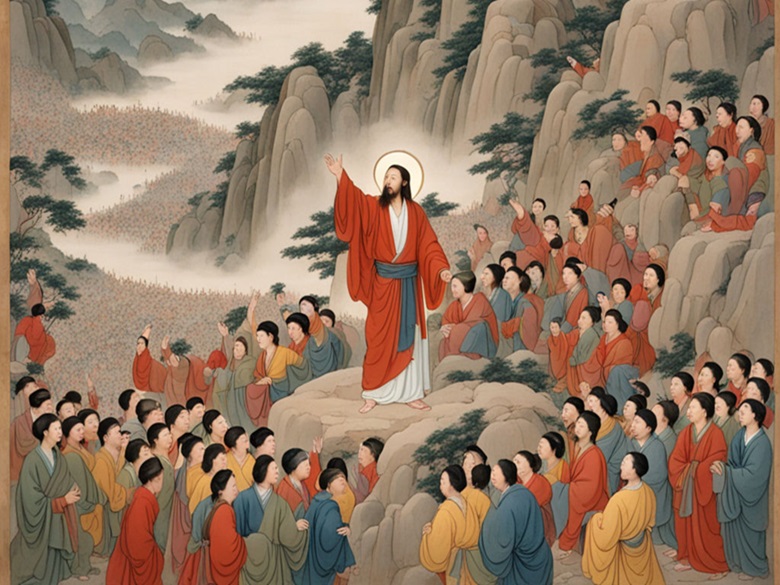
AI Image generated by the author on Playground.com
Jesus and Lao Tzu’s leadership style looks quite different from the power-hungry brand that the world values. Religious, political, business, social, and other kinds of front-runners would do well to follow the leadership style of these two masters of the Way of humility.
Tao Te Ching, Verse 3, J.H. McDonald Translation
If you overly esteem talented individuals,
people will become overly competitive.
If you overvalue possessions,
people will begin to steal.
Do not display your treasures
or people will become envious.
The Master leads by
emptying people’s minds,
filling their bellies,
weakening their ambitions,
and making them become strong.
Preferring simplicity and freedom from desires,
avoiding the pitfalls of knowledge and wrong action.
For those who practice not-doing,
everything will fall into place.
The third verse of Lao Tzu’s Tao Te Ching contrasts two opposing types of leaders. First is the “talented individual,” and second is the “master.” The talented individual impresses people to gain a following, while the one who develops mastery of the Way helps people to live by the Tao.
Each Followed Their Own Way
In the Book of Judges, when the Israelites settle in Canaan, no king governs the people. Everyone does as they see fit. Or, as some have translated, “Each followed their own Way (Tao).” This isn’t a bad thing. Rather than interpreting this as a time of anarchy, we might see it as everyone following the Way of their own spiritual connection to the divine Source. Instead of a king, the loose confederation of tribes finds its leadership in women and men gifted to lead, rather than their neighbors’ patriarchal and hereditary monarchic systems.
“Give Us a King!”
Yet, because the people feel inadequate following the Way without a leader, they cry out for a king. So begins the search for a talented, impressive leader. When Israel crowns its first monarch, Saul certainly fits the bill. He is tall and handsome, demanding loyalty, praise, fealty, and taxes. It’s like a deal with the devil: people get what they want—with a cruel twist. When they subject themselves to this new ruler, the people become ineffective. They relinquish their power to a monarch jealous of any competition. Because he overvalues his throne, Saul eventually attempts to murder David. This results in war, and in time, David wins the king’s crown.
David proves no more righteous than his predecessor Saul. In fact, in many ways, he shows himself to be worse. David values his many possessions and considers women as part of that collection. In his sexual conquests, he treats women as possessions to be won or stolen. He ravages Bathsheba and murders her husband Uriah to cover-up the resulting pregnancy. David’s family begins to fall apart—a steady decline that ends in rape and incest, rebellion, murder, and civil war. All this originates with people overly esteeming talented leadership and treasure.
Jesus’ Style of Leadership
Jesus stands in sharp contrast to this style of leadership. Though people call him the Son of David, Jesus knows he must take a different Path from his ancestor. Jesus does not lead as royalty does, filling people’s minds with pomp, pageantry, and wealth to make them envious. Instead, he guides by helping people clear their minds of such distractions and teaching them to simplify their souls. Jesus does not lead as the priests and religious teachers, adding expectations of increasing righteousness. Instead of piling on perfectionism, Jesus leads by subtraction—reducing his requirements to two: loving God and loving people. This, he says, fulfills the entire law and the prophets.
Leadership That Is Indifferent to Power
As a teacher of the Way in the style of Lao Tzu’s Tao Te Ching, Jesus leads by taking care of the people’s basic needs. He heals their bodies and casts out evil spirits. He fills their hungry bellies. He teaches them to be content with simple things, detaching themselves from cravings. Jesus says:
“Therefore I tell you, do not worry about your life, what you will eat or what you will drink, or about your body, what you will wear. Is not life more than food and the body more than clothing? Look at the birds of the air: they neither sow nor reap nor gather into barns, and yet your heavenly Father feeds them. Are you not of more value than they? And which of you by worrying can add a single hour to your span of life? And why do you worry about clothing? Consider the lilies of the field, how they grow; they neither toil nor spin, yet I tell you, even Solomon in all his glory was not clothed like one of these. But if God so clothes the grass of the field, which is alive today and tomorrow is thrown into the oven, will he not much more clothe you—you of little faith? Therefore do not worry, saying, ‘What will we eat?’ or ‘What will we drink?’ or ‘What will we wear?’ For it is the gentiles who seek all these things, and indeed your heavenly Father knows that you need all these things.
Jesus said that the necessary manifestations of the world will be added to you if you first seek the heavenly realm and divine Virtue. This is true of physical possessions, but it also applies to power and prestige. Jesus wants his disciples to be indifferent to their own desires for supremacy and celebrity. He teaches that leaders must become servants and that the last will be the first.
Jockeying for Position
The Gospel of Mark relates one such story, where Jesus rebukes his disciples for jockeying with one another for position:
James and John, the sons of Zebedee, came forward to him and said to him, “Teacher, we want you to do for us whatever we ask of you.” And he said to them, “What is it you want me to do for you?” And they said to him, “Appoint us to sit, one at your right hand and one at your left, in your glory.” But Jesus said to them, “You do not know what you are asking. Are you able to drink the cup that I drink or be baptized with the baptism that I am baptized with?” They replied, “We are able.” Then Jesus said to them, “The cup that I drink you will drink, and with the baptism with which I am baptized you will be baptized, but to sit at my right hand or at my left is not mine to appoint, but it is for those for whom it has been prepared.”
When the ten heard this, they began to be angry with James and John. So Jesus called them and said to them, “You know that among the Gentiles those whom they recognize as their rulers lord it over them, and their great ones are tyrants over them. But it is not so among you; instead, whoever wishes to become great among you must be your servant, and whoever wishes to be first among you must be slave of all. For the Son of Man came not to be served but to serve…
God Chooses the Foolish, Weak, & Low
Lao Tzu writes about “avoiding the pitfalls of knowledge and wrong action.” Likewise, Jesus teaches simplicity to the point of foolishness as a Way of Virtue. The apostle Paul comments on this when he writes:
“…God chose what is foolish in the world to shame the wise; God chose what is weak in the world to shame the strong; God chose what is low and despised in the world, things that are not, to abolish things that are, so that no one might boast in the presence of God.”
Jesus’ Way of humility confuses those who trust in their own strength and knowledge. Time and again his life and teachings baffle religious leaders. Jesus makes their wisdom seem foolish. His is the truth that they cannot comprehend. Theirs is a way of striving after righteousness, but Jesus practices Non-Doing and Non-Striving.
Jesus, the Lord of Rest
The third stanza of Lao Tzu’s Tao Te Ching concludes, “For those who practice not-doing, everything will fall into place.” Jesus so identifies with the spirit of wu-wei (the Taoist concept of doing without striving) that he called himself the “Lord of the Sabbath.” The English word “sabbath” comes from the Hebrew shavat, “to rest.”
It’s interesting, then, that the Lord of Rest so frequently gets caught working on the Sabbath. By this, Jesus demonstrates how to work in a restful Way and rest productively. Rest and work are the Yin and Yang that make up the whole Way of life. Action should be done out of a place of wu-wei, or Non-Action. By practicing Non-Doing, everything gets done. By working on the Sabbath, Jesus shows us how to make work an activity born out of rest.
Which Style of Leadership?
Essentially, there are two types of leadership. You can support and emulate a leadership style based on clutching for power, manipulating others, and hoarding treasures. Or you can adopt a leadership method modeled after Lao Tzu and Jesus’s restful approach. The latter emphasizes simplicity, freedom from grasping, humility, and respect. The choice is obvious to the eternally-minded person. But is it obvious to the world?
Something to Pray…
Jesus, you who put yourself last so that others could be first, help me to lead as you lead. May I follow your example in choosing those whom humans esteem to be weak, foolish, and low. Instead of promoting myself, may I amplify the voices of the marginalized to that their story is heard. Lord of Rest, I take refuge in you, my who are my Sabbath.
For related reading, check out my other articles:
- Introduction: How Are Jesus & Lao Tzu Like Peanut Butter Cups?
- 1: Is God Really Knowable? Here’s What Jesus And Lao Tzu Say…
- 2: Jesus & Lao Tzu’s Judgement-Free Zone
- 4: Jesus And Lao Tzu At The Well Of Living Water
New Visions
Careers, Workplace and Religion
Business, Finance and Religion

About Gregory T. Smith
I live in the beautiful Fraser Valley of British Columbia and work in northern Washington State as a behavioral health specialist with people experiencing homelessness and those who are overly involved in the criminal justice system. Before that, I spent over a quarter-century as lead pastor of several Virginia churches. My newspaper column, “Spirit and Truth” ran in Virginia newspapers for fifteen years. I am one of fourteen contributing authors of the Patheos/Quoir Publishing book “Sitting in the Shade of another Tree: What We Learn by Listening to Other Faiths.” I hold a degree in Religious Studies from Virginia Commonwealth University, and also studied at Baptist Theological Seminary at Richmond. My wife Christina and I have seven children between us, and we are still collecting grandchildren. You can read more about the author here.
Previous Post

April 11, 2024
What's in a Name? Deadnaming, Misgendering & Other Rudeness
Next Post

April 18, 2024 It’s a Small World—We’re More Connected Than We Know
Recent Comments
"Absolutely, Glen! That's a great example! And the Roman centurion who trusted Jesus. I've heard ..."
“Can You Follow Jesus and Still ..."
"Captian of the Syrian military, Naaman in 2 Kings 5 might be considered."
“Can You Follow Jesus and Still ..."
"Hi, Bob. Not sure why it's doing that...I've been having problems with my comments settings. ..."
"OMG, who CARES?!?!"
“Can You Follow Jesus and Still ..."
Browse Our Archives
Select a Category Challenging the Church Deconstruction For Pastors Heathen Christianity Holidays and special days Mental Health Social Justice Spirituality Taoism Theology Uncategorized
Select a Month October 2026 September 2026 August 2026 July 2026 June 2026 May 2026 April 2026 March 2026 February 2026 January 2026 December 2025 November 2025 October 2025 September 2025 August 2025 July 2025 June 2025 May 2025 April 2025 March 2025 February 2025 January 2025 December 2024 November 2024 October 2024 September 2024 August 2024 July 2024 June 2024 May 2024 April 2024 March 2024 February 2024 January 2024 December 2023 November 2023 October 2023 September 2023 August 2023 July 2023 June 2023 May 2023 April 2023 March 2023 February 2023 January 2023 December 2022 November 2022 October 2022 September 2022 August 2022 July 2022 June 2022 May 2022 April 2022 March 2022 February 2022 January 2022
Follow Us!
TAKE THE
Religious Wisdom Quiz
Seek the Lord, all you humble of the land. Seek righteousness, seek what else?
Select your answer to see how you score.
Mercy Peace Justice Humility
Related posts from Breathing Space

Lead a Church Study of “Jesus and Lao...

Jesus and Lao Tzu: Seven Striking Parallels

Mo Thomas: Book Review from a Black Hole

“You Got Your Lao Tzu on My Jesus!”
TRENDING AT PATHEOS Progressive Christian

What Being a Modern-Day Apostle Means to Me
In my last column, I discussed the ins and outs of modern-day...

Did Ancient China Once Worship the God of...
Across human history, a common thread weaves through the origins of the...

Love Your Neighbor – Including Earth-Kin: Lev. 19,...
God’s command to love your neighbor means acting in an ethical and...

Lead a Church Study of “Jesus and Lao...
Guest writer Jack Thomas (The Irreverent Reverend) reflects on leading his church...

Pastoral Wisdom for Responding to Sermon Pushback
Getting sermon pushback on your social justice sermon? Learn practical, Proverbs-based strategies...

Principles for Understanding the Apostolic Ministry Today
Whenever people discover that my formal ministry title is "apostle," as in...
view all Progressive Christian blogs
What Are Your Thoughts?leave a comment
Ad-Free & Subscriber Log-In Subscription Support
- About Us
- 2026 Calendar
- Videos
- Podcasts
- Library of World Religions
- Faith In Media Tracker
- Advertise With Us
- Write for Us
- Privacy Policy
- Terms of Service
- Do Not Sell My Data
- Contact Us
- Radiant Digital
- Manage Newsletter Subscriptions
- Unsubscribe From Notifications
- Sitemap
Copyright 2008-2026, Patheos. All rights reserved.
Subscription Support Ad-Free & Subscriber Log-In
Follow Patheos