
BuddhistCatholicContemplativeEvangelicalGeneral ChristianHinduJewishLatter-day SaintMuslimNew VisionsProgressive Christian
Beliefs
- Buddhist
- Catholic
- Contemplative
- Evangelical
- General Christian
- Hindu
- Jewish
- Latter-day Saint
- More Voices
- Muslim
- New Visions
- Pagan
- Progressive Christian
Topics
- Religion News
- Food and Religion
- Sports and Religion
- Religious Art
- Religious Music and Entertainment
- Religious Events
- History and Religion
- Style and Religion
- Politics and Religion
- Women in Religion
- Recreation Outdoors and Religion
- Business Finance and Religion
- Careers Workplace and Religion
- Education and Religion
- Family Parenting and Religion
- Health Fitness and Religion
- Home and Religion
- Relationships and Religion
- Technology and Religion
- Travel and Religion
Columnists
- Buddhist Columnists
- Business Finance and Religion Columnists
- Careers Workplace and Religion Columnists
- Catholic Columnists
- Contemplative Columnists
- Education and Religion Columnists
- Evangelists Columnists
- Family Parenting and Religion Columnists
- General Christian Columnists
- Health Fitness and Religion Columnists
- Hindu Columnists
- History and Religion Columnists
- Home and Religion Columnists
- Jewish Columnists
- More Voices Columnists
- Latter Day Columnists
- Muslim Columnists
- New Visions Columnists
- Nonreligious Columnists
- Pagan Columnists
- Politics and Religion Columnists
- Progressive Columnists
- Recreation Outdoors and Religion Columnists
- Relationships and Religion Columnists
- Religion News Columnists
- Religious Art Columnists
- Religious Events Columnists
- Religious Music and Entertainment Columnists
- Sports and Religion Columnists
- Style and Religion Columnists
- Technology and Religion Columnists
- Travel and Religion Columnists
- Women in Religion Columnists
Resource Library
- 2026 Calendar
- Library of World Religions
- The 100 Most Holy Places on Earth
- Patheos Answers
- Podcasts
- Videos
- Faith Leaders Database
- Anglican Episcopalian
- Bahai
- Baptist
- Buddhism
- Christianity
- Confucianism
- Eastern Orthodoxy
- Hinduism
- Holiness and Pentecostal
- ISKCON
- Islam
- Judaism
- Lutheran
- Methodist
- The Church of Jesus Christ of Latter-day Saints
- New Age
- Paganism
- Presbytarian and Reformed
- Protestantism
- Religion Behind the Scenes
- Roman Catholic
- Scientology
- Shia Islam
- Sikhism
- Sufism
- Sunni Islam
- Taoism
- Zen
- See all religions
Research Tools
 Ad-Free & Subscriber Log-In Subscription Support
Ad-Free & Subscriber Log-In Subscription Support
Follow Patheos 

- Trending:
- Forgiveness
- |
- Marriage
- |
- Consciousness
- |
- Death Penalty
- |
- Election
- |
- Halloween

-
Categories
- Home
- Progressive Christian
- Education and Religion
- Jesus and Lao Tzu at the Well of Living Water
Jesus and Lao Tzu at the Well of Living Water
Last updated on: April 21, 2024 at 7:35 am by Gregory T. Smith
Jesus and Lao Tzu at the Well of Living Water 2024-04-21T07:35:17-08:00 Gregory T. Smith
Patheos Explore the world's faith through different perspectives on religion and spirituality! Patheos has the views of the prevalent religions and spiritualities of the world.
What did Jesus mean by “living water?” A 2,500-year-old Chinese text may give a clue. Let’s compare the words of Jesus and Lao Tzu.
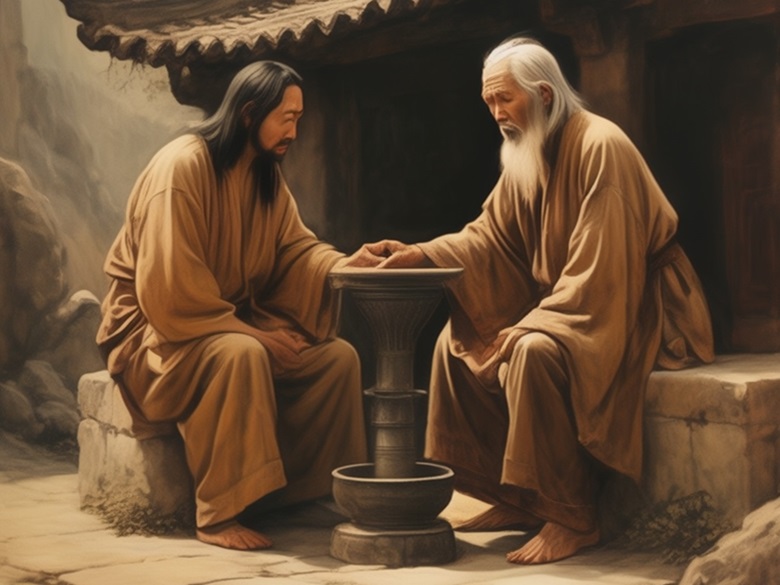
Image generated by Gregory T. Smith on Open.AI
In honor of World Water Day, March 22 this year, I want to look at the spiritual meaning of water from two great traditions—Christianity and Taoism. The following is adapted from a book I am writing. The book’s working title is The Tao of Love: The Way of Jesus. In this article, I will discuss the mystical symbolism of water, and our spiritual responsibility to care for the water on our planet.
The Tao is Like Water
In the Tao Te Ching (Book of the Way and its Virtue) ancient Taoist philosopher Lao Tzu compares the universe’s primal energy, the Tao, to water. It flows through all creation, giving life to everything. As a river carries boats to the ocean, the Tao leads everyone to the Source. Everything that lives needs water. No living creature can do without it. J.H. McDonald translates verse four of Lao Tzu’s book*:*
The Tao is like an empty container:
it can never be emptied and can never be filled.
Infinitely deep, it is the source of all things.
It dulls the sharp, unties the knotted,
shades the lighted, and unites all of creation with dust.
It is hidden but always present.
I don’t know who gave birth to it.
It is older than the concept of God.
Stephen Mitchell’s version of the Tao Te Ching opens verse four with the phrase, “The Tao is like a well: used but never used up.” Jim Clatfelder’s translation says the Tao is “like a well; Always giving, never taking.” Likewise, Jesus compares eternal life (a synonym for the Tao) to a well of living water.
Wells Represent Life
Throughout the Bible, wells represent the source of physical life. Access to clean water is hard to come by in desert cultures. One well or oasis might supply a whole village. As such, this water becomes a source of social life as well. It was at wells that the townsfolk met, mingled, and met their marriage partners. At wells, villagers exchanged news of the day, socialized, and made business arrangements. Wells represented social stability. If you owned a well, you became the center of community life. You became the richest person around—not because people paid you for water but because of the influence you gained by being the cultural hub. In biblical societies, wealth followed water.
Wealth Follows Water
Wealth follows water today, too. Drought-stricken areas fall into poverty and must rely on the world’s generosity to sustain them. The modern water scarcity crisis causes governments to contend with each other over shared rivers, lakes, and other water sources. Wealthy communities can afford to have water trucked in. They can afford expensive and innovative water treatment centers. Poorer areas simply become ghost towns as climate refugees flee to more sustainable areas. Water is a source of life for all living creatures on the planet. This is one reason why water is compared to the Tao.
A Spring of Living Water
The Gospel of Luke tells the story of Jesus traveling through Samaria and stopping by a well at midday. When Jesus encounters a woman drawing water there, he instantly knows something is wrong. Customarily, women would go to the well in the cool of the morning or evening, but here this woman is, risking heat exhaustion to draw and carry her water back to her home. Only a social outcast would be found doing such strenuous work in the noonday sun. Pushed to the margins, respectable society forces her to draw water at a time when no one else is around. Socially, she is as dry and thirsty as Jesus’s parched throat. Luke writes:
Jesus said to her, “Give me a drink.” (His disciples had gone to the city to buy food.) The Samaritan woman said to him, “How is it that you, a Jew, ask a drink of me, a woman of Samaria?” (Jews do not share things in common with Samaritans.) Jesus answered her, “If you knew the gift of God and who it is that is saying to you, ‘Give me a drink,’ you would have asked him, and he would have given you living water.” The woman said to him, “Sir, you have no bucket, and the well is deep. Where do you get that living water? Are you greater than our ancestor Jacob, who gave us the well and with his sons and his flocks drank from it?” Jesus said to her, “Everyone who drinks of this water will be thirsty again, but those who drink of the water that I will give them will never be thirsty. The water that I will give will become in them a spring of water gushing up to eternal life.”
Of course, Jesus is not talking about physical water. He is talking about the Tao, which he calls “eternal life.” This is a wealth of spiritual nourishment that sustains a person even when their heart and soul are parched. The Way of Jesus is like a well that is never used up.
Rivers of Living Water
On another occasion, Jesus stands in the temple and declares this watercourse Way in a loud voice, for all to hear:
On the last day of the festival, the great day, while Jesus was standing there, he cried out, “Let anyone who is thirsty come to me, and let the one who believes in me drink. As the scripture has said, ‘Out of the believer’s heart shall flow rivers of living water.’” Now he said this about the Spirit, which believers in him were to receive, for as yet there was no Spirit because Jesus was not yet glorified.
Speaking as a personification of the Tao, Jesus invites everyone to come to himself and drink. All who taste of the Tao become like a person possessing a deep well that never runs dry. The Tao Te Ching says, “Infinitely deep, it is the source of all things.” Connected to the Source of life, you have all you need—physically, spiritually, socially, and in every other way.
The Great Leveler
Lao Tzu writes that the Tao “dulls the sharp, unties the knotted, shades the lighted, and unites all of creation with dust.” In other words, the Tao is the great leveler. Because water seeks the lowest places, carpenters use it in their levels as a true measure of flatness. The Tao works to erode extremes, eroding mountains and raising valleys.
In the New Testament, John the Baptist works to erode the extremes of his day. When questioned about his mission, he quotes the prophet Isaiah, who says:
A voice cries out:
“In the wilderness prepare the way of the Lord;
make straight in the desert a highway for our God.
Every valley shall be lifted up,
and every mountain and hill be made low;
the uneven ground shall become level,
and the rough places a plain.
Then the glory of the Lord shall be revealed,
and all flesh shall see it together,
for the mouth of the Lord has spoken.”
John’s mission is the same as Isaiah’s. Filled with the Holy Spirit (another name for the Tao), prophets challenge systems of oppression. They dull the sharp, untie the knotted, shade the lighted, and work for the unity of all creation. Representing the Tao, the likes of John, Isaiah, Jesus, and Lao Tzu work to bring balance and equity to their cultures.
The Source of All Things
The Tao can level all things because it is the Source of all things. Lao Tzu says that the Tao “is hidden but always present. I don’t know who gave birth to it. It is older than the concept of God.” This verse hearkens to the first verse of the Tao Te Ching, where the Source is called “darkness” and the “Mother of all creation.”
Likewise, The book of Genesis describes pre-creation as a dark, watery womb from which all life came. The Spirit of God hovers over the waters like a bird over its chicks. Many believers seek security by literally interpreting Genesis as a six-day creation story. Yet, the authors of Genesis intended the universe’s origins to be shrouded in mythic wonder rather than certainty. It’s better to simply embrace the mysterious Mother as Lao Tzu did and say, “I don’t know.” For it is in uncertainty that humility is born.
Water and Spirit
The Tao is the sacred Mother of all creation, filled with the humble waters of life. It develops embryonic faith in the heart of every person until each soul is ready to give birth—a birth of both water and spirit. Through the birth of a believer, that living water continues to sustain and nourish. It is available to all who will dip their buckets into the well of their own soul. The deeper you look, the more you will discover. And the more you discover, the more you will understand how much mystery remains.
The Importance of Water
Those who read Lao Tzu come quickly to understand that water is symbolic of “Life with a capital L.” This living water is also called the Tao, or the Way. So, when Jesus, offering living water, says, “I am the Way, the Truth, and the Life,” he is talking about the same thing. Water is symbolic of spiritual life.
Not Just a Symbol
But water is important, not just as a symbol. In this early part of the twenty-first century, humanity must come together to solve the environmental crisis. Water scarcity and climate change, rising sea levels and melting ice caps, superstorms and droughts all threaten the survival of humanity on planet earth. If Lao Tzu and Jesus can agree on so many things—and they do, that’s what my book is about—then surely faithful people from all religions can come together to solve our common crisis.
Learning to Flow Together
Water doesn’t just represent life. Water is life. It’s time for humanity to seek a common Wisdom, one that leads to spiritual transformation and global healing. The common ground between Christianity and Taoism is just one example of the unification that must happen for us to save this planet. On World Water Day and every day, I hope that people of every religion will learn to flow together. Only by learning that we are innumerable drops, running together to reach one Source, can we ever find unity and peace. Only then can we work together to heal this world.
Something to Ponder…
What can you do to conserve water on this planet, where you live? Consider participating in a river cleanup. Repair any drips or leaks you may have in your home plumbing. Plan your shopping to avoid heavier liquid products, because water-based products are heavier, bulkier, and thus require more fuel for shipping. How might it help the earth and your body if you purchased a water filtering pitcher so you can drink from the tap instead of water bottled for one-time consumption? What are some other ways you can care for the water supply of this planet?
For related reading, check out my other articles:
- Jesus and Melchizedek: Christ in Another Religion
- Is It OK to Be Friends with People of Other Faiths?
- World Religion Day: Why Outreach Shouldn’t Mean Evangelism
- How Taoism Made Me a Better Christian
General Christian
Education and Religion

About Gregory T. Smith
I live in the beautiful Fraser Valley of British Columbia and work in northern Washington State as a behavioral health specialist with people experiencing homelessness and those who are overly involved in the criminal justice system. Before that, I spent over a quarter-century as lead pastor of several Virginia churches. My newspaper column, “Spirit and Truth” ran in Virginia newspapers for fifteen years. I am one of fourteen contributing authors of the Patheos/Quoir Publishing book “Sitting in the Shade of another Tree: What We Learn by Listening to Other Faiths.” I hold a degree in Religious Studies from Virginia Commonwealth University, and also studied at Baptist Theological Seminary at Richmond. My wife Christina and I have seven children between us, and we are still collecting grandchildren. You can read more about the author here.
Previous Post

March 11, 2024
Inner Healing: Prescriptions for Medication and Meditation
Next Post

March 18, 2024 Christian & Pagan Holidays: Easter Bunnies Come from Ostara
Recent Comments
"Absolutely, Glen! That's a great example! And the Roman centurion who trusted Jesus. I've heard ..."
“Can You Follow Jesus and Still ..."
"Captian of the Syrian military, Naaman in 2 Kings 5 might be considered."
“Can You Follow Jesus and Still ..."
"Hi, Bob. Not sure why it's doing that...I've been having problems with my comments settings. ..."
"OMG, who CARES?!?!"
“Can You Follow Jesus and Still ..."
Browse Our Archives
Select a Category Challenging the Church Deconstruction For Pastors Heathen Christianity Holidays and special days Mental Health Social Justice Spirituality Taoism Theology Uncategorized
Select a Month October 2026 September 2026 August 2026 July 2026 June 2026 May 2026 April 2026 March 2026 February 2026 January 2026 December 2025 November 2025 October 2025 September 2025 August 2025 July 2025 June 2025 May 2025 April 2025 March 2025 February 2025 January 2025 December 2024 November 2024 October 2024 September 2024 August 2024 July 2024 June 2024 May 2024 April 2024 March 2024 February 2024 January 2024 December 2023 November 2023 October 2023 September 2023 August 2023 July 2023 June 2023 May 2023 April 2023 March 2023 February 2023 January 2023 December 2022 November 2022 October 2022 September 2022 August 2022 July 2022 June 2022 May 2022 April 2022 March 2022 February 2022 January 2022
Follow Us!
TAKE THE
Religious Wisdom Quiz
Who said, "Even though I walk through the valley of the shadow of death, I will fear no evil"?
Select your answer to see how you score.
David Moses Job Paul
Related posts from Breathing Space

Lead a Church Study of “Jesus and Lao...

Jesus and Lao Tzu: Seven Striking Parallels

Mo Thomas: Book Review from a Black Hole

“You Got Your Lao Tzu on My Jesus!”
TRENDING AT PATHEOS Progressive Christian

What Being a Modern-Day Apostle Means to Me
In my last column, I discussed the ins and outs of modern-day...

Did Ancient China Once Worship the God of...
Across human history, a common thread weaves through the origins of the...

Love Your Neighbor – Including Earth-Kin: Lev. 19,...
God’s command to love your neighbor means acting in an ethical and...

Lead a Church Study of “Jesus and Lao...
Guest writer Jack Thomas (The Irreverent Reverend) reflects on leading his church...

Pastoral Wisdom for Responding to Sermon Pushback
Getting sermon pushback on your social justice sermon? Learn practical, Proverbs-based strategies...

Principles for Understanding the Apostolic Ministry Today
Whenever people discover that my formal ministry title is "apostle," as in...
view all Progressive Christian blogs
What Are Your Thoughts?leave a comment
Ad-Free & Subscriber Log-In Subscription Support
- About Us
- 2026 Calendar
- Videos
- Podcasts
- Library of World Religions
- Faith In Media Tracker
- Advertise With Us
- Write for Us
- Privacy Policy
- Terms of Service
- Do Not Sell My Data
- Contact Us
- Radiant Digital
- Manage Newsletter Subscriptions
- Unsubscribe From Notifications
- Sitemap
Copyright 2008-2026, Patheos. All rights reserved.
Subscription Support Ad-Free & Subscriber Log-In
Follow Patheos