
BuddhistCatholicContemplativeEvangelicalGeneral ChristianHinduJewishLatter-day SaintMuslimNew VisionsProgressive Christian
Beliefs
- Buddhist
- Catholic
- Contemplative
- Evangelical
- General Christian
- Hindu
- Jewish
- Latter-day Saint
- More Voices
- Muslim
- New Visions
- Pagan
- Progressive Christian
Topics
- Religion News
- Food and Religion
- Sports and Religion
- Religious Art
- Religious Music and Entertainment
- Religious Events
- History and Religion
- Style and Religion
- Politics and Religion
- Women in Religion
- Recreation Outdoors and Religion
- Business Finance and Religion
- Careers Workplace and Religion
- Education and Religion
- Family Parenting and Religion
- Health Fitness and Religion
- Home and Religion
- Relationships and Religion
- Technology and Religion
- Travel and Religion
Columnists
- Buddhist Columnists
- Business Finance and Religion Columnists
- Careers Workplace and Religion Columnists
- Catholic Columnists
- Contemplative Columnists
- Education and Religion Columnists
- Evangelists Columnists
- Family Parenting and Religion Columnists
- General Christian Columnists
- Health Fitness and Religion Columnists
- Hindu Columnists
- History and Religion Columnists
- Home and Religion Columnists
- Jewish Columnists
- More Voices Columnists
- Latter Day Columnists
- Muslim Columnists
- New Visions Columnists
- Nonreligious Columnists
- Pagan Columnists
- Politics and Religion Columnists
- Progressive Columnists
- Recreation Outdoors and Religion Columnists
- Relationships and Religion Columnists
- Religion News Columnists
- Religious Art Columnists
- Religious Events Columnists
- Religious Music and Entertainment Columnists
- Sports and Religion Columnists
- Style and Religion Columnists
- Technology and Religion Columnists
- Travel and Religion Columnists
- Women in Religion Columnists
Resource Library
- 2026 Calendar
- Library of World Religions
- The 100 Most Holy Places on Earth
- Patheos Answers
- Podcasts
- Videos
- Faith Leaders Database
- Anglican Episcopalian
- Bahai
- Baptist
- Buddhism
- Christianity
- Confucianism
- Eastern Orthodoxy
- Hinduism
- Holiness and Pentecostal
- ISKCON
- Islam
- Judaism
- Lutheran
- Methodist
- The Church of Jesus Christ of Latter-day Saints
- New Age
- Paganism
- Presbytarian and Reformed
- Protestantism
- Religion Behind the Scenes
- Roman Catholic
- Scientology
- Shia Islam
- Sikhism
- Sufism
- Sunni Islam
- Taoism
- Zen
- See all religions
Research Tools
 Ad-Free & Subscriber Log-In Subscription Support
Ad-Free & Subscriber Log-In Subscription Support
Follow Patheos 

- Trending:
- Forgiveness
- |
- Marriage
- |
- Consciousness
- |
- Death Penalty
- |
- Election
- |
- Halloween

-
Categories
- Home
- Progressive Christian
- Politics and Religion
- Should US Presidents Believe in a Higher Power?
Should US Presidents Believe in a Higher Power?
Last updated on: February 18, 2024 at 8:47 pm by Gregory T. Smith
Should US Presidents Believe in a Higher Power? 2024-02-18T20:47:55-08:00 Gregory T. Smith
Patheos Explore the world's faith through different perspectives on religion and spirituality! Patheos has the views of the prevalent religions and spiritualities of the world.
In the US, February 19 is Presidents’ Day. How important is it for a President to believe in a Higher Power?
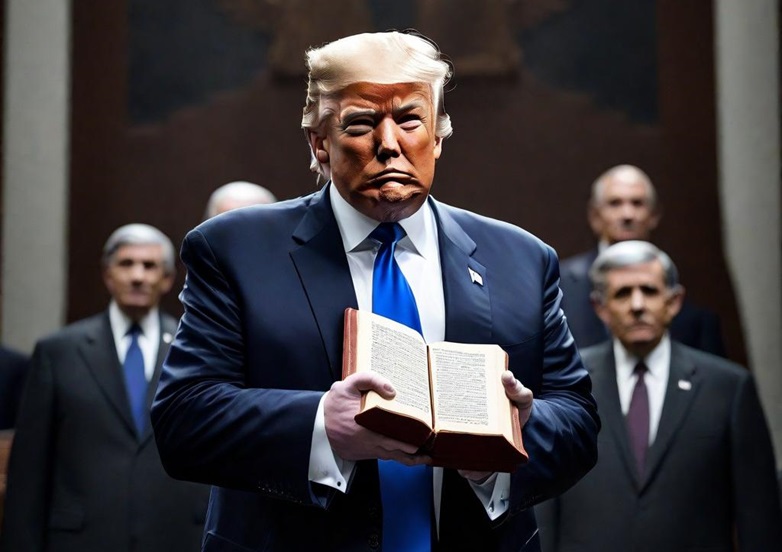
AI generated image from Limewire. Created by author.
History of Presidential Affiliations
Since the founding of the United States, every President has at least claimed to be Christian. Here’s a list of the denominational affiliations of the US Presidents, according to the Pew Research Center:
Episcopalian
- George H.W. Bush
- Gerald Ford
- Franklin Roosevelt
- Chester Arthur
- Franklin Pierce
- Zachary Taylor
- John Tyler
- William Harrison
- James Monroe
- James Madison
- George Washington
Presbyterian
- Ronald Reagan
- Dwight Eisenhower
- Woodrow Wilson
- Benjamin Harrison
- Grover Cleveland
- James Buchanan
- James Polk
- Andrew Jackson
Baptist
- Bill Clinton
- Jimmy Carter
- Harry Truman
- Warren Harding
Methodist
- George W. Bush
- William McKinley
- Rutherford Hayes
- Ulysses Grant
Unitarian
- William Howard Taft
- Millard Fillmore
- John Quincy Adams
- John Adams
No Formal Affiliation
- Andrew Johnson
- Abraham Lincoln
- Thomas Jefferson
- Donald Trump
Disciples of Christ
- Lyndon Johnson
- James Garfield
Dutch Reformed
- Theodore Roosevelt
- Martin Van Buren
Quaker
- Richard Nixon
- Herbert Hoover
Roman Catholic
- John F. Kennedy
- Joe Biden
Congregationalist
- Calvin Coolidge
United Church of Christ
- Barack Obama
According to Christianity Today, Trump was “the first President since Eisenhower to change faiths in office.” While serving as President, he moved from the Presbyterian Church to calling himself a “non-denominational Christian.”
“The Founding Fathers” Were Deists
Many who promote the idea that America is a Christian nation point to the fact that the “founding fathers” were Christians. In truth, while they were members of Christian churches, several of them were Deists. Nicholas Rathod writes:
Many of the founding fathers—Washington, Jefferson, Franklin, Madison and Monroe—practiced a faith called Deism. Deism is a philosophical belief in human reason as a reliable means of solving social and political problems. Deists believe in a supreme being who created the universe to operate solely by natural laws—and after creation, is absent from the world. This belief in reason over dogma helped guide the founders toward a system of government that respected faiths like Christianity, while purposely isolating both from encroaching on one another so as not to dilute the overall purpose and objectives of either.
America’s Deist “founding fathers” found Christianity to be a handy vehicle to communicate their beliefs. Yet, we must recognize the fallacy in the narrative that they were traditionally Christian. Surely, they were members of Christian denominations—but their actual beliefs differed significantly from orthodox Christianity. Still, they did believe in a Higher Power—the values of reason, liberty, equality, and justice. (At least, for landowning White men.)
Kennedy and Catholicism
John F. Kennedy, Jr. was the first Roman Catholic US President. During his campaign, many American voters asked themselves whether a Catholic President might have divided loyalties. Since the Pope is a head of state besides being a religious leader, Protestants wondered whether they might elect a President who submitted himself to the Vatican as a higher authority.
NPR reports that on September 12, 1960, then-candidate Kennedy delivered a speech in which he countered the anti-Catholic argument that he might have divided loyalties. The following is an excerpt from that speech:
I believe in an America where the separation of church and state is absolute, where no Catholic prelate would tell the president (should he be Catholic) how to act, and no Protestant minister would tell his parishioners for whom to vote; where no church or church school is granted any public funds or political preference; and where no man is denied public office merely because his religion differs from the president who might appoint him or the people who might elect him.
I believe in an America that is officially neither Catholic, Protestant nor Jewish; where no public official either requests or accepts instructions on public policy from the Pope, the National Council of Churches or any other ecclesiastical source; where no religious body seeks to impose its will directly or indirectly upon the general populace or the public acts of its officials; and where religious liberty is so indivisible that an act against one church is treated as an act against all.
While Kennedy was a Roman Catholic, he insisted that he was not the Catholic candidate for President. Instead, he was the Democratic Party’s candidate for President—who happened to be Roman Catholic. As evidenced by the fact that he won the Presidency, he clearly convinced his Protestant voters. They believed that Catholicism’s doctrines and values were close enough to their own to garner their support. Clearly, Kennedy believed in a Higher Power called Jesus Christ and upheld the American values of liberty and justice for all.
Romney and Mormonism
In 2007, when Mitt Romney ran for President, Evangelicals asked themselves similar questions. They wondered whether he might have divided loyalties between the Church of Jesus Christ of Latter-Day Saints and the Presidency. Evangelicals also wondered whether the differences in LDS doctrine might eclipse the fact that the two groups shared the same morals and values.
In the end, Romney’s Evangelical supporters decided that, even though they didn’t consider Mormons “Christian enough” to join the Evangelical fold, Romney’s support of their values was enough to win their conservative vote. Ultimately, their vote was not determined by what doctrines he believed, but by what morals he supported. It was enough for Evangelicals that Romney believed in a divine Higher Power, even if he didn’t believe in the same way they did.
Donald Trump
In 2016, when Donald Trump ran for President, he made it public he was a Presbyterian. Yet, in his desire to appeal to Evangelicals, he announced in 2020 that he had become a non-denominational Christian. Yet, his personal beliefs and behavior bear no evidence of, or resemblance to, any real Christian faith. Still, Evangelicals wrapped their arms around him because he promised to protect their interests.
According to Pew Research, “Most Americans don’t see Trump as religious; fewer than half say they think he’s Christian.” Still, he gets the Evangelical vote, not because he believes in a divine Higher Power or even personally represents their values. Instead, they vote for him because he gives them what they want.
The same Republicans who insisted that “character matters” when it came to Clinton’s affair now believe that character doesn’t matter as it relates to Donald Trump. The difference? Clinton was a Democrat, and Trump is a Republican. So, the Christian Right believes bad morals disqualify a POTUS who believes in environmental and social programs. At the same time, they support a hateful, bigoted, and immoral President as long as he holds a Bible for photo ops. Apparently, the Evangelical-led GOP no longer believes it’s important for a President to believe in a Higher Power.
Or Does He?
Or…Maybe Trump does believe in a higher power. Come to think of it, Trump has consistently demonstrated that he believes himself to be the highest power around. This is why he believes he can “grab [women] by the p*ssy.” And this is why he keeps classified documents at his personal residence, even after he’s left power. Because he believes there is no power higher than himself, he can do whatever he wants. “I could stand in the middle of 5th Avenue and shoot somebody and I wouldn’t lose voters,” Trump famously said. A Forbes article reports:
Former President Donald Trump suggested on Truth Social early Thursday he believes presidents should be allowed to “cross the line” without legal consequences, as an appeals court prepares to rule on whether he has “immunity” from criminal charges—and after Trump’s attorney suggested in court that presidents could even assassinate political rivals without being charged.
So, yes, Donald Trump does believe in a higher power—himself. He believes he can do whatever he wants, including killing political opponents. And Evangelicals are voting for this guy because he helps them get what they want. I wonder—do they even believe in their Higher Power anymore?
Should US Presidents Believe in a Higher Power?
Ultimately, a US President is going to believe one of two things. They will either believe in a Higher Power, or they will not. If they do, this doesn’t necessarily mean they believe in a Trinitarian God. In the future, we might have a President who follows Buddhism, Hinduism, Islam, Judaism, or some other religion. In that case, they will believe in a divine Higher Power like Christians do.
But even if they are not religious, a President may still believe in a Higher Power. They can do this if they uphold the ideals of freedom, justice, equality, reason, environmental concern, or other principles that are higher than themselves. A President who believes in a Higher Power will always remember that the White House is not their throne and that they serve a greater good.
But a President who believes themself to be the highest power is dangerous not just for Americans but for the entire world. Even a President who believes in no higher power at all would be better than a would-be dictator who makes a god of themself. A head of state must never be above the law. They must never place their own agenda ahead of the common good. They must uphold a standard of integrity, decency, self-respect, and respect for others.
When a political party finds a candidate who lets “justice roll on like a river, righteousness like a never-failing stream,” Christians should be proud to endorse such an individual. But until then, we must be wary of wolves in sheep’s clothing who claim to believe in a Higher Power, but who believe themselves to be above others, and above the law.
For related reading, check out my other articles:
- January 6—The New September 11
- Use This One Phrase To Develop Empathy
- For All Who Have Walked Out Of Church
General Christian
Politics and Religion
History and Religion
Religious affiliations of US Presidents
Should US Presidents Believe in a Higher Power?

About Gregory T. Smith
I live in the beautiful Fraser Valley of British Columbia and work in northern Washington State as a behavioral health specialist with people experiencing homelessness and those who are overly involved in the criminal justice system. Before that, I spent over a quarter-century as lead pastor of several Virginia churches. My newspaper column, “Spirit and Truth” ran in Virginia newspapers for fifteen years. I am one of fourteen contributing authors of the Patheos/Quoir Publishing book “Sitting in the Shade of another Tree: What We Learn by Listening to Other Faiths.” I hold a degree in Religious Studies from Virginia Commonwealth University, and also studied at Baptist Theological Seminary at Richmond. My wife Christina and I have seven children between us, and we are still collecting grandchildren. You can read more about the author here.
Previous Post

February 14, 2024
What Does the Bible Say About Random Acts of Kindness?
Next Post

February 22, 2024 Mostly Dead: The Princess Bride & Religious Deconstruction
Recent Comments
"Absolutely, Glen! That's a great example! And the Roman centurion who trusted Jesus. I've heard ..."
“Can You Follow Jesus and Still ..."
"Captian of the Syrian military, Naaman in 2 Kings 5 might be considered."
“Can You Follow Jesus and Still ..."
"Hi, Bob. Not sure why it's doing that...I've been having problems with my comments settings. ..."
"OMG, who CARES?!?!"
“Can You Follow Jesus and Still ..."
Browse Our Archives
Select a Category Challenging the Church Deconstruction For Pastors Heathen Christianity Holidays and special days Mental Health Social Justice Spirituality Taoism Theology Uncategorized
Select a Month October 2026 September 2026 August 2026 July 2026 June 2026 May 2026 April 2026 March 2026 February 2026 January 2026 December 2025 November 2025 October 2025 September 2025 August 2025 July 2025 June 2025 May 2025 April 2025 March 2025 February 2025 January 2025 December 2024 November 2024 October 2024 September 2024 August 2024 July 2024 June 2024 May 2024 April 2024 March 2024 February 2024 January 2024 December 2023 November 2023 October 2023 September 2023 August 2023 July 2023 June 2023 May 2023 April 2023 March 2023 February 2023 January 2023 December 2022 November 2022 October 2022 September 2022 August 2022 July 2022 June 2022 May 2022 April 2022 March 2022 February 2022 January 2022
Follow Us!
TAKE THE
Religious Wisdom Quiz
What is the name for the Christian "day of rest and worship"?
Select your answer to see how you score.
Sabbath Feast Seder Day of Prayer
Related posts from Breathing Space

I Met Papa Before I Read The Shack

The Guest Who Stayed at an Unfriendly Table
Jesus and Lao Tzu: Allowing Your Enemies
Which Version of Superman is the Most Punk...
TRENDING AT PATHEOS Progressive Christian

What Being a Modern-Day Apostle Means to Me
In my last column, I discussed the ins and outs of modern-day...

Did Ancient China Once Worship the God of...
Across human history, a common thread weaves through the origins of the...

Love Your Neighbor – Including Earth-Kin: Lev. 19,...
God’s command to love your neighbor means acting in an ethical and...

Lead a Church Study of “Jesus and Lao...
Guest writer Jack Thomas (The Irreverent Reverend) reflects on leading his church...

Pastoral Wisdom for Responding to Sermon Pushback
Getting sermon pushback on your social justice sermon? Learn practical, Proverbs-based strategies...

Principles for Understanding the Apostolic Ministry Today
Whenever people discover that my formal ministry title is "apostle," as in...
view all Progressive Christian blogs
What Are Your Thoughts?leave a comment
Ad-Free & Subscriber Log-In Subscription Support
- About Us
- 2026 Calendar
- Videos
- Podcasts
- Library of World Religions
- Faith In Media Tracker
- Advertise With Us
- Write for Us
- Privacy Policy
- Terms of Service
- Do Not Sell My Data
- Contact Us
- Radiant Digital
- Manage Newsletter Subscriptions
- Unsubscribe From Notifications
- Sitemap
Copyright 2008-2026, Patheos. All rights reserved.
Subscription Support Ad-Free & Subscriber Log-In
Follow Patheos