
BuddhistCatholicContemplativeEvangelicalGeneral ChristianHinduJewishLatter-day SaintMuslimNew VisionsProgressive Christian
Beliefs
- Buddhist
- Catholic
- Contemplative
- Evangelical
- General Christian
- Hindu
- Jewish
- Latter-day Saint
- More Voices
- Muslim
- New Visions
- Pagan
- Progressive Christian
Topics
- Religion News
- Food and Religion
- Sports and Religion
- Religious Art
- Religious Music and Entertainment
- Religious Events
- History and Religion
- Style and Religion
- Politics and Religion
- Women in Religion
- Recreation Outdoors and Religion
- Business Finance and Religion
- Careers Workplace and Religion
- Education and Religion
- Family Parenting and Religion
- Health Fitness and Religion
- Home and Religion
- Relationships and Religion
- Technology and Religion
- Travel and Religion
Columnists
- Buddhist Columnists
- Business Finance and Religion Columnists
- Careers Workplace and Religion Columnists
- Catholic Columnists
- Contemplative Columnists
- Education and Religion Columnists
- Evangelists Columnists
- Family Parenting and Religion Columnists
- General Christian Columnists
- Health Fitness and Religion Columnists
- Hindu Columnists
- History and Religion Columnists
- Home and Religion Columnists
- Jewish Columnists
- More Voices Columnists
- Latter Day Columnists
- Muslim Columnists
- New Visions Columnists
- Nonreligious Columnists
- Pagan Columnists
- Politics and Religion Columnists
- Progressive Columnists
- Recreation Outdoors and Religion Columnists
- Relationships and Religion Columnists
- Religion News Columnists
- Religious Art Columnists
- Religious Events Columnists
- Religious Music and Entertainment Columnists
- Sports and Religion Columnists
- Style and Religion Columnists
- Technology and Religion Columnists
- Travel and Religion Columnists
- Women in Religion Columnists
Resource Library
- 2026 Calendar
- Library of World Religions
- The 100 Most Holy Places on Earth
- Patheos Answers
- Podcasts
- Videos
- Faith Leaders Database
- Anglican Episcopalian
- Bahai
- Baptist
- Buddhism
- Christianity
- Confucianism
- Eastern Orthodoxy
- Hinduism
- Holiness and Pentecostal
- ISKCON
- Islam
- Judaism
- Lutheran
- Methodist
- The Church of Jesus Christ of Latter-day Saints
- New Age
- Paganism
- Presbytarian and Reformed
- Protestantism
- Religion Behind the Scenes
- Roman Catholic
- Scientology
- Shia Islam
- Sikhism
- Sufism
- Sunni Islam
- Taoism
- Zen
- See all religions
Research Tools
 Ad-Free & Subscriber Log-In Subscription Support
Ad-Free & Subscriber Log-In Subscription Support
Follow Patheos 

- Trending:
- Forgiveness
- |
- Marriage
- |
- Consciousness
- |
- Death Penalty
- |
- Election
- |
- Halloween

-
Categories
- Home
- Progressive Christian
- Travel and Religion
- Macy’s, Confederate Generals, and Stumbling Blocks
Macy’s, Confederate Generals, and Stumbling Blocks
Last updated on: January 22, 2024 at 3:59 am by Gregory T. Smith
Macy’s, Confederate Generals, and Stumbling Blocks 2024-01-13T11:28:48-08:00 Gregory T. Smith
Patheos Explore the world's faith through different perspectives on religion and spirituality! Patheos has the views of the prevalent religions and spiritualities of the world.
What do Macy’s Department Store and Confederate generals have in common? They’re both stumbling blocks that retraumatize people.

Jefferson Davis Statue at Hollywood Cemetery, Richmond, Virginia. Photo from Wikimedia Commons

Recently, I spent some time with my much-loved Uncle Ron, who is eighty. He’s a Vietnam vet who retired from the US Army after a full career of active duty. This loyal service member is as patriotic as they come, never one to completely retire from service to his nation. Even at this age, he continues to work full-time for a branch of the government I might or might not be able to name. I’m extremely proud of this man. He also frustrates me to no end.
Benign Racism?
Though he would deny my assertion, my Uncle Ron is a racist. Of course, he would never say that he hates people of color. But whenever a “Black TV show” comes on, he conveniently finds something else he’d rather watch. Living in the American South, he gets angry when municipalities remove Southern iconography from the American Civil War. And he talks about going on lunch breaks with “my Black coworker,” when his colleague’s race has nothing to do with his narrative. Some would call it benign racism—but I don’t think racism is ever benign.
Society is Changing
On a recent trip to Richmond, Virginia, Uncle Ron and I visited Civil War battlefields where he recounted histories as if he had been there. Truly he is a great student of the Civil War. But obviously, his sympathies lie with the South. We visited the grave of Jefferson Davis, President of the Confederate States of America. Gazing up at the statue, he complained, “Of course, they’re no longer flying the Confederate flag over his grave!” It offends Uncle Ron that society is changing and no longer values the heroes and ideals he grew up cherishing.
Trying to Erase the Past
“They’re trying to erase the past,” he lamented. I tried to help him see that nobody is deleting the names of his beloved Confederates from the history books. It’s just that society no longer sees them as heroes. What’s more, many see them as villains akin to Nazis of the Third Reich. “You won’t go to Germany and see Fuhrer Avenue, or a statue of Hitler at a town square,” I have pointed out to him. “You’ll never go there and see a nostalgic Swastika flying over a government building, to celebrate German heritage and not hate.” But he refuses to see the parallel. That’s because the trauma of African Americans isn’t his trauma. (More on that later.)
Aunt Jemima and Uncle Ben
Uncle Ron’s struggle with a changing society manifests in other ways. Ron complains that Aunt Jemima pancake syrup and Uncle Ben’s Rice have changed their names and logos. He denies that the depictions of Ben and Jemima were stylized to depict stereotypically racist imagery. He also overlooks the fact that “Uncle” and “Aunt” were used as pejorative honorifics by White Southerners who refused to give African Americans the honor of calling them “Mr.” and Mrs.” All he can see is that society is changing, and he doesn’t like it.
Confederate Statues and Holidays
What’s more, Uncle Ron frequently complains about Richmond’s removal of its city-owned statues of Confederate generals on Monument Avenue and other places. He doesn’t see how these lost cause narrative symbols were designed as a daily reminder to the African American population that members of the racist old guard still kept their eyes on them. All Ron can see is that his heroes are being removed.
Certain holidays spark Uncle Ron’s racism. Every year on Columbus Day he gripes that history now sees the namesake as a villain. Virginia used to celebrate Lee-Jackson Day, in honor of two Confederate generals. Later, the Commonwealth added Martin Luther King, Jr. to the mix and for a while there was Lee-Jackson-King Day. That is until people realized the hypocrisy of honoring those men on the same day, and Lee-Jackson Day was eliminated. Ever since Virginia dropped Lee and Jackson, and elevated King to hero status, Uncle Ron has been complaining. These and related topics have been the subject of rants for years. To some extent, it’s just curmudgeonly grumbling about society changing in ways that he can’t control. But to another extent, it evidences his benign racism.
“That Damned Red Star”
While watching television one day, he harumphed at a Macy’s commercial. “I’ll never shop at Macy’s!” he said.
Curious, I asked, “Why is that, Uncle Ron?”
He looked at me with a mixture of disappointment and distaste, as if he couldn’t believe that his Beloved Youngster didn’t already know. “Because their logo is a communist symbol!”
A lightbulb went off in my head. I said, “Oh? Tell me more…”
“I’ve been shot at by men wearing that damned star on their helmets,” he said. “You wouldn’t believe how it makes veterans feel when they see that logo. A lot of veterans have written to Macy’s, asking them to change their logo, but they just won’t do it.”
I imagined that Uncle Ron must feel the same about Heineken’s red star, but I didn’t want to confuse the conversation. I also inconspicuously Googled Macy’s red star logo as we talked, learning that it has nothing to do with Communism. It has to do with a tattoo Mr. Macy got on his travels. But I didn’t mention that, either. I wanted to stay on point.
I said, “Wow—I never thought of that before. You’re saying that there’s a whole group of veterans who served their country and deserve to be honored (I agree)—who feel triggered when advertisers force this communist symbol upon them. They’re made to relive their trauma of being targeted by people who wore this star.”
“That’s right!” he said.
“So, it would just be good business,” I said, “If companies that used the red star as their logo were to change their images, so they didn’t retraumatize potential customers. Not to mention that it would just be the kind thing to do.”
Again, he agreed.
“I see where you’re going with this,” I told him. “It’s just like African Americans who feel retraumatized every time they see the Confederate flag, or when they see Southern generals touted as heroes. It’s just like BIPOC folks who don’t want to purchase a product that has a racist depiction of servile Black people on the label.”
Game, set, match. But the tennis ball went flying right over Uncle Ron’s head.
Macy’s, Confederate Generals, and Stumbling Blocks
Jesus addresses this issue in Matthew 18:6-9. In these verses, Jesus talks about causing people to stumble. Here, I use the NRSVUE, which translates the Greek words σκανδαλίσῃ (skandalisē) and σκανδάλων (skandalōn) as “sin.” Then, in the footnotes, the NRSVUE clarifies that the word actually means “to stumble.” Jesus says:
“If any of you cause one of these little ones who believe in me to sin, it would be better for you if a great millstone were fastened around your neck and you were drowned in the depth of the sea. Woe to the world because of things that cause sin! Such things are bound to come, but woe to the one through whom they come!
“If your hand or your foot causes you to sin, cut it off and throw it away; it is better for you to enter life maimed or lame than to have two hands or two feet and to be thrown into the eternal fire. And if your eye causes you to sin, tear it out and throw it away; it is better for you to enter life with one eye than to have two eyes and to be thrown into the hell of fire.*
Matthew’s Jesus uses the Greek word skandalōn. This differentiates it from αμαρτία (amartía), which is Greek for “sin.” Despite mistranslations, stumbling and sinning are not the same. Jesus is talking about doing something that causes the downfall of others, or something that might bring yourself down. Rather than causing yourself or others to stumble, it’s best to remove the stumbling block. That way, everyone can share the road in safety.
Focusing on the Needs of the Traumatized
Further, Jesus advocates focusing on the needs of minorities, rather than focusing on the wants of a majority that is already in a safe place. In verses 10-14, the Good Shepherd says:
“Take care that you do not despise one of these little ones, for I tell you, in heaven their angels continually see the face of my Father in heaven. What do you think? If a shepherd has a hundred sheep and one of them has gone astray, does he not leave the ninety-nine on the mountains and go in search of the one that went astray? And if he finds it, truly I tell you, he rejoices over it more than over the ninety-nine that never went astray. So it is not the will of your Father in heaven that one of these little ones should be lost.
For that one little lamb, getting lost is traumatic. Jesus tells his followers to focus on the needs of the traumatized—even if they are as little as one percent, rather than guarding the safety of the rest—though they be as many as ninety-nine percent. In Uncle Ron’s case, this would mean that companies like Macy’s and Heineken should consider changing their logos to accommodate the PTSD of the nation’s veterans. In other cases, it means recognizing that society must move on from heroizing conquistadores, Confederates, crooked cops, and anybody else who oppresses others. To focus on the needs of minorities, we must learn the principles of trauma-informed care.
Jesus and Trauma-Informed Care
In my article, “Jesus and Trauma-Informed Care,” I discuss how Jesus understands our pain. “It’s a bit of an oversimplification, but not off the mark, to simply remember that the Golden Rule guides Trauma-Informed Care.” If we want others to be sensitive to our trauma and make accommodations to avoid triggering our pain, then we should do the same for them. If we want people to be sensitive to avoid the red stars in our lives, then we must take steps to remove the flags, statues, and stumbling blocks from theirs.
I encourage you to read “Jesus and Trauma-Informed Care” to learn principles that guide us to treat others with compassion rather than judgment. Perhaps, like my Uncle Ron, you’ve had a tough time adjusting to changes in society. Adjusting is as simple as following the Golden Rule, and treating others the way you’d like to be treated.
Or maybe you’re like me and you have Uncle Rons in your own life. You might have a clever zinger that you hope will help them see things from your perspective. But your words, like Confederate cannonballs, may go right over their heads. If we want them to focus on the Golden Rule, the best thing is for us to start with that as well. Have compassion for their inability to change. Find out what trauma in their lives created their defensiveness. By addressing their pain, you may be able to help them heal and learn.
To read more, check out these important websites:
- Charlottesville’s Robert E. Lee statue melted down through Swords Into Plowshares initiative
- Swords Into Plowshares
Note:
*Contrary to widespread belief, Jesus’ reference to a hell of fire does not indicate a damnation of eternal conscious torment. Click here to read my article, “Fun-Damn-Mentalists: What I Don’t Believe About Hell.”
General Christian
Travel and Religion
History and Religion
Confederate generals as stumbling blocks
Macy's star a communist symbol
Previous Post

January 18, 2024
How to Put Prayer and Meditation in Your Fitness Routine
Next Post

January 25, 2024 What Type of Music Should I Play When I Meditate?
Recent Comments
"Absolutely, Glen! That's a great example! And the Roman centurion who trusted Jesus. I've heard ..."
“Can You Follow Jesus and Still ..."
"Captian of the Syrian military, Naaman in 2 Kings 5 might be considered."
“Can You Follow Jesus and Still ..."
"Hi, Bob. Not sure why it's doing that...I've been having problems with my comments settings. ..."
"OMG, who CARES?!?!"
“Can You Follow Jesus and Still ..."
Browse Our Archives
Select a Category Challenging the Church Deconstruction For Pastors Heathen Christianity Holidays and special days Mental Health Social Justice Spirituality Taoism Theology Uncategorized
Select a Month October 2026 September 2026 August 2026 July 2026 June 2026 May 2026 April 2026 March 2026 February 2026 January 2026 December 2025 November 2025 October 2025 September 2025 August 2025 July 2025 June 2025 May 2025 April 2025 March 2025 February 2025 January 2025 December 2024 November 2024 October 2024 September 2024 August 2024 July 2024 June 2024 May 2024 April 2024 March 2024 February 2024 January 2024 December 2023 November 2023 October 2023 September 2023 August 2023 July 2023 June 2023 May 2023 April 2023 March 2023 February 2023 January 2023 December 2022 November 2022 October 2022 September 2022 August 2022 July 2022 June 2022 May 2022 April 2022 March 2022 February 2022 January 2022
Follow Us!
TAKE THE
Religious Wisdom Quiz
Which prophet lamented over Israel's oppression of the poor?
Select your answer to see how you score.
Amos Hosea Obadiah Joel
Related posts from Breathing Space

All the Colors of the Rainbow Testify to...

Why the Rainbow Became a Pride Symbol

No, the Rainbow is Not a Christian Trademark
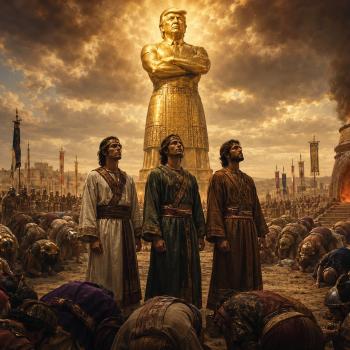
Refusing to Bow to Trump's Golden Idol
TRENDING AT PATHEOS Progressive Christian

What Being a Modern-Day Apostle Means to Me
In my last column, I discussed the ins and outs of modern-day...

Did Ancient China Once Worship the God of...
Across human history, a common thread weaves through the origins of the...

Love Your Neighbor – Including Earth-Kin: Lev. 19,...
God’s command to love your neighbor means acting in an ethical and...

Lead a Church Study of “Jesus and Lao...
Guest writer Jack Thomas (The Irreverent Reverend) reflects on leading his church...

Pastoral Wisdom for Responding to Sermon Pushback
Getting sermon pushback on your social justice sermon? Learn practical, Proverbs-based strategies...

Principles for Understanding the Apostolic Ministry Today
Whenever people discover that my formal ministry title is "apostle," as in...
view all Progressive Christian blogs
What Are Your Thoughts?leave a comment
Ad-Free & Subscriber Log-In Subscription Support
- About Us
- 2026 Calendar
- Videos
- Podcasts
- Library of World Religions
- Faith In Media Tracker
- Advertise With Us
- Write for Us
- Privacy Policy
- Terms of Service
- Do Not Sell My Data
- Contact Us
- Radiant Digital
- Manage Newsletter Subscriptions
- Unsubscribe From Notifications
- Sitemap
Copyright 2008-2026, Patheos. All rights reserved.
Subscription Support Ad-Free & Subscriber Log-In
Follow Patheos