
BuddhistCatholicContemplativeEvangelicalGeneral ChristianHinduJewishLatter-day SaintMuslimNew VisionsProgressive Christian
Beliefs
- Buddhist
- Catholic
- Contemplative
- Evangelical
- General Christian
- Hindu
- Jewish
- Latter-day Saint
- More Voices
- Muslim
- New Visions
- Pagan
- Progressive Christian
Topics
- Religion News
- Food and Religion
- Sports and Religion
- Religious Art
- Religious Music and Entertainment
- Religious Events
- History and Religion
- Style and Religion
- Politics and Religion
- Women in Religion
- Recreation Outdoors and Religion
- Business Finance and Religion
- Careers Workplace and Religion
- Education and Religion
- Family Parenting and Religion
- Health Fitness and Religion
- Home and Religion
- Relationships and Religion
- Technology and Religion
- Travel and Religion
Columnists
- Buddhist Columnists
- Business Finance and Religion Columnists
- Careers Workplace and Religion Columnists
- Catholic Columnists
- Contemplative Columnists
- Education and Religion Columnists
- Evangelists Columnists
- Family Parenting and Religion Columnists
- General Christian Columnists
- Health Fitness and Religion Columnists
- Hindu Columnists
- History and Religion Columnists
- Home and Religion Columnists
- Jewish Columnists
- More Voices Columnists
- Latter Day Columnists
- Muslim Columnists
- New Visions Columnists
- Nonreligious Columnists
- Pagan Columnists
- Politics and Religion Columnists
- Progressive Columnists
- Recreation Outdoors and Religion Columnists
- Relationships and Religion Columnists
- Religion News Columnists
- Religious Art Columnists
- Religious Events Columnists
- Religious Music and Entertainment Columnists
- Sports and Religion Columnists
- Style and Religion Columnists
- Technology and Religion Columnists
- Travel and Religion Columnists
- Women in Religion Columnists
Resource Library
- 2026 Calendar
- Library of World Religions
- The 100 Most Holy Places on Earth
- Patheos Answers
- Podcasts
- Videos
- Faith Leaders Database
- Anglican Episcopalian
- Bahai
- Baptist
- Buddhism
- Christianity
- Confucianism
- Eastern Orthodoxy
- Hinduism
- Holiness and Pentecostal
- ISKCON
- Islam
- Judaism
- Lutheran
- Methodist
- The Church of Jesus Christ of Latter-day Saints
- New Age
- Paganism
- Presbytarian and Reformed
- Protestantism
- Religion Behind the Scenes
- Roman Catholic
- Scientology
- Shia Islam
- Sikhism
- Sufism
- Sunni Islam
- Taoism
- Zen
- See all religions
Research Tools
 Ad-Free & Subscriber Log-In Subscription Support
Ad-Free & Subscriber Log-In Subscription Support
Follow Patheos 

- Trending:
- Forgiveness
- |
- Marriage
- |
- Consciousness
- |
- Death Penalty
- |
- Election
- |
- Halloween

-
Categories
- Home
- Progressive Christian
- Religious Events
- Best Practices for Church Security
Best Practices for Church Security
Last updated on: March 22, 2023 at 11:00 am by Gregory T. Smith
Best Practices for Church Security 2023-03-22T11:00:11-08:00 Gregory T. Smith
Patheos Explore the world's faith through different perspectives on religion and spirituality! Patheos has the views of the prevalent religions and spiritualities of the world.
When my parishioner threatened to bring a gun to church and start shooting, we wished we had some best practices for church security. Are you concerned about safety during worship services and other events? Here’s how your church can begin taking church security seriously and add a measure of safety to your proceedings.
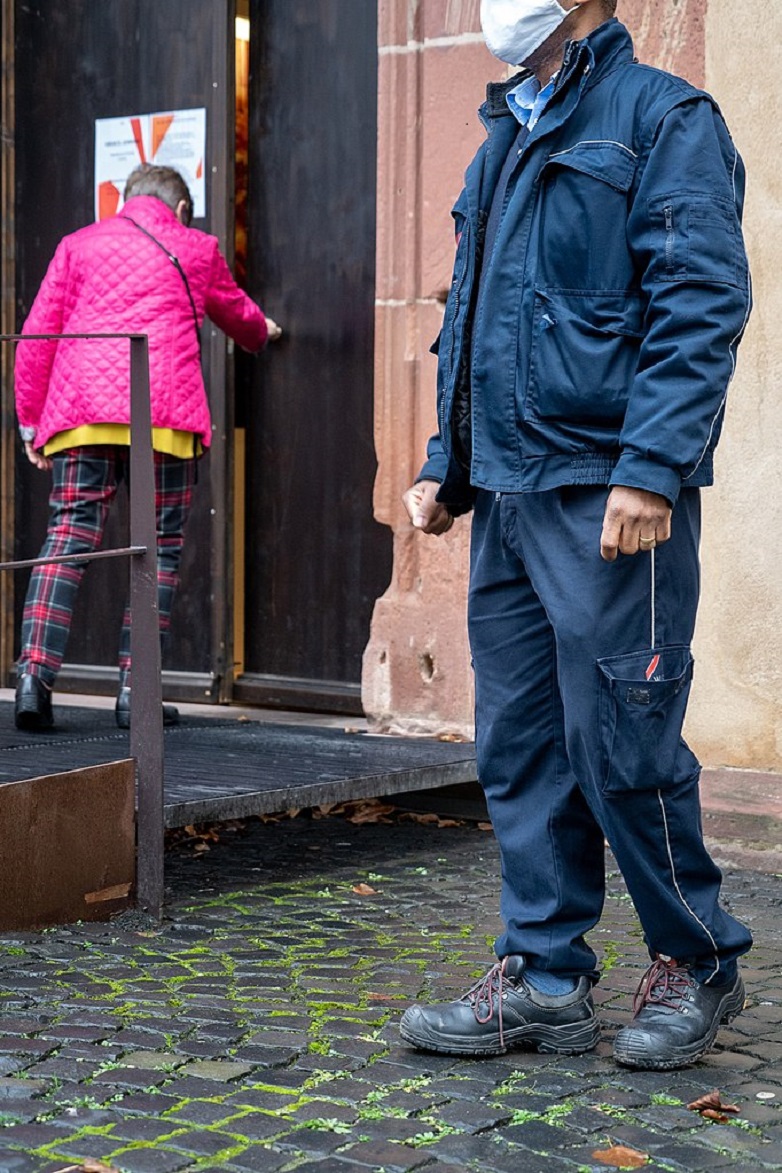
Masked security controls entrance to a church in Frankfurt, Germany, during Corona times
by CoronaBrowser.com
The Threat
It was playtime at Vacation Bible School, with a hundred children running around our church’s playground. Bill (not his real name) had come to church, his temper as hot and unforgiving as the summertime sun overhead. But he wasn’t there for worship. He was there looking for a fight. Bill wasn’t a bad guy. But he was in the middle of several stressful life changes. And he was off his meds. Everybody knew to watch out for him when he was off his meds. Built like a bear, he could be dangerous and unpredictable. But it wasn’t his stature we were worried about that day. The real concern was the loaded gun in his truck, and his threat to use it.
The Recommendation
Thankfully, he didn’t use the gun. The crisis diffused. He went home in peace. That is until he started making threats again. We reported it to law enforcement, and they agreed to stay close to our church on Sunday mornings for the next few weeks. But they also recommended that we create some best practices for church security. If you’re concerned about security at your house of worship, I’d like to share our plan with you. Some things, I’d do differently today. This was years ago, and my philosophies have changed. First, I’ll share what I’d do differently. Then, I’ll share the other measures we took, and some other suggestions, besides.
The Action
When Bill threatened the children at our VBS, it shook me. Later in the week, when he threatened to come to my house and settle matters, it scared me even more. I had to decide what action I was going to take to keep my family and myself safe. So, I bought a gun. I got trained and certified. But in Virginia, the carry permit doesn’t require tactical training. It only requires that you know how to use the weapon proficiently. For a while, I carried my gun concealed whenever I wasn’t at home: in the church office during the week, in the community, and at church during services.
In Virginia, firearms are illegal in houses of worship. But the district attorney assured me I had a right because the proprietor can carry in his own business—and I was the proprietor. I had to switch to an ankle holster when the little old lady who hugged me asked what was beneath my jacket. I carried that gun regularly for a couple of years until the situation changed, and the threat was no longer present. But I don’t carry anymore.
I know—gun enthusiasts will say that the threat is always present. Or, potentially so, anyway. The aim of this article isn’t to discuss gun rights or to tell you what you should do about carrying a gun. My point is simply that every day when I loaded and strapped on my gun, I had to think about shooting people. And that wasn’t who I wanted to be. I wasn’t a police officer or soldier–I was a pastor. This was something I wish I’d handled differently. I don’t even own a gun anymore—and that’s more in line with my personality.
That isn’t to say I don’t take safety seriously. Now, as a behavioral health specialist who works with many homeless individuals with violent criminal charges, I make safety a matter of paramount importance—for myself and others. What I’m about to share comes from a long career as a pastor, and my training in de-escalation and situational awareness for working with potentially volatile individuals. Here are some best practices for church security:
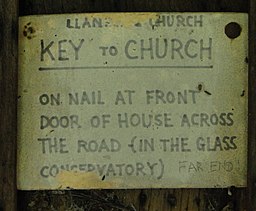
Security arrangements, Llanelieu church – geograph.org.uk – 2607066
by Philip Pankhurst
Best Practices for Church Security
- Invite your law enforcement agency to conduct a safety evaluation of your property. Most jurisdictions will provide this free of charge. They’ll take a look at your facilities and tell you where your vulnerabilities lie. They can make recommendations for your congregation’s safety. Some of these will involve an output of funds. Others can be done for free.
- Get some situational awareness training. Tactical Hyve defines situational awareness as, “the improvement of someone’s perception of environmental elements and events, the comprehension of their meaning, and the projection of their future status.” Training your church body, or at least church leaders, in situational awareness can be a matter of life and death. This training teaches people to sense, evaluate, avoid, act on, or eliminate threats around them. Situational awareness training generally focuses on a defensive response rather than an aggressive approach to threats. You can Google trainers near you or contact your local law enforcement agency for ideas.
- Get some de-escalation training. De-escalation training provides negotiation techniques to deal with troubled or troublesome individuals. The goal of de-escalation is to lower the temperature of the conversation, much as someone in my church did with Bill. Getting formal de-escalation training for your church leaders would mean that if a person is verbally challenging but not physically violent your staff can deal with it. Again, you can Google trainings or contact local law enforcement for these resources.
- Mark and clear your exits. Make sure all the exits are marked clearly so that, in the event of an active shooter or other threat, people know where they can retreat. Clearing your exits means making sure that there isn’t a bottleneck if people need to rush the exit all at once. One church I served had bulky furniture near the doors, which would obstruct a rapid exit. Another church had a playground with only one way in or out. This might help them corral the kids—but in the event of an attacker, it would turn the playground into a shooting gallery. Clearing the exits meant opening the flow for people’s quick egress.
- Have occasional drills. If schools and places of employment can have fire drills and active shooter drills, so can your church. Periodically going through drills may seem scary. But it’s even scarier to think of a situation with no preparedness. Nobody wants to consider violent potentialities in their house of worship. But these things do happen—so it’s best to train your people to be prepared. If your people know what to do in case of a fire, they’ll be ready. If you decide to institute an active shooter plan, you might just save lives if the worst thing happens. You can get some good ideas by learning what public schools do for their active shooter drills.
- Consider locking your church doors fifteen minutes after the service starts. Nobody wants to be late to church. They certainly don’t want to make a scene by knocking if they’re late. Yet, locking the doors so they can still be pushed open from the inside keeps everyone safe. Again, you don’t want to create a bottleneck where people are locked inside in a volatile situation. The doors must be able to be instantly pushed open from the inside while remaining secure against aggression from the outside. As an added benefit, if parishioners know they could get locked out, maybe they’ll try to get to church on time.
- Change your doorknobs and doors. By removing old-fashioned doorknobs, you can make your church safer. Instead, install the kind with a handle on the outside and a panic bar on the inside. This will make it easier for people to leave in case of an emergency. Make sure your doors swing out instead of in. Install deadbolts with reinforced doorjambs. Make it so an intruder can’t kick the door down. Consider fireproof doors in hallways, to create zones that block the spread of fire.
- Install bright lighting in your parking lot, the property perimeter, and entrances. Not only will this keep criminals away—it will help people see a threat if it exists. This applies not just to troublemakers but also to icy steps, slick pavement, and other hazards.
- Trim the bushes. People breaking into churches often look for bushes to hide behind before they smash a window. Bushes near entrances also offer attackers a place to lurk. Keeping them trimmed eliminates the hiding spots.
- Install doorbells. During the week, the secretary may be alone in the building. Sometimes I worked on sermons late into the night. Doorbells and locked doors mean that nobody can sneak up on someone working in the church office. Along with doorbells, you might…
- Install cameras and intercoms. With cameras, someone in the office can see who’s at the door. With an intercom, you could talk with the person who’s ringing the doorbell. Consider a lock that allows someone in the office to buzz a visitor in. Don’t allow church staff to be alone in the building with the doors unlocked.
- Install a security system. This is more for property security than personal safety. You won’t have your alarm armed when people are in the building. Still, it could keep your stuff from being stolen. Consider wire-reinforced glass on the lower levels of your church building or bars in a high-crime area.
- Create safety procedures for the kitchen, nursery, playground, and other hazardous zones. This should include a large first aid kit in each of these areas. By law, you need fire extinguishers at key locations throughout your building (make sure they are up to date). Your church might invest in an AED device, along with first aid, CPR, and AED training for key leaders. Nursery workers, cafeteria workers, or parish nurses come to mind. Assign someone the task of keeping the first-aid kits well-stocked and fire extinguishers inspected.
-
Create a church security team.
- First, this would include parking lot attendants, who can not only help people park but can spot suspicious persons the minute they come onto church property.
- Second, it includes greeters, who not only offer a warm handshake but provide a visual assessment. They can look for weapons-bulges under clothing, erratic behavior, or other disturbing mannerisms. Be careful that they know the difference between reasonable caution and unreasonable profiling, though. You don’t want your church to get a reputation for treating visitors with fear. You want your greeters to make people feel welcomed, not mistrusted.
- Third, you might have a camera person who can monitor the security situation around the property.
- Fourth, include the person who stocks the first aid kits and schedules fire extinguisher inspections on the security team.
- Fifth, If you’re really concerned about violence, you could add a third layer of security—bouncers. These shouldn’t be people who love violence and are looking for an excuse to lay hands on people. They should be folks who love their church and are willing to risk their own safety for the sake of others.

A Word About Bouncers
I can’t tell you what your church’s philosophy should be about bouncers. I will remind you that Jesus said we should turn the other cheek, and that all who take up the sword will die by the sword. Yet, he also made a whip out of cords and drove the moneychangers from the temple. I’ve heard sermons about how the Good Shepherd beats off the wolves with the rod and staff. You can make a biblical and ethical case, either way you want, for pacifism or for the justifiable use of violence. I don’t plan on solving that issue for you today. That’s a consideration for your church and its leaders to determine. However, I will give you a few reflections, based on my experience:
- My church did, in fact, create a security team complete with bouncers. These individuals carried concealed pistols to church. They were only allowed to do so in their capacity as active-duty law enforcement or military personnel. They were trained not only in the use of their weapons, but in tactics, hand-to-hand combat, situational awareness, and de-escalation. I would not have considered lethally armed security in my church if we had not had active-duty law enforcement and military personnel who could conduct this task.
- It is possible for your bouncers to arm themselves with less-lethal options. These would include pepper spray, tasers, Pepperball launchers, and the like. Make sure you check your local laws regarding less lethal weapons. And, if your bouncers are armed with anything, they should be trained.
- When I took Aikido lessons, our sensei taught us that the best defensive move is saying, “After you.” When you hold the door for someone, it looks like you’re polite but you’re actually keeping an eye on the other person, and not turning your back toward them. You’ve heard that “the best offense is a good defense.” That’s because once you’ve gone on the offensive, you’ve narrowed your focus. Once you’ve thrown a punch, you can’t stop your momentum. When you’ve escalated an event with violence, you can’t put the toothpaste back in the tube. This is probably why Jesus told Peter to put up his sword.
- From a tactical perspective, a hand with a weapon is only a weapon. Here’s what I mean: With an open hand, you can open a door for someone. You can offer a handshake, a hug, hand out a bulletin, or reach for your cell phone. But once you put a weapon in that hand, your hand is only a weapon. You’ve eliminated your options and narrowly focused your intent on violence. Even in a combat situation, a hand with a weapon in it is no longer able to grab, push, pull, block, deflect, or anything else. Your bouncers need to keep this in mind—this is why Jesus said it’s best to turn the other cheek. A handshake, a wave, or a guiding hand may de-escalate matters. And de-escalation is the goal when it comes to dealing with problematic individuals.
- I’ll say again—if your church has bouncers, they’d better not look like bouncers. They should only be used in extreme emergencies. Bouncers aren’t a goon squad to enforce the pastor’s rules. If your church has bouncers, they should only be utilized as a response to aggression—not to be aggressors themselves. Too many aggressive Christians are one of the problems with this world.
Are You Concerned About Safety?
Easter is coming. Are you concerned about safety during worship services for major holidays? By putting some best practices for church security into place, your church can be prepared, should the unthinkable happen. Note that of the fourteen suggestions above, only one of these suggestions involved a security team. Of the five kinds of people on the security team, only one role involves the potential for violent conflict. If your church’s best practices involve an aggressive response to threats, that should be the last resort. In Matthew 11.12, Jesus said, “The Kingdom of the Heavens has been suffering violent assault, and the violent have been seizing it by force.” Perhaps the best practice for church security is to ask yourself how Jesus himself responded to violence. Figure out what Jesus would do—and do that.
Remember, best practices for church security involve far more than the possibility of violence. They include such things as first aid, fire safety, and property protection as well. Your security team doesn’t want to become the kind of people who are constantly thinking about violence. That just turns us into violent people. Training in de-escalation and situational awareness is better than training in violence. Jesus is the Prince of Peace, who wants his followers to be purveyors of peace. This is the first and best part of the Christian mission.
Follow-Up with Bill
One more thing before I let you go—We did a lot of follow-up with Bill. In a safe environment, we ministered to his many needs. He got back on his meds. We walked him through the crises that precipitated his irrational behavior. In fact, we repaired the relationship so much that I was the person he called for help when the next crisis arose. By the time I left that church, he was hugging me, crying, and telling me that I was his best friend.
The best offense is a good defense. And sometimes the good defense is caring for people who are hurting. Remember that there are no bad guys—there are hurting people who make bad decisions. When you care for the hurting and bind up the brokenhearted, you never know what church disaster you may be avoiding in the future.
For Further reading, check out my article, “Jesus and Trauma-Informed Care”
General Christian
Religious Events
Family, Parenting and Religion
situational awareness training

Next Post

March 26, 2023 What if the Church Valued Doubt as Much as Faith?
Recent Comments
"Absolutely, Glen! That's a great example! And the Roman centurion who trusted Jesus. I've heard ..."
“Can You Follow Jesus and Still ..."
"Captian of the Syrian military, Naaman in 2 Kings 5 might be considered."
“Can You Follow Jesus and Still ..."
"Hi, Bob. Not sure why it's doing that...I've been having problems with my comments settings. ..."
"OMG, who CARES?!?!"
“Can You Follow Jesus and Still ..."
Browse Our Archives
Select a Category Challenging the Church Deconstruction For Pastors Heathen Christianity Holidays and special days Mental Health Social Justice Spirituality Taoism Theology Uncategorized
Select a Month October 2026 September 2026 August 2026 July 2026 June 2026 May 2026 April 2026 March 2026 February 2026 January 2026 December 2025 November 2025 October 2025 September 2025 August 2025 July 2025 June 2025 May 2025 April 2025 March 2025 February 2025 January 2025 December 2024 November 2024 October 2024 September 2024 August 2024 July 2024 June 2024 May 2024 April 2024 March 2024 February 2024 January 2024 December 2023 November 2023 October 2023 September 2023 August 2023 July 2023 June 2023 May 2023 April 2023 March 2023 February 2023 January 2023 December 2022 November 2022 October 2022 September 2022 August 2022 July 2022 June 2022 May 2022 April 2022 March 2022 February 2022 January 2022
Follow Us!
TAKE THE
Religious Wisdom Quiz
What is the shortest book in the New Testament?
Select your answer to see how you score.
3 John 2 John Philemon Jude
Related posts from Breathing Space

“Can You Follow Jesus and Still Practice Smudging?”

Lead a Church Study of “Jesus and Lao...

The Guest Who Stayed at an Unfriendly Table

When Being a Good Guest Is Better than...
TRENDING AT PATHEOS Progressive Christian

What Being a Modern-Day Apostle Means to Me
In my last column, I discussed the ins and outs of modern-day...

Did Ancient China Once Worship the God of...
Across human history, a common thread weaves through the origins of the...

Love Your Neighbor – Including Earth-Kin: Lev. 19,...
God’s command to love your neighbor means acting in an ethical and...

Lead a Church Study of “Jesus and Lao...
Guest writer Jack Thomas (The Irreverent Reverend) reflects on leading his church...

Pastoral Wisdom for Responding to Sermon Pushback
Getting sermon pushback on your social justice sermon? Learn practical, Proverbs-based strategies...

Principles for Understanding the Apostolic Ministry Today
Whenever people discover that my formal ministry title is "apostle," as in...
view all Progressive Christian blogs
What Are Your Thoughts?leave a comment
Ad-Free & Subscriber Log-In Subscription Support
- About Us
- 2026 Calendar
- Videos
- Podcasts
- Library of World Religions
- Faith In Media Tracker
- Advertise With Us
- Write for Us
- Privacy Policy
- Terms of Service
- Do Not Sell My Data
- Contact Us
- Radiant Digital
- Manage Newsletter Subscriptions
- Unsubscribe From Notifications
- Sitemap
Copyright 2008-2026, Patheos. All rights reserved.
Subscription Support Ad-Free & Subscriber Log-In
Follow Patheos