
BuddhistCatholicContemplativeEvangelicalGeneral ChristianHinduJewishLatter-day SaintMuslimNew VisionsProgressive Christian
Beliefs
- Buddhist
- Catholic
- Contemplative
- Evangelical
- General Christian
- Hindu
- Jewish
- Latter-day Saint
- More Voices
- Muslim
- New Visions
- Pagan
- Progressive Christian
Topics
- Religion News
- Food and Religion
- Sports and Religion
- Religious Art
- Religious Music and Entertainment
- Religious Events
- History and Religion
- Style and Religion
- Politics and Religion
- Women in Religion
- Recreation Outdoors and Religion
- Business Finance and Religion
- Careers Workplace and Religion
- Education and Religion
- Family Parenting and Religion
- Health Fitness and Religion
- Home and Religion
- Relationships and Religion
- Technology and Religion
- Travel and Religion
Columnists
- Buddhist Columnists
- Business Finance and Religion Columnists
- Careers Workplace and Religion Columnists
- Catholic Columnists
- Contemplative Columnists
- Education and Religion Columnists
- Evangelists Columnists
- Family Parenting and Religion Columnists
- General Christian Columnists
- Health Fitness and Religion Columnists
- Hindu Columnists
- History and Religion Columnists
- Home and Religion Columnists
- Jewish Columnists
- More Voices Columnists
- Latter Day Columnists
- Muslim Columnists
- New Visions Columnists
- Nonreligious Columnists
- Pagan Columnists
- Politics and Religion Columnists
- Progressive Columnists
- Recreation Outdoors and Religion Columnists
- Relationships and Religion Columnists
- Religion News Columnists
- Religious Art Columnists
- Religious Events Columnists
- Religious Music and Entertainment Columnists
- Sports and Religion Columnists
- Style and Religion Columnists
- Technology and Religion Columnists
- Travel and Religion Columnists
- Women in Religion Columnists
Resource Library
- 2026 Calendar
- Library of World Religions
- The 100 Most Holy Places on Earth
- Patheos Answers
- Podcasts
- Videos
- Faith Leaders Database
- Anglican Episcopalian
- Bahai
- Baptist
- Buddhism
- Christianity
- Confucianism
- Eastern Orthodoxy
- Hinduism
- Holiness and Pentecostal
- ISKCON
- Islam
- Judaism
- Lutheran
- Methodist
- The Church of Jesus Christ of Latter-day Saints
- New Age
- Paganism
- Presbytarian and Reformed
- Protestantism
- Religion Behind the Scenes
- Roman Catholic
- Scientology
- Shia Islam
- Sikhism
- Sufism
- Sunni Islam
- Taoism
- Zen
- See all religions
Research Tools
 Ad-Free & Subscriber Log-In Subscription Support
Ad-Free & Subscriber Log-In Subscription Support
Follow Patheos 

- Trending:
- Forgiveness
- |
- Marriage
- |
- Consciousness
- |
- Death Penalty
- |
- Election
- |
- Halloween

-
Categories
- Home
- Progressive Christian
- Style and Religion
- Evangelical Preaching Tricks of the Trade: Manipulations from the Pulpit
Evangelical Preaching Tricks of the Trade: Manipulations from the Pulpit
Last updated on: December 7, 2022 at 7:11 am by Gregory T. Smith
Evangelical Preaching Tricks of the Trade: Manipulations from the Pulpit 2022-12-07T07:11:34-08:00 Gregory T. Smith
Patheos Explore the world's faith through different perspectives on religion and spirituality! Patheos has the views of the prevalent religions and spiritualities of the world.
If you go to an Evangelical Church, chances are your preacher has a few tricks up their sleeve. I’m not saying your pastor is deceptive or tricky. But within the culture of Evangelical preaching, there are certain tricks of the trade that pastors learn from their preaching mentors, who modeled their preaching after the ministers before them. Perhaps they never stopped to think about what’s behind some of the homiletical techniques that they employ. And maybe if they did, they would realize that some of them can be manipulative.
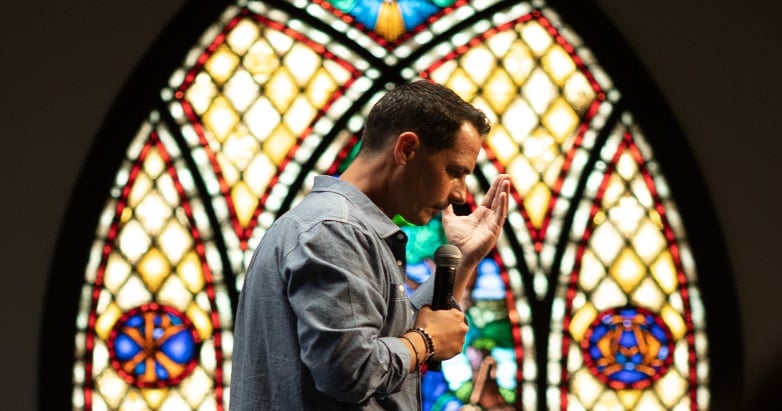
Photo by Mark Neal on Unsplash
Some Tricks of the Trade:
- “Turn to your neighbor and say…” This is generally a sermon warm-up. Typically, the preacher follows up with a command to say something ridiculous to the person next to you. This is a rhetorical device designed to garner a laugh. Generally, it has nothing to do with the sermon, so it seems a little out of place. It’s designed to get people in a good mood. But there is a nefarious side to this silly preaching device. If the speaker can get his listeners to follow such ridiculous instructions, then he can get them to follow his teaching instructions as well. It’s a way of training the listeners to be obedient.
- “Somebody, say, ‘Amen!’” Or, “Can I get an ‘Amen?’” This technique serves a double function. First, by asking the audience to affirm what she has just said, the preacher converts her audience from noncommittal hearers to committed listeners. Second, the preacher may be generally insecure or nervous about how people will receive her message. This rhetorical device is a request for affirmation that helps the speaker’s insecurity.
- “And all God’s people said…” This one is tied closely to the above technique of asking for approval or agreement. The difference is that preachers use “And all God’s people said” when they’re praying, not usually when they’re preaching. The response that you’re supposed to know (if you’re part of the in-crowd) is, “Amen!” So, this technique serves two purposes. First, it asks for agreement or approval. Second, it distinguishes insiders from outsiders. If you’re an outsider and you want to be an insider, you’d better learn the responses.
- “God is good (all the time), and all the time (God is good)!” This innocuous phrase drives me nuts because its logic is so ridiculously obvious. “A=B,” says the pastor, and the people repeat, “B=A!” as if they’d said something profound. Another one I’ve heard that follows the same logic is, “What kind of man is a godly man?” Then the congregation replies, “A godly man is a man of God!” Yep, A=B; B=A. This phrase falls into the category of, “I just got you to do what I told you to do!” Plus, it distinguishes insiders from outsiders, just like the previous trick of the trade.
- “God gave me a word,” or, “God laid it on my heart…” This is code for, “Everything I’m about to say is indisputable because it is straight from God. Here, the Evangelical preacher speaks ex-cathedra. Who can question what the minister says if God told him to say it?
- “Dear Father (or Lord) Weejus…” In prayer, many people add the word just after the word we, making it sound like When praying, many pastors and others use the phrase, “Dear Lord Weejus,” or “Dear Father Weejus.” On the surface, this sounds like humility. “Dear Lord, we just thank you” means that “all we are doing is thanking you.” Or, “Dear Lord we just ask…” means we are simply asking. The problem is that this phrase that sounds humble is really self-denigration. It turns the praying person into a lowly petitioner. It turns a request into a groveling entreaty. We don’t need to grovel before God. Dear Lord Weejus tells people that they have no real right to ask for what they are requesting in prayer. It’s designed to keep the people weak and subjected.
- “Holy Spirit, fill us again…” The idea of filling up your God tank suggests that you could ever run out of God, like a car running on empty. The notion that we need more of God in our lives (another similar phrase) implies that there is a lack of God in the universe. Since God is omnipresent at all times, we neither need nor is it possible to get, more of God. In fact, we can never have less of God. The notion of filling up your God tank is a preaching device designed to keep people coming back to church as if it is their local Exxon station.
- “How many know that…” Similar to “Can I get an ‘Amen,’” the preacher uses this phrase to ask for affirmation. But in this case, he asks people to raise their hands if they know that what he is saying is true. “How many know that you can’t get to heaven on roller skates? You’ll roll right past those pearly gates!” It’s like in a church business meeting where you want to clarify the vote by a show of hands instead of people saying “Aye.” The show of hands just goes one step beyond, “Can I get a (verbal) ‘Amen?’” The fact that the preacher is asking how many people know this or that underscores the idea that Christianity and salvation are all about having the right knowledge and believing the right doctrine.
- “This isn’t my opinion; it’s the Bible…” This is similar to “God gave me a word” and “The Lord laid it on my heart.” But, instead of direct divine inspiration, the preacher relies on the notion that the secondhand information you get from the Bible is word-for-word from God. And they insist that when they preach, it’s 100% Bible and 0% interpretation. Since you only hear inerrantists using this expression, this is equivalent to the preacher claiming infallibility. If a pastor has his congregation convinced that the Bible is infallible, he likely also has them convinced that it is possible to preach straight from the Bible without any human interpretation. Of course, as any thinking person knows, it is impossible to read something or teach something without interpreting it.
- “Stop resisting the Spirit!” I’ve heard Charismatic pastors say this when they’re praying over you and you aren’t falling over beneath the miraculous power of their hand on your forehead. Or when you question the doctrine you’re hearing from their mouths. Basically, this means, “Stop resisting me, because you know I’m a vessel of the Holy Spirit!”
- “Every head bowed, and every eye closed…” This is a complicated one, so hold on! For those unfamiliar with this phrase, typically the pastor says this in preparation for an invitation or altar call. It’s similar to “Turn to your neighbor and say…” If the pastor can get her audience to close their eyes and bow their heads when they are told to, then she has succeeded in making them obedient. Particularly if she says something like, “Don’t you dare look around.”
Once every head is bowed and every eye is closed, the preacher usually follows up by saying something like, “Now raise your hand if you want to receive Jesus as your savior. Lift up a hand if you need to confess sin in your life. Every head is bowed, and every eye is closed. Nobody’s looking.”
Of course, that means nobody is looking except the preacher. You know the preacher is looking when she says, “Yes, there’s a hand. And there’s another. God sees you. Bless you.” If your head is bowed and your eyes are closed, you presume that the pastor is saying these things each time a hand slips up into the air. Maybe that’s true, and perhaps it’s not. But as the pastor continues to say things like, “There are hands going up all over the room this morning,” you trust that this is a mighty move of the Holy Spirit—whether there are actually any hands raised or not. Because with every eye closed, who could tell?
Since you perceive that other people are raising their hands, you lift yours as well. “Now look up here,” the preacher says. Everyone raises their heads and looks at the minister. She continues, “Jesus never called anybody privately. He always called them publicly. So now if you raised your hands, I’m going to invite you to come to the front so I can pray for you.”
Now you look like a deer caught in the headlights, or rather, caught by the pastor’s bait and switch. You raised your hand because you thought it was a private moment between you, God, and maybe the pastor. And now, your minister is telling you to step out in front of everyone. You never signed up for that, but you can’t exactly stay in your seat since the preacher saw you raise your hand. Don’t be mistaken, this is all about control. And it’s one of the best ways to drive a crowd of people right to the altar.
Not Bad Pastors—Just Bad Catch Phrases
I’m certainly not trying to point a finger and say that your pastor is trying to manipulate you. No doubt, they have the purest of intentions and would think of these techniques as persuasion rather than manipulation. Some of these phrases are so ingrained that most pastors who grow up in Evangelical preaching culture never think about them one way or another. They just find themselves repeating things they heard from their own preaching mentors. I’m sure I used some of these tricks of the trade when I was a pastor, and I never meant anything malevolent.
When You Know Better, You Do Better
If you attend an Evangelical church, I’m certain you have heard these oratory devices before. I invite you to see these for what they are, and not be manipulated by them. Try not to get trapped by the group-think of these catchphrases.
If you are a well-meaning, good-hearted pastor who has never thought about these things before, I challenge you to examine why you say what you say. Some of these sayings roll right off the tongue—but as James said, the tongue can do great damage. Let’s be a bit more intentional and careful about the things we say from the pulpit. Let’s make sure our preaching is always designed to convince, and never to control.
Evangelical
Style and Religion
And all God's people said Amen
Previous Post

December 2, 2022
Was Jesus Homeless? Yes, No, and Kind Of
Next Post
December 9, 2022 Deconstructing Santa; Deconstructing Religion
Browse Our Archives
Select a Category Challenging the Church Deconstruction For Pastors Heathen Christianity Holidays and special days Mental Health Social Justice Spirituality Taoism Theology Uncategorized
Select a Month October 2026 September 2026 August 2026 July 2026 June 2026 May 2026 April 2026 March 2026 February 2026 January 2026 December 2025 November 2025 October 2025 September 2025 August 2025 July 2025 June 2025 May 2025 April 2025 March 2025 February 2025 January 2025 December 2024 November 2024 October 2024 September 2024 August 2024 July 2024 June 2024 May 2024 April 2024 March 2024 February 2024 January 2024 December 2023 November 2023 October 2023 September 2023 August 2023 July 2023 June 2023 May 2023 April 2023 March 2023 February 2023 January 2023 December 2022 November 2022 October 2022 September 2022 August 2022 July 2022 June 2022 May 2022 April 2022 March 2022 February 2022 January 2022
Follow Us!
TAKE THE
Religious Wisdom Quiz
What is the Christian response to being wronged?
Select your answer to see how you score.
Forgive Hold a grudge Revenge Gossip
Related posts from Breathing Space

“Can You Follow Jesus and Still Practice Smudging?”

Lead a Church Study of “Jesus and Lao...

I Met Papa Before I Read The Shack

The Guest Who Stayed at an Unfriendly Table
TRENDING AT PATHEOS Progressive Christian

What Being a Modern-Day Apostle Means to Me
In my last column, I discussed the ins and outs of modern-day...

Did Ancient China Once Worship the God of...
Across human history, a common thread weaves through the origins of the...

Love Your Neighbor – Including Earth-Kin: Lev. 19,...
God’s command to love your neighbor means acting in an ethical and...

Lead a Church Study of “Jesus and Lao...
Guest writer Jack Thomas (The Irreverent Reverend) reflects on leading his church...

Pastoral Wisdom for Responding to Sermon Pushback
Getting sermon pushback on your social justice sermon? Learn practical, Proverbs-based strategies...

Principles for Understanding the Apostolic Ministry Today
Whenever people discover that my formal ministry title is "apostle," as in...
view all Progressive Christian blogs
Ad-Free & Subscriber Log-In Subscription Support
- About Us
- 2026 Calendar
- Videos
- Podcasts
- Library of World Religions
- Faith In Media Tracker
- Advertise With Us
- Write for Us
- Privacy Policy
- Terms of Service
- Do Not Sell My Data
- Contact Us
- Radiant Digital
- Manage Newsletter Subscriptions
- Unsubscribe From Notifications
- Sitemap
Copyright 2008-2026, Patheos. All rights reserved.
Subscription Support Ad-Free & Subscriber Log-In
Follow Patheos