
BuddhistCatholicContemplativeEvangelicalGeneral ChristianHinduJewishLatter-day SaintMuslimNew VisionsProgressive Christian
Beliefs
- Buddhist
- Catholic
- Contemplative
- Evangelical
- General Christian
- Hindu
- Jewish
- Latter-day Saint
- More Voices
- Muslim
- New Visions
- Pagan
- Progressive Christian
Topics
- Religion News
- Food and Religion
- Sports and Religion
- Religious Art
- Religious Music and Entertainment
- Religious Events
- History and Religion
- Style and Religion
- Politics and Religion
- Women in Religion
- Recreation Outdoors and Religion
- Business Finance and Religion
- Careers Workplace and Religion
- Education and Religion
- Family Parenting and Religion
- Health Fitness and Religion
- Home and Religion
- Relationships and Religion
- Technology and Religion
- Travel and Religion
Columnists
- Buddhist Columnists
- Business Finance and Religion Columnists
- Careers Workplace and Religion Columnists
- Catholic Columnists
- Contemplative Columnists
- Education and Religion Columnists
- Evangelists Columnists
- Family Parenting and Religion Columnists
- General Christian Columnists
- Health Fitness and Religion Columnists
- Hindu Columnists
- History and Religion Columnists
- Home and Religion Columnists
- Jewish Columnists
- More Voices Columnists
- Latter Day Columnists
- Muslim Columnists
- New Visions Columnists
- Nonreligious Columnists
- Pagan Columnists
- Politics and Religion Columnists
- Progressive Columnists
- Recreation Outdoors and Religion Columnists
- Relationships and Religion Columnists
- Religion News Columnists
- Religious Art Columnists
- Religious Events Columnists
- Religious Music and Entertainment Columnists
- Sports and Religion Columnists
- Style and Religion Columnists
- Technology and Religion Columnists
- Travel and Religion Columnists
- Women in Religion Columnists
Resource Library
- 2026 Calendar
- Library of World Religions
- The 100 Most Holy Places on Earth
- Patheos Answers
- Podcasts
- Videos
- Faith Leaders Database
- Anglican Episcopalian
- Bahai
- Baptist
- Buddhism
- Christianity
- Confucianism
- Eastern Orthodoxy
- Hinduism
- Holiness and Pentecostal
- ISKCON
- Islam
- Judaism
- Lutheran
- Methodist
- The Church of Jesus Christ of Latter-day Saints
- New Age
- Paganism
- Presbytarian and Reformed
- Protestantism
- Religion Behind the Scenes
- Roman Catholic
- Scientology
- Shia Islam
- Sikhism
- Sufism
- Sunni Islam
- Taoism
- Zen
- See all religions
Research Tools
 Ad-Free & Subscriber Log-In Subscription Support
Follow Patheos 

- Trending:
- Advent
- |
- Forgiveness
- |
- Thanksgiving
- |
- Election
- |
- Seasonal Holidays
- |
- Marriage

-
Categories
- Home
- Progressive Christian
- Politics and Religion
- What Jesus Said to the Homeless Man
What Jesus Said to the Homeless Man
Last updated on: January 15, 2023 at 3:24 pm by Gregory T. Smith
What Jesus Said to the Homeless Man 2023-01-15T15:24:23-08:00 Gregory T. Smith
Patheos Explore the world's faith through different perspectives on religion and spirituality! Patheos has the views of the prevalent religions and spiritualities of the world.
What do you say to people experiencing homelessness when they speak to you on the street? You might say, “Sorry, I don’t carry cash.” Or “Get away from my door!” Jesus brought his disciples to a region called the Gerasenes. There, they encountered someone without a home, and abandoned by society. What Jesus said to the homeless man changed his life. In this article, I’ll talk about how we can respond more like Jesus.
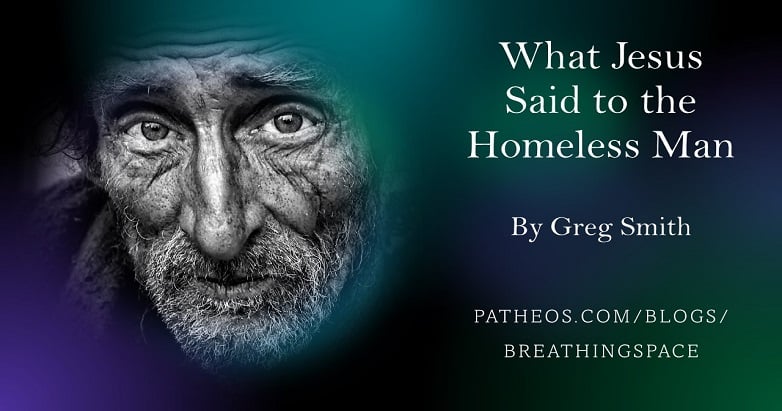
Image by Leroy Skalstad from Pixabay
I am a behavioral health specialist who works with unsheltered individuals every day. I am also a former pastor and Bible teacher. This gives me a unique insight into what Jesus said to the homeless man that he met at a place called Gadara. You can find this story in Matthew 8:28-34 and Mark 5:1-20. I will be looking at Luke 8:26-39. But first, I want to make some observations about this man, that apply to most people experiencing homelessness.
“A Man from the City (v.27)”
When I pastored rural churches, we tended to think of homelessness as a problem for people in the city. It’s in the city that homelessness is most visible. Many in my churches didn’t want to address the epidemic because it was invisible to them in their bucolic existence. They saw it as someone else’s problem. Or, if they did address it, homelessness was the effort of a special missions trip. You went to the city, you helped the people, then you came home. But many homeless people feel endangered in the inner-city shelters and take to the woods with tent and sleeping bag. Homelessness is not a city problem—it’s an everywhere problem.
“…Who Had Demons (v.27)…”
In my experience, one hundred percent of people experiencing homelessness battle demons every day. For most, these demons are metaphorical. (Click here to read about the causes of homelessness.) The ravages of addiction, mental illness, and poverty ought to have demon-names attached to them. Racism, homophobia, transphobia, and other discrimination are malevolent forces, not just concepts. Lack of affordable medical care, affordable housing, and affordable mental health services—these things aren’t just problems; they are evil incarnate. When I say “demons,” I’m including things like illiteracy, traumatic experiences, domestic violence, and systemic injustice. These are the demons that all homeless people battle. They are possessed (dominated, controlled) by these oppressive structures.
This doesn’t mean that there are no literal demons. Click here to read my article in which I discuss my own angelic and demonic encounter. We read in Ephesians 6.12 (NRSVUE), “…Our struggle is not against blood and flesh but against the rulers, against the authorities, against the cosmic powers of this present darkness, against the spiritual forces of evil in the heavenly places.” The author of Ephesians had in mind not just human power structures, but spiritual forces. We’re fooling ourselves if we believe that the evil power structures in my last paragraph weren’t manipulated by wicked regimes in unseen dimensions. Regarding this type of demon, Jesus said, “… this kind does not go out except by prayer and fasting. (Matthew 17.21 NKJV).” But systemic injustice is something that every human can address on a tangible level.
Many progressive interpreters see biblical stories of exorcism as Jesus curing mental illness. This is because they don’t believe in actual, literal, spiritual demons. Because I do believe in both fallen angels and the reality of mental illness, I don’t think they’re the same thing. Certainly, many mental health symptoms appear to the untrained eye as demon possession. In another article, perhaps I’ll deal with how to tell the difference between the two. Sometimes, when Jesus healed people, they received miraculous healings of mental illness. Other times, they were set free from the presence of actual rebellious spirits. Distinguishing the difference is very important.
“For a Long Time, He Had Not Worn Any Clothes (v. 27)”
Most of us don’t worry too much about basic necessities like food and clothing. But in the United States, one in ten households experience food scarcity. Adequate clothing is a struggle for many, especially in winter. You can help in a tangible way by participating in the winter coat and clothes collections in your area. Some of our clients have lost limbs due to frostbite, and some have frozen to death—you can make the difference between ability and disability, life and death.
“He Did Not Live in a House but in the Tombs (v. 27)”
One of the biggest reasons for homelessness is the combination of low wages and lack of affordable housing. Rents keep going up, and wages are not keeping pace. Those who oppose the increase of minimum wage actually contribute to homelessness. They might say, “If folks can’t afford a place on their own, they should just get a roommate or even several.”
This makes sense for people who don’t go through mental health issues or domestic violence. But for people who experience these things as their daily reality, forcing them into congregate living can be a literal death sentence. Some people just can’t live with others. Forcing them to do so creates and perpetuates destructive cycles. Wages for those who work, and benefits for those who can’t work, need to keep up with housing prices. The alternative for many is the tomb.
“Bound with Chains and Shackles (v. 29)”
Verse 29 NRSVUE says, “He was kept under guard and bound with chains and shackles, but he would break the bonds.” This tells me two things:
- The citizens of the area did what they could to protect themselves without making an effort to help the man himself. They treated him as a problem to be solved, rather than a person to be loved. We do this when we criminalize behaviors associated with homelessness. If you have a home, there are all sorts of things you can do in the privacy of your home that are illegal in public. We have clients who are arrested or fined for sleeping, urinating, masturbating, drinking, and having sex in parks and other public places. These things are normal for human beings—but if you’re homeless, they are illegal. So, we bind homeless individuals with chains designed to make us feel more comfortable—to make us feel secure, not to keep them safe.
- The homeless individual showed amazing resilience despite being a victim of an unjust system. Regardless of repression, this man couldn’t be kept down. With supernatural strength, he broke free of the chains that people put on him. They called him mad, demon-possessed, unclean. But he broke out of oppressive systems and lived on his own terms—even if that meant sleeping in crypts. You would be amazed at how resilient people who are homeless can be. Resilience is a superpower that most of them possess. They are survivors, not criminals. Most of them are just doing what it takes to get by.
“When He Saw Jesus, He Cried Out and Fell Down Before Him (v. 28)…”
Despite the demons in his head, this man ran to Jesus. He was drawn to a divine source of healing. Verse 27 says the man “met” Jesus. The Greek word suggests he intentionally went out to encounter Jesus. We stigmatize homeless individuals when we assume they are living a life that avoids responsibility. Some may be that way, of course. But most are seeking the solution they need, to heal the hurts and trauma they’ve endured. Some are going to the wrong places to find it, self-medicating with alcohol, street drugs, or prescribed opioids. But most, on some level and at some point, reach out for help. This is why we need to provide more outreach centers, harm-reduction clinics, addiction recovery centers, emergency shelters, food banks, community action programs, clothes closets, housing opportunities, employment centers, and more. Most people know they need help, and just like the man in the Gerasenes, they’re desperate to find it.
What Jesus Didn’t Say
I know I’ve been teasing you so far, making observations before telling you what Jesus said to the homeless man. Let me tease you a little more, by first telling you what Jesus didn’t say:
- He didn’t say, “Not in my backyard.”
- He didn’t say, “Go somewhere else for help.”
- He didn’t say, “Get a job.”
- He didn’t say, “Please don’t spend it on booze.”
- Click here to read Five Things to Never Say to a Person Who’s Homeless, by Kayla Robbins.
When we say these things, we increase the stigma of homelessness. We express our own entitlement. We belittle the person who is just reaching out for help. Instead, we need to learn what Jesus would say—and say that.
What Jesus Said to the Homeless Man
You can learn from what Jesus said to the homeless man, and you can say it, too. It’s easy—it’s just four words. In Luke 8.30 and Mark 5.9, Jesus asks a question. If you’re using a red-letter Bible, it really stands out, among all the black. Jesus says, “What is your name?” It’s that simple.
Did you know that many individuals experiencing homelessness can go weeks without someone calling them by name? Usually, people call them, “Hey, you!” or “tweaker” or “dope-fiend,” or “bum,” or “bag lady.” Sometimes homeless people go by street names of their own choosing because it’s one way they can protect themselves. When you ask an unsheltered person their name, they may choose not to answer, or to give you their street name. Sometimes a person’s chosen name is more important than their given name (feel free to read gender issues into this if you like). Whatever they choose to call themselves, when you ask their name, you should treat them like human beings and call them what they want to be called.
Too often, we treat people who are homeless like they are less than human. We ignore them. We avoid eye contact. We see their need and pass by without saying a word. Asking someone their name, and then calling them by the name of their choosing, should be the first, and the least, thing you can do. It makes them feel like somebody cares. And it changes your perception of them. It humanizes them. It’s easy to tell the “wino” to get a job. But when you get to know Carlos or Jasmine, Bodhi or Little Bear, their lives take on meaning. You can’t walk past them anymore. When you know their name, you have to engage.
Knowing a person’s name makes you treat them as a person. Using person-first language also does that. They aren’t “the homeless.” They are “homeless people,” or “unsheltered people.” Better yet, they are “people experiencing homelessness,” or “individuals experiencing homelessness.” (Note that their personhood comes first in these monikers, and the adjectives come second.) This way homelessness doesn’t define them. They are defined by their personhood and their individuality.
“We are Legion, For We Are Many”
In Mark 5.9 (NRSVUE) when Jesus asks his name, the man replies, “My name is Legion, for we are many.” You might say this was the man’s street name. Luke 8.30 (NRSVUE) says, “He said, ‘Legion,’ for many demons had entered him.” Some Bible commentators talk about the number of demons being the same as a Roman legion. Others point out the political ramifications in occupied Israel, possessed by legions of Roman occupiers. All these may be true, but I want to add another dimension.
“My name is Legion, for we are many” highlights the throngs of unsheltered people in your own backyard. Jesus said, “You will always have the poor with you (Matthew 26.11 NRSVUE).” Annual surveys of how many homeless people live in your area are called PITs, or Point-in-Time Counts. You can Google “point in time count” and then the name of your city, county, district, or region. This will show you that homelessness is truly an epidemic. Keep in mind that homelessness itself is the epidemic—not that your community is suffering from an epidemic of homeless people.
What Jesus said to the homeless man initiated his healing. You can do the same thing. You can ask the name of the person who lives, literally, on your doorstep. You can strike up a conversation, and then a relationship. You might not be a behavioral health specialist or the director of a shelter. But you can call somebody by name and see where it goes from there. A legion of people from countless encampments cries to you— “Know me by name!” Will you find out who they are?
For another article like this one, check out “Jesus and Trauma-Informed Care.”
General Christian
Politics and Religion
Home and Religion

About Greg Smith
I live in the beautiful Fraser Valley of British Columbia and work in northern Washington State as a behavioral health specialist with formerly homeless people and those currently experiencing homelessness. Before that, I spent over a quarter-century as lead pastor of several Virginia churches. My newspaper column, “Spirit and Truth” ran in Virginia newspapers for a dozen years. My wife Christina and I have seven children between us, and we are still collecting grandchildren. You can read more about the author here.
Previous Post

September 29, 2022
Tongues: A Prayer Language?
Next Post

October 4, 2022 Pastors are Quiet Quitting the Church
Browse Our Archives
Select a Category Challenging the Church Deconstruction For Pastors Heathen Christianity Holidays and special days Mental Health Social Justice Spirituality Taoism Theology Uncategorized
Select a Month November 2026 October 2026 September 2026 August 2026 July 2026 June 2026 May 2026 April 2026 March 2026 February 2026 January 2026 December 2025 November 2025 October 2025 September 2025 August 2025 July 2025 June 2025 May 2025 April 2025 March 2025 February 2025 January 2025 December 2024 November 2024 October 2024 September 2024 August 2024 July 2024 June 2024 May 2024 April 2024 March 2024 February 2024 January 2024 December 2023 November 2023 October 2023 September 2023 August 2023 July 2023 June 2023 May 2023 April 2023 March 2023 February 2023 January 2023 December 2022 November 2022 October 2022 September 2022 August 2022 July 2022 June 2022 May 2022 April 2022 March 2022 February 2022 January 2022
Follow Us!
TAKE THE
Religious Wisdom Quiz
How long were the Jews in Babylonian captivity?
Select your answer to see how you score.
60 years 80 years 70 years 50 years
Related posts from Breathing Space

Christ the King? Maybe We've Misunderstood the Crown

Paul Young’s Return to the Shack: God’s Love...

Christians Against the World???

Brandy Anderson, Team Weird, and Transcending Church
TRENDING AT PATHEOS Progressive Christian

Can a Chatbot Touch Your Soul?
Can a chatbot offer genuine spiritual counsel? One conversation brought me to...

Religion and Politics: How Should We Then Live?
Two cultural axioms get repeated in polite company. Don't mix religion and...

7 Things We Get Wrong About Giving Thanks
It's a time of year when many of us turn to the...

Uncaging Truth: Spirituality Beyond Institutions
The Lost Connection: Why True Spirituality, Not Religion, Is the Key to...

Christ the King? Maybe We've Misunderstood the Crown
What do we mean when we say that Jesus is King? What...

Counter “Christ Is King” Nationalism with Christ THE...
Christ the King Sunday is an ideal time to address the heresy...
view all Progressive Christian blogs
Ad-Free & Subscriber Log-In Subscription Support
- About Us
- 2026 Calendar
- Videos
- Podcasts
- Library of World Religions
- Faith In Media Tracker
- Advertise With Us
- Write for Us
- Privacy Policy
- Terms of Service
- Do Not Sell My Data
- Contact Us
- Radiant Digital
- Manage Newsletter Subscriptions
- Unsubscribe From Notifications
- Sitemap
Copyright 2008-2026, Patheos, part of the Radiant Digital network of media brands. All rights reserved.
Subscription Support Ad-Free & Subscriber Log-In
Follow Patheos