
BuddhistCatholicContemplativeEvangelicalGeneral ChristianHinduJewishLatter-day SaintMuslimNew VisionsProgressive Christian
Beliefs
- Buddhist
- Catholic
- Contemplative
- Evangelical
- General Christian
- Hindu
- Jewish
- Latter-day Saint
- More Voices
- Muslim
- New Visions
- Pagan
- Progressive Christian
Topics
- Religion News
- Food and Religion
- Sports and Religion
- Religious Art
- Religious Music and Entertainment
- Religious Events
- History and Religion
- Style and Religion
- Politics and Religion
- Women in Religion
- Recreation Outdoors and Religion
- Business Finance and Religion
- Careers Workplace and Religion
- Education and Religion
- Family Parenting and Religion
- Health Fitness and Religion
- Home and Religion
- Relationships and Religion
- Technology and Religion
- Travel and Religion
Columnists
- Buddhist Columnists
- Business Finance and Religion Columnists
- Careers Workplace and Religion Columnists
- Catholic Columnists
- Contemplative Columnists
- Education and Religion Columnists
- Evangelists Columnists
- Family Parenting and Religion Columnists
- General Christian Columnists
- Health Fitness and Religion Columnists
- Hindu Columnists
- History and Religion Columnists
- Home and Religion Columnists
- Jewish Columnists
- More Voices Columnists
- Latter Day Columnists
- Muslim Columnists
- New Visions Columnists
- Nonreligious Columnists
- Pagan Columnists
- Politics and Religion Columnists
- Progressive Columnists
- Recreation Outdoors and Religion Columnists
- Relationships and Religion Columnists
- Religion News Columnists
- Religious Art Columnists
- Religious Events Columnists
- Religious Music and Entertainment Columnists
- Sports and Religion Columnists
- Style and Religion Columnists
- Technology and Religion Columnists
- Travel and Religion Columnists
- Women in Religion Columnists
Resource Library
- 2026 Calendar
- Library of World Religions
- The 100 Most Holy Places on Earth
- Patheos Answers
- Podcasts
- Videos
- Faith Leaders Database
- Anglican Episcopalian
- Bahai
- Baptist
- Buddhism
- Christianity
- Confucianism
- Eastern Orthodoxy
- Hinduism
- Holiness and Pentecostal
- ISKCON
- Islam
- Judaism
- Lutheran
- Methodist
- The Church of Jesus Christ of Latter-day Saints
- New Age
- Paganism
- Presbytarian and Reformed
- Protestantism
- Religion Behind the Scenes
- Roman Catholic
- Scientology
- Shia Islam
- Sikhism
- Sufism
- Sunni Islam
- Taoism
- Zen
- See all religions
Research Tools
 Ad-Free & Subscriber Log-In Subscription Support
Ad-Free & Subscriber Log-In Subscription Support
Follow Patheos 

- Trending:
- Forgiveness
- |
- Marriage
- |
- Consciousness
- |
- Death Penalty
- |
- Election
- |
- Halloween

-
Categories
- Home
- Progressive Christian
- Family, Parenting and Religion
- Is the Gift of Tongues a Second Blessing?
Is the Gift of Tongues a Second Blessing?
Last updated on: September 19, 2022 at 3:43 pm by Gregory T. Smith
Is the Gift of Tongues a Second Blessing? 2022-09-18T19:04:26-08:00 Gregory T. Smith
Patheos Explore the world's faith through different perspectives on religion and spirituality! Patheos has the views of the prevalent religions and spiritualities of the world.
“Receive the Holy Spirit,” whispered my Pentecostal friend. One hand was on my chest and the other on my forehead as he prayed that I might receive the Holy Spirit as evidenced by the gift of tongues. Others in the group babbled their incoherent prayers around me, having already received the gift. These Pentecostals believed in what they called the Second Blessing. They believe that salvation is the first blessing to come to people who receive Jesus as their Savior. After that, the Holy Spirit arrives as a second blessing for faithful believers, along with the initial evidence of speaking in tongues. This was quite different from my Baptist upbringing. When I was exposed to this teaching, I had to learn more.
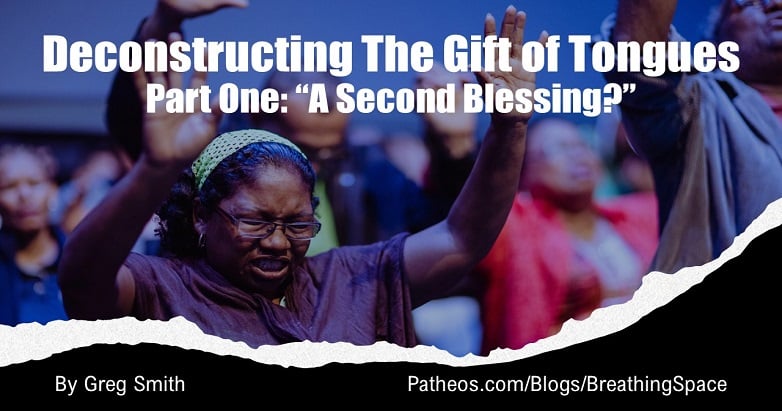
Photo by Louis Quintero on Pexels.com
Proof Texts for a Second Blessing
Here are the biggest proof texts for the Pentecostal doctrine that the initial evidence of the baptism of the Holy Spirit is speaking in tongues:
- Mark 16.14-18 – Mark’s version of the Great Commission includes snake handling, supernatural healing, and speaking in tongues.
- John 20.22 – Jesus breathes on his disciples (who were already believers) and says, “Receive the Holy Spirit.”
- Acts 2 – The disciples, already believers, are at a later time filled with the Holy Spirit and speak in tongues.
- Acts 8.14-17 – When the disciples hear that Samaritans have accepted the word of God, they send Peter and John to investigate. These two lay their hands on the believers, who receive the Holy Spirit. (No mention of glossolalia in this passage.)
- Acts 10.45-46 – Cornelius and his household accept the gospel and speak in tongues.
- Acts 19.1-7 – The believers in Corinth say they have never heard of the Holy Spirit, only the baptism of John. Paul baptizes them in the name of Jesus and prays for them. After that, they speak in tongues and prophesy.
- 1 Corinthians 13 – Paul says, “If I speak in the tongues of humans and of angels but do not have love, I am a noisy gong or a clanging cymbal.” For this reason, many Pentecostals and charismatics believe that tongue-speaking is a heavenly language.
- 1 Corinthians 14 – Paul gives instructions for the proper use of tongues in the church.
This second blessing was news to me. As a Baptist teenager, I had been raised to believe that every Christian automatically got the Holy Spirit inside them when they became a Christian. Like when Jesus was baptized, and the Holy Spirit descended like a dove. It was a package deal that comes along with being a Christian.
It wasn’t until much later that I came to understand that every person has all of God in them already. Click here to read my article, “Do Christians have a Monopoly on the Holy Spirit?” The Holy Spirit isn’t a Second Blessing only for Christians—but inherent in the personhood of all God’s children. And tongues are not the initial evidence of the baptism of the Holy Spirit. They can be one of many evidences that a person is operating in the gifts of the Spirit–but they are not a necessary sign that a person has reached some higher level of spirituality.
Discovering Tongues
My first experience was a childhood visit to the Calvary Pentecostal Tabernacle campground outside of Ashland, Virginia. The worship seemed so wild to me, compared to my Baptist upbringing. People were dancing and shouting, raising their hands and speaking in words I couldn’t understand. One little old lady ran up to me, grabbed my hands, and raised them, declaring, “You can speak in tongues—you can do it! Just go, ‘Na na na na na!” Frankly, it freaked me out.
Less intimidating were the encounters I had with tongues-speakers in informal settings. Some of my friends were charismatics (Christians who practice in the Pentecostal style, without being members of a Pentecostal church). We also had some charismatics in our home Bible study, and I frequently heard them lapse into unrecognizable speech when they prayed. I admired their deep spirituality and asked them about this gift. They often talked about it as a heavenly language. They also told stories of believers who were given the miraculous ability to speak earthly languages they had never studied or learned. I didn’t understand it—but I kind of wanted it.
Baby Talk
So, late one night after work, I met my friends at Taco Bell. We stayed way past closing time, talking about spiritual things. I told them that I wanted to receive the gift of tongues, as they had. One of my friends explained what the old lady had meant. “Well, for me, it started out as baby talk. Nobody wants to sound like a baby, so when I started babbling, I resisted it. The miracle wasn’t that I spoke in tongues—the miracle was that I allowed myself to start out with baby talk. You’ve just got to let it come.”
Right there in the parking lot, with employees closing the restaurant around us, they gathered around me in a circle. Laying hands on me, they prayed that the Lord would fill me. “Receive the Holy Spirit,” whispered my Pentecostal friend. “Let go.”
And I did. As he said, it started out with just a syllable or two of gibberish, that I wanted to stifle. But as it welled up in me, I decided to open up the dam and let it flow. Soon, my holy chatter joined the cacophony of voices around me, each one lifting our prayers in unknown tongues. Tears flooded my eyes, and my heart swelled with feeling. I had no idea what my prayers meant, but that didn’t matter. I wasn’t giving God my intelligent thought—I was giving God all my feelings.
What is the Gift of Tongues?
Since that time, my practice of tongues-speaking has waxed and waned. At first, I was entranced with the experience, which became a major part of my prayer life. Most people don’t know this, but in the three-year interval between my first Baptist pastorate and my second, I actually got ordained with the Pentecostal Holiness Church. For several reasons, that didn’t last long. As I re-entered Baptist life, it wasn’t exactly the kind of atmosphere that promoted that particular gift. So, I allowed the practice to fade into the background. Upon rare occasions, and in private moments, it resurfaces. But I think I have a more advanced view of glossolalia than I did back then.
As I reflect on my experiences witnessing others speaking in tongues, and then my own practice of that gift, it leads me to the question, it makes me want to deconstruct this gift. Paul describes tongues-speaking as a “lesser gift.” What does this mean? How should this gift be used in the church? What is the gift of tongues, anyway? Is it a heavenly language? Is it the miraculous ability to speak an unknown earthly language? Or is it babble? If it is gibberish—does that make it invalid? Or is there some way in which nonsense syllables can be holy? Join me for the rest of this series as we tackle these questions.
General Christian
Evangelical
Contemplative
Family, Parenting and Religion
Previous Post

September 15, 2022
Do Christians Have a Monopoly on the Holy Spirit?
Next Post
September 22, 2022 Is Speaking in Tongues a Lesser Gift?
Browse Our Archives
Select a Category Challenging the Church Deconstruction For Pastors Heathen Christianity Holidays and special days Mental Health Social Justice Spirituality Taoism Theology Uncategorized
Select a Month October 2026 September 2026 August 2026 July 2026 June 2026 May 2026 April 2026 March 2026 February 2026 January 2026 December 2025 November 2025 October 2025 September 2025 August 2025 July 2025 June 2025 May 2025 April 2025 March 2025 February 2025 January 2025 December 2024 November 2024 October 2024 September 2024 August 2024 July 2024 June 2024 May 2024 April 2024 March 2024 February 2024 January 2024 December 2023 November 2023 October 2023 September 2023 August 2023 July 2023 June 2023 May 2023 April 2023 March 2023 February 2023 January 2023 December 2022 November 2022 October 2022 September 2022 August 2022 July 2022 June 2022 May 2022 April 2022 March 2022 February 2022 January 2022
Follow Us!
TAKE THE
Religious Wisdom Quiz
What city is known as the birthplace of Jesus?
Select your answer to see how you score.
Nazareth Galilee Jerusalem Bethlehem
Related posts from Breathing Space

“Can You Follow Jesus and Still Practice Smudging?”

Jesus and Lao Tzu: Seven Striking Parallels

Mo Thomas: Book Review from a Black Hole

“You Got Your Lao Tzu on My Jesus!”
TRENDING AT PATHEOS Progressive Christian

What Being a Modern-Day Apostle Means to Me
In my last column, I discussed the ins and outs of modern-day...

Did Ancient China Once Worship the God of...
Across human history, a common thread weaves through the origins of the...

Love Your Neighbor – Including Earth-Kin: Lev. 19,...
God’s command to love your neighbor means acting in an ethical and...

Lead a Church Study of “Jesus and Lao...
Guest writer Jack Thomas (The Irreverent Reverend) reflects on leading his church...

Pastoral Wisdom for Responding to Sermon Pushback
Getting sermon pushback on your social justice sermon? Learn practical, Proverbs-based strategies...

Principles for Understanding the Apostolic Ministry Today
Whenever people discover that my formal ministry title is "apostle," as in...
view all Progressive Christian blogs
Ad-Free & Subscriber Log-In Subscription Support
- About Us
- 2026 Calendar
- Videos
- Podcasts
- Library of World Religions
- Faith In Media Tracker
- Advertise With Us
- Write for Us
- Privacy Policy
- Terms of Service
- Do Not Sell My Data
- Contact Us
- Radiant Digital
- Manage Newsletter Subscriptions
- Unsubscribe From Notifications
- Sitemap
Copyright 2008-2026, Patheos. All rights reserved.
Subscription Support Ad-Free & Subscriber Log-In
Follow Patheos