
BuddhistCatholicContemplativeEvangelicalGeneral ChristianHinduJewishLatter-day SaintMuslimNew VisionsProgressive Christian
Beliefs
- Buddhist
- Catholic
- Contemplative
- Evangelical
- General Christian
- Hindu
- Jewish
- Latter-day Saint
- More Voices
- Muslim
- New Visions
- Pagan
- Progressive Christian
Topics
- Religion News
- Food and Religion
- Sports and Religion
- Religious Art
- Religious Music and Entertainment
- Religious Events
- History and Religion
- Style and Religion
- Politics and Religion
- Women in Religion
- Recreation Outdoors and Religion
- Business Finance and Religion
- Careers Workplace and Religion
- Education and Religion
- Family Parenting and Religion
- Health Fitness and Religion
- Home and Religion
- Relationships and Religion
- Technology and Religion
- Travel and Religion
Columnists
- Buddhist Columnists
- Business Finance and Religion Columnists
- Careers Workplace and Religion Columnists
- Catholic Columnists
- Contemplative Columnists
- Education and Religion Columnists
- Evangelists Columnists
- Family Parenting and Religion Columnists
- General Christian Columnists
- Health Fitness and Religion Columnists
- Hindu Columnists
- History and Religion Columnists
- Home and Religion Columnists
- Jewish Columnists
- More Voices Columnists
- Latter Day Columnists
- Muslim Columnists
- New Visions Columnists
- Nonreligious Columnists
- Pagan Columnists
- Politics and Religion Columnists
- Progressive Columnists
- Recreation Outdoors and Religion Columnists
- Relationships and Religion Columnists
- Religion News Columnists
- Religious Art Columnists
- Religious Events Columnists
- Religious Music and Entertainment Columnists
- Sports and Religion Columnists
- Style and Religion Columnists
- Technology and Religion Columnists
- Travel and Religion Columnists
- Women in Religion Columnists
Resource Library
- 2026 Calendar
- Library of World Religions
- The 100 Most Holy Places on Earth
- Patheos Answers
- Podcasts
- Videos
- Faith Leaders Database
- Anglican Episcopalian
- Bahai
- Baptist
- Buddhism
- Christianity
- Confucianism
- Eastern Orthodoxy
- Hinduism
- Holiness and Pentecostal
- ISKCON
- Islam
- Judaism
- Lutheran
- Methodist
- The Church of Jesus Christ of Latter-day Saints
- New Age
- Paganism
- Presbytarian and Reformed
- Protestantism
- Religion Behind the Scenes
- Roman Catholic
- Scientology
- Shia Islam
- Sikhism
- Sufism
- Sunni Islam
- Taoism
- Zen
- See all religions
Research Tools
 Ad-Free & Subscriber Log-In Subscription Support
Ad-Free & Subscriber Log-In Subscription Support
Follow Patheos 

- Trending:
- Forgiveness
- |
- Marriage
- |
- Consciousness
- |
- Death Penalty
- |
- Election
- |
- Halloween

-
Categories
- Home
- Progressive Christian
- Family, Parenting and Religion
- Righteousnesslessness (Not a typo)
Righteousnesslessness (Not a typo)
Last updated on: September 18, 2022 at 7:01 pm by Gregory T. Smith
Righteousnesslessness (Not a typo) 2022-09-18T19:01:21-08:00 Gregory T. Smith
Patheos Explore the world's faith through different perspectives on religion and spirituality! Patheos has the views of the prevalent religions and spiritualities of the world.
In my last articles, I must have come across as if I believe that Jesus wasn’t sinless. In my first article, “A Flawless Hero,” I was bold enough to suggest that a hero without imperfections is boring—and Jesus is no boring hero. Next, in “Holy Outlaw,” I said that Jesus certainly wasn’t sinless, if we define sin as a violation of biblical law. Then, in “One of Us,” I subverted the idea of original sin, and the need for virgin birth as a foil for that nonexistent curse. So, I’m sure by this point, I’ve convinced you that I reject the doctrine of Jesus’ sinlessness. But that couldn’t be further from the case. So, if Jesus wasn’t sinless by these definitions, how was Jesus sinless?
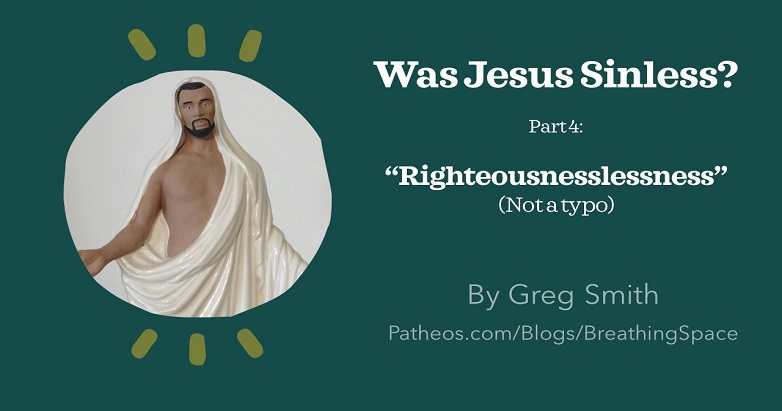
Photo by DodgertonSkillhouse on Morguefile.com
If you’ve been deconstructing traditional doctrine, then maybe you’ve been on the same page with me as I’ve discussed the ways that Jesus wasn’t sinless. However, if we’re to maintain that Jesus was in some way sinless, we must produce a third meaning of sinlessness that applies to the life of Christ. If we reject original sin, but we also reject the idea of Jesus’s perfect record of moral behavior, what is left?
The Biblical Ancestors
First, Jesus was sinless according to the pattern of the biblical ancestors. Romans 4.3 says that Abraham believed God, and God counted it as righteousness. It’s not that Abraham never sinned, but because of Abraham’s faith, God did not count his sin against him, because of his faith. In the same way, Noah is someone whose misdeeds and mistakes are recorded in the Bible, yet the Bible also says that he was perfect in all his ways. Despite this conflicted nature that demonstrates his aspirations to goodness but propensity toward failure, he found grace in the eyes of the Lord. So, a person of faith can be perfectly flawed and in perfect fellowship with God at the same time. To have no barrier between you and God—this is sinlessness.
We can be sinless in this way as well. It’s not that we never violate God’s principles with acts of selfishness and pride. It’s just that if we have the faith of Abraham, Noah, and Jesus, then we too can find grace in the eyes of the Lord. We can believe God, and God will credit it to us as righteousness. And if God considers us righteous, then we are. If God does not consider our sins, this makes us sinless, just like Jesus.
Living Outside the Dichotomy
The second way that Jesus was sinless is that he lived outside of the dichotomy of righteousness versus sin. He was not a black-and-white thinker, labeling everything he saw as either heavenly or evil, worthy or unworthy, clean or unclean. He spent his time among the most disreputable people and really seemed to enjoy their company. When someone called him, “Good Teacher,” Jesus neither contradicted him by saying that he, Jesus, was really an evil sinner nor did he bask in the label of goodness. Instead, he found a third way and said, “Why do you call me good? There is no one good but God alone.” Jesus did not come out and claim to be God, which is how some people interpret this. Neither did he deny his own goodness and Godness. He simply stood outside of the dichotomy. In this way, he could be sinless, because “if you are led by the Spirit, you are not subject to the law.” Jesus was sinless because for him, there was no law, and “where there is no law, there is no transgression.” Where there is no labeling of righteousness and sin, you can live a life free from both sin and righteousness.
Jesus calls us into this sinlessness. He also calls us into this righteousnesslessness. And no, that wasn’t a typo. It’s the quality of lacking the need for righteousness because sin likewise has no meaning. Jesus calls us to be holy, a word that means apart or other. This is different from righteousness. Righteousness focuses on not sinning. It concentrates on the avoidance of evil. It pursues flawless performance. This is why, for those aspiring to the unattainable goal of perfection, Jesus said, “unless your righteousness exceeds that of the scribes and Pharisees, you will never enter the kingdom of heaven.” He was trying to convince them to hang up their efforts at perfect morality because salvation isn’t about righteousness anyway. The truth is that Jesus wasn’t perfect in the sense of never having committed any sin. but he was holy (separate, other) in the sense of separating himself from the need for definitions like righteousness and sin. In this way, he calls us to be perfect even as the heavenly father is perfect. Not perfect in deeds, but perfect in separating ourselves from judgment.
This righteousnesslessness, this judgmentlessness, is how Jesus was sinless. He said, “The Father judges no one but has given all judgment to the Son,” but then he turned right around and said, “You judge by human standards. I judge no one.” When we reserve judgment as Jesus did, we walk in his sinlessness.
We Can Be Sinless
So, the two ways that Jesus was sinless, we can share as well. We can have a faith, a connection to God, where we understand that nothing can separate us from our divine source. Knowing that we are never separated is the same thing as sinlessness if we define sin as separation from God. Since you can never be separated from God, sin is impossible.
If we define sin as a violation of God’s law, and we live as holy, which means separate or apart from the dichotomy of sin and righteousness, then the law no longer applies to us. We have no need to go about trying to avoid violations or attempting to please God through righteous action. Instead, we separate ourselves from the need to do either. In this way, neither sin nor the concept of sin can apply to our lives.
So, was Jesus sinless? Of course! And you can be too. This doesn’t mean you never make a mistake, but it does mean that God does not call your mistakes sins. It means your mistakes can never separate you from God. It also means you no longer judge other people by their mistakes either, because neither righteousness nor sin has any power in your world. This is what it means to be a Christian, a little Christ. It means everything that applies to Jesus also applies to you.
General Christian
Evangelical
Family, Parenting and Religion
Previous Post

September 9, 2022
Sinless Jesus: One of Us
Next Post
September 15, 2022 Do Christians Have a Monopoly on the Holy Spirit?
Browse Our Archives
Select a Category Challenging the Church Deconstruction For Pastors Heathen Christianity Holidays and special days Mental Health Social Justice Spirituality Taoism Theology Uncategorized
Select a Month October 2026 September 2026 August 2026 July 2026 June 2026 May 2026 April 2026 March 2026 February 2026 January 2026 December 2025 November 2025 October 2025 September 2025 August 2025 July 2025 June 2025 May 2025 April 2025 March 2025 February 2025 January 2025 December 2024 November 2024 October 2024 September 2024 August 2024 July 2024 June 2024 May 2024 April 2024 March 2024 February 2024 January 2024 December 2023 November 2023 October 2023 September 2023 August 2023 July 2023 June 2023 May 2023 April 2023 March 2023 February 2023 January 2023 December 2022 November 2022 October 2022 September 2022 August 2022 July 2022 June 2022 May 2022 April 2022 March 2022 February 2022 January 2022
Follow Us!
TAKE THE
Religious Wisdom Quiz
Elisha purified a pot of stew that had been poisoned with what?
Select your answer to see how you score.
Arsenic Wild Gourds Wild Mushrooms Bad Cheese
Related posts from Breathing Space

“Can You Follow Jesus and Still Practice Smudging?”

Lead a Church Study of “Jesus and Lao...

Jesus and Lao Tzu: Seven Striking Parallels

Mo Thomas: Book Review from a Black Hole
TRENDING AT PATHEOS Progressive Christian

What Being a Modern-Day Apostle Means to Me
In my last column, I discussed the ins and outs of modern-day...

Did Ancient China Once Worship the God of...
Across human history, a common thread weaves through the origins of the...

Love Your Neighbor – Including Earth-Kin: Lev. 19,...
God’s command to love your neighbor means acting in an ethical and...

Lead a Church Study of “Jesus and Lao...
Guest writer Jack Thomas (The Irreverent Reverend) reflects on leading his church...

Pastoral Wisdom for Responding to Sermon Pushback
Getting sermon pushback on your social justice sermon? Learn practical, Proverbs-based strategies...

Principles for Understanding the Apostolic Ministry Today
Whenever people discover that my formal ministry title is "apostle," as in...
view all Progressive Christian blogs
Ad-Free & Subscriber Log-In Subscription Support
- About Us
- 2026 Calendar
- Videos
- Podcasts
- Library of World Religions
- Faith In Media Tracker
- Advertise With Us
- Write for Us
- Privacy Policy
- Terms of Service
- Do Not Sell My Data
- Contact Us
- Radiant Digital
- Manage Newsletter Subscriptions
- Unsubscribe From Notifications
- Sitemap
Copyright 2008-2026, Patheos. All rights reserved.
Subscription Support Ad-Free & Subscriber Log-In
Follow Patheos