
BuddhistCatholicContemplativeEvangelicalGeneral ChristianHinduJewishLatter-day SaintMuslimNew VisionsProgressive Christian
Beliefs
- Buddhist
- Catholic
- Contemplative
- Evangelical
- General Christian
- Hindu
- Jewish
- Latter-day Saint
- More Voices
- Muslim
- New Visions
- Pagan
- Progressive Christian
Topics
- Religion News
- Food and Religion
- Sports and Religion
- Religious Art
- Religious Music and Entertainment
- Religious Events
- History and Religion
- Style and Religion
- Politics and Religion
- Women in Religion
- Recreation Outdoors and Religion
- Business Finance and Religion
- Careers Workplace and Religion
- Education and Religion
- Family Parenting and Religion
- Health Fitness and Religion
- Home and Religion
- Relationships and Religion
- Technology and Religion
- Travel and Religion
Columnists
- Buddhist Columnists
- Business Finance and Religion Columnists
- Careers Workplace and Religion Columnists
- Catholic Columnists
- Contemplative Columnists
- Education and Religion Columnists
- Evangelists Columnists
- Family Parenting and Religion Columnists
- General Christian Columnists
- Health Fitness and Religion Columnists
- Hindu Columnists
- History and Religion Columnists
- Home and Religion Columnists
- Jewish Columnists
- More Voices Columnists
- Latter Day Columnists
- Muslim Columnists
- New Visions Columnists
- Nonreligious Columnists
- Pagan Columnists
- Politics and Religion Columnists
- Progressive Columnists
- Recreation Outdoors and Religion Columnists
- Relationships and Religion Columnists
- Religion News Columnists
- Religious Art Columnists
- Religious Events Columnists
- Religious Music and Entertainment Columnists
- Sports and Religion Columnists
- Style and Religion Columnists
- Technology and Religion Columnists
- Travel and Religion Columnists
- Women in Religion Columnists
Resource Library
- 2026 Calendar
- Library of World Religions
- The 100 Most Holy Places on Earth
- Patheos Answers
- Podcasts
- Videos
- Faith Leaders Database
- Anglican Episcopalian
- Bahai
- Baptist
- Buddhism
- Christianity
- Confucianism
- Eastern Orthodoxy
- Hinduism
- Holiness and Pentecostal
- ISKCON
- Islam
- Judaism
- Lutheran
- Methodist
- The Church of Jesus Christ of Latter-day Saints
- New Age
- Paganism
- Presbytarian and Reformed
- Protestantism
- Religion Behind the Scenes
- Roman Catholic
- Scientology
- Shia Islam
- Sikhism
- Sufism
- Sunni Islam
- Taoism
- Zen
- See all religions
Research Tools
 Ad-Free & Subscriber Log-In Subscription Support
Ad-Free & Subscriber Log-In Subscription Support
Follow Patheos 

- Trending:
- Forgiveness
- |
- Marriage
- |
- Consciousness
- |
- Death Penalty
- |
- Election
- |
- Halloween

-
Categories
- Home
- Progressive Christian
- History and Religion
- Who Helped Jesus Carry the Cross?
Who Helped Jesus Carry the Cross?
Last updated on: December 7, 2022 at 7:00 am by Gregory T. Smith
Who Helped Jesus Carry the Cross? 2022-12-07T07:00:14-08:00 Gregory T. Smith
Patheos Explore the world's faith through different perspectives on religion and spirituality! Patheos has the views of the prevalent religions and spiritualities of the world.
Take a journey with me as we visit the Holy City, on a day when Passover was not passive, and a man of peace helped Jesus carry his cross.
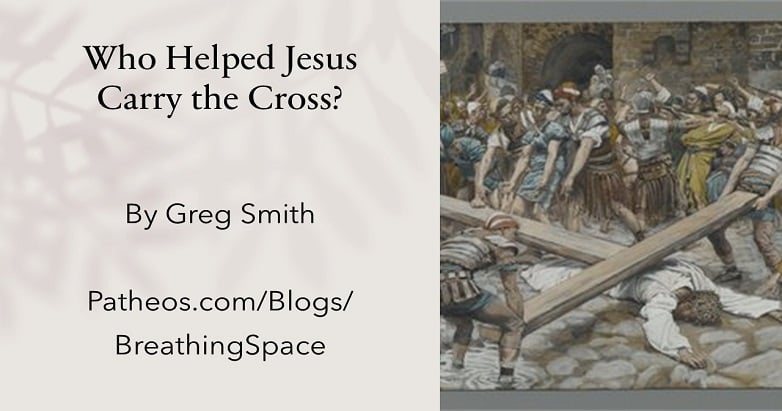
James Tissot (French, 1836-1902). Simon the Cyrenian Compelled to Carry the Cross with Jesus (Simon de Cyrène contraint de porter la Croix avec Jésus), 1886-1894. Opaque watercolor over graphite on gray wove paper, Image: 7 15/16 x 11 11/16 in. (20.2 x 29.7 cm). Brooklyn Museum
Jerusalem teemed with Jewish travelers from all over the Roman Empire, who had come to the holy city for Passover. Though they all worshipped the Jewish God, they came from many cultures. Tarshish, Babylon, Egypt, and Ethiopia all boasted Jewish populations in the Diaspora—and many people, indigenous to those regions, came to worship the Jewish God as well. Simon, from north African Cyrene, was one such pilgrim who made the journey, along with his wife and young sons Rufus and Alexander. They’d come for the annual sacrifice but were overwhelmed by Jerusalem’s unusually large crowds, even for a festival. The people seemed frightened and angry. The crowd surged toward the palace of Governor Pilate. At a distance, Simon could see two men led by soldiers up the stronghold steps so the crowd could see them both.
The governor addressed the crowd, presenting to them an insurgent named Barabbas, and a rabbi named Jesus. Both had been savagely beaten, their faces so streaked with blood that Simon could barely tell the two apart. Pilate reminded the crowd that each year he released one prisoner in honor of the Passover. “Which of the two shall I set free?” he asked. “The killer, or the one you call king?” Fueled by hatred for the Romans, and encouraged by agitators paid by the priests, the crowd shouted for the revolutionary Barabbas. “What shall I do with your king, then?” Pilate asked.
Simon shuddered as he heard the crowd shout, “Crucify him!” Red-cloaked soldiers grabbed Barabbas, cut the ropes that bound his wrists, and gave him a kick that sent him sprawling into the mob. He got up, perplexed, and turned to disappear into the throng. Pilate washed his hands publicly, then sent the rabbi to be crucified.
Simon watched with his children as the executioners led a parade down the street toward Golgotha. The Place of the Skull, located outside the city, was often lined with crosses, symbols of Roman oppression and reminders to keep the empire’s subjects in line. Simon remembered stories from a hundred years ago, when Spartacus led his slave revolt, and six thousand people were crucified in one day. He had personally witnessed many crucifixions and didn’t want his sons to see this one. Taking Rufus by one hand and Alexander by the other, Simon tried to move against the swelling current in the street. He pressed against the violent crowd to make a path, while his wife guarded the boys from the rear. But it was no use—they were caught up in this drama, whether they liked it or not.
Many were slated for execution that day. Soldiers lashed their prisoners down the street. All had been scourged, some worse than others. Some kept up as they were forced to carry their own crossbeams uphill. But Simon saw one prisoner so flagellated that his skin hung in bloody strips. Now he struggled beneath the weight of his cross, falling, unable to rise and carry its weight.
Cruel soldiers whipped him as if further violence might give the poor man strength. But beat him as they might, the man’s energy was gone. So, they turned to the crowd to find someone to carry his cross. The soldiers scanned the mob for someone who looked strong. Alexander knew what the Romans were thinking as they scanned the bystanders. The soldiers weren’t about to carry the cross for him, but it wouldn’t do to pick a local, either. That could start trouble. A foreign face was what they wanted. Then they pointed to the dark African man who stood out so easily in the crowd.
Simon tried to resist. “I have my sons to look after,” he told them.
Legionnaires grabbed Rufus and Alexander, twisting their arms out of their parents’ grasp. “Fine—we’ll make these two carry the cross instead!”
“No!” Simon shouted. “Let them go—I’ll do it.”
Simon’s wife took her boy’s hands. With a look, she let her husband know that they would be all right. So, kneeling before the cross, Simon took it on his own broad shoulders and helped Jesus carry the heavy length of wood. They walked the rest of the way together—the condemned king and the terrified traveler. Jesus spoke no words as they plodded along but breathed easier for this short time without his burden.
As Simon bore the blood-slick cross to Golgotha, he felt a strange affinity for this dark-skinned Judean. Both were victims of oppression and racism by the Romans. Both were men of peace, forced to carry another man’s cross—Simon for Jesus, and Jesus for Barabbas. At last, they arrived at the hill’s summit. Soldiers pushed the crossbeam from Simon’s shoulders, then gave him a shove. Simon wanted to blend back into the pressing mob, to disappear, to find his family. But he couldn’t—he was too invested. He stood and watched the crucifixion. He stayed by Jesus, along with the rabbi’s beloved women and one friend, until the Teacher died.
What Do We Really Know?
Aside from my embellished narrative, we know extraordinarily little about Simon of Cyrene. What do the Bible and history tell us about this man?
- The synoptic gospels all mention him (Matthew 27:32; Mark 15:21; Luke 23:26). The fact that all three include him indicates not only his conversion to Christianity but his prominence in the early church.
- According to Got Questions, “Many Jews from Cyrene had returned to their native Israel and were part of a community in Jerusalem called the Synagogue of the Freedmen comprising Jews from many other provinces including Alexandria (Egypt), Cilicia and Asia (Acts 6:9). Luke records men from Cyrene being among those converted at Pentecost (Acts 2:10). After the martyrdom of Stephen (Acts 7), believers from Cyrene were among the first to be scattered by the persecution in Jerusalem; arriving in Antioch, they preached to the Gentiles there (Acts 11:20). These believers were instrumental in the formation of the church at Antioch, where, for the first time, “the disciples were called Christians” (Acts 11:26).”
- Simon is called a prophet and teacher in Antioch, in Acts 13:1. His transformative experience led him to become a prophet and teacher at the church.
- Simon was a person of color. Acts 13:1 NLT renders it best, but I’ll make one change for proper capitalization: “Among the prophets and teachers of the church at Antioch of Syria were Barnabas, Simeon (called “the [B]lack man”), Lucius (from Cyrene), Manaen (the childhood companion of King Herod Antipas), and Saul.”
- People of African heritage have always felt an affinity for this Black man who played a role in Jesus’ life. Church and Society says, “Black folk claim Simon with reference not to geography but to identity. Simon’s [B]lackness is truth-telling and empowering. It names the ongoing reality of social hostility and forced labor imposed upon [Black people] the world over. It also names the dignity, power, and humanity [B]lack people have had in the face of half a millennium of such oppression. Simon of Cyrene, the [B]lack man in society, helping God carry his burden.”
- Simon’s family would grow to be well known in the church in Rome. Perhaps after Simon’s death, a grown Rufus and his widowed mother moved from Antioch to Italy. Romans 16:13 NRSVUE says, “Greet Rufus, chosen in the Lord, and greet his mother—a mother to me also.”
What Does Simon Mean for Believers?
Simon’s story highlights oppression and injustice. Simon represents all people of color who have been selected out of the crowd by law enforcement, for no other reason than their skin. White (Roman/Italian/European) oppressors used their uniforms and their weapons to conscript him to do their bloody work. Christians who read Simon’s story must recognize that Black lives mattered then, as they do now—and that systemic racism has been happening not for hundreds, but thousands of years.
Simon bore a cross that was not his own. It belonged to Jesus. Just as Jesus carried a cross that belonged to Barabbas. Jesus said, “If any wish to come after me, let them deny themselves and take up their cross and follow me. (Matthew 16:24 NRSVUE).” Sometimes the cross you bear is not yours, but another’s. Jesus also said, “Truly I tell you, just as you did it to one of the least of these brothers and sisters of mine, you did it to me. (Matthew 25:40 NRSVUE).” White believers in positions of power must leverage their privilege to make transformational differences in society, advocate for justice, and speak out for those who are oppressed. White Christians might feel like this isn’t their cross to bear—but Paul tells us in Galatians 6:2 NRSVUE, “Bear one another’s burdens, and in this way you will fulfill the law of Christ.” As Simon was selected to bear Jesus’ cross because of the color of his skin, so White Christians need to bear the cross for people of color, precisely because of the color of their skin.
Simon’s story represents transformation and action. Simon and his family were entirely changed by their experience of Jesus. As a result, they got involved with the subversive movement called the church. As such, they worked against oppression and advocated for people like Jesus and like themselves, who had been repressed by those in authority. The Black Church has learned to do this very thing. Today, all Christians—not just those in minority groups—must follow their example.
A Call to Action
It’s easy for modern readers to skim over the story of Simon of Cyrene and skip from Pilate’s palace to the crucifixion. But Simon’s story calls us to action. We must see the world’s power structures for what they are. In the moment of crisis, we must bend our knees and strain our backs to carry the load of the oppressed and broken. And then, when the crisis is done, we must not become complacent. As Simon and his wife taught Rufus and Alexander, we must teach our children to become cross-bearers for others. When we walk in Simon’s legacy, we live to help others. We become willing to get ourselves dirty and even bloody to carry someone else’s cross.
History and Religion
Travel and Religion
Who helped carry Jesus' Cross?
Previous Post

July 16, 2022
How Should Conservative Christians Treat LGBTQIA+ Folks?
Next Post
July 19, 2022 Can Christians Watch Horror Movies?
Browse Our Archives
Select a Category Challenging the Church Deconstruction For Pastors Heathen Christianity Holidays and special days Mental Health Social Justice Spirituality Taoism Theology Uncategorized
Select a Month October 2026 September 2026 August 2026 July 2026 June 2026 May 2026 April 2026 March 2026 February 2026 January 2026 December 2025 November 2025 October 2025 September 2025 August 2025 July 2025 June 2025 May 2025 April 2025 March 2025 February 2025 January 2025 December 2024 November 2024 October 2024 September 2024 August 2024 July 2024 June 2024 May 2024 April 2024 March 2024 February 2024 January 2024 December 2023 November 2023 October 2023 September 2023 August 2023 July 2023 June 2023 May 2023 April 2023 March 2023 February 2023 January 2023 December 2022 November 2022 October 2022 September 2022 August 2022 July 2022 June 2022 May 2022 April 2022 March 2022 February 2022 January 2022
Follow Us!
TAKE THE
Religious Wisdom Quiz
Who is known for his wisdom and built a temple?
Select your answer to see how you score.
Solomon David Paul Moses
Related posts from Breathing Space

I Met Papa Before I Read The Shack

The Guest Who Stayed at an Unfriendly Table
Jesus and Lao Tzu: Allowing Your Enemies
Which Version of Superman is the Most Punk...
TRENDING AT PATHEOS Progressive Christian

What Being a Modern-Day Apostle Means to Me
In my last column, I discussed the ins and outs of modern-day...

Did Ancient China Once Worship the God of...
Across human history, a common thread weaves through the origins of the...

Love Your Neighbor – Including Earth-Kin: Lev. 19,...
God’s command to love your neighbor means acting in an ethical and...

Lead a Church Study of “Jesus and Lao...
Guest writer Jack Thomas (The Irreverent Reverend) reflects on leading his church...

Pastoral Wisdom for Responding to Sermon Pushback
Getting sermon pushback on your social justice sermon? Learn practical, Proverbs-based strategies...

Principles for Understanding the Apostolic Ministry Today
Whenever people discover that my formal ministry title is "apostle," as in...
view all Progressive Christian blogs
Ad-Free & Subscriber Log-In Subscription Support
- About Us
- 2026 Calendar
- Videos
- Podcasts
- Library of World Religions
- Faith In Media Tracker
- Advertise With Us
- Write for Us
- Privacy Policy
- Terms of Service
- Do Not Sell My Data
- Contact Us
- Radiant Digital
- Manage Newsletter Subscriptions
- Unsubscribe From Notifications
- Sitemap
Copyright 2008-2026, Patheos. All rights reserved.
Subscription Support Ad-Free & Subscriber Log-In
Follow Patheos