
BuddhistCatholicContemplativeEvangelicalGeneral ChristianHinduJewishLatter-day SaintMuslimNew VisionsProgressive Christian
Beliefs
- Buddhist
- Catholic
- Contemplative
- Evangelical
- General Christian
- Hindu
- Jewish
- Latter-day Saint
- More Voices
- Muslim
- New Visions
- Pagan
- Progressive Christian
Topics
- Religion News
- Food and Religion
- Sports and Religion
- Religious Art
- Religious Music and Entertainment
- Religious Events
- History and Religion
- Style and Religion
- Politics and Religion
- Women in Religion
- Recreation Outdoors and Religion
- Business Finance and Religion
- Careers Workplace and Religion
- Education and Religion
- Family Parenting and Religion
- Health Fitness and Religion
- Home and Religion
- Relationships and Religion
- Technology and Religion
- Travel and Religion
Columnists
- Buddhist Columnists
- Business Finance and Religion Columnists
- Careers Workplace and Religion Columnists
- Catholic Columnists
- Contemplative Columnists
- Education and Religion Columnists
- Evangelists Columnists
- Family Parenting and Religion Columnists
- General Christian Columnists
- Health Fitness and Religion Columnists
- Hindu Columnists
- History and Religion Columnists
- Home and Religion Columnists
- Jewish Columnists
- More Voices Columnists
- Latter Day Columnists
- Muslim Columnists
- New Visions Columnists
- Nonreligious Columnists
- Pagan Columnists
- Politics and Religion Columnists
- Progressive Columnists
- Recreation Outdoors and Religion Columnists
- Relationships and Religion Columnists
- Religion News Columnists
- Religious Art Columnists
- Religious Events Columnists
- Religious Music and Entertainment Columnists
- Sports and Religion Columnists
- Style and Religion Columnists
- Technology and Religion Columnists
- Travel and Religion Columnists
- Women in Religion Columnists
Resource Library
- 2026 Calendar
- Library of World Religions
- The 100 Most Holy Places on Earth
- Patheos Answers
- Podcasts
- Videos
- Faith Leaders Database
- Anglican Episcopalian
- Bahai
- Baptist
- Buddhism
- Christianity
- Confucianism
- Eastern Orthodoxy
- Hinduism
- Holiness and Pentecostal
- ISKCON
- Islam
- Judaism
- Lutheran
- Methodist
- The Church of Jesus Christ of Latter-day Saints
- New Age
- Paganism
- Presbytarian and Reformed
- Protestantism
- Religion Behind the Scenes
- Roman Catholic
- Scientology
- Shia Islam
- Sikhism
- Sufism
- Sunni Islam
- Taoism
- Zen
- See all religions
Research Tools
 Ad-Free & Subscriber Log-In Subscription Support
Ad-Free & Subscriber Log-In Subscription Support
Follow Patheos 

- Trending:
- Forgiveness
- |
- Marriage
- |
- Consciousness
- |
- Death Penalty
- |
- Election
- |
- Halloween

-
Categories
- Home
- Progressive Christian
- Education and Religion
- How To Pray When You’re Deconstructing
How To Pray When You’re Deconstructing
Last updated on: December 7, 2022 at 6:57 am by Gregory T. Smith
How To Pray When You’re Deconstructing 2022-12-07T06:57:23-08:00 Gregory T. Smith
Patheos Explore the world's faith through different perspectives on religion and spirituality! Patheos has the views of the prevalent religions and spiritualities of the world.
Christians who deconstruct their faith often feel so overwhelmed with questions without answers that prayer becomes difficult. Sometimes it seems that there is no God listening to your prayers. At other times you may feel God’s presence intimately but have no idea what to say. For all these prayer problems, Lectio Divina offers an answer.
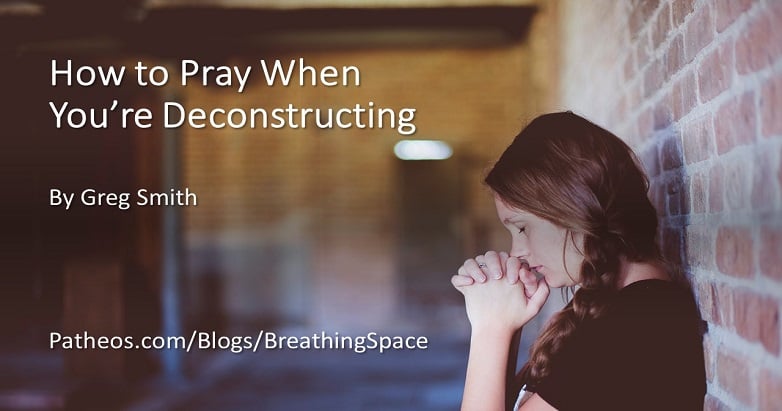
Image by StockSnap from Pixabay
Lectio Divina
Centuries ago, Benedict of Nursia introduced to his desert monks a practice called Lectio Divina that is perfect for people going through the difficult process of deconstruction. First, you begin with Lectio, or Divine Reading. Click here to read my article on the first step. This involves reading a passage of scripture several times to find a word or phrase that stands out to you. This sacred word becomes your mantra, or Logos, that you repeat to yourself. Click here to read my article about the second step, Meditatio, meditation. The third step is called Oratio, or Prayer.
When you feel distanced from God, it helps to have a prayer assignment. Start by practicing Divine Reading. Once you have found your sacred word through the first step of Lectio, and repeated that word in Meditatio, it’s time to pray that word. This way, instead of trying to figure out what to pray about, the topic has already come to you through scripture.
Logos and the Lord’s Prayer
One method of praying the Logos, or the Word, is to use the Lord’s Prayer as your outline, but to let the sacred word be the subject. For example, let’s suppose the scripture you read during the Lectio step was the twenty-third psalm. The word that stood out to you was shepherd. How can you pray about that word, using the Lord’s Prayer as your outline?
- Our Father, which art in heaven, hallowed be thy name. This section is all about God and God’s identity. Since your word was shepherd, this is fairly easy. Take this time in your prayer to focus on God as the divine shepherd. Expand that notion and think about all the ways that a shepherd leads their sheep. What does God’s identity as shepherd mean to you?
- Thy kingdom come; thy will be done on Earth as it is in heaven. This section is about God’s will. Focus your prayer on how a shepherd might communicate their will to the sheep, and how the sheep might understand the shepherd’s purpose. What does this mean in your life today?
- Give us this day our daily bread. Think about how the shepherd leads the sheep to fresh green grass every day and how the sheep never need to concern themselves about their next meal. Worrying about that is the shepherd’s job. How have you taken that responsibility on yourself, instead of trusting the shepherd to give you what you need every day?
- Forgive us our trespasses as we forgive those who trespass against us. Think about how sheep often wander away from the flock, trespassing where they don’t belong. How has God as Shepherd reached out to you to bring you back into the fold? How have others trespassed against you? Can you see the way God has brought them back as well? If the shepherd has been so gentle with you, how can you be gentle with the other sheep who are not so different from you after all?
- Lead us not into temptation but deliver us from evil. Through the lens of the word shepherd, this phrase invites you to consider how the Good Shepherd never leads a sheep into danger. During this time in your prayer, you might feel like a lamb in the arms of the shepherd and rest securely in the knowledge that God is taking care of you.
- For thine is the kingdom and the power and the glory forever. Honestly, sometimes it’s hard to make the sacred word from every Bible reading fit into the Lord’s prayer. Occasionally, the two might even seem contradictory—like kingdom, power, and glory contrasted with the poverty of a shepherd. But maybe the contradiction is worth embracing. Jesus did this when he entered the incarnation, exchanging divine glory for human suffering. The Christian life invites us to do the same thing. This is a powerful observation that you might miss if you dismiss the contradiction between the final phrase in the Lord’s Prayer and the word shepherd. When praying the Logos, don’t be afraid to explore and embrace contradictions because they are sometimes the source of the greatest insights.
Oratio with the Logos
Praying the Lord’s Prayer through the lens of the word shepherd is just one example. This assumes that the scripture you read in your devotion time is Psalm 23. But what if you’re reading other passages? The same principle applies. If you’re reading 1 Corinthians 13 and the word love stands out to you, then Love is the Logos, the lens through which you pray the Lord’s Prayer. Each phrase of the Lord’s Prayer, then, is seen in the context of love.
You can use this same principle with any scripture. The sacred word that stands out to you from scripture becomes the lens through which you pray the Lord’s Prayer. This is easier to do with some scriptures, and harder with others, but if you embrace the challenge then it will give you a way to continue praying even while you’re deconstructing. Your sacred word will change every time you read scripture, but the Lord’s Prayer remains the same. That new Logos gives depth to a familiar prayer that you might otherwise rattle off without thinking.
No one said that deconstruction is easy. Dismantling your faith to build it back up again (or not) is some of the hardest work you’ll ever do. But you don’t have to do it bereft of spirituality. With Lectio Divina as a blueprint, you can deconstruct on purpose rather than letting your faith simply fall apart. You can engage in vibrant spirituality even while refurbishing your theology.
Education and Religion
Home and Religion
Previous Post

June 29, 2022
“Christian Mantras: Hearing from God When You’re Deconstructing”
Next Post
July 2, 2022 Contemplative Prayer: Hearing from God When You're Deconstructing
Browse Our Archives
Select a Category Challenging the Church Deconstruction For Pastors Heathen Christianity Holidays and special days Mental Health Social Justice Spirituality Taoism Theology Uncategorized
Select a Month October 2026 September 2026 August 2026 July 2026 June 2026 May 2026 April 2026 March 2026 February 2026 January 2026 December 2025 November 2025 October 2025 September 2025 August 2025 July 2025 June 2025 May 2025 April 2025 March 2025 February 2025 January 2025 December 2024 November 2024 October 2024 September 2024 August 2024 July 2024 June 2024 May 2024 April 2024 March 2024 February 2024 January 2024 December 2023 November 2023 October 2023 September 2023 August 2023 July 2023 June 2023 May 2023 April 2023 March 2023 February 2023 January 2023 December 2022 November 2022 October 2022 September 2022 August 2022 July 2022 June 2022 May 2022 April 2022 March 2022 February 2022 January 2022
Follow Us!
TAKE THE
Religious Wisdom Quiz
Which Psalm expresses confession: "Against you, you only, have I sinned"?
Select your answer to see how you score.
Psalm 24 Psalm 100 Psalm 51 Psalm 73
Related posts from Breathing Space

“Can You Follow Jesus and Still Practice Smudging?”

Jesus and Lao Tzu: Seven Striking Parallels

Mo Thomas: Book Review from a Black Hole

“You Got Your Lao Tzu on My Jesus!”
TRENDING AT PATHEOS Progressive Christian

What Being a Modern-Day Apostle Means to Me
In my last column, I discussed the ins and outs of modern-day...

Did Ancient China Once Worship the God of...
Across human history, a common thread weaves through the origins of the...

Love Your Neighbor – Including Earth-Kin: Lev. 19,...
God’s command to love your neighbor means acting in an ethical and...

Lead a Church Study of “Jesus and Lao...
Guest writer Jack Thomas (The Irreverent Reverend) reflects on leading his church...

Pastoral Wisdom for Responding to Sermon Pushback
Getting sermon pushback on your social justice sermon? Learn practical, Proverbs-based strategies...

Principles for Understanding the Apostolic Ministry Today
Whenever people discover that my formal ministry title is "apostle," as in...
view all Progressive Christian blogs
Ad-Free & Subscriber Log-In Subscription Support
- About Us
- 2026 Calendar
- Videos
- Podcasts
- Library of World Religions
- Faith In Media Tracker
- Advertise With Us
- Write for Us
- Privacy Policy
- Terms of Service
- Do Not Sell My Data
- Contact Us
- Radiant Digital
- Manage Newsletter Subscriptions
- Unsubscribe From Notifications
- Sitemap
Copyright 2008-2026, Patheos. All rights reserved.
Subscription Support Ad-Free & Subscriber Log-In
Follow Patheos