
BuddhistCatholicContemplativeEvangelicalGeneral ChristianHinduJewishLatter-day SaintMuslimNew VisionsProgressive Christian
Beliefs
- Buddhist
- Catholic
- Contemplative
- Evangelical
- General Christian
- Hindu
- Jewish
- Latter-day Saint
- More Voices
- Muslim
- New Visions
- Pagan
- Progressive Christian
Topics
- Religion News
- Food and Religion
- Sports and Religion
- Religious Art
- Religious Music and Entertainment
- Religious Events
- History and Religion
- Style and Religion
- Politics and Religion
- Women in Religion
- Recreation Outdoors and Religion
- Business Finance and Religion
- Careers Workplace and Religion
- Education and Religion
- Family Parenting and Religion
- Health Fitness and Religion
- Home and Religion
- Relationships and Religion
- Technology and Religion
- Travel and Religion
Columnists
- Buddhist Columnists
- Business Finance and Religion Columnists
- Careers Workplace and Religion Columnists
- Catholic Columnists
- Contemplative Columnists
- Education and Religion Columnists
- Evangelists Columnists
- Family Parenting and Religion Columnists
- General Christian Columnists
- Health Fitness and Religion Columnists
- Hindu Columnists
- History and Religion Columnists
- Home and Religion Columnists
- Jewish Columnists
- More Voices Columnists
- Latter Day Columnists
- Muslim Columnists
- New Visions Columnists
- Nonreligious Columnists
- Pagan Columnists
- Politics and Religion Columnists
- Progressive Columnists
- Recreation Outdoors and Religion Columnists
- Relationships and Religion Columnists
- Religion News Columnists
- Religious Art Columnists
- Religious Events Columnists
- Religious Music and Entertainment Columnists
- Sports and Religion Columnists
- Style and Religion Columnists
- Technology and Religion Columnists
- Travel and Religion Columnists
- Women in Religion Columnists
Resource Library
- 2026 Calendar
- Library of World Religions
- The 100 Most Holy Places on Earth
- Patheos Answers
- Podcasts
- Videos
- Faith Leaders Database
- Anglican Episcopalian
- Bahai
- Baptist
- Buddhism
- Christianity
- Confucianism
- Eastern Orthodoxy
- Hinduism
- Holiness and Pentecostal
- ISKCON
- Islam
- Judaism
- Lutheran
- Methodist
- The Church of Jesus Christ of Latter-day Saints
- New Age
- Paganism
- Presbytarian and Reformed
- Protestantism
- Religion Behind the Scenes
- Roman Catholic
- Scientology
- Shia Islam
- Sikhism
- Sufism
- Sunni Islam
- Taoism
- Zen
- See all religions
Research Tools
 Ad-Free & Subscriber Log-In Subscription Support
Ad-Free & Subscriber Log-In Subscription Support
Follow Patheos 

- Trending:
- Forgiveness
- |
- Marriage
- |
- Consciousness
- |
- Death Penalty
- |
- Election
- |
- Halloween

-
Categories
- Home
- Progressive Christian
- Family, Parenting and Religion
- Does Our Sin Separate Us from God?
Does Our Sin Separate Us from God?
Last updated on: December 7, 2022 at 6:58 am by Gregory T. Smith
Does Our Sin Separate Us from God? 2022-12-07T06:58:48-08:00 Gregory T. Smith
Patheos Explore the world's faith through different perspectives on religion and spirituality! Patheos has the views of the prevalent religions and spiritualities of the world.
Don’t believe the LIE that your sin separates you from God. Jesus proves otherwise.
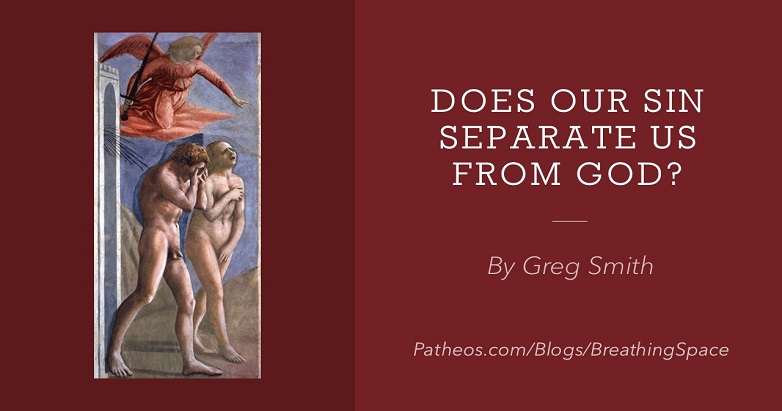
The Expulsion from the Garden of Eden
1426-27. Fresco, 208 x 88 cm. Cappella Brancacci, Santa Maria del Carmine, Florence
Evangelical teachers instruct their students to imagine a great chasm between themselves and God, which can only be bridged by the cross. Gospel tracts usually depict the fires of hell at the bottom of the chasm. The message is your sin separates you from God, and if you don’t receive Jesus you are going to Hell, where you will continue to be separated from God—only this time with the added bonus of torture. The problem with this picture is that the doctrine of God’s omnipresence tells us otherwise.
Psalm 139 – An Omnipresent God
Where can I go from your spirit?
Or where can I flee from your presence?
If I ascend to heaven, you are there;
if I make my bed in Sheol*, you are there.
If I take the wings of the morning
and settle at the farthest limits of the sea,
even there your hand shall lead me,
and your right hand shall hold me fast.
(Psalm 139:7-10 NRSV).
Mystics have known all along that there is no way and no place where humanity can be separate from God. If we are made in God’s image, and if God is the One in whom we live and move and have our being (Acts 17.28 NRSV), then we are intrinsically encompassed and filled with God’s presence. It is impossible for us to be separate from God because God is in us. Likewise, it is impossible for God to be separate from us because God is omnipresent and there is no place where God is not.
Growing up I was always told that Heaven is where God is, and Hell is where God isn’t. They say it would be terrible to go to Hell because that would be a permanent separation from God. That’s just bad theology because it violates the very idea of an omnipresent God.
A Long-Distance Relationship
Sure, it’s possible to feel separate from God, but this is not ultimate truth. This is the feeling you get in a long-distance relationship when you are thousands of miles away from loved ones but can video chat with them every day. You may feel separated from them because of proximity, but in every way that matters you are completely together. You know at some point there will be a plane trip, and you will feel as united physically as you are in spirit. This is the same with God. At times you may feel separated, but it’s a perception, not reality.
Did God Forsake Jesus?
In his incarnation, Jesus frequently felt separated from God. From the cross, he cried, “My God, my God, why have you forsaken me (Matthew 27.46 NRSV)?” Some have erroneously taught that on the cross, the Divine Parent turned away. They claim that God is too holy to look upon sin, and Jesus embodied our sin on the cross, so God couldn’t even look at him. If this were true, then sin would be stronger than God—which would violate the Almighty’s omnipotence. Instead of forced separation, 2 Timothy 2.13 NRSV says God cannot deny Godself. Jesus wasn’t separated from God on the cross—Jesus was God on the cross. And the rest of the Trinity couldn’t be separated from him any more than you can separate hydrogen from oxygen and still call it water.
“Our Father in Heaven…”
Still, Jesus sometimes felt separated from the Divine. And not just on his worst days. Arguably on his best day, when he delivered the sermon on the mountain, Jesus taught us to pray, “Our Father in Heaven…(Matthew 6.9 NRSV)” Every time we pray these words, we’re talking as if God is someplace apart from us. It’s not just the problematic doctrine of Hell that convinces us that it’s possible to be separated from God. The problematic doctrine of Heaven does the same thing. If our sin cannot separate us, then the distance from Earth to Heaven can’t either.
The Separation Delusion
Jesus did not come to Earth to die on the cross and pay the penalty for our sin so that a separated humanity could be reunited with a distant God. Instead, he came to live the kind of life that reminds us we were never separate from God in the first place. Original sin had nothing to do with forbidden fruit. If there is an original sin, it is our delusion that we are separate from God.
In the myth of Eden, the tempted couple would never have eaten the forbidden fruit if not for the delusion of separation that already existed within their minds. When the snake told them they could be like God, they believed it, having forgotten that they were already one with the Creator. They wore this perceived separation on their bodies when they covered their nakedness with fig leaves. God’s response by clothing them in animal skins and expelling them from Eden was simply a recognition of their perceived separation. At no time did God actually separate the divine presence from humanity.
Emmanuel—God with Us
When Christ came to earth, He was called Emmanuel, or God-With-Us. Jesus did not come to restore a broken connection with God. Instead, He reminded us that we were never separated in the first place. This is the very definition of the Incarnation—that God is wholly united with, and never separate from, humanity. Jesus overturned the Pharisees’ notions of separation. Instead, Jesus as both divine and human embraced those that society considered sinners. Not because he “hated the sin but loved the sinner,” but because he embraced humanity in its entirety. He came to demonstrate by his very life that there is no separation.
More Than Conquerors
Salvation is not about receiving the gift of a penal substitutionary sacrifice and being reunited with God. It’s about letting Jesus remind you that you were never separate from God in the first place. You are good. Emmanuel loves you. You are precious, and a bearer of God’s divine presence. This is why Paul wrote:
“Who shall separate us from the love of Christ? Shall trouble or hardship or persecution or famine or nakedness or danger or sword?… No, in all these things we are more than conquerors through him who loved us. For I am convinced that neither death nor life, neither angels nor demons, neither the present nor the future, nor any powers, neither height nor depth, nor anything else in all creation, will be able to separate us from the love of God that is in Christ Jesus our Lord (Romans 8.35, 37-39 NIV).”
If these things can’t separate us from God, then our sin can’t either. Emmanuel shows us that just as God is in Jesus, God is in us. And God cannot deny Godself. For this reason, Christians are called to be “more than conquerors.” The traditional doctrine of original sin teaches that we are inherently sinful—inherently conquerors or people of violent nature. But the truth is that we are more than conquerors—better than this notion of inherent violence and unworthiness*.* Our sin doesn’t separate us from God, causing us to become self-reliant conquerors. Instead, Jesus shows us that we were never separated in the first place. Because of this, we can live in the love of Christ and be like our Savior—representations of God’s continual presence in the world.
****************************************************************
*Sheol is often translated as Hell, but the Hebrew meaning in the psalmist’s time was simply the shadowy place of the dead. In any case, this shows that there is no place where we can go where we are apart from God.
Family, Parenting and Religion
Home and Religion
Previous Post

July 7, 2022
God's Nonbinary Pronouns: How Theology Can Learn from Queer Studies
Next Post
July 12, 2022 The Chosen People and Guns: Our History of Supremacy, Violence, and Genocide
Browse Our Archives
Select a Category Challenging the Church Deconstruction For Pastors Heathen Christianity Holidays and special days Mental Health Social Justice Spirituality Taoism Theology Uncategorized
Select a Month October 2026 September 2026 August 2026 July 2026 June 2026 May 2026 April 2026 March 2026 February 2026 January 2026 December 2025 November 2025 October 2025 September 2025 August 2025 July 2025 June 2025 May 2025 April 2025 March 2025 February 2025 January 2025 December 2024 November 2024 October 2024 September 2024 August 2024 July 2024 June 2024 May 2024 April 2024 March 2024 February 2024 January 2024 December 2023 November 2023 October 2023 September 2023 August 2023 July 2023 June 2023 May 2023 April 2023 March 2023 February 2023 January 2023 December 2022 November 2022 October 2022 September 2022 August 2022 July 2022 June 2022 May 2022 April 2022 March 2022 February 2022 January 2022
Follow Us!
TAKE THE
Religious Wisdom Quiz
I became queen through a beauty contest, hiding my Jewish identity at my cousin's advice. Who am I?
Select your answer to see how you score.
Ruth Vashti Esther Sarah
Related posts from Breathing Space

“Can You Follow Jesus and Still Practice Smudging?”

I Met Papa Before I Read The Shack

The Guest Who Stayed at an Unfriendly Table
Jesus and Lao Tzu: Allowing Your Enemies
TRENDING AT PATHEOS Progressive Christian

What Being a Modern-Day Apostle Means to Me
In my last column, I discussed the ins and outs of modern-day...

Did Ancient China Once Worship the God of...
Across human history, a common thread weaves through the origins of the...

Love Your Neighbor – Including Earth-Kin: Lev. 19,...
God’s command to love your neighbor means acting in an ethical and...

Lead a Church Study of “Jesus and Lao...
Guest writer Jack Thomas (The Irreverent Reverend) reflects on leading his church...

Pastoral Wisdom for Responding to Sermon Pushback
Getting sermon pushback on your social justice sermon? Learn practical, Proverbs-based strategies...

Principles for Understanding the Apostolic Ministry Today
Whenever people discover that my formal ministry title is "apostle," as in...
view all Progressive Christian blogs
Ad-Free & Subscriber Log-In Subscription Support
- About Us
- 2026 Calendar
- Videos
- Podcasts
- Library of World Religions
- Faith In Media Tracker
- Advertise With Us
- Write for Us
- Privacy Policy
- Terms of Service
- Do Not Sell My Data
- Contact Us
- Radiant Digital
- Manage Newsletter Subscriptions
- Unsubscribe From Notifications
- Sitemap
Copyright 2008-2026, Patheos. All rights reserved.
Subscription Support Ad-Free & Subscriber Log-In
Follow Patheos