
BuddhistCatholicContemplativeEvangelicalGeneral ChristianHinduJewishLatter-day SaintMuslimNew VisionsProgressive Christian
Beliefs
- Buddhist
- Catholic
- Contemplative
- Evangelical
- General Christian
- Hindu
- Jewish
- Latter-day Saint
- More Voices
- Muslim
- New Visions
- Pagan
- Progressive Christian
Topics
- Religion News
- Food and Religion
- Sports and Religion
- Religious Art
- Religious Music and Entertainment
- Religious Events
- History and Religion
- Style and Religion
- Politics and Religion
- Women in Religion
- Recreation Outdoors and Religion
- Business Finance and Religion
- Careers Workplace and Religion
- Education and Religion
- Family Parenting and Religion
- Health Fitness and Religion
- Home and Religion
- Relationships and Religion
- Technology and Religion
- Travel and Religion
Columnists
- Buddhist Columnists
- Business Finance and Religion Columnists
- Careers Workplace and Religion Columnists
- Catholic Columnists
- Contemplative Columnists
- Education and Religion Columnists
- Evangelists Columnists
- Family Parenting and Religion Columnists
- General Christian Columnists
- Health Fitness and Religion Columnists
- Hindu Columnists
- History and Religion Columnists
- Home and Religion Columnists
- Jewish Columnists
- More Voices Columnists
- Latter Day Columnists
- Muslim Columnists
- New Visions Columnists
- Nonreligious Columnists
- Pagan Columnists
- Politics and Religion Columnists
- Progressive Columnists
- Recreation Outdoors and Religion Columnists
- Relationships and Religion Columnists
- Religion News Columnists
- Religious Art Columnists
- Religious Events Columnists
- Religious Music and Entertainment Columnists
- Sports and Religion Columnists
- Style and Religion Columnists
- Technology and Religion Columnists
- Travel and Religion Columnists
- Women in Religion Columnists
Resource Library
- 2026 Calendar
- Library of World Religions
- The 100 Most Holy Places on Earth
- Patheos Answers
- Podcasts
- Videos
- Faith Leaders Database
- Anglican Episcopalian
- Bahai
- Baptist
- Buddhism
- Christianity
- Confucianism
- Eastern Orthodoxy
- Hinduism
- Holiness and Pentecostal
- ISKCON
- Islam
- Judaism
- Lutheran
- Methodist
- The Church of Jesus Christ of Latter-day Saints
- New Age
- Paganism
- Presbytarian and Reformed
- Protestantism
- Religion Behind the Scenes
- Roman Catholic
- Scientology
- Shia Islam
- Sikhism
- Sufism
- Sunni Islam
- Taoism
- Zen
- See all religions
Research Tools
 Ad-Free & Subscriber Log-In Subscription Support
Ad-Free & Subscriber Log-In Subscription Support
Follow Patheos 

- Trending:
- Forgiveness
- |
- Marriage
- |
- Consciousness
- |
- Death Penalty
- |
- Election
- |
- Halloween

-
Categories
- Home
- Progressive Christian
- Selling Your Soul to the Creeds: When The Church Makes You Sign on the Dotted Line
Selling Your Soul to the Creeds: When The Church Makes You Sign on the Dotted Line
Last updated on: June 4, 2022 at 7:30 pm by Gregory T. Smith
Selling Your Soul to the Creeds: When The Church Makes You Sign on the Dotted Line 2022-06-04T19:30:57-08:00 Gregory T. Smith
Patheos Explore the world's faith through different perspectives on religion and spirituality! Patheos has the views of the prevalent religions and spiritualities of the world.
Since when did Christianity require people to sign on the dotted line?
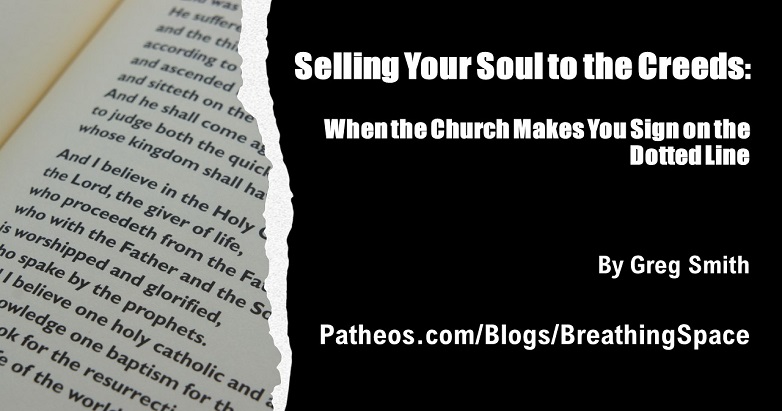
Image by Phill Sacre from Pixabay
It must be in one of the lost Chapters of the Gospels that Jesus, calling his new disciples, pulled out a scroll and made them sign their adherence to the creeds. Or maybe a forgotten passage in the book of Revelation says the names written in the Lamb’s Book of Life are actually the signatures of the Saints, pledging allegiance to the heavenly statement of faith. If not, I’m confused why the church makes people sign on the dotted line if they want to join the club.
Clergy
Ordination boards require candidates to submit to lengthy examinations about their doctrines. When the board finds the ordinand’s theology to conform to their denomination’s statement of faith, they are approved and get the rubber stamp of ordination. But it doesn’t stop with the board. If they want to serve a church, teach in a seminary, or become a missionary, again they’re required to sign on the dotted line, affirming that their beliefs have not changed since the day of their ordination. If they toe the line, they’re hired.
Students
Many Christian schools and universities hold their doctrinal statements up as a standard for their students’ faith and practice. Some require the parents of students to sign agreement to their doctrines. Others mandate that their students conform to lifestyle expectations based on their particular biblical interpretation. For example, Liberty University’s Honor Code requires obedience, even when away from school:
Liberty University policies are always in effect, including summer break and school breaks (e.g. weekends, holidays, fall break, Christmas break, spring break, etc.). All students, whether residing on- or off-campus, are expected to abide by the guidelines and standards of conduct outlined in the Student Honor Code until the student graduates, or is no longer a student at the university.
Liberty is not alone among Christian schools when it dictates its students’ dress, jewelry, and entertainment—on and off campus. But Liberty is a good example of schools that enforce their beliefs with the strength of creeds. Here’s another example, from Liberty’s Honor Code:
Sexual relations outside of a biblically-ordained marriage between a natural-born man and a natural-born woman are not permissible at Liberty University. While mental thoughts, temptations and states of mind are not regulated by The Liberty Way, statements and behaviors that are associated with LGBT states of mind are prohibited. For example, romantic displays of affection with a member of the same sex (e.g., hand-holding, kissing, dating, etc.) and actions confirming denial of biological birth sex (e.g., asking to be referred to by pronouns inconsistent with one’s birth sex, using restrooms and changing facilities reserved for persons other than one’s birth sex, etc.) are prohibited.
Employees
Religious institutions often employ others besides clergy. Administrative staff, groundskeepers, custodians, financial workers, coordinators, and a host of others are required to keep the machine afloat. Many require adherence to their statement of faith. Outside of religious institutions, corporations like Chick-fil-A and Hobby Lobby claim to be “Christian” businesses. Even if these do not require their secular employees to believe their doctrines, they often dictate conformity of appearance. Besides physical characteristics like uniform, hairstyle, tattoos, and piercings, some of these “Christian” employers penalize employees who don’t live up to their standards. So even if they’re not required to sign on the dotted line in a literal sense, employees are required to subject themselves to doctrines with which they might disagree.
Church Members
Many churches require parishioners to attend membership or baptism classes in which they are schooled on the doctrines of the church. Membership comes with the applicant’s agreement with creedal statements, whether there is a literal dotted line or not. Of course, serving on committees, teaching classes, and other service in the church are generally reserved for those who are members. So full participation in church life is for those who have signed on the line.
Attendees
Beyond membership, even nonmembers are often asked to recite a creed in the worship service—an oral “dotted line.” My childhood church even had a covenant pasted inside the cover of every hymnal. From time to time we would open the flyleaf and together recite the code of conduct. This included, among other things, refraining from alcohol and tobacco products and avoiding fellowship with those who partake. Even visitors who happened to attend on the particular Sundays when we recited this covenant were peer-pressured to participate.
The History of Creeds
The earliest forms of Christianity had no creeds and focused more on orthopraxy (correct practice) than on orthodoxy (correct teaching). “Jesus is Lord” was the closest the first generations of Christians came to a creed. If you tried to live like Jesus, you were a Christian.
As viewpoints diversified, the church adopted creeds to separate true believers from heretics. The Apostle’s Creed (150-250 CE), the Athanasian Creed (293-373 AD), the Creed of Nicaea (325 CE), the Nicaea-Constantinopolitan Creed (381 CE), and the Chalcedonian Creed (451 CE) are early examples. Creeds became litmus tests that determined who was in and who was out.
When the Church separated into denominations, each group had to develop its own statement of faith to distinguish itself from its opponents. Examples of later creeds are the Augsburg Confession of Faith (1530 CE), the Canons of Dort (1618-1619 CE), the Westminster Confession of Faith (1648 CE), the London Baptist Confession of Faith (1689 CE), the Chicago Statement on Biblical Inerrancy (1978 CE), and the Nashville Statement (2017 CE). If you want to be in the “in-crowd” of any particular group, you’ve got to sign on the dotted line.
Non-Creedal People
Many Evangelicals come from pietistic traditions that consider themselves non-creedal. In other words, they recognize that a healthy faith will evolve and grow. Sometimes that means deconstructing what you were always taught and growing in new directions. Non-creedal people understand that the moment you sign on the dotted line, you put God into a theological box. That line can be a dangerous thing, stifling spiritual development.
The problem is that many denominations that started out as non-creedal have sold their souls to their faith statements. This results in such things as the Southern Baptist International Mission Board firing missionaries who practiced and taught charismatic gifts such as tongues, because it doesn’t fit Baptist theology. Or Southern Baptists defunding the Cooperative Baptist Fellowship because the latter reversed their anti-LGBTQIA+ position. I use these examples because I spent so much time in that denomination, but examples from other faith groups abound.
If your church, denomination, or employer expects you to sign your faith on the dotted line, what options do you have?
-
Fudge it
Once I knew a formerly Baptist minister who transferred his ordination to the Pentecostal Holiness denomination. The board asked him if he believed their denominational statement that the initial evidence for the baptism of the Holy Spirit was speaking in tongues. He told me that he fudged the answer, saying that he believed all Christians can speak in tongues if God wants them to. I asked another liberal pastor serving a conservative church if he actually believed the Earth was created in 6 days. He replied that God could have done it any way that God wanted to.
These two pastors found a way to fudge their answers and fooled their congregants into believing that they agreed with the denominational faith statement. Maybe it was also a way to fool themselves into feeling comfortable serving a church that was more conservative than they were. Many leaders do this to maintain their employment in a setting that would penalize them for free thought.
Church members whose employment doesn’t depend on signing on the dotted line still find themselves fudging their answers. When I was a member of the church with the covenant on the flyleaf, I conveniently developed a cough every time we were all expected to say that we would refrain from drinking or fellowship with drinkers. By fudging it, I allowed myself to maintain fellowship with people I loved, while refusing to say words with which I disagreed.
-
Forget It
Some people are able to fudge it. Others are forced to say “forget it!” Unable to pretend any longer, they give up and separate themselves from that group. This is especially difficult if you have spent a lot of time in community with people you love. It’s particularly difficult if you draw a paycheck from that group, and resigning makes it hard for you to support your family. That’s too high a price to pay for many who remain closeted objectors to their churches’ creed. Nonetheless, many are fired when their true doctrinal perspectives become known.
-
Fix It
Wouldn’t it be better if our focus were on orthopraxy rather than orthodoxy? If we fixed our standards for Christian fellowship so they weren’t based on adherence to the creeds or other doctrinal statements? What if we defined a Christian not as someone who understands the four spiritual laws or recites the Apostles Creed, but as someone who tries to live like Jesus? If Jesus is your hero, you are in! No more judging each other by fine points of theology that can never be proven anyway. No more using creeds as a litmus test to determine who is in and who is out. What if we actually believed Jesus who said, “By this everyone will know you are my disciples, if you love one another.” How would that change the Church, Christian institutions, and even the world?
Previous Post

June 1, 2022
What Does Biblical Marriage REALLY Look Like?
Next Post
June 8, 2022 For All Who Have Walked Out of Church
Browse Our Archives
Select a Category Challenging the Church Deconstruction For Pastors Heathen Christianity Holidays and special days Mental Health Social Justice Spirituality Taoism Theology Uncategorized
Select a Month October 2026 September 2026 August 2026 July 2026 June 2026 May 2026 April 2026 March 2026 February 2026 January 2026 December 2025 November 2025 October 2025 September 2025 August 2025 July 2025 June 2025 May 2025 April 2025 March 2025 February 2025 January 2025 December 2024 November 2024 October 2024 September 2024 August 2024 July 2024 June 2024 May 2024 April 2024 March 2024 February 2024 January 2024 December 2023 November 2023 October 2023 September 2023 August 2023 July 2023 June 2023 May 2023 April 2023 March 2023 February 2023 January 2023 December 2022 November 2022 October 2022 September 2022 August 2022 July 2022 June 2022 May 2022 April 2022 March 2022 February 2022 January 2022
Follow Us!
TAKE THE
Religious Wisdom Quiz
What is the primary language of the Eastern Orthodox liturgy in Greece?
Select your answer to see how you score.
Greek Russian Latin English
Related posts from Breathing Space

“Can You Follow Jesus and Still Practice Smudging?”

Lead a Church Study of “Jesus and Lao...

I Met Papa Before I Read The Shack

The Guest Who Stayed at an Unfriendly Table
TRENDING AT PATHEOS Progressive Christian

What Being a Modern-Day Apostle Means to Me
In my last column, I discussed the ins and outs of modern-day...

Did Ancient China Once Worship the God of...
Across human history, a common thread weaves through the origins of the...

Love Your Neighbor – Including Earth-Kin: Lev. 19,...
God’s command to love your neighbor means acting in an ethical and...

Lead a Church Study of “Jesus and Lao...
Guest writer Jack Thomas (The Irreverent Reverend) reflects on leading his church...

Pastoral Wisdom for Responding to Sermon Pushback
Getting sermon pushback on your social justice sermon? Learn practical, Proverbs-based strategies...

Principles for Understanding the Apostolic Ministry Today
Whenever people discover that my formal ministry title is "apostle," as in...
view all Progressive Christian blogs
Ad-Free & Subscriber Log-In Subscription Support
- About Us
- 2026 Calendar
- Videos
- Podcasts
- Library of World Religions
- Faith In Media Tracker
- Advertise With Us
- Write for Us
- Privacy Policy
- Terms of Service
- Do Not Sell My Data
- Contact Us
- Radiant Digital
- Manage Newsletter Subscriptions
- Unsubscribe From Notifications
- Sitemap
Copyright 2008-2026, Patheos. All rights reserved.
Subscription Support Ad-Free & Subscriber Log-In
Follow Patheos