
BuddhistCatholicContemplativeEvangelicalGeneral ChristianHinduJewishLatter-day SaintMuslimNew VisionsProgressive Christian
Beliefs
- Buddhist
- Catholic
- Contemplative
- Evangelical
- General Christian
- Hindu
- Jewish
- Latter-day Saint
- More Voices
- Muslim
- New Visions
- Pagan
- Progressive Christian
Topics
- Religion News
- Food and Religion
- Sports and Religion
- Religious Art
- Religious Music and Entertainment
- Religious Events
- History and Religion
- Style and Religion
- Politics and Religion
- Women in Religion
- Recreation Outdoors and Religion
- Business Finance and Religion
- Careers Workplace and Religion
- Education and Religion
- Family Parenting and Religion
- Health Fitness and Religion
- Home and Religion
- Relationships and Religion
- Technology and Religion
- Travel and Religion
Columnists
- Buddhist Columnists
- Business Finance and Religion Columnists
- Careers Workplace and Religion Columnists
- Catholic Columnists
- Contemplative Columnists
- Education and Religion Columnists
- Evangelists Columnists
- Family Parenting and Religion Columnists
- General Christian Columnists
- Health Fitness and Religion Columnists
- Hindu Columnists
- History and Religion Columnists
- Home and Religion Columnists
- Jewish Columnists
- More Voices Columnists
- Latter Day Columnists
- Muslim Columnists
- New Visions Columnists
- Nonreligious Columnists
- Pagan Columnists
- Politics and Religion Columnists
- Progressive Columnists
- Recreation Outdoors and Religion Columnists
- Relationships and Religion Columnists
- Religion News Columnists
- Religious Art Columnists
- Religious Events Columnists
- Religious Music and Entertainment Columnists
- Sports and Religion Columnists
- Style and Religion Columnists
- Technology and Religion Columnists
- Travel and Religion Columnists
- Women in Religion Columnists
Resource Library
- 2026 Calendar
- Library of World Religions
- The 100 Most Holy Places on Earth
- Patheos Answers
- Podcasts
- Videos
- Faith Leaders Database
- Anglican Episcopalian
- Bahai
- Baptist
- Buddhism
- Christianity
- Confucianism
- Eastern Orthodoxy
- Hinduism
- Holiness and Pentecostal
- ISKCON
- Islam
- Judaism
- Lutheran
- Methodist
- The Church of Jesus Christ of Latter-day Saints
- New Age
- Paganism
- Presbytarian and Reformed
- Protestantism
- Religion Behind the Scenes
- Roman Catholic
- Scientology
- Shia Islam
- Sikhism
- Sufism
- Sunni Islam
- Taoism
- Zen
- See all religions
Research Tools
 Ad-Free & Subscriber Log-In Subscription Support
Ad-Free & Subscriber Log-In Subscription Support
Follow Patheos 

- Trending:
- Forgiveness
- |
- Marriage
- |
- Consciousness
- |
- Death Penalty
- |
- Election
- |
- Halloween

-
Categories
- Home
- Progressive Christian
- Health, Fitness and Religion
- Moses is Your Satan
Moses is Your Satan
Last updated on: December 7, 2022 at 6:53 am by Gregory T. Smith
Moses is Your Satan 2022-12-07T06:53:34-08:00 Gregory T. Smith
Patheos Explore the world's faith through different perspectives on religion and spirituality! Patheos has the views of the prevalent religions and spiritualities of the world.
In medieval artwork, Moses is hard to distinguish from the devil. Could there be a connection between the two?
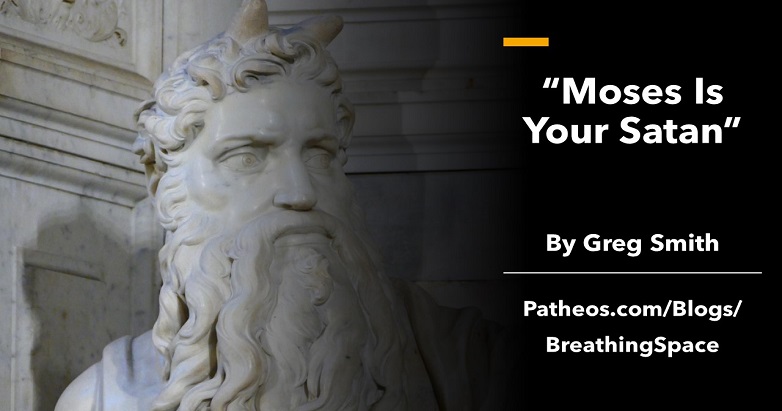
Image by LoggaWiggler on Pixaby
Artists of the Middle Ages depicted Moses with horns because of a common mistranslation that rendered the rays of light from his face as “horns.” (See Exodus 34:29-35.) Due to this translational error, countless artists depicted the prophet with golden shafts from his head, while others gave him full-blown antlers. Interestingly, artwork of the same era depicted Satan with horns. But this similarity may be more than mere appearance.
Your Accuser is Moses
Jesus said to the religious leaders of his day, “Your accuser is Moses, on whom all your hopes are set (Jn 5:45 NIV).” This must have sounded strange in his hearers’ ears. The Hebrew word for adversary or accuser is Satan. Biblia by Faithlife says:
The Hebrew noun שָׂטָן (satan) means “adversary” or “accuser.” The term appears in Job 1–2 as a title for a heavenly being who has some sort of prosecutorial or adversarial role in the heavenly court (Job 1:6–9, 12; 2:1–7; compare Zech 3:1). The word can also be used in a general sense for an accuser in a human legal context (e.g., Psa 109:6) or for a military or political enemy (e.g., 1 Sam 29:4; 1 Kgs 5:18). By the New Testament, the Hebrew word satan has come into Greek as Σᾰτάν (Sătan), a name for the devil (e.g., Luke 13:16). This being’s role as an accuser is mentioned once in the NT where Satan is called ὁ κατήγωρ (ho katēgōr, “the accuser”; Rev 12:9–10).
So, what could Jesus have meant when he said that Moses was their Satan? In John 5:46-47 NIV, Jesus says:
If you believed Moses, you would believe me, for he wrote about me. But since you do not believe what he wrote, how are you going to believe what I say?”
Does the Bible Save You?
The religious leaders of Jesus’ time claimed that they understood scripture better than anyone else. If they had been able to read between the lines, Jesus said they would have understood that Moses was writing about him. I’m cautious about superimposing the New Testament on top of Hebrew scriptures. Jewish writers never intentionally wrote about Jesus himself. They did, however, write about the Messiah, without a specific individual in mind. More importantly, they wrote about the Messianic way, in which every believer can live as a messiah. Even though Jesus’ religious hearers knew the scriptures, somehow, they missed the message.
In 5:39-40 NIV, Jesus says:
You study the Scriptures diligently because you think that in them you have eternal life. These are the very Scriptures that testify about me, yet you refuse to come to me to have life.
Those who heard Jesus’s message believed that their spirituality, oneness with God, and salvation could be found in keeping the whole of the law. Jesus said it was by this keeping of the law that they presumed to possess eternal life. Yet, this is not the point of the scriptures. Salvation does not come by keeping every point of the law, but by walking in Jesus’s Spirit of grace. It comes by replacing legalism with love, as Jesus did.
What Then is the purpose of the law? It gives moral direction, not perfectionism. When people fail, it guides them to redirect their course. It highlights principles of compassion and justice, and calls people to live a better way. But the law has a darker side, and Jesus touched on that when he said that Moses can be your Satan.
A Religion of Rules
As in Jesus’s time, religious people today often think that they can please God by keeping the law. Christianity for some is all about rules and regulations. “Do this, don’t do that, can’t you read the signs?” For these people, Moses and the law stand as accusers that point out personal failures. That horny devil Moses, with his tablets of law instead of pitchfork, stands as an accuser, shining a light on every failure for those who try to be saved by law-keeping. Trying to please God by keeping the law only results in disappointment.
The Law of Love
What, then, should we do? Antinomians abandon the law altogether, stating that where there is no law there is no transgression. But Jesus did not come to abolish the law. Instead, he came to fulfill it. How did he do this? By wrapping 613 Commandments up in two: to love God and love your neighbor. If you have done this, he says that you have fulfilled the law and the prophets. The Christian Life is not antinomian. There is a law – the law of love.
If you try to please God through moralism, Moses ceases to be a spiritual guide and instead becomes your accuser. Legalism does nothing but prove it’s impossible to keep the law. Pretty soon, holiness results in failure. But wholeness can come by living the law of love. Legalism pricks you with horny tines. But love makes your face shine like one who has seen God.
Health, Fitness and Religion
Home and Religion
Previous Post

June 14, 2022
Chopping Down the Tree of Life: How We’re Disconnecting from the Divine
Next Post
June 18, 2022 “Are Christians God’s Public Relations Committee?”
Browse Our Archives
Select a Category Challenging the Church Deconstruction For Pastors Heathen Christianity Holidays and special days Mental Health Social Justice Spirituality Taoism Theology Uncategorized
Select a Month October 2026 September 2026 August 2026 July 2026 June 2026 May 2026 April 2026 March 2026 February 2026 January 2026 December 2025 November 2025 October 2025 September 2025 August 2025 July 2025 June 2025 May 2025 April 2025 March 2025 February 2025 January 2025 December 2024 November 2024 October 2024 September 2024 August 2024 July 2024 June 2024 May 2024 April 2024 March 2024 February 2024 January 2024 December 2023 November 2023 October 2023 September 2023 August 2023 July 2023 June 2023 May 2023 April 2023 March 2023 February 2023 January 2023 December 2022 November 2022 October 2022 September 2022 August 2022 July 2022 June 2022 May 2022 April 2022 March 2022 February 2022 January 2022
Follow Us!
TAKE THE
Religious Wisdom Quiz
What did Moses break upon seeing the people worshiping an idol?
Select your answer to see how you score.
Stone tablets The altar The Ark Aaron's staff
Related posts from Breathing Space

“Can You Follow Jesus and Still Practice Smudging?”

Jesus and Lao Tzu: Seven Striking Parallels

Mo Thomas: Book Review from a Black Hole

“You Got Your Lao Tzu on My Jesus!”
TRENDING AT PATHEOS Progressive Christian

Why Christians Have a Sacred Duty to Vote:...
The Bible offers strong support for the sacred duty to vote. Here...

What Being a Modern-Day Apostle Means to Me
In my last column, I discussed the ins and outs of modern-day...

Did Ancient China Once Worship the God of...
Across human history, a common thread weaves through the origins of the...

Love Your Neighbor – Including Earth-Kin: Lev. 19,...
God’s command to love your neighbor means acting in an ethical and...

Lead a Church Study of “Jesus and Lao...
Guest writer Jack Thomas (The Irreverent Reverend) reflects on leading his church...

Principles for Understanding the Apostolic Ministry Today
Whenever people discover that my formal ministry title is "apostle," as in...
view all Progressive Christian blogs
Ad-Free & Subscriber Log-In Subscription Support
- About Us
- 2026 Calendar
- Videos
- Podcasts
- Library of World Religions
- Faith In Media Tracker
- Advertise With Us
- Write for Us
- Privacy Policy
- Terms of Service
- Do Not Sell My Data
- Contact Us
- Radiant Digital
- Manage Newsletter Subscriptions
- Unsubscribe From Notifications
- Sitemap
Copyright 2008-2026, Patheos. All rights reserved.
Subscription Support Ad-Free & Subscriber Log-In
Follow Patheos