
BuddhistCatholicContemplativeEvangelicalGeneral ChristianHinduJewishLatter-day SaintMuslimNew VisionsProgressive Christian
Beliefs
- Buddhist
- Catholic
- Contemplative
- Evangelical
- General Christian
- Hindu
- Jewish
- Latter-day Saint
- More Voices
- Muslim
- New Visions
- Pagan
- Progressive Christian
Topics
- Religion News
- Food and Religion
- Sports and Religion
- Religious Art
- Religious Music and Entertainment
- Religious Events
- History and Religion
- Style and Religion
- Politics and Religion
- Women in Religion
- Recreation Outdoors and Religion
- Business Finance and Religion
- Careers Workplace and Religion
- Education and Religion
- Family Parenting and Religion
- Health Fitness and Religion
- Home and Religion
- Relationships and Religion
- Technology and Religion
- Travel and Religion
Columnists
- Buddhist Columnists
- Business Finance and Religion Columnists
- Careers Workplace and Religion Columnists
- Catholic Columnists
- Contemplative Columnists
- Education and Religion Columnists
- Evangelists Columnists
- Family Parenting and Religion Columnists
- General Christian Columnists
- Health Fitness and Religion Columnists
- Hindu Columnists
- History and Religion Columnists
- Home and Religion Columnists
- Jewish Columnists
- More Voices Columnists
- Latter Day Columnists
- Muslim Columnists
- New Visions Columnists
- Nonreligious Columnists
- Pagan Columnists
- Politics and Religion Columnists
- Progressive Columnists
- Recreation Outdoors and Religion Columnists
- Relationships and Religion Columnists
- Religion News Columnists
- Religious Art Columnists
- Religious Events Columnists
- Religious Music and Entertainment Columnists
- Sports and Religion Columnists
- Style and Religion Columnists
- Technology and Religion Columnists
- Travel and Religion Columnists
- Women in Religion Columnists
Resource Library
- 2026 Calendar
- Library of World Religions
- The 100 Most Holy Places on Earth
- Patheos Answers
- Podcasts
- Videos
- Faith Leaders Database
- Anglican Episcopalian
- Bahai
- Baptist
- Buddhism
- Christianity
- Confucianism
- Eastern Orthodoxy
- Hinduism
- Holiness and Pentecostal
- ISKCON
- Islam
- Judaism
- Lutheran
- Methodist
- The Church of Jesus Christ of Latter-day Saints
- New Age
- Paganism
- Presbytarian and Reformed
- Protestantism
- Religion Behind the Scenes
- Roman Catholic
- Scientology
- Shia Islam
- Sikhism
- Sufism
- Sunni Islam
- Taoism
- Zen
- See all religions
Research Tools
 Ad-Free & Subscriber Log-In Subscription Support
Ad-Free & Subscriber Log-In Subscription Support
Follow Patheos 

- Trending:
- Forgiveness
- |
- Marriage
- |
- Consciousness
- |
- Death Penalty
- |
- Election
- |
- Halloween

-
Categories
- Home
- Progressive Christian
- “The Rocks Cry Out: Jesus and Panentheism”
“The Rocks Cry Out: Jesus and Panentheism”
Last updated on: April 10, 2022 at 5:00 am by Gregory T. Smith
“The Rocks Cry Out: Jesus and Panentheism” 2022-04-08T15:41:49-08:00 Gregory T. Smith
Patheos Explore the world's faith through different perspectives on religion and spirituality! Patheos has the views of the prevalent religions and spiritualities of the world.
My personal journey of faith deconstruction began with the events of Palm Sunday.
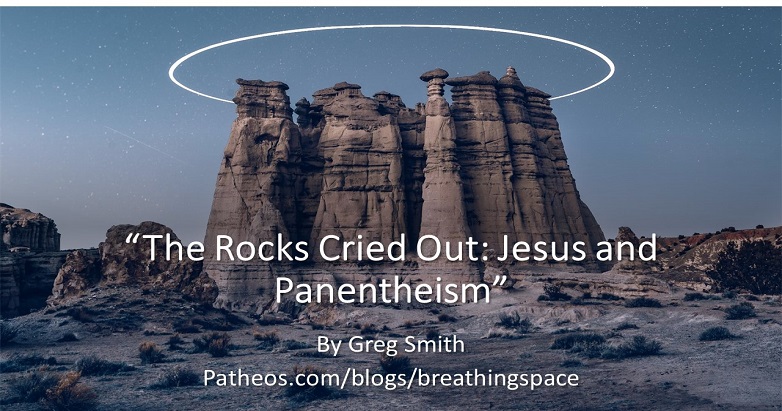
“Aerial Photography of Rock Formation” by Ian Beckley on Pexels
My Deconstruction Began on Palm Sunday
Palm Sunday sermons focus on Jesus’ triumphal entry into Jerusalem. Believers in penal substitutionary atonement often say that on this same day, lambs were selected for sacrifice, and Jesus was selected by the crowd that hailed him. Progressives like me often discuss how Jesus refused participate in societal power structures, as evidenced by his riding a donkey rather than a stallion. (See my article, “The God Who Wouldn’t Be King.”)
But today I want to focus on something more mystical, that became a part of my personal story of deconstruction. When Jesus entered Jerusalem on what we now call Palm Sunday, a crowd welcomed him with palm branches. Luke 19.37-40 NRSV says:
As he was now approaching the path down from the Mount of Olives, the whole multitude of the disciples began to praise God joyfully with a loud voice for all the deeds of power that they had seen, saying,
“Blessed is the king
who comes in the name of the Lord!
Peace in heaven,
and glory in the highest heaven!”
Some of the Pharisees in the crowd said to him, “Teacher, order your disciples to stop.” He answered, “I tell you, if these were silent, the stones would shout out.”
Wait–What?
Jesus’ words stopped me in my tracks. “Did he just say that the stones could cry out to praise him?” Deconstruction can happen when you’re going along, reading a perfectly normal scripture that you’ve encountered hundreds of times, and you stop. “Wait—what?” Suddenly, something hits you differently than it ever did before, and its impact changes your life. It invites you to dig into its meaning and opens an array of other interpretations. When you’re done, your faith and your life are changed forever. For me, these verses were the beginning of my deconstruction.
What If…?
Growing up in a conservative church, I was raised to take the whole Bible literally. Now, I no longer take it all literally, though I do take it all seriously. But a quarter century ago when this passage first smacked me in the face, I was much more literalistic in my approach. I began to wonder about this—what if the stones could cry out? What if they are crying out, and we just don’t hear it? What if all creation is more sentient than we think it is? Are there other scriptures that support this notion? I turned to Psalm 19.1-4 NRSV:
The heavens are telling the glory of God;
and the firmament proclaims his handiwork.
Day to day pours forth speech,
and night to night declares knowledge.
There is no speech, nor are there words;
their voice is not heard;
yet their voice goes out through all the earth,
and their words to the end of the world.
I asked myself, “What if the heavens really had a voice?” The rabbit hole was getting deeper. I continued searching the Bible…
- In Matthew 8.26 NRSV, the disciples “…were amazed, saying, “What sort of man is this, that even the winds and the sea obey him?” If the wind and waves can obey, they must be sentient.
- Isaiah 55.12 NRSV says, “For you shall go out in joy, and be led back in peace; the mountains and the hills before you shall burst into song, and all the trees of the field shall clap their hands.”
- Romans 8.22 NRSV says, “We know that the whole creation has been groaning in labor pains until now; and not only the creation, but we ourselves, who have the first fruits of the Spirit, groan inwardly while we wait for adoption, the redemption of our bodies.
- When Jesus curses the fig tree in Matthew 21 and Mark 11, the scripture implies that he did so because the plant disobeyed his expectations that it miraculously produce fruit out of season.
A Living Universe
Countless other scriptures use “poetic” language to describe a sentient creation that responds to God, humanity, and itself in ways that would be uncanny if they were taken literally. I continued to ponder. I even started drafting a novel based on the idea. (I never finished it, and now I realize that C.S. Lewis’ Narnia is like what I had envisioned.) The idea continued to intrigue me. I began to realize how Christianity had divorced itself from Creation. I saw how, along with modernization and the Enlightenment, we had adopted a view of a mechanized universe as opposed to a living one. The more I studied, the more I came to believe that these verses weren’t all poetic—and that the cosmos has more awareness than we give it credit for.
I thought, “How strange, that denominations that believe the Bible literally don’t give these passages the same treatment.” I wondered, “What if there are other scriptures that are meant to be taken literally instead of poetically? Or, conversely, scriptures that we take literally, that are meant figuratively?” This opened an assortment of problems on an array of topics that I won’t get into here. I’ll just say it created the freedom to view the Bible in fresh ways, and to deconstruct scriptures from the way I’d originally learned them.
Exploring Panentheism
I began to delve into the spirituality of my Celtic and Native American ancestors, discovering a connection that I had never known before. I attuned myself to the cycles of the moon, to the song and flight of birds, to the aromas of grass and flower and soil. I began to live in communion with nature, speaking to the trees and listening to the brooks. Monthly, I took the Lord’s Supper in solitude, under the pregnant moon and stars, offering the elements to the Elements and inviting them to share the body and blood of Christ with me.
All of this was so beautiful that I wondered why the Evangelical American church had divorced itself from nature. Why had we made Creation something to be subdued rather than tended? With my new earth-based Christianity, I began to adopt the ancient view of panentheism, the view that God is in all things. I came to believe that this was Jesus’ view, as well. The rocks could cry out, because they are full of God—just like we bear witness to the holy because the Divine is in us. Later, I discovered Richard Rohr’s views of panentheism, that “nature is ensouled.” We don’t live in a clockwork universe, but a holy, living, sentient, and expanding sphere of God’s presence.
All of this came to me from one verse that we normally read in passing during Holy Week. One verse caused an avalanche that shifted the spiritual ground on which I stood. Nothing has been the same for me ever since. I hope that during this season, your heart is opened to fresh birdsong from the Holy Spirit. As the rocks cry out and the heavens declare, I pray you’ll have ears to hear and a heart that’s expansive enough to listen to their chorus.
Previous Post

April 8, 2022
Grace comes before repentance, not after.
Next Post
April 12, 2022 Pastors: Deconstructing Your Faith Can Get You Crucified
Browse Our Archives
Select a Category Challenging the Church Deconstruction For Pastors Heathen Christianity Holidays and special days Mental Health Social Justice Spirituality Taoism Theology Uncategorized
Select a Month October 2026 September 2026 August 2026 July 2026 June 2026 May 2026 April 2026 March 2026 February 2026 January 2026 December 2025 November 2025 October 2025 September 2025 August 2025 July 2025 June 2025 May 2025 April 2025 March 2025 February 2025 January 2025 December 2024 November 2024 October 2024 September 2024 August 2024 July 2024 June 2024 May 2024 April 2024 March 2024 February 2024 January 2024 December 2023 November 2023 October 2023 September 2023 August 2023 July 2023 June 2023 May 2023 April 2023 March 2023 February 2023 January 2023 December 2022 November 2022 October 2022 September 2022 August 2022 July 2022 June 2022 May 2022 April 2022 March 2022 February 2022 January 2022
Follow Us!
TAKE THE
Religious Wisdom Quiz
Who preached the first Christian sermon on Pentecost in Acts?
Select your answer to see how you score.
James Peter Paul Philip
Related posts from Breathing Space

“Can You Follow Jesus and Still Practice Smudging?”

Lead a Church Study of “Jesus and Lao...

Jesus and Lao Tzu: Seven Striking Parallels

Mo Thomas: Book Review from a Black Hole
TRENDING AT PATHEOS Progressive Christian

What Being a Modern-Day Apostle Means to Me
In my last column, I discussed the ins and outs of modern-day...

Did Ancient China Once Worship the God of...
Across human history, a common thread weaves through the origins of the...

Love Your Neighbor – Including Earth-Kin: Lev. 19,...
God’s command to love your neighbor means acting in an ethical and...

Lead a Church Study of “Jesus and Lao...
Guest writer Jack Thomas (The Irreverent Reverend) reflects on leading his church...

Pastoral Wisdom for Responding to Sermon Pushback
Getting sermon pushback on your social justice sermon? Learn practical, Proverbs-based strategies...

Principles for Understanding the Apostolic Ministry Today
Whenever people discover that my formal ministry title is "apostle," as in...
view all Progressive Christian blogs
Ad-Free & Subscriber Log-In Subscription Support
- About Us
- 2026 Calendar
- Videos
- Podcasts
- Library of World Religions
- Faith In Media Tracker
- Advertise With Us
- Write for Us
- Privacy Policy
- Terms of Service
- Do Not Sell My Data
- Contact Us
- Radiant Digital
- Manage Newsletter Subscriptions
- Unsubscribe From Notifications
- Sitemap
Copyright 2008-2026, Patheos. All rights reserved.
Subscription Support Ad-Free & Subscriber Log-In
Follow Patheos