
BuddhistCatholicContemplativeEvangelicalGeneral ChristianHinduJewishLatter-day SaintMuslimNew VisionsProgressive Christian
Beliefs
- Buddhist
- Catholic
- Contemplative
- Evangelical
- General Christian
- Hindu
- Jewish
- Latter-day Saint
- More Voices
- Muslim
- New Visions
- Pagan
- Progressive Christian
Topics
- Religion News
- Food and Religion
- Sports and Religion
- Religious Art
- Religious Music and Entertainment
- Religious Events
- History and Religion
- Style and Religion
- Politics and Religion
- Women in Religion
- Recreation Outdoors and Religion
- Business Finance and Religion
- Careers Workplace and Religion
- Education and Religion
- Family Parenting and Religion
- Health Fitness and Religion
- Home and Religion
- Relationships and Religion
- Technology and Religion
- Travel and Religion
Columnists
- Buddhist Columnists
- Business Finance and Religion Columnists
- Careers Workplace and Religion Columnists
- Catholic Columnists
- Contemplative Columnists
- Education and Religion Columnists
- Evangelists Columnists
- Family Parenting and Religion Columnists
- General Christian Columnists
- Health Fitness and Religion Columnists
- Hindu Columnists
- History and Religion Columnists
- Home and Religion Columnists
- Jewish Columnists
- More Voices Columnists
- Latter Day Columnists
- Muslim Columnists
- New Visions Columnists
- Nonreligious Columnists
- Pagan Columnists
- Politics and Religion Columnists
- Progressive Columnists
- Recreation Outdoors and Religion Columnists
- Relationships and Religion Columnists
- Religion News Columnists
- Religious Art Columnists
- Religious Events Columnists
- Religious Music and Entertainment Columnists
- Sports and Religion Columnists
- Style and Religion Columnists
- Technology and Religion Columnists
- Travel and Religion Columnists
- Women in Religion Columnists
Resource Library
- 2026 Calendar
- Library of World Religions
- The 100 Most Holy Places on Earth
- Patheos Answers
- Podcasts
- Videos
- Faith Leaders Database
- Anglican Episcopalian
- Bahai
- Baptist
- Buddhism
- Christianity
- Confucianism
- Eastern Orthodoxy
- Hinduism
- Holiness and Pentecostal
- ISKCON
- Islam
- Judaism
- Lutheran
- Methodist
- The Church of Jesus Christ of Latter-day Saints
- New Age
- Paganism
- Presbytarian and Reformed
- Protestantism
- Religion Behind the Scenes
- Roman Catholic
- Scientology
- Shia Islam
- Sikhism
- Sufism
- Sunni Islam
- Taoism
- Zen
- See all religions
Research Tools
 Ad-Free & Subscriber Log-In Subscription Support
Ad-Free & Subscriber Log-In Subscription Support
Follow Patheos 

- Trending:
- Forgiveness
- |
- Marriage
- |
- Consciousness
- |
- Death Penalty
- |
- Election
- |
- Halloween

-
Categories
- Home
- Progressive Christian
- Pastors, Should You Hang Up Your Robes?
Pastors, Should You Hang Up Your Robes?
Last updated on: April 3, 2022 at 11:58 am by Gregory T. Smith
Pastors, Should You Hang Up Your Robes? 2022-04-03T11:58:19-08:00 Gregory T. Smith
Patheos Explore the world's faith through different perspectives on religion and spirituality! Patheos has the views of the prevalent religions and spiritualities of the world.
Now more than ever, pastors are asking themselves whether to continue in ministry, retire early, or change professions altogether. If you’re a pastor, what are you going to do?
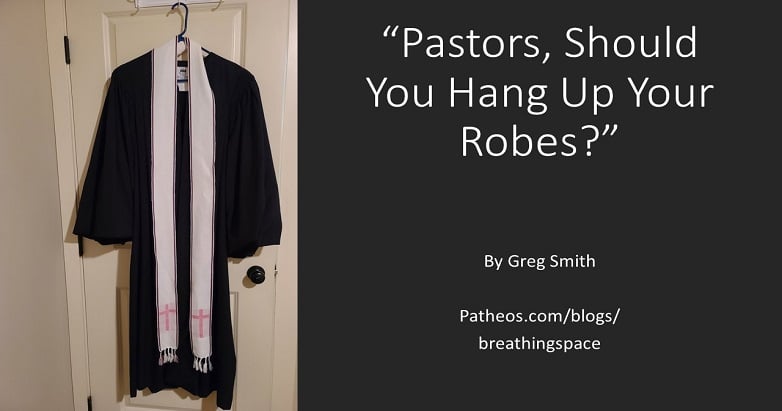
Image by Greg Smith
PASTORS LEAVING THE CHURCH
These days, many pastors are leaving the church, hanging up their robes and collars, taking their certificates off the wall and stuffing them in drawers. Ministers are finding it difficult to navigate the polarization in our society. From COVID guidelines to issues of racial and social justice and so much more, it seems a pastor can’t say anything without offending someone in the congregation. Add to that the increased number of pandemic deaths, economic woes that affect the church, and pastors’ need to learn technology at a rapid pace, and it all contributes to clergy exhaustion that results in pastors leaving the ministry.
I used to think that, at all costs, pastors needed to stay on the playing field. I even attended a multi-day conference called “Staying in the Game.” Ostensibly, the gathering was to discern whether or not to leave the ministry or a current ministry field, but the title indicated the true purpose–stemming the tide of early retirements and career changes. The church is losing pastors in epidemic proportions–and my state convention naturally wanted to encourage their ministers to stay. At the time, I decide to remain–and did stick with it for another eight years.
WHY I LEFT THE MINISTRY
While I certainly felt frustrated, manipulated, exhausted, and so many other things that cause pastors to leave the ministry, that’s not the reason I left the pulpit. I loved the churches that I served. My church was fully supportive of me as I went through an amicable divorce. I had heard horror stories about Baptist pastors forced out of their pulpits due to divorce, but my church stuck by me beautifully. When time passed and I found a new long-distance relationship my church supported that, as well. But as we looked toward marriage, one of us had to move. As we prayed, it became clear to us that the one to move would be me.
Most of the 26 years I spent in ministry were in Southern Baptist churches. I knew I needed to make a change for a couple of reasons. First, there are no Southern Baptist churches in the Fraser Valley in British Columbia, where I now live. Second, I was never a good Baptist theologically. My divorce threw me into a time of spiritual deconstruction and reconstruction that made me even more of a theological misfit. So, I knew my days in Baptist churches were done.
In addition, I didn’t want to jump through the hoops required to transfer my ordination to another denomination. Truthfully, I couldn’t find another denomination that was a good fit for me anyway. I like the vitality of contemporary worship, but my theology is progressive. It’s hard to find a left-leaning ministry setting that embraces contemporary worship music. All this makes me a poor fit for any church or denomination.
Plus**, I saw the damage that ministry had done to my first marriage, and to my children.** Although my new wife, Christina, was ready to join me in ministry, I wasn’t sure it was a hardship I wanted to subject her to. The church is a difficult employer, and I didn’t want to add that stress to an international move and a new marriage. So, I knew I’d look for employment outside the church.
Besides that, I’m now fully convinced that even if I had not remarried and moved, I still would have left ministry by now. I was finding it hard to keep my mouth shut about certain concerns that were dear to my heart. Various social and theological issues have come up in the last three years that would have made it difficult for me to maintain the tactful neutrality that the pastorate demands**. Once I voiced my perspective on LGBTQ rights, BLM, immigration, and other issues, I would not have lasted long in rural Southern Baptist life.**
THE JOB HUNT
To discourage ministers from leaving the ministry, I was told that nobody wants to hire former pastors. Supposedly, we possess a unique set of skills that’s specific enough to disqualify us from secular work, yet not specific enough to qualify us for jobs in the private sector. This belief that I couldn’t get a good-paying job elsewhere held me bound to the idea that, in terms of career, I was “stuck” in ministry.
Fortunately, another former pastor who happened to work at an employment agency helped me refine my resume. Instead of a history-based resume that said, “Church, church, church,” we developed a skills-based resume that highlighted the soft skills that do transfer from ministry to the secular job market. Things like, “Office management, public speaking, time management, supervision of staff,” and so on. As soon as I re-worked my ministry resume into a secular one, that overcame the first hurdle. I quickly learned that former pastors have skills that translate to the secular job market–especially in the field of nonprofit and social work. After that, it wasn’t difficult to find meaningful and gainful employment.
WHY I’M OK OUTSIDE OF THE PULPIT
At one time, I felt that if I left the ministry, I was betraying my calling. I encouraged other hurting pastors to stay the course, no matter what. Those days are no more. Today, my ordination certificate and license to ministry lie folded in a drawer with my underwear–something else that people know I have, but never need to see. When a friend asked me, “Do you think you’d ever need those papers to pastor a church again?” I snorted and almost blew coffee out of my nose.
“Hell, no!” I told her. Of course, I should never say never, but probably not. Here’s why I don’t think I’ll ever pastor a church again:
1. I’ve realized that calls to ministry aren’t necessarily for life. There’s no doctrinal or ecclesial reason a pastor must remain a pastor until he or she dies. There’s also nothing stating that if a pastor leaves ministry, it’s a failure. When a person puts in twenty years, they can retire from the military at age thirty-eight, with full honors and full pension. So, after I put twenty-six years into church ministry, why can’t I retire with dignity and have a whole other career? I can!
2. I’m still making a positive difference in the world. If my motivation for ministry were to help the hurting and empower the powerless, that role is filled by the past few years I’ve spent as a case manager, working mostly with clients experiencing homelessness. I think I’ve learned far more by doing social justice work than I did from seminary or church work. But I’ve also learned that I could drive a truck, work a toll booth, or have any other job, and still care for people as Jesus would. This Jesus-style love fulfills my calling, regardless of my employer. I used to preach that all Christians are ministers. If I believe that truth, then I can live that truth.
3. There are more people who read my blog than heard my sermons. So, if I were motivated by the need to have an audience, the blog’s better than a pulpit any day. Sure, there are times when I miss public speaking–but sermons always start with writing–and I’m doing more of that than I did before.
4. It’s good to not be in control. If I felt like ministry was about being a spiritual authority or having power over others, that would have been the wrong motivation. Certainly, some pastors see themselves as “over” their parishioners–but that was never my view. In fact, this method of ministry can be the gateway to spiritual abuse. With writing, there’s no suggestion that I have any spiritual guardianship over my readers–and that’s a good thing! I’m not responsible for your spiritual welfare–I just tell the truth as I see it, and let the Holy Spirit do the rest. I’m not about controlling your beliefs.
5. Nobody’s policing my beliefs, as was frequently the case in the twenty-six years I served the Church. While not everybody likes the things I write, the worst they can do is leave a negative comment–they don’t control my paycheck. This financial control over a pastor’s spiritual development and theology is probably the biggest reason for not going back to the pulpit. Each time I stuck my neck out to express a new spiritual thought, I knew that my detractors within that congregation would use it to convince others that I was a heretic, or a liberal, or whatever label they wanted to use to gain control over me. In the churches I served, we talked about the pastor having the “freedom of the pulpit,” but that was more of a theory than a reality. I feel so much freedom, now that I don’t have any theology watchdogs breathing down my neck.
WHAT ABOUT YOU?
Today, I’m as certain as I can be that I won’t pastor another church. But what about you? Are you prayerfully considering leaving full-time ministry? Are you thinking of retirement or changing careers? If you are, you’ve likely told others who are doing their best to convince you to stay. Perhaps they’ve said you’re abandoning your call from God. Or maybe they’ve spread guilt on thick about all the folks who need you. I’m guessing you’re hearing voices saying that you should stay.
So let me be a voice from the other side. The only*“should”* is what you decide to do, and whatever you can live with, in your own conscience. Don’t let anybody manipulate you to believe otherwise.
The same Holy Spirit who called you to ministry can also release you from it. There’s good you can do, outside the role of pastor. Don’t let anybody convince you that there’s no other employment for you. You’ve gained great skills as the leader of a nonprofit and can build your resume on those. You can still make a positive difference, helping people. You can still share your faith–with a wider audience than before. I’m not saying you ought to step out of your pulpit. I am saying that if you do, you’re not abandoning your ministry. You may just discover a new facet that you’ve never seen before.
Previous Post

March 29, 2022
Praying Like My Cat
Next Post
April 6, 2022 Does Your Church Have Hoarding Disorder?
Browse Our Archives
Select a Category Challenging the Church Deconstruction For Pastors Heathen Christianity Holidays and special days Mental Health Social Justice Spirituality Taoism Theology Uncategorized
Select a Month October 2026 September 2026 August 2026 July 2026 June 2026 May 2026 April 2026 March 2026 February 2026 January 2026 December 2025 November 2025 October 2025 September 2025 August 2025 July 2025 June 2025 May 2025 April 2025 March 2025 February 2025 January 2025 December 2024 November 2024 October 2024 September 2024 August 2024 July 2024 June 2024 May 2024 April 2024 March 2024 February 2024 January 2024 December 2023 November 2023 October 2023 September 2023 August 2023 July 2023 June 2023 May 2023 April 2023 March 2023 February 2023 January 2023 December 2022 November 2022 October 2022 September 2022 August 2022 July 2022 June 2022 May 2022 April 2022 March 2022 February 2022 January 2022
Follow Us!
TAKE THE
Religious Wisdom Quiz
What city is known as the birthplace of Jesus?
Select your answer to see how you score.
Nazareth Galilee Jerusalem Bethlehem
Related posts from Breathing Space

“Can You Follow Jesus and Still Practice Smudging?”

I Met Papa Before I Read The Shack

The Guest Who Stayed at an Unfriendly Table

Jesus and Lao Tzu: Allowing Your Enemies
TRENDING AT PATHEOS Progressive Christian

What Being a Modern-Day Apostle Means to Me
In my last column, I discussed the ins and outs of modern-day...

Did Ancient China Once Worship the God of...
Across human history, a common thread weaves through the origins of the...

Love Your Neighbor – Including Earth-Kin: Lev. 19,...
God’s command to love your neighbor means acting in an ethical and...

Lead a Church Study of “Jesus and Lao...
Guest writer Jack Thomas (The Irreverent Reverend) reflects on leading his church...

Pastoral Wisdom for Responding to Sermon Pushback
Getting sermon pushback on your social justice sermon? Learn practical, Proverbs-based strategies...

Principles for Understanding the Apostolic Ministry Today
Whenever people discover that my formal ministry title is "apostle," as in...
view all Progressive Christian blogs
Ad-Free & Subscriber Log-In Subscription Support
- About Us
- 2026 Calendar
- Videos
- Podcasts
- Library of World Religions
- Faith In Media Tracker
- Advertise With Us
- Write for Us
- Privacy Policy
- Terms of Service
- Do Not Sell My Data
- Contact Us
- Radiant Digital
- Manage Newsletter Subscriptions
- Unsubscribe From Notifications
- Sitemap
Copyright 2008-2026, Patheos. All rights reserved.
Subscription Support Ad-Free & Subscriber Log-In
Follow Patheos