
BuddhistCatholicContemplativeEvangelicalGeneral ChristianHinduJewishLatter-day SaintMuslimNew VisionsProgressive Christian
Beliefs
- Buddhist
- Catholic
- Contemplative
- Evangelical
- General Christian
- Hindu
- Jewish
- Latter-day Saint
- More Voices
- Muslim
- New Visions
- Pagan
- Progressive Christian
Topics
- Religion News
- Food and Religion
- Sports and Religion
- Religious Art
- Religious Music and Entertainment
- Religious Events
- History and Religion
- Style and Religion
- Politics and Religion
- Women in Religion
- Recreation Outdoors and Religion
- Business Finance and Religion
- Careers Workplace and Religion
- Education and Religion
- Family Parenting and Religion
- Health Fitness and Religion
- Home and Religion
- Relationships and Religion
- Technology and Religion
- Travel and Religion
Columnists
- Buddhist Columnists
- Business Finance and Religion Columnists
- Careers Workplace and Religion Columnists
- Catholic Columnists
- Contemplative Columnists
- Education and Religion Columnists
- Evangelists Columnists
- Family Parenting and Religion Columnists
- General Christian Columnists
- Health Fitness and Religion Columnists
- Hindu Columnists
- History and Religion Columnists
- Home and Religion Columnists
- Jewish Columnists
- More Voices Columnists
- Latter Day Columnists
- Muslim Columnists
- New Visions Columnists
- Nonreligious Columnists
- Pagan Columnists
- Politics and Religion Columnists
- Progressive Columnists
- Recreation Outdoors and Religion Columnists
- Relationships and Religion Columnists
- Religion News Columnists
- Religious Art Columnists
- Religious Events Columnists
- Religious Music and Entertainment Columnists
- Sports and Religion Columnists
- Style and Religion Columnists
- Technology and Religion Columnists
- Travel and Religion Columnists
- Women in Religion Columnists
Resource Library
- 2026 Calendar
- Library of World Religions
- The 100 Most Holy Places on Earth
- Patheos Answers
- Podcasts
- Videos
- Faith Leaders Database
- Anglican Episcopalian
- Bahai
- Baptist
- Buddhism
- Christianity
- Confucianism
- Eastern Orthodoxy
- Hinduism
- Holiness and Pentecostal
- ISKCON
- Islam
- Judaism
- Lutheran
- Methodist
- The Church of Jesus Christ of Latter-day Saints
- New Age
- Paganism
- Presbytarian and Reformed
- Protestantism
- Religion Behind the Scenes
- Roman Catholic
- Scientology
- Shia Islam
- Sikhism
- Sufism
- Sunni Islam
- Taoism
- Zen
- See all religions
Research Tools
 Ad-Free & Subscriber Log-In Subscription Support
Ad-Free & Subscriber Log-In Subscription Support
Follow Patheos 

- Trending:
- Forgiveness
- |
- Marriage
- |
- Consciousness
- |
- Death Penalty
- |
- Election
- |
- Halloween

-
Categories
- Home
- Progressive Christian
- Careers, Workplace and Religion
- Pastors: If Your Deconstruction Gets You Crucified, There’s Hope of Resurrection
Pastors: If Your Deconstruction Gets You Crucified, There’s Hope of Resurrection
Last updated on: October 8, 2022 at 6:46 pm by Gregory T. Smith
Pastors: If Your Deconstruction Gets You Crucified, There’s Hope of Resurrection 2022-10-08T18:46:38-08:00 Gregory T. Smith
Patheos Explore the world's faith through different perspectives on religion and spirituality! Patheos has the views of the prevalent religions and spiritualities of the world.
For pastors deconstructing your faith, the events of Holy Week become a showcase for how your faith shift can get you crucified.
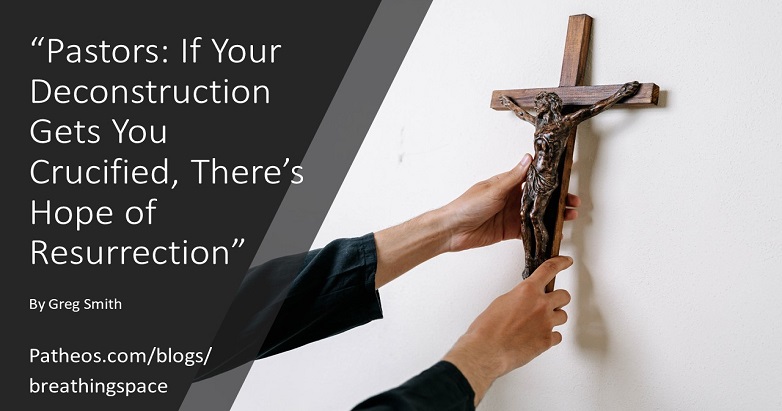
Photo by Ivan Samkov from Pexels
In my last article, I talked about the first half of Holy Week. Palm Sunday was all about Jesus confronting empire. Like Jesus separating himself from the theology of his day, your changing theology can also alter your politics. This can give your parishioners reason to turn against you. Monday marked the day that Jesus cleared the temple. Pastors who reevaluate their religion often come to a point of saying, “enough is enough.” Of course, this can win them enemies among religious leaders. On Tuesday, Jesus called out the hypocrites and blind guides. When your faith revision causes you to confront hypocrisy you never saw before, it may solidify your congregants’ resolve to get rid of the preacher. Let’s take a look at the rest of Holy Week, and how it may lead to your own personal Calvary.
Wednesday – Time to Rest
Scriptures remain silent regarding the events of Holy Wednesday. Perhaps Jesus used this day to rest. Maybe he fished with the disciples or prayed by himself. If so, it was certainly because he suspected what was ahead, and needed to prepare. Given that it was Wednesday, good Evangelicals might expect him to be in Bible Study or choir practice—because church doors must be open mid-week. It’s amazing to me how some believers superimpose twenty-first century church structures on top of first century Jewish life. But the fact is, Jesus probably took the day off on what was traditionally a work day. He had long ago deconstructed certain days as holier or more mundane than others.
You’ve probably done the same—deconstructing Sabbath laws and allowing yourself to work on Sunday but take a day off sometime during the week. You’ve probably also discovered that often your church members don’t understand a pastor’s schedule. You’ve needed to be careful that they don’t find you napping, lest they call you lazy and remind you of all the lost sheep out there. Rest too much, and they’ll say you only work on Sunday. Yes, the fact that you’ve deconstructed enough to allow yourself to rest during the week can often reap criticism from the church.
Thursday – Losing Dear Friends
Jesus’ radical teachings that came from his faith shift caused him to lose friends and gain enemies. Thursday saw him gathering his disciples for a final meal, then heading to the garden to pray. One friend in particular, disappointed in his master’s deconstructed and reshaped teaching and political opinions, betrayed him into the hands of religious authorities. The faith that formed Jesus’ upbringing turned against him when his critique hit too close to home. If he’d never dismantled the flawed teachings they handed him as a youth, he’d have been just fine. But the new beliefs that came from his reevaluation led to new teachings that ostracized friends and fellow teachers alike.
If your path of deconstruction has caused some of your dear friends to desert you, you’re in good company. Many deacons, elders, and other church leaders who had your back in the good times will turn on you quickly if they see you questioning established doctrine. Fellow ministers with whom you’ve built deep relationships will shun you or argue with you in public. Rather than giving you the freedom to explore and question, they’ll label you a heretic and ask for your resignation. Be careful about revealing too much before you’re ready, or Judas just might kiss your cheek.
Friday – “Eloi, Eloi, Lama Sabachthani”
Hanging from the cross, Jesus asked God, “Why have you forsaken me?” You’ve heard it—and maybe you’ve even preached it—that because God cannot look on sin, the Divine Parent turned an offended face away from the Son who bore our sin. The problem with this notion is that God can never deny Godself and could never have abandoned Jesus on the cross. So, what did Jesus’ agonized outcry mean? Simply this—in addition to the unimaginable anguish of the cross, Jesus’ situation caused him to doubt his own belovedness.
Let’s not glorify deconstruction. It really sucks. Deconstruction can be like dominoes that fall one after another. One problematic doctrine leads to a whole set of untenable dogmas from your church or denomination. The Bible becomes fair game, and after that the church traditions topple too. Everything’s up for reevaluation. It can feel lonely, especially when you lose friends, family, or church members over it. When you get crucified before the church board or even lose your job, you might ask yourself the same question Jesus did. “My God—why have you forsaken me?” Deconstruction isn’t trendy or sexy—it’s excruciating and scary. And, like Jesus, you might not see any hope before the end.
In the crucifixion’s grief, it seemed all was lost. Jesus lay in the tomb, and the disciples scattered. Deconstruction had led to death, and hopelessness held the faithful bound. But, as the old sermon by S.M. Lockridge says, “It’s Friday, but Sunday’s coming.” They didn’t know it yet, but resurrection was on the way. It’s the same for you, when deconstruction leads to the death of all you’ve known. It may feel like Friday. But Sunday’s coming. Remember—the end isn’t the end.
Resurrection Day
If the events of Holy Week serve as a showcase for deconstruction leading to crucifixion, then Easter promises resurrection. Whether your faith shift has led you from conservative to progressive Christianity, or whether it’s led you away from the faith altogether, there’s still hope in the message of Easter. You don’t have to believe in a literal resurrection to know that life can arise from death. Like Jesus from the tomb, or like a sapling from a stump, you can rise from doubt, abandonment, agony, and despair.
Deconstruction is like the grief of death—you’re never the same afterwards. Just as you never get over the loss of a loved one, you can never un-deconstruct. The cord is cut; the golden bowl is broken. While you can’t put the pieces back together, if you still yearn for God after all the dust has cleared, you can rebuild a new relationship with the Creator. Your old dead theology doesn’t mean an old dead God. You can thoughtfully develop a relationship with the God of your new understanding—whether or not your family, old friends, parishioners, or colleagues agree.
Finally, if you’re a pastor whose deconstruction has threatened or ended a job, there’s hope of resurrection for you. That loss might be a blessing in disguise, setting you free from the constraints of a doctrinal system that held you bound. Just as Jesus left his grave clothes behind, you can step out of the old wrappings into a new and glorious career.
If you still feel called to ministry, you may need to look into changing to a denomination or church that more closely fits your convictions. That could mean going back to school, if you’re up for it. Or, you might consider social work as I have done, helping the marginalized in a full-time capacity rather than the occasional benevolent request that crosses a pastor’s desk. Or, you may decide to step back from helping professions and focus on something entirely different. I know former pastors who have found fulfillment as carpenters, painters, or bus drivers. They say it’s refreshing to work with something physical instead of handling theological concepts and vicarious trauma. Read my article, “Pastors, Should You Hang Up Your Robes?” to explore more. However you reconstruct your career, let me assure you. As painful as it is now, it will feel like resurrection once you’re free from the systems that control you today.
Yes, Pastors just want to be like Jesus. And just like him, deconstructing your faith can get you crucified. But just as Jesus’ resurrected body differed in glory from that of his earthly body, so your rebuilt life and faith can be infinitely more free than what you knew before. This Holy Week, if you feel like your faith shift could lead to the dismantling of your ministry, let me encourage you. It may feel like Friday—but Sunday’s coming.
Catholic
Contemplative
Eastern Orthodox
Evangelical
General Christian
Careers, Workplace and Religion
Previous Post

April 12, 2022
Pastors: Deconstructing Your Faith Can Get You Crucified
Next Post
April 17, 2022 When Your Story Sucks--Write a Better Ending
Browse Our Archives
Select a Category Challenging the Church Deconstruction For Pastors Heathen Christianity Holidays and special days Mental Health Social Justice Spirituality Taoism Theology Uncategorized
Select a Month October 2026 September 2026 August 2026 July 2026 June 2026 May 2026 April 2026 March 2026 February 2026 January 2026 December 2025 November 2025 October 2025 September 2025 August 2025 July 2025 June 2025 May 2025 April 2025 March 2025 February 2025 January 2025 December 2024 November 2024 October 2024 September 2024 August 2024 July 2024 June 2024 May 2024 April 2024 March 2024 February 2024 January 2024 December 2023 November 2023 October 2023 September 2023 August 2023 July 2023 June 2023 May 2023 April 2023 March 2023 February 2023 January 2023 December 2022 November 2022 October 2022 September 2022 August 2022 July 2022 June 2022 May 2022 April 2022 March 2022 February 2022 January 2022
Follow Us!
TAKE THE
Religious Wisdom Quiz
True or False: Saul held the coats of those who stoned Stephen.
Select your answer to see how you score.
TRUE FALSE
Related posts from Breathing Space

“Can You Follow Jesus and Still Practice Smudging?”

Lead a Church Study of “Jesus and Lao...

Jesus and Lao Tzu: Seven Striking Parallels

Mo Thomas: Book Review from a Black Hole
TRENDING AT PATHEOS Progressive Christian

What Being a Modern-Day Apostle Means to Me
In my last column, I discussed the ins and outs of modern-day...

Did Ancient China Once Worship the God of...
Across human history, a common thread weaves through the origins of the...

Love Your Neighbor – Including Earth-Kin: Lev. 19,...
God’s command to love your neighbor means acting in an ethical and...

Lead a Church Study of “Jesus and Lao...
Guest writer Jack Thomas (The Irreverent Reverend) reflects on leading his church...

Pastoral Wisdom for Responding to Sermon Pushback
Getting sermon pushback on your social justice sermon? Learn practical, Proverbs-based strategies...

Principles for Understanding the Apostolic Ministry Today
Whenever people discover that my formal ministry title is "apostle," as in...
view all Progressive Christian blogs
Ad-Free & Subscriber Log-In Subscription Support
- About Us
- 2026 Calendar
- Videos
- Podcasts
- Library of World Religions
- Faith In Media Tracker
- Advertise With Us
- Write for Us
- Privacy Policy
- Terms of Service
- Do Not Sell My Data
- Contact Us
- Radiant Digital
- Manage Newsletter Subscriptions
- Unsubscribe From Notifications
- Sitemap
Copyright 2008-2026, Patheos. All rights reserved.
Subscription Support Ad-Free & Subscriber Log-In
Follow Patheos