
BuddhistCatholicContemplativeEvangelicalGeneral ChristianHinduJewishLatter-day SaintMuslimNew VisionsProgressive Christian
Beliefs
- Buddhist
- Catholic
- Contemplative
- Evangelical
- General Christian
- Hindu
- Jewish
- Latter-day Saint
- More Voices
- Muslim
- New Visions
- Pagan
- Progressive Christian
Topics
- Religion News
- Food and Religion
- Sports and Religion
- Religious Art
- Religious Music and Entertainment
- Religious Events
- History and Religion
- Style and Religion
- Politics and Religion
- Women in Religion
- Recreation Outdoors and Religion
- Business Finance and Religion
- Careers Workplace and Religion
- Education and Religion
- Family Parenting and Religion
- Health Fitness and Religion
- Home and Religion
- Relationships and Religion
- Technology and Religion
- Travel and Religion
Columnists
- Buddhist Columnists
- Business Finance and Religion Columnists
- Careers Workplace and Religion Columnists
- Catholic Columnists
- Contemplative Columnists
- Education and Religion Columnists
- Evangelists Columnists
- Family Parenting and Religion Columnists
- General Christian Columnists
- Health Fitness and Religion Columnists
- Hindu Columnists
- History and Religion Columnists
- Home and Religion Columnists
- Jewish Columnists
- More Voices Columnists
- Latter Day Columnists
- Muslim Columnists
- New Visions Columnists
- Nonreligious Columnists
- Pagan Columnists
- Politics and Religion Columnists
- Progressive Columnists
- Recreation Outdoors and Religion Columnists
- Relationships and Religion Columnists
- Religion News Columnists
- Religious Art Columnists
- Religious Events Columnists
- Religious Music and Entertainment Columnists
- Sports and Religion Columnists
- Style and Religion Columnists
- Technology and Religion Columnists
- Travel and Religion Columnists
- Women in Religion Columnists
Resource Library
- 2026 Calendar
- Library of World Religions
- The 100 Most Holy Places on Earth
- Patheos Answers
- Podcasts
- Videos
- Faith Leaders Database
- Anglican Episcopalian
- Bahai
- Baptist
- Buddhism
- Christianity
- Confucianism
- Eastern Orthodoxy
- Hinduism
- Holiness and Pentecostal
- ISKCON
- Islam
- Judaism
- Lutheran
- Methodist
- The Church of Jesus Christ of Latter-day Saints
- New Age
- Paganism
- Presbytarian and Reformed
- Protestantism
- Religion Behind the Scenes
- Roman Catholic
- Scientology
- Shia Islam
- Sikhism
- Sufism
- Sunni Islam
- Taoism
- Zen
- See all religions
Research Tools
 Ad-Free & Subscriber Log-In Subscription Support
Ad-Free & Subscriber Log-In Subscription Support
Follow Patheos 

- Trending:
- Forgiveness
- |
- Marriage
- |
- Consciousness
- |
- Death Penalty
- |
- Election
- |
- Halloween

-
Categories
- Home
- Progressive Christian
- If You See God, Kill Him! – Separating God From Our Beliefs About God
If You See God, Kill Him! – Separating God From Our Beliefs About God
Last updated on: April 23, 2022 at 9:14 am by Gregory T. Smith
If You See God, Kill Him! – Separating God From Our Beliefs About God 2022-04-23T09:14:06-08:00 Gregory T. Smith
Patheos Explore the world's faith through different perspectives on religion and spirituality! Patheos has the views of the prevalent religions and spiritualities of the world.
“If you see the Buddha, kill him,” say the Buddhists. What a strange thing from people talking about their beloved teacher! Of course, they’re not referring to Gautama himself, since that enlightened one died thousands of years ago. So, what does this saying mean?
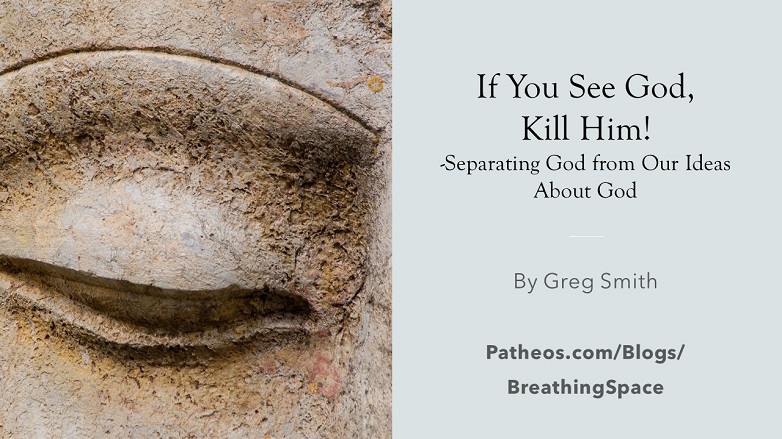
Image by donations welcome from Pixabay
Religions, Philosophies, and Ultimate Reality
The famous Buddhist aphorism means that ultimate reality is ultimately ungraspable. Suppose you were walking down the street one day and you met the Buddha. From the Buddhist perspective, this character claiming to be the Buddha may be a channel, but cannot be the source of absolute truth. Whatever seems to be perfect is less than perfect, and only represents perfection. Even Gautama, whom Buddhists revere, only points to the ultimate. And whatever we perceive to be supreme is still subdued so that human beings can grasp it.
Taoism says something similar. The Tao Te Ching begins by saying, “That which can be described as the Tao is not the Tao. Taoism employs many metaphors to describe the ultimate way. The Tao is like water, strong but soft. But water is not the Tao—it only represents the Watercourse Way. Lao Tzu says, “Nameless, is the origin of Heaven and Earth; The named is the Mother of all Things. Thus, the constant void enables one to observe the true essence.” Even naming it the Tao is insufficient—because anything you call it falls short of ultimate reality.
Even Plato agrees. The philosopher imagines that every tangible thing that exists only does so because it has an ultimate role model. A chair is a chair only because it is informed by the ultimate Chair that exists in an ethereal plane called the World of Forms. Anything that exists, Plato says, can only exist as a shadow of its perfect form. It follows, then, according to Platonism, that a god is only a god because somewhere there exists the ultimate God. But as soon as you point out something that looks and smells like a god, you know it cannot be ultimate God. Why? Because you saw it too clearly.
God at an Angle
Ultimate truth is something you can look at from the corner of your eye. But once you turn your head to focus, it vanishes like smoke. Perhaps this is why God put Moses in the cleft of the rock and allowed him only to see the Divine backside (Exodus 33). It’s said that no one can see God’s face and live. Metaphorically, this means that we cannot fully comprehend God. We can only get a glimpse of God at an angle, because our minds are too small to take in God’s fulness. We can’t put God in a box because once we do, God will prove to be bigger than the box.
Divine Metaphor
Like Lao Tzu, Jesus used metaphor to describe ultimate reality. The kingdom of God is adaptive, like childhood. Or free, like the wind. Or life-giving, like living water. The kingdom of God is expansive, like a bit of yeast in dough or a seed that grows into a tree. But these things are analogies, pointing to perfect truth without themselves being that ultimate reality. You cannot hold a seed in your hand and think that the seed is God. Though God is in the water, wind, or yeast, they are not God. That which points to God is not God. “If you meet the Buddha, kill him.” Anything that claims to be non-metaphorical God should be destroyed.
God in a Box
This explains the Hebrew prohibition against graven images. Prophets and heroes of old smashed idols to prove that stone and wood could not contain the Divine. The Tabernacle and Temple, seen as resting places for God, were not God and could not contain God. Though the Ark of the Covenant contained divine artifacts, it could not contain God—because you can’t put God in a box.
On the mount of transfiguration, Peter tried to put God in a box. He had such a sublime experience with Moses, Jesus, and Elijah that he wanted to construct three tabernacles to contain all the glory (Matthew 17). But God spoke from the mist, telling Peter instead to listen to Jesus. In other words, instead of trying to contain the moment, he should simply be in the moment. If you have a mountaintop experience of God, don’t try to hang onto that experience. Let your experience of God be fleeting—because God will not be contained.
“If you see the Buddha, kill him.” If you find one man to encapsulate ultimate truth, destroy him. Of course, this is what they did to Jesus who claimed to be the way, the truth, and the life. Jesus was so much God that they could not grasp him. Their theology couldn’t hold him. He blew their minds to such an extent that they had to get rid of him. The Cross could not overcome him, and the grave could not enclose him. You can’t put God in a box, and you can’t get a handle on Jesus.
Idol Making
Human nature, though, is to make an idol out of anything that looks like God. It’s not good Buddhism, but some Buddhists pray to statues of the enlightened one. It’s not good Christianity, but some Christians pray to the saints. Others pray to statues or pictures of Jesus—but by doing so, they miss the ultimate reality of God. What they are looking for it is not an image of God, but Actual God.
Still others make an idol out of their own theology. Facts and ideas about God become God to them. They become so certain that they have encapsulated God in their understanding that their notions about God become ultimate in their own minds. This is what Jesus meant when he said there will be many deceivers. If you hear someone say, “There’s Jesus on the mountain,” do not go. Because Jesus did not come to point us to ideas about God. He didn’t come to give us a better theology. He came to point us to Actual God and the Kingdom of Heaven.
“Do Not Cling to Me”
Even after his resurrection, Jesus told Mary, “Do not cling to me for I have not yet ascended to the Father (John 20.17).” Jesus knew that he is not the Source, but only came to point us to that Source. He came from the Source and ascended to the Source, but must not be confused with the Source. Jesus is part of the God, and told us that to see him is to see God. But only partly. Still, we see only in a mirror darkly. Now we know partially, but one day we will look Ultimate Reality straight in the face.
Of course, the face of God is a metaphor as well. But for now we deal with metaphors, pictures, and analogies. If you see the buddha, kill him. The Tao that can be described is not the Tao. The Kingdom of heaven is at hand, but not yet. We shall see him face to face—but God doesn’t have a face.
Grasping After the Wind
Does it bother you that so much theology seems like grasping after the wind? Instead of frustration, try holding the mystery lightly. “Let your attitude be like Christ Jesus, who did not consider equality with God something to be grasped (Philippians 2.5-6).” Constant grasping wears out the hands. You can’t grasp or contain God with your doctrines or creeds. With the humility of Jesus as your example, you can hold your ideas about God loosely, like cupping your hands into a bowl to catch water. For a little while, you can contain it, but soon it will run through your fingers. Let it be okay when God escapes your grasp. Because the god that can be described by your theology is not God. And you can really only see God out of the corner of your eye.
Previous Post

April 19, 2022
The Idol of Americianity
Next Post
April 25, 2022 Wrestling with God Builds Spiritual Muscle
Browse Our Archives
Select a Category Challenging the Church Deconstruction For Pastors Heathen Christianity Holidays and special days Mental Health Social Justice Spirituality Taoism Theology Uncategorized
Select a Month October 2026 September 2026 August 2026 July 2026 June 2026 May 2026 April 2026 March 2026 February 2026 January 2026 December 2025 November 2025 October 2025 September 2025 August 2025 July 2025 June 2025 May 2025 April 2025 March 2025 February 2025 January 2025 December 2024 November 2024 October 2024 September 2024 August 2024 July 2024 June 2024 May 2024 April 2024 March 2024 February 2024 January 2024 December 2023 November 2023 October 2023 September 2023 August 2023 July 2023 June 2023 May 2023 April 2023 March 2023 February 2023 January 2023 December 2022 November 2022 October 2022 September 2022 August 2022 July 2022 June 2022 May 2022 April 2022 March 2022 February 2022 January 2022
Follow Us!
TAKE THE
Religious Wisdom Quiz
Who built the Tower of Babel?
Select your answer to see how you score.
The Babylonians The Philistines The Canaanites The people of Shinar
Related posts from Breathing Space

“Can You Follow Jesus and Still Practice Smudging?”

Lead a Church Study of “Jesus and Lao...

Jesus and Lao Tzu: Seven Striking Parallels

Mo Thomas: Book Review from a Black Hole
TRENDING AT PATHEOS Progressive Christian

What Being a Modern-Day Apostle Means to Me
In my last column, I discussed the ins and outs of modern-day...

Did Ancient China Once Worship the God of...
Across human history, a common thread weaves through the origins of the...

Love Your Neighbor – Including Earth-Kin: Lev. 19,...
God’s command to love your neighbor means acting in an ethical and...

Lead a Church Study of “Jesus and Lao...
Guest writer Jack Thomas (The Irreverent Reverend) reflects on leading his church...

Pastoral Wisdom for Responding to Sermon Pushback
Getting sermon pushback on your social justice sermon? Learn practical, Proverbs-based strategies...

Principles for Understanding the Apostolic Ministry Today
Whenever people discover that my formal ministry title is "apostle," as in...
view all Progressive Christian blogs
Ad-Free & Subscriber Log-In Subscription Support
- About Us
- 2026 Calendar
- Videos
- Podcasts
- Library of World Religions
- Faith In Media Tracker
- Advertise With Us
- Write for Us
- Privacy Policy
- Terms of Service
- Do Not Sell My Data
- Contact Us
- Radiant Digital
- Manage Newsletter Subscriptions
- Unsubscribe From Notifications
- Sitemap
Copyright 2008-2026, Patheos. All rights reserved.
Subscription Support Ad-Free & Subscriber Log-In
Follow Patheos