
BuddhistCatholicContemplativeEvangelicalGeneral ChristianHinduJewishLatter-day SaintMuslimNew VisionsProgressive Christian
Beliefs
- Buddhist
- Catholic
- Contemplative
- Evangelical
- General Christian
- Hindu
- Jewish
- Latter-day Saint
- More Voices
- Muslim
- New Visions
- Pagan
- Progressive Christian
Topics
- Religion News
- Food and Religion
- Sports and Religion
- Religious Art
- Religious Music and Entertainment
- Religious Events
- History and Religion
- Style and Religion
- Politics and Religion
- Women in Religion
- Recreation Outdoors and Religion
- Business Finance and Religion
- Careers Workplace and Religion
- Education and Religion
- Family Parenting and Religion
- Health Fitness and Religion
- Home and Religion
- Relationships and Religion
- Technology and Religion
- Travel and Religion
Columnists
- Buddhist Columnists
- Business Finance and Religion Columnists
- Careers Workplace and Religion Columnists
- Catholic Columnists
- Contemplative Columnists
- Education and Religion Columnists
- Evangelists Columnists
- Family Parenting and Religion Columnists
- General Christian Columnists
- Health Fitness and Religion Columnists
- Hindu Columnists
- History and Religion Columnists
- Home and Religion Columnists
- Jewish Columnists
- More Voices Columnists
- Latter Day Columnists
- Muslim Columnists
- New Visions Columnists
- Nonreligious Columnists
- Pagan Columnists
- Politics and Religion Columnists
- Progressive Columnists
- Recreation Outdoors and Religion Columnists
- Relationships and Religion Columnists
- Religion News Columnists
- Religious Art Columnists
- Religious Events Columnists
- Religious Music and Entertainment Columnists
- Sports and Religion Columnists
- Style and Religion Columnists
- Technology and Religion Columnists
- Travel and Religion Columnists
- Women in Religion Columnists
Resource Library
- 2026 Calendar
- Library of World Religions
- The 100 Most Holy Places on Earth
- Patheos Answers
- Podcasts
- Videos
- Faith Leaders Database
- Anglican Episcopalian
- Bahai
- Baptist
- Buddhism
- Christianity
- Confucianism
- Eastern Orthodoxy
- Hinduism
- Holiness and Pentecostal
- ISKCON
- Islam
- Judaism
- Lutheran
- Methodist
- The Church of Jesus Christ of Latter-day Saints
- New Age
- Paganism
- Presbytarian and Reformed
- Protestantism
- Religion Behind the Scenes
- Roman Catholic
- Scientology
- Shia Islam
- Sikhism
- Sufism
- Sunni Islam
- Taoism
- Zen
- See all religions
Research Tools
 Ad-Free & Subscriber Log-In Subscription Support
Ad-Free & Subscriber Log-In Subscription Support
Follow Patheos 

- Trending:
- Forgiveness
- |
- Marriage
- |
- Consciousness
- |
- Death Penalty
- |
- Election
- |
- Halloween

-
Categories
- Home
- Progressive Christian
- Does Your Church Have Hoarding Disorder?
Does Your Church Have Hoarding Disorder?
Last updated on: April 6, 2022 at 5:06 am by Gregory T. Smith
Does Your Church Have Hoarding Disorder? 2022-04-03T12:32:15-08:00 Gregory T. Smith
Patheos Explore the world's faith through different perspectives on religion and spirituality! Patheos has the views of the prevalent religions and spiritualities of the world.
If your church has been around a while, it probably has hoarding disorder. We all know that individuals can have this diagnosable condition–but did you know that churches can be hoarders, too?
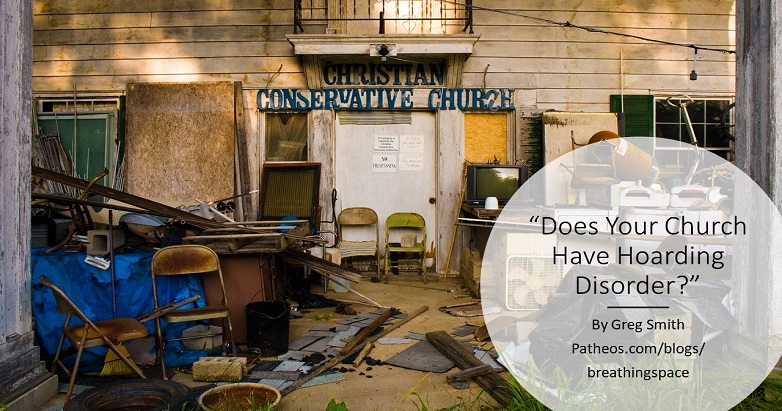
Image by Samantha Jade Royds on Flikr is licensed under CC BY 2.0
The Horror of Hoarding
The DSM-5 defines hoarding disorder as, “Persistent difficulty discarding or parting with possessions, regardless of their actual value.” It continues, “This difficulty is due to a perceived need to save the items and to the distress associated with discarding them.” You’ve seen the A&E TV show Hoarders, and maybe you’ve known someone who keeps their home so full of stuff that it’s hard to get around, difficult to clean, and even dangerous due to fall hazards and pests.
As a pastor and case manager, I’ve helped many people who suffer from hoarding disorder. One parishioner had a lovely yard, but when you entered the home there was wall-to-wall clutter, so thick that narrow footpaths on the floor were the only places you could step. Another church member allowed his hoard to move outdoors so that his yard was a cemetery for cars and tractors. Rusted farm implements lay like corpses at a crime scene, yard overgrown because no mower could cut around the scattered metal bodies. It’s important to remember that for hoarders it’s not about the stuff. It’s about insecurity and anxiety that stem from a loss of control. And this is something that churches know a lot about.
Hoarding Reveals Anxiety
Every church I served was over a hundred years old–which means their members remember the glory days when the pews were packed, the Sunday school rooms were brimming, and the baptistery was used frequently. With church decline, those classrooms are now storage areas filled with broken trophies, VBS decorations from a decade ago, black and white TVs, and moth-eaten choir robes. These unused spaces begin as repositories for imagined future use, but eventually become storehouses of useless junk. Churches that need to stockpile (not treasure) items from the past don’t demonstrate a love of church history. Instead, they reveal members’ anxiety about the future, based on waning attendance and decreased influence in society. They hold onto what they had yesterday because tomorrow is uncertain.
Three Reasons for Hoarding
In his training, Hoarding: How to Help Someone Not Get Evicted, Ryan Dowd describes the three reasons for hoarding as utility, memory, and identity. Some people hoard objects because they’re useful and they might need them. Others hoard things because they bring back recollections of people or events. Still others hoard items that connect them with a sense of being or belonging. The church does the same. For some, it’s a sense of nostalgia. For others, connection to the past is more difficult.
Hoarding and Trauma
Dowd points out a strong correlation between hoarding disorder and trauma. Hoarders are often the victims of physical violence, sexual assault, robbery/burglary, and excessive physical discipline. It seems the more we lose, the more we want to hold onto things. Church members that share one another’s pain, sorrow, and trauma often retain things they would ordinarily discard. Letting go of Grandma’s favorite broken piano feels like letting go of Grandma. It’s hard to get rid of stage props from that 1990s children’s Christmas play, when you’re afraid those grown children will never return.
Working with individuals who suffer from hoarding disorder, it’s best to help them celebrate the good things by creating photo albums, shadow boxes, and other ways of displaying treasures that were buried in the clutter. It’s easier to let go of some things when you learn to value others. One of the churches I served embraced the clean-out when we simultaneously created a “heritage room.” By learning to celebrate rather than stash, churches with hoarding disorder learn to value what’s really important.
Now, here’s where things start to get messy. If you’re not too squeamish, please read on…
Stockpiling People
Churches also exhibit hoarding disorder by stockpiling people. One church I served had a membership list of around two hundred people but had an attendance around forty. Another church numbered almost six hundred, while the attendance was a hundred twenty on Christmas and Easter.
Many no longer attend because they decided to go to church somewhere else but simply never transferred membership. Still others are actively protesting something or someone in the church, but they retain their membership to keep a “foot in the door.”
The problem with retaining so many absentees as members is that in a Baptist church is that every single one of them can vote–even if they haven’t darkened the sanctuary door in a decade. Why does the church allow such things? Well, the answer is complicated…
Hoarding Power
Every good Baptist can tell stories of business meetings where Aunt Sadie* wanted to vote the pastor out so she rallied the non-attending troops who kept their membership. I’ve even known deacons who quit attending church altogether but remained theoretically active on the board. Nobody wants to dissolve their membership, because they are firmly rooted members of the community, and to do so would disrupt the status quo.
People who are new to the neighborhood tend to change or remove their memberships when they no longer attend. However, those whose families are longstanding in the community generally keep their membership, even if they are actively boycotting the church. Aunt Sadie favors such an arrangement because it lets her retain power in the church. If she keeps all the “from-heres” in her pocket, she can keep the “come-heres” at bay. So, when I suggested the church clean up its membership list, Aunt Sadie opposed it. Sadie believes it best to allow people to vote who have no active involvement with the church because they’ll just vote the way she tells them to.
Just In Case
Some church members worship elsewhere or nowhere, but like to keep their membership, “just in case.” (This means that somehow, they believe they’ll face divine judgment after death, plead their membership at a Baptist church, and God will grand them a pass.) As they sing When the Roll is Called Yonder, I’ll be There, they mistake the church record for the Book of Life. Unfortunately, church leaders hesitate to remove such members because they believe the same false equivalency. We must understand that retaining members for the sake of bad theology simply perpetuates misunderstanding.
Maintaining Relationships
Some church leaders mistakenly think that by removing the person from the church roll, they are severing a relationship and preventing that person from returning in a time of crisis. Once, I even had someone request his own removal from membership, and the deacons refused, because “he needs to know he can always come back to us.” This kind of people-hoarding inflates numbers and does nobody any favors. Relationships are organic, and never institutional. If a person wants to return, they will–regardless of their name on a list. But by retaining a person as a member after they have requested removal, we violate their free will and show that their wishes are really no concern of ours.
The Purge
Just as cleaning out a church’s attic can be fraught with unseen perils, it can also be dangerous to purge the membership list of absentee members. Certainly, folks get upset when you throw out church memorabilia willy-nilly but prefer it when you create sacred space like a heritage room to display their hallowed objects. So too, church leaders can find ways to honor and celebrate non-attending members while inviting them to either recommit to attendance, join the other church that they’ve been attending, or withdraw membership entirely. I leave it to your creativity to figure out how to do this, in your community’s context. But by all means–if half of your membership isn’t attending, it’s time to declutter.
As we emerge from COVID, it almost feels like New Year’s–time to lose weight, tackle our untidiness, get a fresh start. As many emerge from their dens, they’re deciding it’s time to work on their hoarding disorder. Churches would do well to practice the same wisdom. When you’re cleaning the junk out of the unused Sunday school rooms, you might discover you have the space for a cafe. Or a food pantry. Or an office for that new staff member who’s long overdue. And while you’re at it, consider whether you’re holding too tightly to people who would rather be set free. By letting go of folks who don’t want to be there anyway, you honor their autonomy, decrease manipulation of church politics, and make room for the Holy Spirit to send you new people who want to commit to your community.
*Aunt Sadie is a fictional character, but she exists in every church.
Previous Post

April 3, 2022
Pastors, Should You Hang Up Your Robes?
Next Post
April 8, 2022 Grace comes before repentance, not after.
Browse Our Archives
Select a Category Challenging the Church Deconstruction For Pastors Heathen Christianity Holidays and special days Mental Health Social Justice Spirituality Taoism Theology Uncategorized
Select a Month October 2026 September 2026 August 2026 July 2026 June 2026 May 2026 April 2026 March 2026 February 2026 January 2026 December 2025 November 2025 October 2025 September 2025 August 2025 July 2025 June 2025 May 2025 April 2025 March 2025 February 2025 January 2025 December 2024 November 2024 October 2024 September 2024 August 2024 July 2024 June 2024 May 2024 April 2024 March 2024 February 2024 January 2024 December 2023 November 2023 October 2023 September 2023 August 2023 July 2023 June 2023 May 2023 April 2023 March 2023 February 2023 January 2023 December 2022 November 2022 October 2022 September 2022 August 2022 July 2022 June 2022 May 2022 April 2022 March 2022 February 2022 January 2022
Follow Us!
TAKE THE
Religious Wisdom Quiz
Who tried to seduce Joseph in Egypt?
Select your answer to see how you score.
Potiphar's wife Tamar Midianite woman Pharaoh's daughter
Related posts from Breathing Space

“Can You Follow Jesus and Still Practice Smudging?”

Lead a Church Study of “Jesus and Lao...

I Met Papa Before I Read The Shack

The Guest Who Stayed at an Unfriendly Table
TRENDING AT PATHEOS Progressive Christian

What Being a Modern-Day Apostle Means to Me
In my last column, I discussed the ins and outs of modern-day...

Did Ancient China Once Worship the God of...
Across human history, a common thread weaves through the origins of the...

Love Your Neighbor – Including Earth-Kin: Lev. 19,...
God’s command to love your neighbor means acting in an ethical and...

Lead a Church Study of “Jesus and Lao...
Guest writer Jack Thomas (The Irreverent Reverend) reflects on leading his church...

Pastoral Wisdom for Responding to Sermon Pushback
Getting sermon pushback on your social justice sermon? Learn practical, Proverbs-based strategies...

Principles for Understanding the Apostolic Ministry Today
Whenever people discover that my formal ministry title is "apostle," as in...
view all Progressive Christian blogs
Ad-Free & Subscriber Log-In Subscription Support
- About Us
- 2026 Calendar
- Videos
- Podcasts
- Library of World Religions
- Faith In Media Tracker
- Advertise With Us
- Write for Us
- Privacy Policy
- Terms of Service
- Do Not Sell My Data
- Contact Us
- Radiant Digital
- Manage Newsletter Subscriptions
- Unsubscribe From Notifications
- Sitemap
Copyright 2008-2026, Patheos. All rights reserved.
Subscription Support Ad-Free & Subscriber Log-In
Follow Patheos