
BuddhistCatholicContemplativeEvangelicalGeneral ChristianHinduJewishLatter-day SaintMuslimNew VisionsProgressive Christian
Beliefs
- Buddhist
- Catholic
- Contemplative
- Evangelical
- General Christian
- Hindu
- Jewish
- Latter-day Saint
- More Voices
- Muslim
- New Visions
- Pagan
- Progressive Christian
Topics
- Religion News
- Food and Religion
- Sports and Religion
- Religious Art
- Religious Music and Entertainment
- Religious Events
- History and Religion
- Style and Religion
- Politics and Religion
- Women in Religion
- Recreation Outdoors and Religion
- Business Finance and Religion
- Careers Workplace and Religion
- Education and Religion
- Family Parenting and Religion
- Health Fitness and Religion
- Home and Religion
- Relationships and Religion
- Technology and Religion
- Travel and Religion
Columnists
- Buddhist Columnists
- Business Finance and Religion Columnists
- Careers Workplace and Religion Columnists
- Catholic Columnists
- Contemplative Columnists
- Education and Religion Columnists
- Evangelists Columnists
- Family Parenting and Religion Columnists
- General Christian Columnists
- Health Fitness and Religion Columnists
- Hindu Columnists
- History and Religion Columnists
- Home and Religion Columnists
- Jewish Columnists
- More Voices Columnists
- Latter Day Columnists
- Muslim Columnists
- New Visions Columnists
- Nonreligious Columnists
- Pagan Columnists
- Politics and Religion Columnists
- Progressive Columnists
- Recreation Outdoors and Religion Columnists
- Relationships and Religion Columnists
- Religion News Columnists
- Religious Art Columnists
- Religious Events Columnists
- Religious Music and Entertainment Columnists
- Sports and Religion Columnists
- Style and Religion Columnists
- Technology and Religion Columnists
- Travel and Religion Columnists
- Women in Religion Columnists
Resource Library
- 2026 Calendar
- Library of World Religions
- The 100 Most Holy Places on Earth
- Patheos Answers
- Podcasts
- Videos
- Faith Leaders Database
- Anglican Episcopalian
- Bahai
- Baptist
- Buddhism
- Christianity
- Confucianism
- Eastern Orthodoxy
- Hinduism
- Holiness and Pentecostal
- ISKCON
- Islam
- Judaism
- Lutheran
- Methodist
- The Church of Jesus Christ of Latter-day Saints
- New Age
- Paganism
- Presbytarian and Reformed
- Protestantism
- Religion Behind the Scenes
- Roman Catholic
- Scientology
- Shia Islam
- Sikhism
- Sufism
- Sunni Islam
- Taoism
- Zen
- See all religions
Research Tools
 Ad-Free & Subscriber Log-In Subscription Support
Ad-Free & Subscriber Log-In Subscription Support
Follow Patheos 

- Trending:
- Forgiveness
- |
- Marriage
- |
- Consciousness
- |
- Death Penalty
- |
- Election
- |
- Halloween

-
Categories
- Home
- Progressive Christian
- Where’s Christ in Communion?
Where’s Christ in Communion?
Last updated on: February 21, 2022 at 8:00 pm by Gregory T. Smith
Where’s Christ in Communion? 2022-02-21T20:00:04-08:00 Gregory T. Smith
Patheos Explore the world's faith through different perspectives on religion and spirituality! Patheos has the views of the prevalent religions and spiritualities of the world.
If you’re questioning your faith, you may find it difficult to experience God in the Lord’s Supper. But Communion can be redeemed if you know its history and reimagine its meaning for yourself.
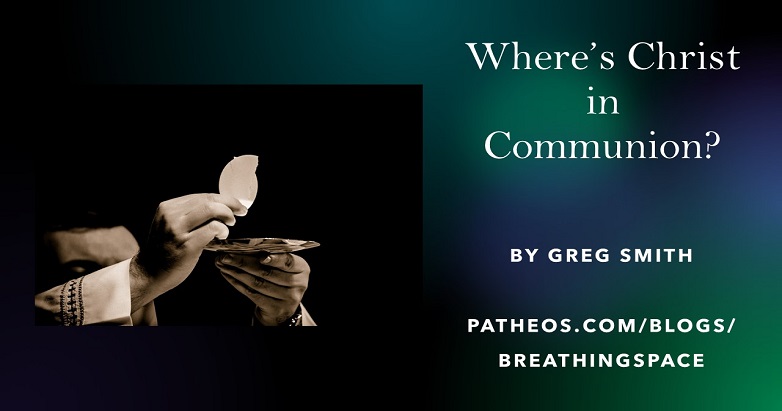
Image by Robert Cheaib from Pixabay
Guess Who’s Coming to Dinner
Ancient humans believed the deities needed sacrifice just as surely as people need to eat. They understood the gods as mystically consuming the sacrificial meat through fiery digestion. In the Bible, when Pagan worshipers offered human or animal sacrifices, they believed they were feeding the gods. Others knew that though celestial beings could not eat physical food, they were pleased and strengthened by the aroma of the offering.
Hebrew cultic worship suggested the same ideology. YHWH was pleased by the aroma of both incense and sacrificial smoke. Usually, worshipers kindled sacrificial fires themselves, but sometimes God miraculously burned offerings with fire from heaven. In 1 Kings 18, Elijah offered a sacrifice in a dramatic contest with the prophets of Baal. YHWH consumed the meat, firewood, and even anthropomorphically licked up the water from the trench around the offering. Clearly both prophets of both Baal and YHWH believed their deity capable of eating the sacrifice.
In the Hebrew scriptures, Abraham had the best story of a fellowship meal with God. In Genesis 18, three men visited Abraham. Theologians often interpret these as God plus two angels, or as the Trinity. The patriarch ordered a tender calf to be prepared and served to his guests, along with curds and milk. Though the Bible gives no indication of ritual slaughter, the calf was offered as a sacrifice to feed the visiting God. No one by Abraham can claim the honor of having eaten with God—prior to the Incarnation of Christ.
Body and Blood
Instead of feeding God, Jesus suggests that the faithful should feed on God. He reminds his followers of the manna God sent in the wilderness. In John 6.32b-33 NIV, he says:
“Very truly I tell you, it is not Moses who has given you the bread from heaven, but it is my Father who gives you the true bread from heaven. For the bread of God is the bread that comes down from heaven and gives life to the world.”
He says in verse 35b:
“I am the bread of life. Whoever comes to me will never go hungry, and whoever believes in me will never be thirsty.
Jesus turns his followers completely off when he tells them that his body is the main course of the sacrificial meal.
“Very truly I tell you, unless you eat the flesh of the Son of Man and drink his blood, you have no life in you. Whoever eats my flesh and drinks my blood has eternal life, and I will raise them up at the last day. For my flesh is real food and my blood is real drink. Whoever eats my flesh and drinks my blood remains in me, and I in them. Just as the living Father sent me and I live because of the Father, so the one who feeds on me will live because of me. This is the bread that came down from heaven. Your ancestors ate manna and died, but whoever feeds on this bread will live forever (John 6.53-58 NIV).”
Jesus later transforms his final Passover into a new kind of meal that he shares with his remaining disciples before his execution (Mt 26; Mk 14; Lk 22). As the fledgling church grows in the first century, agape meals are the central focus of fellowship gatherings. Over time, the Eucharist becomes a ritual practice eventually canonized as a sacrament or ordinance of the church.
Theology Schmeology
Theologians disagree on what happens to the eucharistic elements during Communion. Transubstantiation is the Roman Catholic doctrine that the bread and wine are transformed into the body and blood of Jesus. In this way, believers experience the real presence of Christ in the Lord’s Supper. Luther taught an alternate view, consubstantiation. This doctrine holds that the real presence of Christ is in and through the elements, without the need for a change in substance. Zwingli believed that the Eucharist is nothing more than a memorial meal, a symbolic remembrance of Jesus’ death. But all this theology loses people who just want to experience God.
Jesus lost his audience with all his talk of cannibalism. Theologians lose theirs with their arguments over elements. Christians who are questioning their faith often find it difficult to experience God in Communion, when they have a hard time buying all these mystical doctrines. But Jesus himself presents the solution.
Christ in You, the Hope of Communion
Jesus shows that all three of these theological views miss the point. When we share Communion, we do experience the real presence of Christ—but not in the way that many think. Bread and wine do not make a Eucharist, and we’re missing something if we believe those molecules contain Christ. The real presence of Jesus is in and around and through the believers who share the fellowship meal. Repeatedly, Jesus emphasizes his presence in people. What we do to them, we do to him. When we share a meal with God’s people, we share that meal with God.
When our concept of Eucharist extends beyond the church, compassion becomes Communion. As you give a granola bar to a person who is homeless, you break the bread of Christ. A glass of wine with friends at dinner becomes sacramental when you realize the presence of God in them. The real presence of Christ was never in bread and juice anyway—it’s always been in the love we share. Because love for others is love for God.
For people who struggle with faith, The Lord’s Supper can be a challenge. Many churches and denominations forbid you from participating unless you believe (or believe just as they do.) They insist you accept their interpretation of the significance of the Eucharist. As you deconstruct what you do and don’t believe, I suggest this alternate view of Communion. It may help you to transform a sacrificial meal into fellowship with the Holy that resides in your neighbor. Because this is what Jesus was doing when he shared a last meal with his friends.
Next Up… Deconstructing Designs: When a New Way Just Comes to You
Previous Post

February 16, 2022
Jesus and Trauma-Informed Care
Next Post
February 20, 2022 Deconstructing Designs: When A New Way Just Comes to You
Browse Our Archives
Select a Category Challenging the Church Deconstruction For Pastors Heathen Christianity Holidays and special days Mental Health Social Justice Spirituality Taoism Theology Uncategorized
Select a Month October 2026 September 2026 August 2026 July 2026 June 2026 May 2026 April 2026 March 2026 February 2026 January 2026 December 2025 November 2025 October 2025 September 2025 August 2025 July 2025 June 2025 May 2025 April 2025 March 2025 February 2025 January 2025 December 2024 November 2024 October 2024 September 2024 August 2024 July 2024 June 2024 May 2024 April 2024 March 2024 February 2024 January 2024 December 2023 November 2023 October 2023 September 2023 August 2023 July 2023 June 2023 May 2023 April 2023 March 2023 February 2023 January 2023 December 2022 November 2022 October 2022 September 2022 August 2022 July 2022 June 2022 May 2022 April 2022 March 2022 February 2022 January 2022
Follow Us!
TAKE THE
Religious Wisdom Quiz
I am a bush that burned but was not consumed, from which God spoke to Moses. What am I?
Select your answer to see how you score.
The burning bush Ark of the Covenant A holy fire Pillar of fire
Related posts from Breathing Space

“Can You Follow Jesus and Still Practice Smudging?”

Jesus and Lao Tzu: Seven Striking Parallels

Mo Thomas: Book Review from a Black Hole

“You Got Your Lao Tzu on My Jesus!”
TRENDING AT PATHEOS Progressive Christian

Why Christians Have a Sacred Duty to Vote:...
The Bible offers strong support for the sacred duty to vote. Here...

What Being a Modern-Day Apostle Means to Me
In my last column, I discussed the ins and outs of modern-day...

Did Ancient China Once Worship the God of...
Across human history, a common thread weaves through the origins of the...

Love Your Neighbor – Including Earth-Kin: Lev. 19,...
God’s command to love your neighbor means acting in an ethical and...

Lead a Church Study of “Jesus and Lao...
Guest writer Jack Thomas (The Irreverent Reverend) reflects on leading his church...

Principles for Understanding the Apostolic Ministry Today
Whenever people discover that my formal ministry title is "apostle," as in...
view all Progressive Christian blogs
Ad-Free & Subscriber Log-In Subscription Support
- About Us
- 2026 Calendar
- Videos
- Podcasts
- Library of World Religions
- Faith In Media Tracker
- Advertise With Us
- Write for Us
- Privacy Policy
- Terms of Service
- Do Not Sell My Data
- Contact Us
- Radiant Digital
- Manage Newsletter Subscriptions
- Unsubscribe From Notifications
- Sitemap
Copyright 2008-2026, Patheos. All rights reserved.
Subscription Support Ad-Free & Subscriber Log-In
Follow Patheos