
BuddhistCatholicContemplativeEvangelicalGeneral ChristianHinduJewishLatter-day SaintMuslimNew VisionsProgressive Christian
Beliefs
- Buddhist
- Catholic
- Contemplative
- Evangelical
- General Christian
- Hindu
- Jewish
- Latter-day Saint
- More Voices
- Muslim
- New Visions
- Pagan
- Progressive Christian
Topics
- Religion News
- Food and Religion
- Sports and Religion
- Religious Art
- Religious Music and Entertainment
- Religious Events
- History and Religion
- Style and Religion
- Politics and Religion
- Women in Religion
- Recreation Outdoors and Religion
- Business Finance and Religion
- Careers Workplace and Religion
- Education and Religion
- Family Parenting and Religion
- Health Fitness and Religion
- Home and Religion
- Relationships and Religion
- Technology and Religion
- Travel and Religion
Columnists
- Buddhist Columnists
- Business Finance and Religion Columnists
- Careers Workplace and Religion Columnists
- Catholic Columnists
- Contemplative Columnists
- Education and Religion Columnists
- Evangelists Columnists
- Family Parenting and Religion Columnists
- General Christian Columnists
- Health Fitness and Religion Columnists
- Hindu Columnists
- History and Religion Columnists
- Home and Religion Columnists
- Jewish Columnists
- More Voices Columnists
- Latter Day Columnists
- Muslim Columnists
- New Visions Columnists
- Nonreligious Columnists
- Pagan Columnists
- Politics and Religion Columnists
- Progressive Columnists
- Recreation Outdoors and Religion Columnists
- Relationships and Religion Columnists
- Religion News Columnists
- Religious Art Columnists
- Religious Events Columnists
- Religious Music and Entertainment Columnists
- Sports and Religion Columnists
- Style and Religion Columnists
- Technology and Religion Columnists
- Travel and Religion Columnists
- Women in Religion Columnists
Resource Library
- 2026 Calendar
- Library of World Religions
- The 100 Most Holy Places on Earth
- Patheos Answers
- Podcasts
- Videos
- Faith Leaders Database
- Anglican Episcopalian
- Bahai
- Baptist
- Buddhism
- Christianity
- Confucianism
- Eastern Orthodoxy
- Hinduism
- Holiness and Pentecostal
- ISKCON
- Islam
- Judaism
- Lutheran
- Methodist
- The Church of Jesus Christ of Latter-day Saints
- New Age
- Paganism
- Presbytarian and Reformed
- Protestantism
- Religion Behind the Scenes
- Roman Catholic
- Scientology
- Shia Islam
- Sikhism
- Sufism
- Sunni Islam
- Taoism
- Zen
- See all religions
Research Tools
 Ad-Free & Subscriber Log-In Subscription Support
Ad-Free & Subscriber Log-In Subscription Support
Follow Patheos 

- Trending:
- Forgiveness
- |
- Marriage
- |
- Consciousness
- |
- Death Penalty
- |
- Election
- |
- Halloween

-
Categories
- Home
- Progressive Christian
- The Beatitudes: Continuum of Spiritual Growth
The Beatitudes: Continuum of Spiritual Growth
Last updated on: February 12, 2022 at 8:13 pm by Gregory T. Smith
The Beatitudes: Continuum of Spiritual Growth 2022-02-12T20:13:03-08:00 Gregory T. Smith
Patheos Explore the world's faith through different perspectives on religion and spirituality! Patheos has the views of the prevalent religions and spiritualities of the world.
The Beatitudes are not a list of happy sayings, but a continuum of Christian growth. When Jesus delivered his famous aphorisms, he wasn’t interested in speaking pleasant things to nice people. He was giving a roadmap to deeper spirituality. As you journey with Jesus, the Beatitudes invite you to be mindful of each stage on the way. First, let’s look at Jesus’ words from the NRSV:
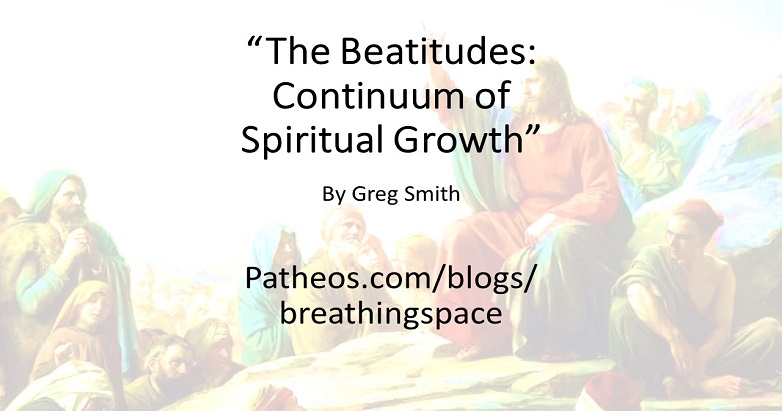
Sermon on the Mount by Carl Bloch (1877)
Matthew 5:1-10 – The Beatitudes
When Jesus saw the crowds, he went up the mountain; and after he sat down, his disciples came to him. 2 Then he began to speak, and taught them, saying:
3 “Blessed are the poor in spirit, for theirs is the kingdom of heaven.
4 “Blessed are those who mourn, for they will be comforted.
5 “Blessed are the meek, for they will inherit the earth.
6 “Blessed are those who hunger and thirst for righteousness, for they will be filled.
7 “Blessed are the merciful, for they will receive mercy.
8 “Blessed are the pure in heart, for they will see God.
9 “Blessed are the peacemakers, for they will be called children of God.
10 “Blessed are those who are persecuted for righteousness’ sake, for theirs is the kingdom of heaven.
Spiritual Poverty
To be poor in spirit means to recognize our own spiritual poverty, and our inability to do anything without the Spirit of God in us. Nobody can begin their spiritual pilgrimage without first becoming poor in spirit. You can’t enter the Kingdom of God without realizing that you can’t do it on your own and that all you need is in God’s hands, not yours. Salvation (spiritual wealth) can only come as a gift from the spiritually wealthy (God alone) to the spiritually poor (us).
Mourning
Here, Jesus isn’t talking about mourning the death of a loved one. He’s talking about mourning your own sin. We can only get to a point of grief over our own sin once we’ve realized our spiritual poverty. Confronted with his own sin, Isaiah said, “Woe is me! I am ruined! For I am a man of unclean lips, and I live among a people of unclean lips, and my eyes have seen the King, the LORD Almighty (Isaiah 6:5).” Once a person has reached a point of spiritual poverty, they naturally move to repentance or change. This is, of course, followed by grace – “Your guilt is taken away and your sin atoned for (6:6).” Unfortunately, too many Christians stop at this point, focusing on their own poverty, sin, and grief. But once we understand grace, everything changes.
Meekness
A person can only cultivate true meekness in her life when she has realized her own spiritual poverty and sin, entered a time of repentance, and received the grace of God. Without these prerequisite steps, a person tends to think of themselves more highly than they ought (Rom 12:3). Once they have walked the path of poverty and mourning, God can begin to develop within the new believer a character of meekness. Because of their past failures, meek people refrain from judging others and extend grace to one another.
Hunger and Thirst for Righteousness
Those who have not developed meekness in their lives never get to this stage of spiritual growth. The un-meek are still seeking self-fulfillment and self-gratification. They might look at righteousness as something to admire in others, but they do not hunger and thirst for it themselves. While an un-meek person thinks he has already become all that he needs to be, a meek person recognizes his own need for spiritual growth.
Mercy
Once you have a passion for personal righteousness, that will naturally extend to a desire to help restore others who are hurting. Religion that is all about personal righteousness is never enough—social justice work becomes important to you when you develop to the point of mercy. You can do good things for other people without reaching this point, but true mercy depends on a spirit that seeks God.
Purity
I can never be pure without first developing these other qualities in my life. The word pure comes from the Latin purus, which means “unmixed.” Psalm 86:11 says, “Teach me your way, O LORD, and I will walk in your truth; give me an undivided heart, that I may fear your name.” This level of Christian growth can only take place once we move through spiritual poverty, mourning over our own sin, into the meekness of a saved soul. A desire for righteousness leads to mercy. Until a person has practiced mercy, they cannot honestly say that they have an undivided heart. Unless he reaches out to his enemies in love, he maintains a sense of “I’m right and you’re wrong, and I’m better than you are.” Mercy defeats a superior attitude and allows a person to grow enough to move past the divisions in his heart, and on to purity.
Peacemaking
Having reached a point of mercy and purity, the growing believer develops a greater desire. She develops an outward orientation that seeks not only personal restoration but communal wholeness. The pure in heart become peacemakers when they see the growth God is bringing about in their own lives and desire to see that same growth in others. As the world does not want or understand peace, the peacemaker, ironically, will become the recipient of…
Persecution
This is the highest level of spiritual growth when the world ceases to honor you and wants to do away with you instead. In John 15:18-19, Jesus says, “If the world hates you, keep in mind that it hated me first. If you belonged to the world, it would love you as its own. As it is, you do not belong to the world, but I have chosen you out of the world. That is why the world hates you.” Of course, the goal of our growth is not to be mistreated. The result of our growth, however, may be persecution–if we take peacemaking seriously.
The Way to Spiritual Growth
The goal of faith is never to remain at the initial stages of Christian growth but to develop maturity as we go. Jesus’ early followers, who called his movement The Way, knew that the spiritual life was a journey. For them, the Sermon on the Mount encapsulated the core teachings of Jesus, and the Beatitudes provided the road map for their pilgrimage. As you walk his path, each step brings you closer to the Master, making you a little more like him.
Next Up… “Pastors Under Pressure”
Previous Post

January 18, 2022
When "Standing on the Promises" Leads to a Fall
Next Post

January 22, 2022 Pastors Under Pressure
Browse Our Archives
Select a Category Challenging the Church Deconstruction For Pastors Heathen Christianity Holidays and special days Mental Health Social Justice Spirituality Taoism Theology Uncategorized
Select a Month October 2026 September 2026 August 2026 July 2026 June 2026 May 2026 April 2026 March 2026 February 2026 January 2026 December 2025 November 2025 October 2025 September 2025 August 2025 July 2025 June 2025 May 2025 April 2025 March 2025 February 2025 January 2025 December 2024 November 2024 October 2024 September 2024 August 2024 July 2024 June 2024 May 2024 April 2024 March 2024 February 2024 January 2024 December 2023 November 2023 October 2023 September 2023 August 2023 July 2023 June 2023 May 2023 April 2023 March 2023 February 2023 January 2023 December 2022 November 2022 October 2022 September 2022 August 2022 July 2022 June 2022 May 2022 April 2022 March 2022 February 2022 January 2022
Follow Us!
TAKE THE
Religious Wisdom Quiz
Who was the first person murdered?
Select your answer to see how you score.
Elijah Jeremiah Abel Isaiah
Related posts from Breathing Space

Jesus and Lao Tzu: Seven Striking Parallels

Mo Thomas: Book Review from a Black Hole

“You Got Your Lao Tzu on My Jesus!”

If Birds Talked, They Couldn’t Fly
TRENDING AT PATHEOS Progressive Christian

What Being a Modern-Day Apostle Means to Me
In my last column, I discussed the ins and outs of modern-day...

Did Ancient China Once Worship the God of...
Across human history, a common thread weaves through the origins of the...

Love Your Neighbor – Including Earth-Kin: Lev. 19,...
God’s command to love your neighbor means acting in an ethical and...

Lead a Church Study of “Jesus and Lao...
Guest writer Jack Thomas (The Irreverent Reverend) reflects on leading his church...

Pastoral Wisdom for Responding to Sermon Pushback
Getting sermon pushback on your social justice sermon? Learn practical, Proverbs-based strategies...

Principles for Understanding the Apostolic Ministry Today
Whenever people discover that my formal ministry title is "apostle," as in...
view all Progressive Christian blogs
Ad-Free & Subscriber Log-In Subscription Support
- About Us
- 2026 Calendar
- Videos
- Podcasts
- Library of World Religions
- Faith In Media Tracker
- Advertise With Us
- Write for Us
- Privacy Policy
- Terms of Service
- Do Not Sell My Data
- Contact Us
- Radiant Digital
- Manage Newsletter Subscriptions
- Unsubscribe From Notifications
- Sitemap
Copyright 2008-2026, Patheos. All rights reserved.
Subscription Support Ad-Free & Subscriber Log-In
Follow Patheos