
BuddhistCatholicContemplativeEvangelicalGeneral ChristianHinduJewishLatter-day SaintMuslimNew VisionsProgressive Christian
Beliefs
- Buddhist
- Catholic
- Contemplative
- Evangelical
- General Christian
- Hindu
- Jewish
- Latter-day Saint
- More Voices
- Muslim
- New Visions
- Pagan
- Progressive Christian
Topics
- Religion News
- Food and Religion
- Sports and Religion
- Religious Art
- Religious Music and Entertainment
- Religious Events
- History and Religion
- Style and Religion
- Politics and Religion
- Women in Religion
- Recreation Outdoors and Religion
- Business Finance and Religion
- Careers Workplace and Religion
- Education and Religion
- Family Parenting and Religion
- Health Fitness and Religion
- Home and Religion
- Relationships and Religion
- Technology and Religion
- Travel and Religion
Columnists
- Buddhist Columnists
- Business Finance and Religion Columnists
- Careers Workplace and Religion Columnists
- Catholic Columnists
- Contemplative Columnists
- Education and Religion Columnists
- Evangelists Columnists
- Family Parenting and Religion Columnists
- General Christian Columnists
- Health Fitness and Religion Columnists
- Hindu Columnists
- History and Religion Columnists
- Home and Religion Columnists
- Jewish Columnists
- More Voices Columnists
- Latter Day Columnists
- Muslim Columnists
- New Visions Columnists
- Nonreligious Columnists
- Pagan Columnists
- Politics and Religion Columnists
- Progressive Columnists
- Recreation Outdoors and Religion Columnists
- Relationships and Religion Columnists
- Religion News Columnists
- Religious Art Columnists
- Religious Events Columnists
- Religious Music and Entertainment Columnists
- Sports and Religion Columnists
- Style and Religion Columnists
- Technology and Religion Columnists
- Travel and Religion Columnists
- Women in Religion Columnists
Resource Library
- 2026 Calendar
- Library of World Religions
- The 100 Most Holy Places on Earth
- Patheos Answers
- Podcasts
- Videos
- Faith Leaders Database
- Anglican Episcopalian
- Bahai
- Baptist
- Buddhism
- Christianity
- Confucianism
- Eastern Orthodoxy
- Hinduism
- Holiness and Pentecostal
- ISKCON
- Islam
- Judaism
- Lutheran
- Methodist
- The Church of Jesus Christ of Latter-day Saints
- New Age
- Paganism
- Presbytarian and Reformed
- Protestantism
- Religion Behind the Scenes
- Roman Catholic
- Scientology
- Shia Islam
- Sikhism
- Sufism
- Sunni Islam
- Taoism
- Zen
- See all religions
Research Tools
 Ad-Free & Subscriber Log-In Subscription Support
Ad-Free & Subscriber Log-In Subscription Support
Follow Patheos 

- Trending:
- Forgiveness
- |
- Marriage
- |
- Consciousness
- |
- Death Penalty
- |
- Election
- |
- Halloween
 Church Grammar
- Home
- Evangelical
- Salvation by “Faith” Alone or “Allegiance” Alone?
Salvation by “Faith” Alone or “Allegiance” Alone?
Last updated on: March 8, 2017 at 6:00 am by Brandon D. Smith
Salvation by “Faith” Alone or “Allegiance” Alone? 2017-03-07T16:12:22-05:00 Brandon D. Smith
Patheos Explore the world's faith through different perspectives on religion and spirituality! Patheos has the views of the prevalent religions and spiritualities of the world.
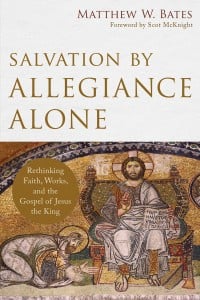 If you spend any time talking to me about the Trinity, you’ll know that I’m quick to recommend Matthew Bates’s book, The Birth of the Trinity. This book received wide acclaim from various tribes, and it’s on many people’s lists of go-to works on the Trinity and the early church. His new book, however, is getting a little more heat. I was provided a review copy of the book, and it’s certainly worth dealing with—whether one ends up agreeing with Bates’s proposal or not.
In Salvation by Allegiance Alone, Bates seeks to nuance or expand upon the traditional Reformation doctrine of sola fide (“faith alone”). In short, he argues that the Greek word pistis (often rendered “faith”) needs a fresh look. Bates makes the point that though we are saved by faith alone and not by works, it’s more right to say that we are saved by allegiance alone to King Jesus. So for Bates, faith isn’t just a one-time assent to belief, but rather is ongoing, with works as a necessary vehicle toward final justification.
One of Bates’s fundamental arguments is that Jesus’s enthronement and rule is not external to the gospel (as is commonly assumed), but part of the gospel proper. For Bates, this is why responding in “faith” to the gospel involves responding in “allegiance” to a king—when Jesus’s kingship is wrongly excluded from the gospel, the result is that pistis as it relates to the gospel is misunderstood.
Tom Schreiner, whose recent book on faith alone was a huge help in my writing of Echoes of the Reformation, wrote a winsome but critical review of Bates’s new book at The Gospel Coalition. A snippet:
Salvation By Allegiance Alone is full of helpful insights, and space is lacking to interact with everything Bates writes. His emphasis on submission to Jesus as King, the enthroned Lord of the universe, nicely captures the New Testament emphasis on what it means to be a Christian. He also reminds us that our lives in this world matter, and that idolatry isn’t an abstraction but shows up in how we live. We aren’t disembodied entities; we’re flesh-and-blood creatures anticipating new-creation life. Bates rightly says the gospel is broader than simply receiving Jesus as Savior, and he emphasizes God’s grace in saving us. I also sympathize with his emphasis on allegiance; too many Protestants reduce faith to mere verbal agreement. Many are mistakenly assured they’ll enjoy eternal life apart from any obedience if they accept Jesus as Savior. Bates convincingly demonstrates that such a reading doesn’t accord with the New Testament’s emphasis on works, for works are clearly essential for the reception of eternal life. We must maintain our faith until the end to be saved.
Despite the advantages of the word “allegiance,” though, I still believe “trust” or “faith” is better since “allegiance” puts the emphasis squarely on the human subject—on what we do, on our commitment. “Allegiance” captures the importance of subsequent good works, but it leaves something out as well, for faith is fundamentally receptive. We receive the gift of righteousness with an empty hand, and this conception is absent when we put “allegiance” in place of “faith.” Similarly, the notion that true faith or trust inevitably leads to good works handles the New Testament witness in a more fitting way.
You can read the rest of the review here. Schreiner’s pushback is three-fold: (1) Bates’s book offers a substandard view of justification; (2) the Arminian-like view of corporate election over individual election is lacking nuance; and (3) the insinuation in the book that one can possibly lose his salvation (Bates would say “they ceased giving allegiance”) is unbiblical. All of these critiques by Schreiner are reasonable, and to Bates’s credit, he gives a biblical defense of these matters that the reader will need to engage for himself.
That said, perhaps Bates could have done a better job anticipating these sort of critiques, given that he’s dealing with Reformed categories and trying to nuance or rework them. In Chapters 2, 4, and 8 particularly, Bates spends a good deal of time engaging the biblical warrant for “faith,” justification, the ordo salutis, etc. But Bates’s issue is that writing a book trying to challenge well-worn theological paths runs the risk of being too assertive in some areas, and too vague in others.
Scot McKnight, who wrote the foreword to the book, wrote a more positive review. This is not surprising because (1) McKnight wrote the foreword, and (2) because this book would fall more in line with his theological positions. That said, McKnight makes a good case for why we should consider Bates’s work. Here’s a snippet from McKnight’s review:
For sure, it pokes the Reformation slogan — faith alone — in the eye, but it does so by out-Reforming the Reformation crowd opposing this new book. How so? In true Reformation fashion, this book takes us back to the Bible to ask “What does faith mean in the Bible?” The best way to be faithful to the Reformation is to go back to the Bible and to be semper reformanda. Bates is that with courage.
His answer? It means more than what we mean by “faith” and should be translated allegiance. Couldn’t agree more. This definition does not erase trust or faith or believing and instead swallows them up into a larger sense, one that is faithful to the Bible’s own teaching: faith in king Jesus means allegiance to king Jesus.
So while Schreiner wants to defend the traditional Reformation view of faith alone, McKnight makes the case that Bates’s questions and reworkings actually fall in line with the Reformation principle of semper reformanda (“always reforming”). McKnight is right in noting that Bates is taking up a worthy cause here (and he takes up this cause with serious exegetical chops), but in the end I certainly understand and feel Schreiner’s concerns.
Regardless, it should go without saying that a book that gets both Schreiner and McKnight talking is worth dealing with yourself.
Previous Post

March 7, 2017
Curiosity Won't Kill the Christian: A Conversation with Barnabas Piper
Next Post
March 14, 2017 A New Initiative: The Center for Baptist Renewal
Browse Our Archives
Select a Category Academics Apologetics Baptists Biblical Interpretation Biblical Studies Blog News Books Christian Life Church History Culture Ecclesiology Eschatology Gospel Interviews New Creation News Politics Science Scripture Sexual Sin Social Media Spiritual Discipline The Smorgasbord Theology Trinity Word Matters Podcast
Select a Month September 2017 August 2017 July 2017 June 2017 May 2017 April 2017 March 2017 February 2017 January 2017 December 2016 November 2016 October 2016 September 2016 August 2016 July 2016 June 2016 May 2016 April 2016 December 2015 November 2015 October 2015 July 2015 June 2015 May 2015 April 2015 March 2015 February 2015
TAKE THE
Religious Wisdom Quiz
Which letter encourages believers to "be quick to listen, slow to speak, and slow to anger"?
Select your answer to see how you score.
2 Peter James Romans 1 John
Books by This Author Books by Brandon D. Smith
Related posts from Church Grammar

What We Know about Arius and His Heresy

Two Tools that Make My PhD Life Easier

The Sermon on the Mount and Jesus's Command...

Why Did the Book of Revelation Outlast Other...
TRENDING AT PATHEOS Evangelical

How the author of the world's best hymn...
I've been working with John Newton for a while now. This makes...

Long before this Lectio Divina, Psalm 130 - the song - started...

What About the Trees? Another Living Parable
After I finished writing the last article about falling leaves as a...

Why Classical Education Is a Conversation, Not a...
Come and Read: Joy in Classical Education When I was a little...

Falling Leaves: A Living Parable on Letting Go
I’ve spent the vast majority of my life in the southeast corner...

Cornell University has received a great deal of negative publicity and intense...
view all Evangelical blogs
Ad-Free & Subscriber Log-In Subscription Support
- About Us
- 2026 Calendar
- Videos
- Podcasts
- Library of World Religions
- Faith In Media Tracker
- Advertise With Us
- Write for Us
- Privacy Policy
- Terms of Service
- Do Not Sell My Data
- Contact Us
- Radiant Digital
- Manage Newsletter Subscriptions
- Unsubscribe From Notifications
- Sitemap
Copyright 2008-2026, Patheos. All rights reserved.
Subscription Support Ad-Free & Subscriber Log-In
Follow Patheos