
BuddhistCatholicContemplativeEvangelicalGeneral ChristianHinduJewishLatter-day SaintMuslimNew VisionsProgressive Christian
Beliefs
- Buddhist
- Catholic
- Contemplative
- Evangelical
- General Christian
- Hindu
- Jewish
- Latter-day Saint
- More Voices
- Muslim
- New Visions
- Pagan
- Progressive Christian
Topics
- Religion News
- Food and Religion
- Sports and Religion
- Religious Art
- Religious Music and Entertainment
- Religious Events
- History and Religion
- Style and Religion
- Politics and Religion
- Women in Religion
- Recreation Outdoors and Religion
- Business Finance and Religion
- Careers Workplace and Religion
- Education and Religion
- Family Parenting and Religion
- Health Fitness and Religion
- Home and Religion
- Relationships and Religion
- Technology and Religion
- Travel and Religion
Columnists
- Buddhist Columnists
- Business Finance and Religion Columnists
- Careers Workplace and Religion Columnists
- Catholic Columnists
- Contemplative Columnists
- Education and Religion Columnists
- Evangelists Columnists
- Family Parenting and Religion Columnists
- General Christian Columnists
- Health Fitness and Religion Columnists
- Hindu Columnists
- History and Religion Columnists
- Home and Religion Columnists
- Jewish Columnists
- More Voices Columnists
- Latter Day Columnists
- Muslim Columnists
- New Visions Columnists
- Nonreligious Columnists
- Pagan Columnists
- Politics and Religion Columnists
- Progressive Columnists
- Recreation Outdoors and Religion Columnists
- Relationships and Religion Columnists
- Religion News Columnists
- Religious Art Columnists
- Religious Events Columnists
- Religious Music and Entertainment Columnists
- Sports and Religion Columnists
- Style and Religion Columnists
- Technology and Religion Columnists
- Travel and Religion Columnists
- Women in Religion Columnists
Resource Library
- 2026 Calendar
- Library of World Religions
- The 100 Most Holy Places on Earth
- Patheos Answers
- Podcasts
- Videos
- Faith Leaders Database
- Anglican Episcopalian
- Bahai
- Baptist
- Buddhism
- Christianity
- Confucianism
- Eastern Orthodoxy
- Hinduism
- Holiness and Pentecostal
- ISKCON
- Islam
- Judaism
- Lutheran
- Methodist
- The Church of Jesus Christ of Latter-day Saints
- New Age
- Paganism
- Presbytarian and Reformed
- Protestantism
- Religion Behind the Scenes
- Roman Catholic
- Scientology
- Shia Islam
- Sikhism
- Sufism
- Sunni Islam
- Taoism
- Zen
- See all religions
Research Tools
 Ad-Free & Subscriber Log-In Subscription Support
Ad-Free & Subscriber Log-In Subscription Support
Follow Patheos 

- Trending:
- Forgiveness
- |
- Marriage
- |
- Consciousness
- |
- Death Penalty
- |
- Election
- |
- Halloween
 Church Grammar
- Home
- Evangelical
- Curiosity Won’t Kill the Christian: A Conversation with Barnabas Piper
Curiosity Won’t Kill the Christian: A Conversation with Barnabas Piper
Last updated on: March 7, 2017 at 11:33 am by Brandon D. Smith
Curiosity Won’t Kill the Christian: A Conversation with Barnabas Piper 2017-03-07T11:33:55-05:00 Brandon D. Smith
Patheos Explore the world's faith through different perspectives on religion and spirituality! Patheos has the views of the prevalent religions and spiritualities of the world.
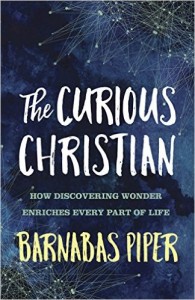 Christians struggle with questions—let’s be honest. We don’t know which questions to ask, which questions are “too far,” or how to rightly question God himself. Thankfully, Barnabas Piper’s new book, The Curious Christian, helps us navigate some of these tensions. Rather than running away from doubt or curiosity, Piper argues that these things can be signs of a faith that truly seeks to know God and his truth.
I am thankful to count Barnabas a friend, and excited that he’s recently moved to the B&H Academic team and now offices across the hall from me. Here’s a brief conversation I had with Barnabas about his fantastic and unique new book.
BRANDON: In your last book, Help My Unbelief, you talked about belief, doubt, and asking questions. How does The Curious Christian compare and contrast with that book?
BARNABAS: Without being a sequel it is sort of a natural follow-up book. Help My Unbelief offered ideas about asking questions well and The Curious Christian takes that idea and runs with it to show where our questions can take us in relationship with God and others and the world.
As I thought about questions and asking and seeking truth while I wrote Help My Unbelief I began to realize the significance of curiosity across the breadth of the Christian life and the utter lack of it for so many people. People don’t know what questions to ask, what they can ask them about, who to ask them to, or where their questions will take them. And they don’t know the wonder and the promise that lies on the other side of honest, truth-seeking questions.
How has curiosity played a role in your life as a Christian?
Having been raised in a conservative evangelical context, I had the tacit understanding that curiosity was, if not off limits, at least a bit juvenile. But I had this innate desire—nurtured by my parents—to know, to learn, and to connect with great ideas and people. I just didn’t have a clear sense of how that fit into a systematized faith centered around Jesus.
I began to realize that each of those interests was not secondary to a love of God, but rather an inroad to knowing God more. It was then that curiosity became intentional for me—something to be fostered, fed, and practiced. I began to see more and more truth about God through people and places and things and ideas where previously I had tried to segment them into buckets of “sacred” and “secular.” And I saw that faith is not as neatly systematized as many would like to make it.
Instead I began to learn how to be comfortable – or at least to reside – in theological tensions and cultural conflicts. Rather than take sides I began to see that both sides often reflect something of God’s character and workmanship. We often try to boil things down to either/or and to simplify them into pat arguments, but truth doesn’t work that way and God is not bound by our lists and points and arguments. Curiosity helped me see this and helps me navigate it now.
You’ve courageously written recently about a painful recent event in your life. In what ways has this book been formed by your own suffering?
Last year my wife of eleven-and-a-half years and I divorced. I have never experienced something so acutely painful nor have I ever been so thankful for the complexities of God’s Word and promises and work. No pat answers would suffice. No books answered the questions I faced.
But curiosity, the pursuit of truth, lived on. And with it I was able to see hope in God’s word beyond the proof-text promises so many Christians provide. I found it in Ecclesiastes and Job and Lamentations. I lived in the minor prophets, full of darkness and hope. And I was thankful for all the questions I had asked and explored for years prior through which God had shown Himself faithful and real.
And the complexities and ugliness of my own marriage’s end taught me empathy and to seek to understand others better. People have hidden stories and pain that shape them. Am I curious enough to ask and to listen and to understand? Sharing some of my story connected me with others walking through something similar, and that is what curiosity does – it connects. It connects people to people and people to truth and ideas to ideas.
In writing the book, I hoped to offer hope and life and perspective to people whatever their circumstances. My own experiences told me that curiosity offered all those things, even and especially to the hurting.
What types of questions should Christians be asking on a daily basis?
I think most Christians just need to start asking questions to begin with. Curiosity is less about what particular questions are asked and more about where the questions are pointed. One of the hardest things to do is notice something you have never noticed before or to find a new perspective on something you’ve seen or heard a thousand times, but that is curiosity.
Any question is a good question if it genuinely, humbly seeks truth. And that mindset, that stance of the heart is where curiosity begins. The two things Christians need to focus their curiosity on are God himself and then the opportunities closest to them.
God is infinite, so the more questions we ask, the more truth we will find—leading to only more opportunities for discovery. And as we turn our curiosity on our immediate world, we will discover starting places in relationships, neighborhoods, neighbors, our immediate surroundings, or a hundred aspects of life we’d previously overlooked.
What’s the difference between skepticism, doubt, and curiosity? How do each play a role in the Christian life?
Doubt is simply not knowing something, the inability to be sure. It is inherent to being human since we have finite knowledge of the work of an infinite God. We will encounter doubts all the time, and this is neither a good or bad thing. What makes it good or bad is what we do in response—do our doubts lead us to seek answers in God or lead us away from God?
Skepticism is when we mistrust something or someone. This is not a good lens through which to view life most of the time because it distances us from relationship or vulnerability or learning. However, skepticism is necessary in doses because we live in a world marked by sin and one that is full of deceit. We cannot be foolish or gullible in how we interact with it, so sometimes a dash of skepticism is simply wisdom at work. Curiosity is the pursuit of truth, which means it should be the force that take our doubts and points them in a godly, healthy direction and knows how and when to use skepticism.
Curiosity can’t be overly skeptical or the pursuit of truth stalls. However, in order to find truth, a curious person must have enough judicious skepticism to sort through the nonsense.
Speaking of curiosity, have you been able to figure out why your Minnesota Vikings are actively trying to be the worst team in the league?
No. My questions have more to do with why God has cursed them to break the hearts of their fans despite their best efforts to win. It is one of the many inexorable conundrums of life. But any way, SKOL.
Previous Post

February 27, 2017
Theology, Church History, and Guarding the Good Deposit
Next Post
March 8, 2017 Salvation by "Faith" Alone or "Allegiance" Alone?
Browse Our Archives
Select a Category Academics Apologetics Baptists Biblical Interpretation Biblical Studies Blog News Books Christian Life Church History Culture Ecclesiology Eschatology Gospel Interviews New Creation News Politics Science Scripture Sexual Sin Social Media Spiritual Discipline The Smorgasbord Theology Trinity Word Matters Podcast
Select a Month September 2017 August 2017 July 2017 June 2017 May 2017 April 2017 March 2017 February 2017 January 2017 December 2016 November 2016 October 2016 September 2016 August 2016 July 2016 June 2016 May 2016 April 2016 December 2015 November 2015 October 2015 July 2015 June 2015 May 2015 April 2015 March 2015 February 2015
TAKE THE
Religious Wisdom Quiz
According to 2 Thessalonians, what are believers told to stand firm and hold fast to?
Select your answer to see how you score.
The faith once delivered The teachings passed on to them The traditions of the elders The word of God
Books by This Author Books by Brandon D. Smith
Related posts from Church Grammar

The Sermon on the Mount and Jesus's Command...

Blood Moons, Babylonian Whores, and Reading Revelation Rightly

Jesus, Jonah, and Doubting God

TRENDING AT PATHEOS Evangelical

How the author of the world's best hymn...
I've been working with John Newton for a while now. This makes...

Long before this Lectio Divina, Psalm 130 - the song - started...

What About the Trees? Another Living Parable
After I finished writing the last article about falling leaves as a...

Why Classical Education Is a Conversation, Not a...
Come and Read: Joy in Classical Education When I was a little...

Falling Leaves: A Living Parable on Letting Go
I’ve spent the vast majority of my life in the southeast corner...

Cornell University has received a great deal of negative publicity and intense...
view all Evangelical blogs
Ad-Free & Subscriber Log-In Subscription Support
- About Us
- 2026 Calendar
- Videos
- Podcasts
- Library of World Religions
- Faith In Media Tracker
- Advertise With Us
- Write for Us
- Privacy Policy
- Terms of Service
- Do Not Sell My Data
- Contact Us
- Radiant Digital
- Manage Newsletter Subscriptions
- Unsubscribe From Notifications
- Sitemap
Copyright 2008-2026, Patheos. All rights reserved.
Subscription Support Ad-Free & Subscriber Log-In
Follow Patheos