
BuddhistCatholicContemplativeEvangelicalGeneral ChristianHinduJewishLatter-day SaintMuslimNew VisionsProgressive Christian
Beliefs
- Buddhist
- Catholic
- Contemplative
- Evangelical
- General Christian
- Hindu
- Jewish
- Latter-day Saint
- More Voices
- Muslim
- New Visions
- Pagan
- Progressive Christian
Topics
- Religion News
- Food and Religion
- Sports and Religion
- Religious Art
- Religious Music and Entertainment
- Religious Events
- History and Religion
- Style and Religion
- Politics and Religion
- Women in Religion
- Recreation Outdoors and Religion
- Business Finance and Religion
- Careers Workplace and Religion
- Education and Religion
- Family Parenting and Religion
- Health Fitness and Religion
- Home and Religion
- Relationships and Religion
- Technology and Religion
- Travel and Religion
Columnists
- Buddhist Columnists
- Business Finance and Religion Columnists
- Careers Workplace and Religion Columnists
- Catholic Columnists
- Contemplative Columnists
- Education and Religion Columnists
- Evangelists Columnists
- Family Parenting and Religion Columnists
- General Christian Columnists
- Health Fitness and Religion Columnists
- Hindu Columnists
- History and Religion Columnists
- Home and Religion Columnists
- Jewish Columnists
- More Voices Columnists
- Latter Day Columnists
- Muslim Columnists
- New Visions Columnists
- Nonreligious Columnists
- Pagan Columnists
- Politics and Religion Columnists
- Progressive Columnists
- Recreation Outdoors and Religion Columnists
- Relationships and Religion Columnists
- Religion News Columnists
- Religious Art Columnists
- Religious Events Columnists
- Religious Music and Entertainment Columnists
- Sports and Religion Columnists
- Style and Religion Columnists
- Technology and Religion Columnists
- Travel and Religion Columnists
- Women in Religion Columnists
Resource Library
- 2026 Calendar
- Library of World Religions
- The 100 Most Holy Places on Earth
- Patheos Answers
- Podcasts
- Videos
- Faith Leaders Database
- Anglican Episcopalian
- Bahai
- Baptist
- Buddhism
- Christianity
- Confucianism
- Eastern Orthodoxy
- Hinduism
- Holiness and Pentecostal
- ISKCON
- Islam
- Judaism
- Lutheran
- Methodist
- The Church of Jesus Christ of Latter-day Saints
- New Age
- Paganism
- Presbytarian and Reformed
- Protestantism
- Religion Behind the Scenes
- Roman Catholic
- Scientology
- Shia Islam
- Sikhism
- Sufism
- Sunni Islam
- Taoism
- Zen
- See all religions
Research Tools
 Ad-Free & Subscriber Log-In Subscription Support
Ad-Free & Subscriber Log-In Subscription Support
Follow Patheos 

- Trending:
- Forgiveness
- |
- Marriage
- |
- Consciousness
- |
- Death Penalty
- |
- Election
- |
- Halloween
 Church Grammar
- Home
- Evangelical
- A White Man’s Meditations on Martin Luther King Day
A White Man’s Meditations on Martin Luther King Day
Last updated on: January 31, 2017 at 10:57 pm by Brandon D. Smith
A White Man’s Meditations on Martin Luther King Day 2017-01-31T22:57:56-05:00 Brandon D. Smith
Patheos Explore the world's faith through different perspectives on religion and spirituality! Patheos has the views of the prevalent religions and spiritualities of the world.
 Most of my childhood, I lived in highly diverse neighborhoods. My neighborhoods and schools were a mishmash of white, black, Asian, Hispanic, Pacific Islander, Middle Eastern, and more. I recently looked up the stats of my junior high, for example, and the current student population is 33% white, 30% Hispanic, 25% African American, 10% Asian, and a few others. This type of relatively even split is how I remember it.
I don’t remember my parents ever making blatantly racist comments. Race was never a major divider at my school—cliques were based on belonging to a particular sport or hobby, not on race or ethnicity. I had friends and dated girls of varying races and ethnicities. We all hung out together, and we never had conversations about race. As far as I can remember, I spent the majority of my childhood ignorant of blatant racism.
As I got older, I saw more blatant racism, especially in high school. Recent stats show that my former high school is currently 51% white, 26% Hispanic, 14% black, and 7% Asian. This sounds about right, too, though it feels like 51% white is a low number for my time there. Needless to say, high school felt a bit different to me. It was noticeably white and noticeably affluent, at least in my eyes. I remember distinctly racial fights and cliques; I remember more racist jokes about blacks and Hispanics; and I remember people not being invited to outings because of their race or ethnicity. This is the first time I remember hearing the N-word pejoratively.
I didn’t reflect on this much until Eric Garner was killed. And then Michael Brown. And then Laquan McDonald. And then Tamir Rice. And then Walter Scott. And then Freddie Gray. And then…
It’s taken me some time to realize that part of the reason I was so ignorant to racism when I was younger is because I’m white. No one pointed out my race disparagingly. My parents never had to talk to me about being wrongly profiled. I probably never had an authority figure treat me a certain way because of the color of my skin.
In one sense, I’m grateful that I grew up in diverse neighborhoods and learned at an early age to appreciate people of all stripes. On the other hand, that environment made me calloused toward actual injustice. I didn’t notice injustice because I wasn’t made aware of my own privilege. I just assumed everyone had it as easy as me.
But, of course, my memories are tinted by my own color, and so I don’t remember what were surely extensive injustices against my friends and their families. Many of my friends’ parents were in jail—how many deserved to be there? Many of my friends were expelled from school—how many were given an extra dose of punishment? How many times did an authority figure look the other way because I was a relatively good white kid? These are questions I don’t have the answer to, but am now finally asking.
As much as I’d like to believe that growing up in diverse neighborhoods helps me better understand my black brothers and sisters, it doesn’t. I’ll never know what it’s like to look in the mirror and assume I could be targeted for the skin color looking back at me. I’ll never know what it’s like to walk into a job interview and wonder if I’m being discounted from the start because of my race. I’ll never have to talk to my kids about being a minority in their culture, and the potentially scary ramifications that could come of it.
However, as a Christian, I’m called to be a reconciler. Most of my Christian life, I’ve thought this simply had to do with evangelism. If someone gave their life to Christ, they were reconciled to God, and this made me by extension a reconciler between God and man.
But now I’m realizing that a key part of my life in Christ is being a reconciler between man and man.
Revelation 21-22 says that people of every tribe, tongue, and nation will worship God forever. Ephesians 2 says that God is right now destroying racial and ethnic division through the cross. Matthew 28:18-20 says that I’m called to make disciples of all nations. These passages and more point to one glorious truth—that one foundational way to preview eternity is to intentionally break down walls that divide people. If there are no walls in eternity, there should be no walls right now.
So, I shouldn’t huddle up with people like me, waiting on God to sort it out later. That would be easy. Instead, I should fight tooth-and-nail against the temptation to be comfortable and monolithic. The cross of Christ demands that I press on to the point of shed blood to love my brothers and sisters of all races and ethnicities. As Russell Moore so aptly puts it, in the fight for racial reconciliation, “We’re not getting anywhere if we gather in church with people we’d gather with if Jesus were still dead.” The death and resurrection of Jesus means that sin and death are dead—taking hatred and division to Hell with them.
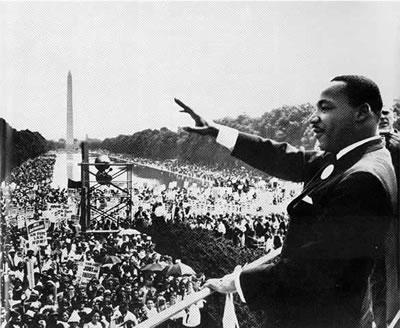
On Martin Luther King, Jr. Day, I’m reminded of the sacrifice so many people have made to break down these walls—and I’m also reminded of how little I’ve done. It took multiple dead black brothers and sisters to wake me up, but I’m committed to never being silent or apathetic again.
Today is not a day merely to commemorate one man’s dream, but another day among 364 others to wage war against the racism and division that one Man died and resurrected to destroy once and for all.
To my white brothers and sisters: don’t merely post on social media about your frustration about race relations in our country. Don’t let your actions be relegated to hashtags and retweets. True reconciliation happens around dinner tables and in marching lines. True empathy comes not from watching another iPhone video, but from putting your arms around someone whose skin doesn’t match yours. True friendship comes not from a Twitter follow or a Sunday morning sentiment, but from a lifelong commitment to co-suffering and co-laboring. True love doesn’t happen with a half-hearted apology, but with an open mind to be an active part of the solution.
Though personal relationships are the most important, it would also help to read some books on race by black authors. Let their perspective help shape the narrative. For example, read Life and Times of Frederick Douglass by Douglass, Divided by Faith: Evangelical Religion and the Problem of Race in America by Michael Emerson, and United: Captured by God’s Vision for Diversity by Trillia Newbell.
You may feel like only one friendship or one conversation is a waste, but it isn’t. Nothing you do in this life is inconsequential. God works through even the smallest steps, however awkward and heavy they may seem. As Dr. King said, “Injustice anywhere is a threat to justice everywhere.” Make your anywhere count.
Previous Post

December 18, 2016
Immanuel: When God the Son Became Like Us
Next Post

January 31, 2017 How Does the Holy Spirit Unite Us to Christ?
Browse Our Archives
Select a Category Academics Apologetics Baptists Biblical Interpretation Biblical Studies Blog News Books Christian Life Church History Culture Ecclesiology Eschatology Gospel Interviews New Creation News Politics Science Scripture Sexual Sin Social Media Spiritual Discipline The Smorgasbord Theology Trinity Word Matters Podcast
Select a Month September 2017 August 2017 July 2017 June 2017 May 2017 April 2017 March 2017 February 2017 January 2017 December 2016 November 2016 October 2016 September 2016 August 2016 July 2016 June 2016 May 2016 April 2016 December 2015 November 2015 October 2015 July 2015 June 2015 May 2015 April 2015 March 2015 February 2015
TAKE THE
Religious Wisdom Quiz
According to 2 Thessalonians, what are believers told to stand firm and hold fast to?
Select your answer to see how you score.
The faith once delivered The teachings passed on to them The traditions of the elders The word of God
Books by This Author Books by Brandon D. Smith
Related posts from Church Grammar

Blood Moons, Babylonian Whores, and Reading Revelation Rightly

Should Pastors Read Widely? A Plea for Caution


From Selling Drugs to Selling Bibles
TRENDING AT PATHEOS Evangelical

How the author of the world's best hymn...
I've been working with John Newton for a while now. This makes...

Long before this Lectio Divina, Psalm 130 - the song - started...

What About the Trees? Another Living Parable
After I finished writing the last article about falling leaves as a...

Why Classical Education Is a Conversation, Not a...
Come and Read: Joy in Classical Education When I was a little...

Falling Leaves: A Living Parable on Letting Go
I’ve spent the vast majority of my life in the southeast corner...

Cornell University has received a great deal of negative publicity and intense...
view all Evangelical blogs
Ad-Free & Subscriber Log-In Subscription Support
- About Us
- 2026 Calendar
- Videos
- Podcasts
- Library of World Religions
- Faith In Media Tracker
- Advertise With Us
- Write for Us
- Privacy Policy
- Terms of Service
- Do Not Sell My Data
- Contact Us
- Radiant Digital
- Manage Newsletter Subscriptions
- Unsubscribe From Notifications
- Sitemap
Copyright 2008-2026, Patheos. All rights reserved.
Subscription Support Ad-Free & Subscriber Log-In
Follow Patheos