
BuddhistCatholicContemplativeEvangelicalGeneral ChristianHinduJewishLatter-day SaintMuslimNew VisionsProgressive Christian
Beliefs
- Buddhist
- Catholic
- Contemplative
- Evangelical
- General Christian
- Hindu
- Jewish
- Latter-day Saint
- More Voices
- Muslim
- New Visions
- Pagan
- Progressive Christian
Topics
- Religion News
- Food and Religion
- Sports and Religion
- Religious Art
- Religious Music and Entertainment
- Religious Events
- History and Religion
- Style and Religion
- Politics and Religion
- Women in Religion
- Recreation Outdoors and Religion
- Business Finance and Religion
- Careers Workplace and Religion
- Education and Religion
- Family Parenting and Religion
- Health Fitness and Religion
- Home and Religion
- Relationships and Religion
- Technology and Religion
- Travel and Religion
Columnists
- Buddhist Columnists
- Business Finance and Religion Columnists
- Careers Workplace and Religion Columnists
- Catholic Columnists
- Contemplative Columnists
- Education and Religion Columnists
- Evangelists Columnists
- Family Parenting and Religion Columnists
- General Christian Columnists
- Health Fitness and Religion Columnists
- Hindu Columnists
- History and Religion Columnists
- Home and Religion Columnists
- Jewish Columnists
- More Voices Columnists
- Latter Day Columnists
- Muslim Columnists
- New Visions Columnists
- Nonreligious Columnists
- Pagan Columnists
- Politics and Religion Columnists
- Progressive Columnists
- Recreation Outdoors and Religion Columnists
- Relationships and Religion Columnists
- Religion News Columnists
- Religious Art Columnists
- Religious Events Columnists
- Religious Music and Entertainment Columnists
- Sports and Religion Columnists
- Style and Religion Columnists
- Technology and Religion Columnists
- Travel and Religion Columnists
- Women in Religion Columnists
Resource Library
- 2026 Calendar
- Library of World Religions
- The 100 Most Holy Places on Earth
- Patheos Answers
- Podcasts
- Videos
- Faith Leaders Database
- Anglican Episcopalian
- Bahai
- Baptist
- Buddhism
- Christianity
- Confucianism
- Eastern Orthodoxy
- Hinduism
- Holiness and Pentecostal
- ISKCON
- Islam
- Judaism
- Lutheran
- Methodist
- The Church of Jesus Christ of Latter-day Saints
- New Age
- Paganism
- Presbytarian and Reformed
- Protestantism
- Religion Behind the Scenes
- Roman Catholic
- Scientology
- Shia Islam
- Sikhism
- Sufism
- Sunni Islam
- Taoism
- Zen
- See all religions
Research Tools
 Ad-Free & Subscriber Log-In Subscription Support
Ad-Free & Subscriber Log-In Subscription Support
Follow Patheos 

- Trending:
- Forgiveness
- |
- Marriage
- |
- Consciousness
- |
- Death Penalty
- |
- Election
- |
- Halloween
 Church Grammar
- Home
- Evangelical
- How Augustine Helps Us Live in Light of the Trinity
How Augustine Helps Us Live in Light of the Trinity
Last updated on: February 18, 2015 at 10:58 am by Brandon D. Smith
How Augustine Helps Us Live in Light of the Trinity 2015-02-18T10:58:33-05:00 Brandon D. Smith
Patheos Explore the world's faith through different perspectives on religion and spirituality! Patheos has the views of the prevalent religions and spiritualities of the world.
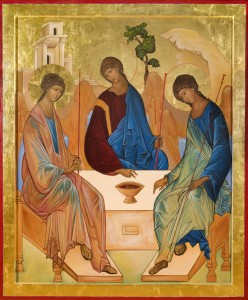 In the first paragraph of Confessions, Augustine penned his now famous line, “You stir man to take pleasure in praising you, because you have made us for yourself, and our heart is restless until it finds its rest in you.”
This phrase is a fitting summary of Augustine’s theology. First, it reveals that man is utterly restless without God, lost and wandering. Second, it reveals that only God can provide true rest for the human heart. Augustine finds great comfort and affection in the character, nature, and works of God.
Augustine’s understanding of life, and of his own conversion, is tethered to the salvific work of the Triune God in his own life. He can only make sense of his salvation through the lens of God’s sovereignty and redemptive purposes, through the work of the Godhead. For Augustine, the whole of theology and life flow from God. Reflecting on his own transformation, Augustine confesses, “You, my God, brought that about. … How can salvation be obtained except through your hand remaking what you once made?”
Augustine’s Trinitarianism is a helpful reference point for us. His view can, at least in part, provide a template for considering the Trinity in our own lives. We can summarize Augustine’s teaching like this:
1. The Father as Initiator
For Augustine, the Father’s role in the creation narrative is as the one who begets the Son through the Spirit, and the one who creates all things through them. This is one of Augustine’s most pointed emphases on the work of the Father.
Yet, he does not promote hierarchy. He’s not necessarily treating the Son and Spirit as mere bench players. Augustine explains that “the Trinity, my God — Father, and Son, and Holy Spirit [is] Creator of the entire creation.” So God the Father creates with and through God the Son and God the Spirit, giving the Divine Persons co-equal tribute for the creation of all things. This, for Augustine, is derived from Genesis 1’s statement “let us make man in our image.”
2. The Son as Mediator
In Confessions, he critiques his pre-conversion Neo-Platonism, saying that though they helped him understand aspects of abiding in Christ, they did not “contain that ‘at the right time he died for the impious’ (Rom. 5:6), and that ‘you did not spare your only Son but gave him up for us all’ (Rom. 8:32).” Without this, it is only foolishness masquerading as wisdom. Without the Incarnation or paschal elements of Christ’s work, there is no true reflection of his work on man’s behalf.
For Augustine, a living relationship with Christ must include reconciliation to God through the payment for sins. This is why the Son of God “appeared among mortal sinners as the immortal righteous one, mortal like humanity, righteous like God. Because the wages of righteousness are life and peace (Rom. 6:23).” Christ “came into the Virgin’s womb … so that mortal flesh should not for ever be mortal.”
For God himself to condescend to the earth, after man’s disobedience, means that arrogance for the believer should not exist. It is the humility of God that humbles us. This is what the Neo-Platonists missed. They were arrogant in thinking that the divine life could be achieved alone, through human means. But only through the “true Mediator” God in the flesh, could man find salvation.
3. The Holy Spirit as Unifier
Returning to the initial quote from Augustine, “You stir man to take pleasure in praising you, because you have made us for yourself, and our heart is restless until it finds its rest in you,” Augustine brings this quote full circle near the end, saying that:
At one time we were moved to do what is good, after our heart conceived through your Spirit. But at an earlier time we were moved to do wrong and to forsake you. But you God, one and good, have never ceased to do good. … [W]e hope to rest in your great sanctification. But you, the Good, in need of no other good, are ever at rest since you yourself are your own rest.
The Holy Spirit dwells within believers and unites them to the Godhead. By sharing in God’s life, believers will share in his rest for eternity. So finding rest in God is not only a disposition of the affections or the will; rest is something intrinsic within God and therefore intrinsic within the souls of those united with him.
Augustine also explains that the Holy Spirit is the giver of the knowledge of God. Hostile-minded unbelievers “do not see your works with the help of your Spirit and do not recognize you in them.” No one knows or loves the things of God except through receiving his Spirit.
The Trinity-Shaped Gospel
Augustine poetically states in Confessions that God is “the life of souls, the life of lives. You live in dependence only on yourself, and you never change, life of my soul.” The Triune God revealed in the Scriptures, confessed by the creeds, and experienced through the life-altering work of the Holy Spirit, was a reality that Augustine could not escape. And once he was gripped by God, Augustine’s theology and life were subject to him.
For us, the Trinity is sometimes assumed, overlooked. We say, “The Trinity. Ah, of course: three-in-one. Water, snow, ice. Got it.” The Trinity becomes a dusty Sunday school fact, not a fresh-every-day source of wonder. Understanding God as triune is a theology-driving, awe-inspiring, life-giving truth.
The Triune God is reclaiming his Kingdom and redeeming all things, including you and me. The gospel has an inescapably Trinitarian shape. The Father has chosen to reveal his love to us through the sacrifice of the Son and the sending of the Holy Spirit (Eph. 1:9-14).
As Alister McGrath has said, “God is both the goal of our journey and the means by which we find him.”
Previous Post

February 17, 2015
3 Reasons Why I'm Writing at Patheos
Next Post

February 19, 2015 Jihadists, 50 Shades of Grey, and Violent Pornography
Browse Our Archives
Select a Category Academics Apologetics Baptists Biblical Interpretation Biblical Studies Blog News Books Christian Life Church History Culture Ecclesiology Eschatology Gospel Interviews New Creation News Politics Science Scripture Sexual Sin Social Media Spiritual Discipline The Smorgasbord Theology Trinity Word Matters Podcast
Select a Month September 2017 August 2017 July 2017 June 2017 May 2017 April 2017 March 2017 February 2017 January 2017 December 2016 November 2016 October 2016 September 2016 August 2016 July 2016 June 2016 May 2016 April 2016 December 2015 November 2015 October 2015 July 2015 June 2015 May 2015 April 2015 March 2015 February 2015
TAKE THE
Religious Wisdom Quiz
Which prophet had a vision of a fiery chariot ascending to heaven?
Select your answer to see how you score.
Daniel Isaiah Elijah Ezekiel
Books by This Author Books by Brandon D. Smith
Related posts from Church Grammar

What We Know about Arius and His Heresy

The Sermon on the Mount and Jesus's Command...

Why Did the Book of Revelation Outlast Other...

Blood Moons, Babylonian Whores, and Reading Revelation Rightly
TRENDING AT PATHEOS Evangelical

The REST of Your Life: A Creative Wrestles...
This week I had a conversation with a good friend from church....

How the author of the world's best hymn...
I've been working with John Newton for a while now. This makes...

Long before this Lectio Divina, Psalm 130 - the song - started...

What About the Trees? Another Living Parable
After I finished writing the last article about falling leaves as a...

Why Classical Education Is a Conversation, Not a...
Come and Read: Joy in Classical Education When I was a little...

Cornell University has received a great deal of negative publicity and intense...
view all Evangelical blogs
Ad-Free & Subscriber Log-In Subscription Support
- About Us
- 2026 Calendar
- Videos
- Podcasts
- Library of World Religions
- Faith In Media Tracker
- Advertise With Us
- Write for Us
- Privacy Policy
- Terms of Service
- Do Not Sell My Data
- Contact Us
- Radiant Digital
- Manage Newsletter Subscriptions
- Unsubscribe From Notifications
- Sitemap
Copyright 2008-2026, Patheos. All rights reserved.
Subscription Support Ad-Free & Subscriber Log-In
Follow Patheos