
BuddhistCatholicContemplativeEvangelicalGeneral ChristianHinduJewishLatter-day SaintMuslimNew VisionsProgressive Christian
Beliefs
- Buddhist
- Catholic
- Contemplative
- Evangelical
- General Christian
- Hindu
- Jewish
- Latter-day Saint
- More Voices
- Muslim
- New Visions
- Pagan
- Progressive Christian
Topics
- Religion News
- Food and Religion
- Sports and Religion
- Religious Art
- Religious Music and Entertainment
- Religious Events
- History and Religion
- Style and Religion
- Politics and Religion
- Women in Religion
- Recreation Outdoors and Religion
- Business Finance and Religion
- Careers Workplace and Religion
- Education and Religion
- Family Parenting and Religion
- Health Fitness and Religion
- Home and Religion
- Relationships and Religion
- Technology and Religion
- Travel and Religion
Columnists
- Buddhist Columnists
- Business Finance and Religion Columnists
- Careers Workplace and Religion Columnists
- Catholic Columnists
- Contemplative Columnists
- Education and Religion Columnists
- Evangelists Columnists
- Family Parenting and Religion Columnists
- General Christian Columnists
- Health Fitness and Religion Columnists
- Hindu Columnists
- History and Religion Columnists
- Home and Religion Columnists
- Jewish Columnists
- More Voices Columnists
- Latter Day Columnists
- Muslim Columnists
- New Visions Columnists
- Nonreligious Columnists
- Pagan Columnists
- Politics and Religion Columnists
- Progressive Columnists
- Recreation Outdoors and Religion Columnists
- Relationships and Religion Columnists
- Religion News Columnists
- Religious Art Columnists
- Religious Events Columnists
- Religious Music and Entertainment Columnists
- Sports and Religion Columnists
- Style and Religion Columnists
- Technology and Religion Columnists
- Travel and Religion Columnists
- Women in Religion Columnists
Resource Library
- 2026 Calendar
- Library of World Religions
- The 100 Most Holy Places on Earth
- Patheos Answers
- Podcasts
- Videos
- Faith Leaders Database
- Anglican Episcopalian
- Bahai
- Baptist
- Buddhism
- Christianity
- Confucianism
- Eastern Orthodoxy
- Hinduism
- Holiness and Pentecostal
- ISKCON
- Islam
- Judaism
- Lutheran
- Methodist
- The Church of Jesus Christ of Latter-day Saints
- New Age
- Paganism
- Presbytarian and Reformed
- Protestantism
- Religion Behind the Scenes
- Roman Catholic
- Scientology
- Shia Islam
- Sikhism
- Sufism
- Sunni Islam
- Taoism
- Zen
- See all religions
Research Tools
 Ad-Free & Subscriber Log-In Subscription Support
Ad-Free & Subscriber Log-In Subscription Support
Follow Patheos 

- Trending:
- Forgiveness
- |
- Marriage
- |
- Consciousness
- |
- Death Penalty
- |
- Election
- |
- Halloween
 Brad Jersak
- Home
- Progressive Christian
- Q & R: A Question about “Ultimate Redemption”
Q & R: A Question about “Ultimate Redemption”
Last updated on: November 4, 2019 at 12:08 pm by Brad Jersak
Q & R: A Question about “Ultimate Redemption” 2019-10-31T12:22:05-07:00 Brad Jersak
Patheos Explore the world's faith through different perspectives on religion and spirituality! Patheos has the views of the prevalent religions and spiritualities of the world.

“Can’t everyone respond to God, even if it’s in the next life?
QUESTION:
Why can’t everyone come to know God’s grace and mercy, even if it means doing that in the next life? God is much more powerful, loving, understanding and his ways of making that happen are past our finding out.
RESPONSE:
I do share your hope that, in view of God’s infinite power and love, Christ might also ultimately redeem everyone, including those the world judges as irredeemable. As my friend Robin Parry has said, “God can save everyone (because he’s all-powerful) and God wants to save everyone (because he’s all-loving)—so he will!” And while we both use the word “hope” to describe our perspective, others should not mistake our hope for presumption, NOR reduce our hope to wishful thinking or double-minded doubt. Rather, our hope twins with our faith and our love (1 Corinthians 13:13), since we put our hope and our faith in the person, the love and the gospel of our Lord Jesus Christ. Indeed, Paul directly refers to Christ as “our blessed hope” (Titus 2:13). As the old hymn says, “My hope is built on nothing less than Jesus’ blood and righteousness … On Christ the solid rock I stand…” That’s a very firm foundation!
Some would call such confidence “universalism.” I can’t identify with that term because in its popular use, universalism too often imagines everyone as already “saved” (okay, but) without any reference to the problem of sin, the need for a Redeemer, the importance of the Cross and Resurrection, the necessity of a willing faith response or the reality of a forthcoming judgment. My own conviction is that all these facts are essential to the gospel AND, happily, the very means of humanity’s redemption. Sadly, most pop-universalists today have moved beyond faith in Christ and imagine his gospel to be automatic, optional or obsolete. That’s why I’ve found it necessary to disavow the “universalist” label.
On the other, I do love the term “ultimate redemption.” Ultimate redemption first acknowledges the tragedy of the human condition and embraces God’s provision of our Redeemer—the Lamb slain and risen—who said, “When I am lifted up from the earth, will draw all people to myself” (John 12:32).
In that single statement, Christ doesn’t seem to doubt the need for, the purpose of, or the success of his mission. He locates redemption in his Incarnation, his Passion and his Resurrection. He foresees his ascension and ultimately, his glorious return as the All-Merciful Judge and Savior of all. This opens the door to a host of further questions:
Must we exercise faith in Christ? Does a free-will response matter? Or is God’s grace irresistible? When we finally encounter the love of Christ face-to-face, we might experience his beauty as irresistible, but not as coercive. Rather, the sight of his face will rejuvenate our dysfunctional hearts so that when every eye shall see him (Revelation 1:7), then every knee will [willingly] bow and every tongue [gratefully] confess, in heaven and on earth and [even] under that earth, that Jesus Christ is Lord (Philippians 2:10-11), just as Paul did on the Damascus Road. Without coercion, he somehow “saw the light” and responded. So, I believe that salvation will forever be contingent on a willing YES love and to Christ. Otherwise, we would be automatons with no choice. But the New Testament boldly foretells this forthcoming, glorious YES, and does so repeatedly.
Is a faith response to Christ possible beyond the grave? Or does death forever bar the door into the kingdom of God? The resurrection of Christ marks Christ’s complete conquest of death. Christ now holds the keys of death and hades and his life—eternal life—reigns (Revelation 1:18). As author Wm. Paul Young often says, “God does not take away our freedom to say YES after death. If the event of death could take away our ability to say YES to God, why didn’t God take away our ability to say NO before death—from the beginning—and save all the damage and harm that we call human history? Not doing so would make him a monster.”
Apparently, our freedom to say YES or NO is of crucial importance to the image of God in each of us, because without it, love (the nature of God and humanity) would be impossible.
Will all finally respond? If we forever have the freedom to say YES or NO to God’s invitation, will ALL say YES, or will some exercise a “forever NO”? How about the wicked? Might some never emerge from judgment? Because of God’s commitment to human freedom, in principle, we might imagine someone resisting God for all eternity. But the New Testament does not. The New Testament foresees past its dire warnings of penultimate[second to last]judgment in“the age to come”] to promise an ultimate [truly lasting] redemption at “the end of the ages,” his glorious “restoration of everything” (Acts 3:21).
The Bible doesn’t suggest anyone gets to skip the reality of judgment. And for some, even a restorative judgment or remedial trial might feel like an eternity of facing the meaning of their life and the crisis of being freed from our attachments (whether we cling to our self-righteousness or our shame). Who hasn’t already experienced struggles that seemed to “last forever?” But the early Christians did not see God as the cause of this torment, but rather, the accusing judgments of our own stricken conscience. But, says James, ultimately, the way of God’s mercy is to triumph over judgment (James 2:13) when*,* Paul says, all evil will be eradicated so that “God will be all in all.” 1 Corinthians 15:22-28 says:
22 For as in Adam all die, so in Christ, all will be made alive. 23 But each in turn: Christ, the firstfruits; then, when he comes, those who belong to him. 24 Then the end will come, when he hands over the kingdom to God the Father after he has destroyed all dominion, authority and power. 25 For he must reign until he has put all his enemies under his feet. 26 The last enemy to be destroyed is death. 27 For he “has put everything under his feet … 28 When he has done this, then the Son himself will be made subject to him who put everything under him, so that God may be all in all.
That, finally, is the nature of God’s eternal love revealed in Jesus Christ.
Previous Post

November 2, 2019
Q & R: Reading Romans without courtroom lenses - Brad Jersak
Next Post

November 7, 2019 Inter-faith Dialogue with Christian Atheists - Brad Jersak
Browse Our Archives
Select a Category Uncategorized
Select a Month April 2020 March 2020 February 2020 January 2020 December 2019 November 2019 October 2019 September 2019
Follow Us!
TAKE THE
Religious Wisdom Quiz
What does "Jabez" mean in Hebrew?
Select your answer to see how you score.
Sorrow Victory Strength The Lord Saves
Related posts from Brad Jersak
Where I Found Belonging - Brad Jersak
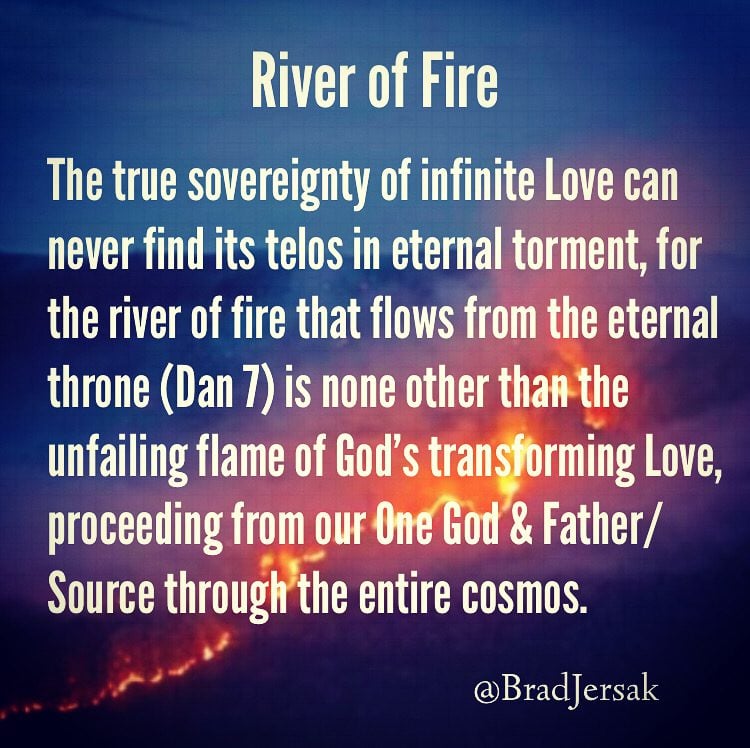
The River of Fire: the Sovereignty of Infinite...

Is Humanity the Real Plague? (Spoiler—No) - Brad...

The Covid-19 Reset: Dark Clouds, Silver Linings &...
TRENDING AT PATHEOS Progressive Christian

Why Christians Have a Sacred Duty to Vote:...
The Bible offers strong support for the sacred duty to vote. Here...

What Being a Modern-Day Apostle Means to Me
In my last column, I discussed the ins and outs of modern-day...

Did Ancient China Once Worship the God of...
Across human history, a common thread weaves through the origins of the...

Love Your Neighbor – Including Earth-Kin: Lev. 19,...
God’s command to love your neighbor means acting in an ethical and...

Lead a Church Study of “Jesus and Lao...
Guest writer Jack Thomas (The Irreverent Reverend) reflects on leading his church...

Principles for Understanding the Apostolic Ministry Today
Whenever people discover that my formal ministry title is "apostle," as in...
view all Progressive Christian blogs
Ad-Free & Subscriber Log-In Subscription Support
- About Us
- 2026 Calendar
- Videos
- Podcasts
- Library of World Religions
- Faith In Media Tracker
- Advertise With Us
- Write for Us
- Privacy Policy
- Terms of Service
- Do Not Sell My Data
- Contact Us
- Radiant Digital
- Manage Newsletter Subscriptions
- Unsubscribe From Notifications
- Sitemap
Copyright 2008-2026, Patheos. All rights reserved.
Subscription Support Ad-Free & Subscriber Log-In
Follow Patheos