
BuddhistCatholicContemplativeEvangelicalGeneral ChristianHinduJewishLatter-day SaintMuslimNew VisionsProgressive Christian
Beliefs
- Buddhist
- Catholic
- Contemplative
- Evangelical
- General Christian
- Hindu
- Jewish
- Latter-day Saint
- More Voices
- Muslim
- New Visions
- Pagan
- Progressive Christian
Topics
- Religion News
- Food and Religion
- Sports and Religion
- Religious Art
- Religious Music and Entertainment
- Religious Events
- History and Religion
- Style and Religion
- Politics and Religion
- Women in Religion
- Recreation Outdoors and Religion
- Business Finance and Religion
- Careers Workplace and Religion
- Education and Religion
- Family Parenting and Religion
- Health Fitness and Religion
- Home and Religion
- Relationships and Religion
- Technology and Religion
- Travel and Religion
Columnists
- Buddhist Columnists
- Business Finance and Religion Columnists
- Careers Workplace and Religion Columnists
- Catholic Columnists
- Contemplative Columnists
- Education and Religion Columnists
- Evangelists Columnists
- Family Parenting and Religion Columnists
- General Christian Columnists
- Health Fitness and Religion Columnists
- Hindu Columnists
- History and Religion Columnists
- Home and Religion Columnists
- Jewish Columnists
- More Voices Columnists
- Latter Day Columnists
- Muslim Columnists
- New Visions Columnists
- Nonreligious Columnists
- Pagan Columnists
- Politics and Religion Columnists
- Progressive Columnists
- Recreation Outdoors and Religion Columnists
- Relationships and Religion Columnists
- Religion News Columnists
- Religious Art Columnists
- Religious Events Columnists
- Religious Music and Entertainment Columnists
- Sports and Religion Columnists
- Style and Religion Columnists
- Technology and Religion Columnists
- Travel and Religion Columnists
- Women in Religion Columnists
Resource Library
- 2026 Calendar
- Library of World Religions
- The 100 Most Holy Places on Earth
- Patheos Answers
- Podcasts
- Videos
- Faith Leaders Database
- Anglican Episcopalian
- Bahai
- Baptist
- Buddhism
- Christianity
- Confucianism
- Eastern Orthodoxy
- Hinduism
- Holiness and Pentecostal
- ISKCON
- Islam
- Judaism
- Lutheran
- Methodist
- The Church of Jesus Christ of Latter-day Saints
- New Age
- Paganism
- Presbytarian and Reformed
- Protestantism
- Religion Behind the Scenes
- Roman Catholic
- Scientology
- Shia Islam
- Sikhism
- Sufism
- Sunni Islam
- Taoism
- Zen
- See all religions
Research Tools
 Ad-Free & Subscriber Log-In Subscription Support
Ad-Free & Subscriber Log-In Subscription Support
Follow Patheos 

- Trending:
- Forgiveness
- |
- Marriage
- |
- Consciousness
- |
- Death Penalty
- |
- Election
- |
- Halloween
 Born to Reform
- Home
- Evangelical
- What is Amillennialism?
What is Amillennialism?
Last updated on: March 15, 2013 at 7:21 am by Born to Reform
What is Amillennialism? 2013-03-15T07:21:34-05:00 Born to Reform
Patheos Explore the world's faith through different perspectives on religion and spirituality! Patheos has the views of the prevalent religions and spiritualities of the world.
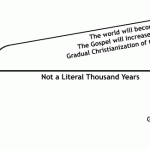
“Amillennialism” comes from a term that means, literally, “no thousand years”. Thus, it is essentially a way of interpreting Revelation 20, which six times mentions a period of a thousand years, during which Satan is bound and believers reign with Christ. Amillennialists believe that there will be no future thousand-year period of time when the Kingdom of God will be visibly flourishing in the world, and the whole earth will be fruitful and at peace. Speaking symbollically like the rest of Revelation, the millennium is simply a figurative way of speaking of a long period of time that is taking place after Jesus inaugurated the Kingdom of God with his resurrection. Amillennialists believe Revelation 20 is one of a series of visions, each of which describes the entire period of time between Christ’s first and second comings in a different manner. The millennial Kingdom is taking place now, for Satan has been bound by Christ’s work on the cross, so that he can no longer hold all the nations in deception; and believers, who seem to be persecuted and afflicted, are really reigning with Christ, and causing his Kingdom, which does not now come visibly, to spread to every corner of the earth. There is a difference of opinion in amillennial interpretation over whether those who reign with Christ are believers who are still alive, or those who have died in the Lord, and are now in his presence.
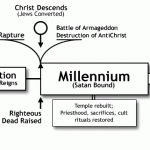
Some amillennialists object to the term “amillennialism,” because they do not properly believe that there is no millenium, they just believe that the millennium spoken of in Revelation 20 is taking place now (figuratively), and thus there will be no future golden age of the Kingdom, prior to Christ’s coming and ushering in the eternal state. Amillennialists also believe that Revealtion 20 is more fully understood when reading John chapter 5 (John being the same author as Revelation). Two resurrections are also spoken of in this passage (one spiritual and one physical at the end of the age). It reveals that when Christ returns to judge the earth, the resurrection of the wicked and the righteous occur simultaneously. This contrasts sharply with premillennialism which asserts that there is a one thousand year seperation between the resurrection of the righteous and thw wicked, which John 5 excludes the possibility of. Amillennialism is really the most simple of the various eschatologies as it affirms that Jesus will soon return to judge the living and the dead and then comes the resurrection, or the eternal state, which Christ will reign on the new earth.
We will continue our 3-part series with part 2, “What is Postmillennialism?” later this week, followed by part 3, “What is Premillennialism?” next week.
Have more questions? Monergism is a great resource, check it out.
Previous Post
March 12, 2013
C.S. Lewis' Life Shaped the World of Narnia
Next Post
March 15, 2013 What is Postmillennialism?
Browse Our Archives
Select a Category Book Reviews Eschatology Series Guest Posts Interviews Originals Other Spurgeon Uncategorized
Select a Month October 2013 September 2013 June 2013 May 2013 April 2013 March 2013 February 2013 January 2013
TAKE THE
Religious Wisdom Quiz
Who fell out of a window and was restored to life by Paul?
Select your answer to see how you score.
Barnabas Silas Timothy Eutychus
Related posts from Born to Reform


TRENDING AT PATHEOS Evangelical

The REST of Your Life: A Creative Wrestles...
This week I had a conversation with a good friend from church....

How the author of the world's best hymn...
I've been working with John Newton for a while now. This makes...

Long before this Lectio Divina, Psalm 130 - the song - started...

What About the Trees? Another Living Parable
After I finished writing the last article about falling leaves as a...

Why Classical Education Is a Conversation, Not a...
Come and Read: Joy in Classical Education When I was a little...

Cornell University has received a great deal of negative publicity and intense...
view all Evangelical blogs
Ad-Free & Subscriber Log-In Subscription Support
- About Us
- 2026 Calendar
- Videos
- Podcasts
- Library of World Religions
- Faith In Media Tracker
- Advertise With Us
- Write for Us
- Privacy Policy
- Terms of Service
- Do Not Sell My Data
- Contact Us
- Radiant Digital
- Manage Newsletter Subscriptions
- Unsubscribe From Notifications
- Sitemap
Copyright 2008-2026, Patheos. All rights reserved.
Subscription Support Ad-Free & Subscriber Log-In
Follow Patheos