
BuddhistCatholicContemplativeEvangelicalGeneral ChristianHinduJewishLatter-day SaintMuslimNew VisionsProgressive Christian
Beliefs
- Buddhist
- Catholic
- Contemplative
- Evangelical
- General Christian
- Hindu
- Jewish
- Latter-day Saint
- More Voices
- Muslim
- New Visions
- Pagan
- Progressive Christian
Topics
- Religion News
- Food and Religion
- Sports and Religion
- Religious Art
- Religious Music and Entertainment
- Religious Events
- History and Religion
- Style and Religion
- Politics and Religion
- Women in Religion
- Recreation Outdoors and Religion
- Business Finance and Religion
- Careers Workplace and Religion
- Education and Religion
- Family Parenting and Religion
- Health Fitness and Religion
- Home and Religion
- Relationships and Religion
- Technology and Religion
- Travel and Religion
Columnists
- Buddhist Columnists
- Business Finance and Religion Columnists
- Careers Workplace and Religion Columnists
- Catholic Columnists
- Contemplative Columnists
- Education and Religion Columnists
- Evangelists Columnists
- Family Parenting and Religion Columnists
- General Christian Columnists
- Health Fitness and Religion Columnists
- Hindu Columnists
- History and Religion Columnists
- Home and Religion Columnists
- Jewish Columnists
- More Voices Columnists
- Latter Day Columnists
- Muslim Columnists
- New Visions Columnists
- Nonreligious Columnists
- Pagan Columnists
- Politics and Religion Columnists
- Progressive Columnists
- Recreation Outdoors and Religion Columnists
- Relationships and Religion Columnists
- Religion News Columnists
- Religious Art Columnists
- Religious Events Columnists
- Religious Music and Entertainment Columnists
- Sports and Religion Columnists
- Style and Religion Columnists
- Technology and Religion Columnists
- Travel and Religion Columnists
- Women in Religion Columnists
Resource Library
- 2026 Calendar
- Library of World Religions
- The 100 Most Holy Places on Earth
- Patheos Answers
- Podcasts
- Videos
- Faith Leaders Database
- Anglican Episcopalian
- Bahai
- Baptist
- Buddhism
- Christianity
- Confucianism
- Eastern Orthodoxy
- Hinduism
- Holiness and Pentecostal
- ISKCON
- Islam
- Judaism
- Lutheran
- Methodist
- The Church of Jesus Christ of Latter-day Saints
- New Age
- Paganism
- Presbytarian and Reformed
- Protestantism
- Religion Behind the Scenes
- Roman Catholic
- Scientology
- Shia Islam
- Sikhism
- Sufism
- Sunni Islam
- Taoism
- Zen
- See all religions
Research Tools
 Ad-Free & Subscriber Log-In Subscription Support
Ad-Free & Subscriber Log-In Subscription Support
Follow Patheos 

- Trending:
- Forgiveness
- |
- Marriage
- |
- Consciousness
- |
- Death Penalty
- |
- Election
- |
- Halloween
 Born Again Witch
- Home
- Pagan
- Relationships and Religion
- Aspecting and Tentacles of Fundamentalism
Aspecting and Tentacles of Fundamentalism
Last updated on: December 18, 2015 at 5:12 pm by Annika Mongan
Aspecting and Tentacles of Fundamentalism 2015-12-18T17:12:54-07:00 Annika Mongan
Patheos Explore the world's faith through different perspectives on religion and spirituality! Patheos has the views of the prevalent religions and spiritualities of the world.
Aspecting – a magical practice in which a priestess or priest channels the presence of a deity or quality. “Aspecting,” says Reclaiming teacher Sage, “is a technique which allows participants to experience the presence of a quality, being or deity in an embodied, physically manifest way.” – Reclaiming Quarterly
Recently I was in a class in which we were going to practice aspecting. But the closer we came to starting our aspecting practice, the more uncomfortable I grew. Eventually I raised my hand and said I would be happy to tend others and support the practice, but that I myself did not want to aspect.
Why did I opt out? In Gods and Radicals Nikki Whiting wrote an excellent article in which she mentions giving ourselves a “menstrual holiday”. I didn’t feel like sharing by crampy body with any other energy, entity, or deity. And I also knew that aspecting would take much more energy than I was willing to expend on my menstrual holiday. Just the thought of it was thoroughly exhausting.
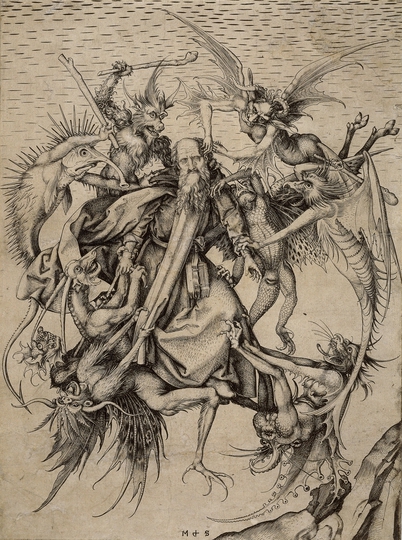
St. Anthony plagued by demons by Martin Schongauer Licensed under Public Domain via Commons
After the class I compared notes with a friend who also chose to opt out. Both of us grew up evangelical Christian. Both of us rebelled against our families by becoming more radical and fundamentalist than our upbringing. We had been taught that any entity or deity other than Jesus was demonic. That, however, was not the reason we opted out. It was the sheer expense of energy that deterred us.
We agreed that we both spent most of our lives aspecting. “What Would Jesus Do?” wasn’t just an intellectual question. “He must increase, but I must decrease” (John 3:30, KJV) When we invited Jesus into our lives, we were always on. We actively tried to undo any boundaries between us and our deity. We were his, available for him to use us in any which way he wanted. Anytime. If we retained any say in the matter, it was counted against us. Our goal was to become thoroughly dependent, possessed by Jesus, the Holy Spirit, the triune God, if you will.
But aspecting is not full possession. Unlike fundamentalist Christians, when we aspect as Pagans, we don’t invite an entity to take over. We set and maintain boundaries. I get that. Intellectually.
John Beckett recently wrote in his excellent piece Eight Years of Useless Religion:
The tentacles of fundamentalism were still in me. Ignoring them and intellectually denying them hadn’t made them go away. Deep down I was still afraid the fundamentalists were right and I was wrong, and if so I was headed straight to hell. This is why I said “you might have to go back and work through some unresolved issues with the theism of your childhood.”
My own worldview has changed dramatically, but becoming a Pagan is more than an intellectual conversion. Unlike in evangelical Christianity, we place little emphasis on intellectual assent to certain beliefs. We seek to embody a different way of life and open to new experiences. That takes active unlearning, not just in the mind, but also in the body.
When faced with aspecting, I can feel the temptation to switch to autopilot. I can feel every cell of my body wanting to submit to whichever entity we’re inviting. I know how to lose myself, to give up my own energy, and turn over control. If I want to set and maintain boundaries with deity, I first need to unlearn the conditioning that resides deep within my body.
![Tentacles. They're kind of gross and fascinating. [photo credit: Public domain, via Wikimedia Commons]](https://wp-media.patheos.com/blogs/sites/575/2015/12/tentacle.jpg)
Tentacles. They’re kind of gross and fascinating.
[photo credit: Public domain, via Wikimedia Commons]
So I opt out sometimes. My spiritual journey is always informed by my past. Sometimes I draw wisdom from the spiritual experiences of my childhood and learn to integrate. But at other times my spiritual work is saying “no”, closing the door, and working through that which no longer serves me.
In the year after my divorce I had to face the realization that I had spent a decade in an abusive, codependent relationship. I knew I never, ever wanted to go there again. For a while I considered becoming a nun. I made a commitment to myself to abstain from dating or being involved in any kind of relationship for at least one year. After that year I’d decide if I’d become a nun or maybe open up to the possibility of marriage again.
Turning down opportunities for intimacy and relationships during that year was one of the hardest things I have ever done. I wanted to desperately not to be alone. And yet I am glad I stuck it out. At the end of the year I discovered a third option. Rather than committing to celibacy or another monogamous relationship, I discovered ethical non-monogamy and eventually became tribalamorous. It’s a lifestyle that feels like it was made for me, and I never went back to codependency and abuse.
Aspecting feels a lot like learning how to date now that I’m divorced from fundamentalist Jesus. The last thing I want is to end up in another abusive relationship with deity. I’d love to believe that I can simply change my theology and jump right in, but setting healthy boundaries takes tremendous energy, focus, and shadow work. So I honor my “no” and I honor my “yes” and I continue the work of facing and untangling myself from one tentacle of fundamentalism after another.
Previous Post

December 10, 2015
How Many People Am I Dating?
Next Post

December 28, 2015 This Is Integration
Browse Our Archives
Select a Category Uncategorized
Select a Month June 2016 May 2016 April 2016 March 2016 February 2016 January 2016 December 2015 November 2015 October 2015 September 2015 August 2015
Follow Us!
TAKE THE
Religious Wisdom Quiz
How many days are in a week?
Select your answer to see how you score.
Five Twelve Ten Seven
Related posts from Born Again Witch


An Intuitive Paintbrush Banishing Ritual

Christians And Pagans As Allies
TRENDING AT PATHEOS Pagan

I was recently chatting with someone on Instagram. She asked me what...

While there are many people who share their results, the end of...

On July 23, I saw Christopher Nolan's The Odyssey which is Homer’s...

As I write this two big events have just finished up. One...

Restoring the Watershed of Divine Love
Perhaps cooperation is not something we manufacture through legislation, ideology, or moral...

Many UUs don’t pray because of bad experiences in a previous religion,...
view all Pagan blogs
Ad-Free & Subscriber Log-In Subscription Support
- About Us
- 2026 Calendar
- Videos
- Podcasts
- Library of World Religions
- Faith In Media Tracker
- Advertise With Us
- Write for Us
- Privacy Policy
- Terms of Service
- Do Not Sell My Data
- Contact Us
- Radiant Digital
- Manage Newsletter Subscriptions
- Unsubscribe From Notifications
- Sitemap
Copyright 2008-2026, Patheos. All rights reserved.
Subscription Support Ad-Free & Subscriber Log-In
Follow Patheos