
BuddhistCatholicContemplativeEvangelicalGeneral ChristianHinduJewishLatter-day SaintMuslimNew VisionsProgressive Christian
Beliefs
- Buddhist
- Catholic
- Contemplative
- Evangelical
- General Christian
- Hindu
- Jewish
- Latter-day Saint
- More Voices
- Muslim
- New Visions
- Pagan
- Progressive Christian
Topics
- Religion News
- Food and Religion
- Sports and Religion
- Religious Art
- Religious Music and Entertainment
- Religious Events
- History and Religion
- Style and Religion
- Politics and Religion
- Women in Religion
- Recreation Outdoors and Religion
- Business Finance and Religion
- Careers Workplace and Religion
- Education and Religion
- Family Parenting and Religion
- Health Fitness and Religion
- Home and Religion
- Relationships and Religion
- Technology and Religion
- Travel and Religion
Columnists
- Buddhist Columnists
- Business Finance and Religion Columnists
- Careers Workplace and Religion Columnists
- Catholic Columnists
- Contemplative Columnists
- Education and Religion Columnists
- Evangelists Columnists
- Family Parenting and Religion Columnists
- General Christian Columnists
- Health Fitness and Religion Columnists
- Hindu Columnists
- History and Religion Columnists
- Home and Religion Columnists
- Jewish Columnists
- More Voices Columnists
- Latter Day Columnists
- Muslim Columnists
- New Visions Columnists
- Nonreligious Columnists
- Pagan Columnists
- Politics and Religion Columnists
- Progressive Columnists
- Recreation Outdoors and Religion Columnists
- Relationships and Religion Columnists
- Religion News Columnists
- Religious Art Columnists
- Religious Events Columnists
- Religious Music and Entertainment Columnists
- Sports and Religion Columnists
- Style and Religion Columnists
- Technology and Religion Columnists
- Travel and Religion Columnists
- Women in Religion Columnists
Resource Library
- 2026 Calendar
- Library of World Religions
- The 100 Most Holy Places on Earth
- Patheos Answers
- Podcasts
- Videos
- Faith Leaders Database
- Anglican Episcopalian
- Bahai
- Baptist
- Buddhism
- Christianity
- Confucianism
- Eastern Orthodoxy
- Hinduism
- Holiness and Pentecostal
- ISKCON
- Islam
- Judaism
- Lutheran
- Methodist
- The Church of Jesus Christ of Latter-day Saints
- New Age
- Paganism
- Presbytarian and Reformed
- Protestantism
- Religion Behind the Scenes
- Roman Catholic
- Scientology
- Shia Islam
- Sikhism
- Sufism
- Sunni Islam
- Taoism
- Zen
- See all religions
Research Tools
 Ad-Free & Subscriber Log-In Subscription Support
Ad-Free & Subscriber Log-In Subscription Support
Follow Patheos 

- Trending:
- Forgiveness
- |
- Marriage
- |
- Consciousness
- |
- Death Penalty
- |
- Election
- |
- Halloween
 Born Again Witch
- Home
- Pagan
- Relationships and Religion
- I, Granddaughter Of The Bombs
I, Granddaughter Of The Bombs
Last updated on: October 9, 2015 at 1:01 pm by Annika Mongan
I, Granddaughter Of The Bombs 2015-10-09T13:01:20-07:00 Annika Mongan
Patheos Explore the world's faith through different perspectives on religion and spirituality! Patheos has the views of the prevalent religions and spiritualities of the world.
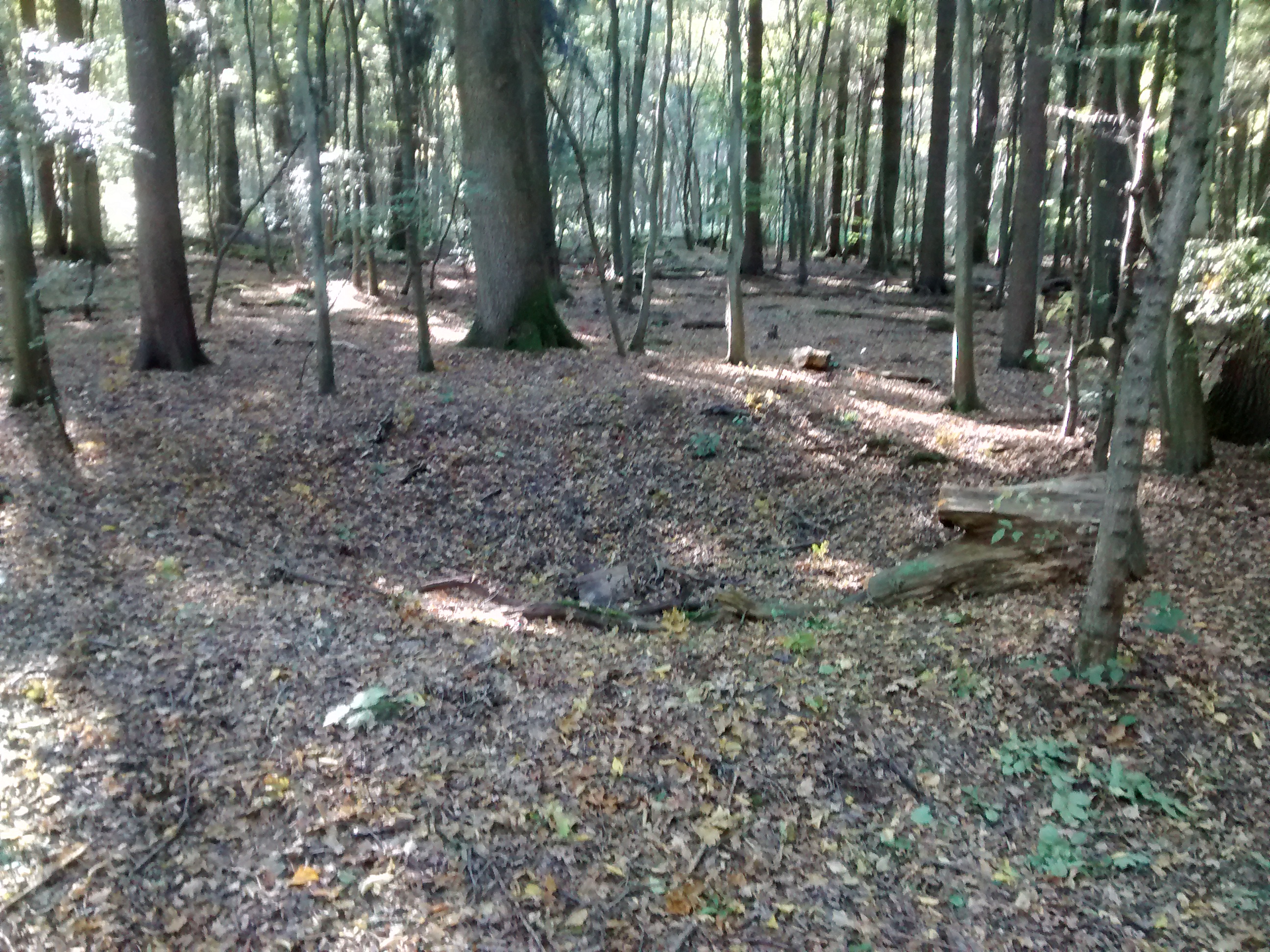
The closer to Hanau, the more bombs.
I must be getting close to the bomb craters. I didn’t plan on coming here today and didn’t bring a map. My partner and I were going to hike the Spessartbogen*, a beautiful trail overlooking the Kinzig Valley, but then he asked me to take him to the craters.*
In my mind I smell garlic. Bombcraters and the smell of garlic go together, because they are found in the same part of the woods. I head toward where I once collected Bärlauch*, the leaves of wild garlic, for making pesto. On my right the forest gives way to a small meadow and I imagine it covered in oval green leaves and white flowers that reflect rays of the waxing sun. The image works, I think this is a wild garlic meadow during spring. That means I am on the right track, but I still don’t see any craters.*
I come to an intersection, paths crossing each other at perfect 90 degree angles. I look up and observe how the sun breaks through the golden canopy of beech trees. It tells me that I am facing West, so I choose the trail on the left, hopefully taking me closer toward Hanau. The closer to Hanau, the more abundant the bombs.
That indentation on my right could be a crater, but I am not sure. There’s a hollow on the left, a few hundred feet farther, but it is too shallow. Maybe the craters have filled in since my childhood?
Finally I spot a rotting wooden structure at another intersection and I recognize it as the beams that once held a gymnastic rings, part of an abandoned fitness trail. And there, just beyond the structure, the forest looks like swiss cheese, craters on either side of the path, some just a few feet apart.
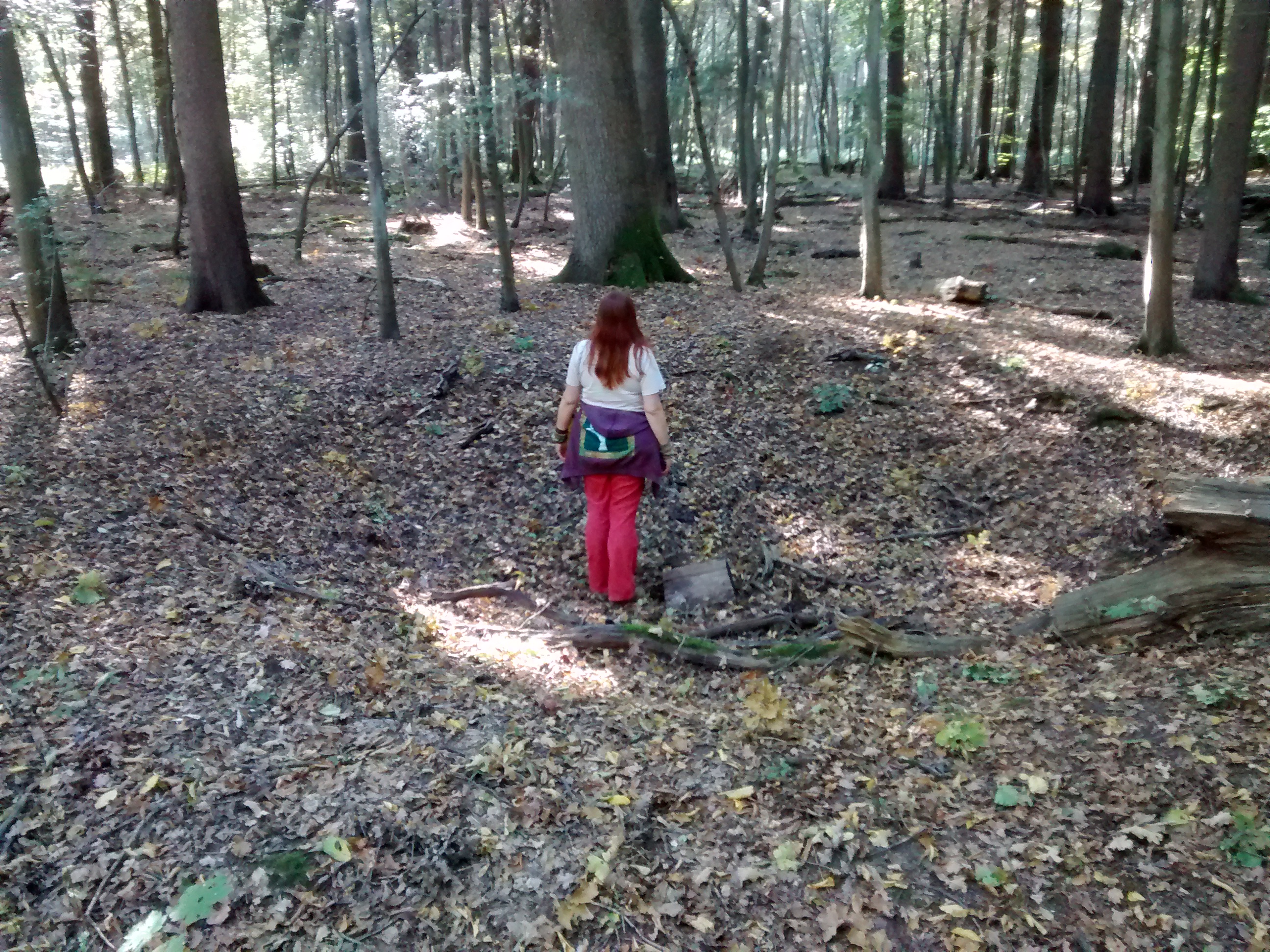
Remembering how these craters in the Bruchköbler forest were “safe zones” in our childrens’ play.
My partner starts snapping pictures. I just stand there, staring at the craters, remembering how much I used to love them. I see myself sliding down the steep sides in winter, slipping on the ice and laughing as I tumble into the snow filled hole. I shake my head as I think of the games of tag we would play, chasing each other through the forest, hoping for bomb craters because they were our designated safe zones. The irony was lost on us children.
Out of all of the sights my partners and I visited during our vacation in Germany, the Dom in Köln, Luther’s door in Wittenberg, the festival at my favorite medieval castle, our time spent with friends and family, it is the pictures my partner took at the bomb craters that haunt me.
I used to think all forests had them. Intellectually I could have realized I was wrong much sooner, but it wasn’t until I walked through old growth woods sans craters in the U.S. at age 19 that it hit me. To me, craters, bombed out churches, and other ruins had been normal.
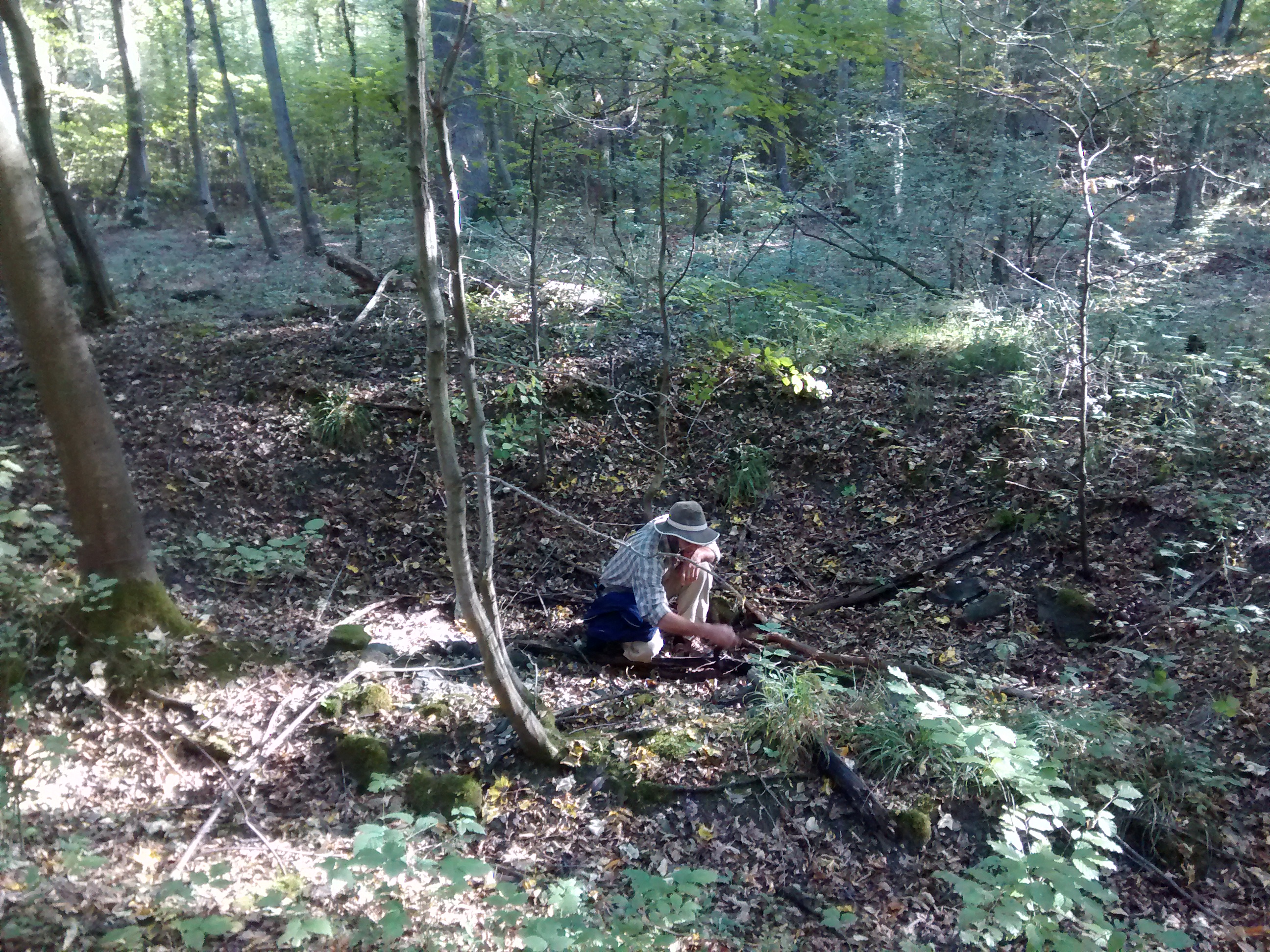
My partner exploring the inside of a crater.
We didn’t talk much about the war when I was a child. In school, we learned about the holocaust and studied it from many angles in our various classes, in German literature, in Social Studies, in History, in Politics, and even in Biology (discussing Social Darwinism). Some of our field trips were like those of my American cousins, but others consisted of tours of Auschwitz and the nearby Hadamar. The echoes of the Holocaust were all around us. The message was clear: you are the descendants of the Nazis. Never forget, never repeat!
It was an important message and I continued my studies outside of school. I read fictional books and eyewitness stories, I asked questions at home, I imagined the horrors, and I vowed to do my part in creating a better future. And I internalized our collective German guilt. I studied the holocaust year after year, until it became a crushing burden of shame for my country of birth. I only found solace in my own family’s history, proud that my Opa had risked his life deserting Hitler and that my American grandpa had fought in the allied forces.
But then came the time when someone mentioned the Dresden firebombing and we spoke of it in hushed voices. We were afraid to be caught shifting our focus from the holocaust to the war, from the way we Germans had caused suffering, to the way we may have also suffered. A door opened into the world of our parents’ and grandparents’ trauma, but it was too soon to open it all the way. We were afraid to distract from the suffering of those persecuted during the holocaust.
Bombs fell when my uncle was a child. They fell when my aunt was a baby and a toddler. My mom grew up in ruined country. I was born in Hanau, a city that was flattened just before the end of the war. I like to joke about the differences in German and American culture, but now I wonder: how many of our differences are really cultural, and how many are really collective inherited trauma?
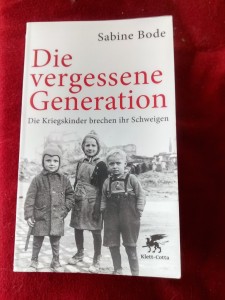
The book my mom gave me. Half way through the introduction I knew I wouldn’t be able to put it down again.
My mom gave me a book by Sabine Bode, The Forgotten Generation. She warned me that it would not be an easy read, that I should wait until after my vacation. I start reading it as soon as I arrive in California. Within the first few minutes, than half way through the introduction to the book, my questions multiply and my reality starts tilting. It is as if we post-war Germans all share an unspeakable secret, but we’ve ignored it so thoroughly that it has become unreal to us.
As I open the door to this secret, I am overwhelmed by information. Bombarded, I would say, but I can no longer use the expression lightly. Bombs are the things that gifted my game of tag its safe zones. But now I know I have inherited much more than the bomb craters. I, too, am shaped by the memories behind the bombs, a generation of traumatized children who raised me, a granddaughter of the bombs. What that means for me, I have yet to discover.
Previous Post
October 1, 2015
Unexpected Tension At A Blood Moon In Germany
Next Post

October 14, 2015 Arriving At The Parliament Of World Religions
Browse Our Archives
Select a Category Uncategorized
Select a Month June 2016 May 2016 April 2016 March 2016 February 2016 January 2016 December 2015 November 2015 October 2015 September 2015 August 2015
Follow Us!
TAKE THE
Religious Wisdom Quiz
True or False: In John's Gospel, Jesus raises Lazarus from the dead after he had been in the tomb for four days.
Select your answer to see how you score.
TRUE FALSE
Related posts from Born Again Witch
Unexpected Tension At A Blood Moon In Germany
Longing For Roots and Wildness
TRENDING AT PATHEOS Pagan

I was recently chatting with someone on Instagram. She asked me what...

While there are many people who share their results, the end of...

On July 23, I saw Christopher Nolan's The Odyssey which is Homer’s...

As I write this two big events have just finished up. One...

Restoring the Watershed of Divine Love
Perhaps cooperation is not something we manufacture through legislation, ideology, or moral...

Many UUs don’t pray because of bad experiences in a previous religion,...
view all Pagan blogs
Ad-Free & Subscriber Log-In Subscription Support
- About Us
- 2026 Calendar
- Videos
- Podcasts
- Library of World Religions
- Faith In Media Tracker
- Advertise With Us
- Write for Us
- Privacy Policy
- Terms of Service
- Do Not Sell My Data
- Contact Us
- Radiant Digital
- Manage Newsletter Subscriptions
- Unsubscribe From Notifications
- Sitemap
Copyright 2008-2026, Patheos. All rights reserved.
Subscription Support Ad-Free & Subscriber Log-In
Follow Patheos