
BuddhistCatholicContemplativeEvangelicalGeneral ChristianHinduJewishLatter-day SaintMuslimNew VisionsProgressive Christian
Beliefs
- Buddhist
- Catholic
- Contemplative
- Evangelical
- General Christian
- Hindu
- Jewish
- Latter-day Saint
- More Voices
- Muslim
- New Visions
- Pagan
- Progressive Christian
Topics
- Religion News
- Food and Religion
- Sports and Religion
- Religious Art
- Religious Music and Entertainment
- Religious Events
- History and Religion
- Style and Religion
- Politics and Religion
- Women in Religion
- Recreation Outdoors and Religion
- Business Finance and Religion
- Careers Workplace and Religion
- Education and Religion
- Family Parenting and Religion
- Health Fitness and Religion
- Home and Religion
- Relationships and Religion
- Technology and Religion
- Travel and Religion
Columnists
- Buddhist Columnists
- Business Finance and Religion Columnists
- Careers Workplace and Religion Columnists
- Catholic Columnists
- Contemplative Columnists
- Education and Religion Columnists
- Evangelists Columnists
- Family Parenting and Religion Columnists
- General Christian Columnists
- Health Fitness and Religion Columnists
- Hindu Columnists
- History and Religion Columnists
- Home and Religion Columnists
- Jewish Columnists
- More Voices Columnists
- Latter Day Columnists
- Muslim Columnists
- New Visions Columnists
- Nonreligious Columnists
- Pagan Columnists
- Politics and Religion Columnists
- Progressive Columnists
- Recreation Outdoors and Religion Columnists
- Relationships and Religion Columnists
- Religion News Columnists
- Religious Art Columnists
- Religious Events Columnists
- Religious Music and Entertainment Columnists
- Sports and Religion Columnists
- Style and Religion Columnists
- Technology and Religion Columnists
- Travel and Religion Columnists
- Women in Religion Columnists
Resource Library
- 2026 Calendar
- Library of World Religions
- The 100 Most Holy Places on Earth
- Patheos Answers
- Podcasts
- Videos
- Faith Leaders Database
- Anglican Episcopalian
- Bahai
- Baptist
- Buddhism
- Christianity
- Confucianism
- Eastern Orthodoxy
- Hinduism
- Holiness and Pentecostal
- ISKCON
- Islam
- Judaism
- Lutheran
- Methodist
- The Church of Jesus Christ of Latter-day Saints
- New Age
- Paganism
- Presbytarian and Reformed
- Protestantism
- Religion Behind the Scenes
- Roman Catholic
- Scientology
- Shia Islam
- Sikhism
- Sufism
- Sunni Islam
- Taoism
- Zen
- See all religions
Research Tools
 Ad-Free & Subscriber Log-In Subscription Support
Ad-Free & Subscriber Log-In Subscription Support
Follow Patheos 

- Trending:
- Forgiveness
- |
- Marriage
- |
- Consciousness
- |
- Death Penalty
- |
- Election
- |
- Halloween
 Bodhisattva Road
- Home
- Buddhist
- Dzogchen’s Seven Mind Trainings
Dzogchen’s Seven Mind Trainings
Last updated on: August 9, 2022 at 5:07 pm by Daniel Scharpenburg
Dzogchen’s Seven Mind Trainings 2022-08-09T17:07:09-05:00 Daniel Scharpenburg
Patheos Explore the world's faith through different perspectives on religion and spirituality! Patheos has the views of the prevalent religions and spiritualities of the world.
There is a teaching in the Dzogchen Buddhist tradition that I want to share with you. This is a form of mind training, but different from some other teachings in it’s depth. This is a preliminary teaching but it goes all the way into some difficult concepts that usually aren’t considered approachable for beginners. For this reason, this is a good teaching to study whether one has been practicing a long time or one is just starting out.
This teaching is called The Seven Mind Trainings and it’s a list of things for us to contemplate.
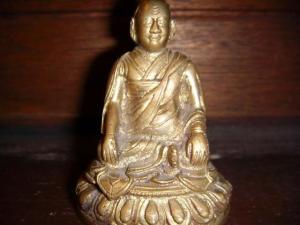
Longchen Rabjam
In “The Seven Mind Trainings: Essential Instructions on the Preliminary Practices” by Longchen Rabjam he labeled them in this way:
1) Impermanence
2) Fleeting and lasting happiness
3) The various circumstances that lead to death
4)The pointlessness of all mundane endeavors
5) The virtues of the Buddha
6) The guru’s instructions
7) Nonconceptuality
I’ll be doing some writings building on these teachings over the next few weeks, but we’ll explore each of them a little now.
Contemplating Impermanence
We tend to think we can hold onto things but we can’t. The truth is we are losing things all the time and we all know that. You can’t hold onto anything in this world. This could really frighten us, or we can work to keep in mind that this means the things we don’t like pass too. Reflecting on impermanence helps us to not try to cling to tightly to everything all the time. It also helps with our tendency toward self obsession.
Longchen Rabjam says, “Without getting distracted, even for a moment, ask yourself wholeheartedly, ‘I wonder if I will die this evening, or perhaps tomorrow?’ All sentient beings that you see will die as well, so meditate on the thought ‘When will these beings pass away?’ Contemplating in this way will help you see that all conditioned phenomena are impermanent by nature. Seeing them as examples of impermanence will help your mind become more focused. The purpose of meditating in this manner is to turn your mind away from impermanence.”
Contemplating Fleeting and Lasting Happiness
The joys in life are fleeting. When you buy a new car, you really enjoy and appreciate for a short time, then it becomes just an ordinary part of your life. We think this way about many things in life. We tend to think, “if I can just get that partner, or that job, then I can finally be happy.” The truth is though when we have big things that we think will finally bring us happiness, it’s usually not as wonderful as we think it will be. And sometimes we get the thing we want and it turns out…we should have wanted something else.
Longchen Rabjam says, “When you think wholeheartedly that all activities end up causing suffering, you will have familiarized yourself with mind training. The purpose of meditation in this way is to elicit a feeling of disenchantment and disillusionment with the suffering of samsara.”
Contemplating the Various Circumstances that Lead to Death
This all feels very dark, doesn’t it? You could die tomorrow. How does thinking about that help?
Like impermanence and the fleeting nature of happiness thinking about this helps us to try to stop being so self obsessed all the time. But it does more than that. Knowing that we’re all in this situation where we could die at any time, that we’re all in it together, really should make us be nicer to other people. It should help us avoid fighting over things that aren’t ultimately all that important. We don’t usually think that way, but we could. We can learn how to stop doing things that harm ourselves and others and how to stop engaging so much in negative behaviors like gossip.
Longchen Rabjam says, “Think to yourself, ‘I must focus solely on virtue!’ With this in mind, reflect on all the good and bad circumstances of the past, what you are doing in the present, and what you will do in the future. Cultivate a sense of disenchantment, and focus your mind. When compassion toward all six classes of beings manifests and you enthusiastically think of all your activities as an offering to the Three Jewels and your guru, you will have mastered this mind training. Meditating in this way serves to elicit the prerequisite of faith.”
Contemplating the Pointlessness of All Mundane Endeavors
The point of this is to compare our ordinary life with our spiritual life. If we engage the teachings, spiritual Enlightenment could be within our reach. If we engage the teachings, we could suffer less and love more. This would be a wonderful thing for us. So what we’re doing is comparing the normal ordinary things we are doing with the spiritual things we could be doing. I can do my meditation practice in the morning instead of taking time to numbly scroll Facebook before I have to go to work. So can you.
Longchen Rabjam says, “What a waste to have spent your time on pointless pursuits: getting caught up in attachment and aversion, quarreling with others, hoping to hear pleasant things and not to hear anything unpleasant, pursuing pleasure and avoiding pain, accumulating and hoarding things, and so on.”
Contemplating the Virtues of the Buddha
The historical figure we call the Buddha overcame suffering and learned how to live in an awakened way. He was just an ordinary person like we are, so we have the ability to attain what he did.
Longchen Rabjam says, “Tell yourself, ‘Since buddhahood cannot be attained without meditating, it is essential that I do so. I must practice with perfect concentration, following the example of the amazing, accomplished masters of the past, who endured hardships and lived in isolated places on their quest for liberation.’ This will serve to strengthen your resolve in meditation.”
Contemplating the Guru’s Instructions
I’ll be honest, this is the one I struggle with. The message I’m taking from it is that we should really take it seriously when we receive spiritual teachings. And anyone that shares spiritual teachings with us should be held in high regard.
Longchen Rabjam says, “For this mind training, ponder the reasons for practicing the guru’s instructions. Consider how the guru is the one who will guide you across the boundless ocean of samsara to liberation. The guru’s instructions, like a great vessel, will liberate you.”
Contemplating Nonconceptuality
This is the mind-blowing part. We’re just going to jump into talking about a mind that’s free of concepts. How can we even talk about that? In his teaching Longchen Rabjam includes three forms of nonconceptuality: bliss-emptiness, clarity-emptiness, and reality. He gives a brief guidance on reflecting on each of these and I’ll include those here.
The Nonconceptuality of Bliss-Emptiness: “Imagine the syllable HAM at the upper end of your central channel and an AH symbol at your navel. Fire blazes forth from the AH and hits the HAM, causing a stream of nectar to descend, filling the four root chakras and all the secondary chakras. This, in turn, causes bliss-emptiness to arise. As you visualize this, pull the lower energy up, press the upper energy down, and focus on a white AH syllable at your heart center. This will produce the empty knowledge that utilizes the skillful means of bliss.”
The Nonconceptuality of Clarity-Emptiness: “Begin by expelling the stale breath three times. As you inhale, imagine that all external appearances and objects melt into light, merge with blue space, and then completely fill your entire body. Finally, join and hold the energies. This will generate clarity-emptiness.”
The Nonconceptuality of Reality Itself: “Relax the body and mind from deep within. Without moving your eyes, meditate in a state free from the comings and goings of thoughts. By meditating in this way, you will be able to concentrate on whatever you direct your attention to, after which you will be able to rest for longer and longer periods in a nonconceptual, space-like, state. When this comes to pass, you will have mastered this practice.”
I’m going to leave that there without a comment from me for now. I will write something about this heavy idea later.
I’ll close with one more quote from Longchen Rabjam.
He said:
“The merits of realizing impermanence are infinite:
You will abandon the faults of samsara and accumulate all the virtues naturally.
You will be freed from grasping at concepts of eternity and will dissolve attachments to loved ones and hatred to foes.
You will swiftly attain the nectar-like deathless state (buddhahood)”
The quotations in this article and the teachings referenced can be found in the book “Steps to the Great Perfection” by Jigme Lingpa. This book can be found here: https://www.shambhala.com/steps-to-the-great-perfection-15118.html
Previous Post

August 5, 2022
Training in Equanimity
Next Post

August 31, 2022 Boundless Heart (recorded talks)
Browse Our Archives
Select a Category 37 Practices blog bodhisattva book review boundless heart buddha buddhism buddhism for beginners compass of zen compassion dhammapada dharma emptiness Faith in Mind fearless heart han shan impermanence inspiration interfaith koans life Lojong mahayana meditation mind training mirror of zen movie review nagarjuna news questions recording song of mind steps to the great perfection suffering sutras suttas Uncategorized vajrayana video videos zen
Select a Month July 2024 June 2024 May 2024 February 2024 January 2024 December 2023 October 2023 September 2023 August 2023 July 2023 June 2023 December 2022 November 2022 October 2022 September 2022 August 2022 July 2022 June 2022 May 2022 March 2022 February 2022 January 2022 September 2021 August 2021 May 2021 April 2021 March 2021 February 2021 January 2021 December 2020 November 2020 August 2020 June 2020 May 2020 August 2019 March 2019 December 2018 November 2018 October 2018 September 2018 August 2018 July 2018 June 2018 May 2018 April 2018 March 2018 February 2018 January 2018 December 2017 November 2017 October 2017 September 2017 August 2017 July 2017 June 2017 May 2017 April 2017 March 2017 February 2017 January 2017 December 2016 October 2016 August 2016 July 2016 June 2016 May 2016 April 2016 March 2016
Follow Us!
TAKE THE
Religious Wisdom Quiz
What is Jesus' most famous sermon called?
Select your answer to see how you score.
The Last Supper The Parable of the Sower The Sermon on the Mount The Beatitudes
Support this
Column


Related posts from Bodhisattva Road

Attachment, Hatred, and the Darkness of Unknowing

Transforming Adversity (recorded talk)

Actions to Avoid (recorded talk)
Four Thoughts That Change The Mind
TRENDING AT PATHEOS Buddhist

On Taking Refuge in the Dharma
(Here I continue the feature of sharing talks and essays by teachers...

(Continuing my intention to share talks and essays by other members of Empty...
The Subtle Art of Bowing: A Dharma Discourse
(This presentation was first offered by my dear friend Dharma Holder Tom...

Internal Family Systems Can Heal you Mentally &...
How IFS Helped Me Stop Fighting Myself Internal Family Systems (IFS) is...

The Bible No One Spoke About: A Family’s...
A mysterious family Bible, unspoken faith, and a journey from curiosity to...

How Uncertainty Can Transform Your Life in 2025
Embracing Uncertainty: A New Year’s Resolution for the Brave As 2025 approaches,...
view all Buddhist blogs
Ad-Free & Subscriber Log-In Subscription Support
- About Us
- 2026 Calendar
- Videos
- Podcasts
- Library of World Religions
- Faith In Media Tracker
- Advertise With Us
- Write for Us
- Privacy Policy
- Terms of Service
- Do Not Sell My Data
- Contact Us
- Radiant Digital
- Manage Newsletter Subscriptions
- Unsubscribe From Notifications
- Sitemap
Copyright 2008-2026, Patheos. All rights reserved.
Subscription Support Ad-Free & Subscriber Log-In
Follow Patheos