
BuddhistCatholicContemplativeEvangelicalGeneral ChristianHinduJewishLatter-day SaintMuslimNew VisionsProgressive Christian
Beliefs
- Buddhist
- Catholic
- Contemplative
- Evangelical
- General Christian
- Hindu
- Jewish
- Latter-day Saint
- More Voices
- Muslim
- New Visions
- Pagan
- Progressive Christian
Topics
- Religion News
- Food and Religion
- Sports and Religion
- Religious Art
- Religious Music and Entertainment
- Religious Events
- History and Religion
- Style and Religion
- Politics and Religion
- Women in Religion
- Recreation Outdoors and Religion
- Business Finance and Religion
- Careers Workplace and Religion
- Education and Religion
- Family Parenting and Religion
- Health Fitness and Religion
- Home and Religion
- Relationships and Religion
- Technology and Religion
- Travel and Religion
Columnists
- Buddhist Columnists
- Business Finance and Religion Columnists
- Careers Workplace and Religion Columnists
- Catholic Columnists
- Contemplative Columnists
- Education and Religion Columnists
- Evangelists Columnists
- Family Parenting and Religion Columnists
- General Christian Columnists
- Health Fitness and Religion Columnists
- Hindu Columnists
- History and Religion Columnists
- Home and Religion Columnists
- Jewish Columnists
- More Voices Columnists
- Latter Day Columnists
- Muslim Columnists
- New Visions Columnists
- Nonreligious Columnists
- Pagan Columnists
- Politics and Religion Columnists
- Progressive Columnists
- Recreation Outdoors and Religion Columnists
- Relationships and Religion Columnists
- Religion News Columnists
- Religious Art Columnists
- Religious Events Columnists
- Religious Music and Entertainment Columnists
- Sports and Religion Columnists
- Style and Religion Columnists
- Technology and Religion Columnists
- Travel and Religion Columnists
- Women in Religion Columnists
Resource Library
- 2026 Calendar
- Library of World Religions
- The 100 Most Holy Places on Earth
- Patheos Answers
- Podcasts
- Videos
- Faith Leaders Database
- Anglican Episcopalian
- Bahai
- Baptist
- Buddhism
- Christianity
- Confucianism
- Eastern Orthodoxy
- Hinduism
- Holiness and Pentecostal
- ISKCON
- Islam
- Judaism
- Lutheran
- Methodist
- The Church of Jesus Christ of Latter-day Saints
- New Age
- Paganism
- Presbytarian and Reformed
- Protestantism
- Religion Behind the Scenes
- Roman Catholic
- Scientology
- Shia Islam
- Sikhism
- Sufism
- Sunni Islam
- Taoism
- Zen
- See all religions
Research Tools
 Ad-Free & Subscriber Log-In Subscription Support
Ad-Free & Subscriber Log-In Subscription Support
Follow Patheos 

- Trending:
- Forgiveness
- |
- Marriage
- |
- Consciousness
- |
- Death Penalty
- |
- Election
- |
- Halloween
 Bodhisattva Road
- Home
- Buddhist
- The Marks of Existence
The Marks of Existence
Last updated on: March 28, 2017 at 7:27 am by Daniel Scharpenburg
The Marks of Existence 2017-02-08T18:29:29-05:00 Daniel Scharpenburg
Patheos Explore the world's faith through different perspectives on religion and spirituality! Patheos has the views of the prevalent religions and spiritualities of the world.
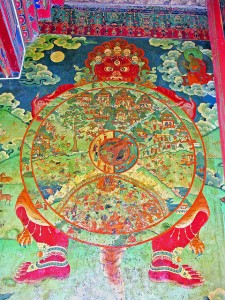
Photo by Dennis Jarvis,
Flickr C.C.
Understanding of the three marks of existence comes about as a result of our dedicated meditation practice. Through our dharma practice we have begun to develop clarity and insight. In this way, we can come to understand the three marks of existence intuitively, rather than from a book or even from listening to a teacher. There’s nothing really special about the three marks of existence, it’s simple to notice them if we pay attention.
They are: Impermanence, Non Self, and Suffering
Impermanence:
Realizing the nature of impermanence usually beings with valuing something. We value something and want it to stick around. The fact that things aren’t permanent doesn’t mean as much to us until we realize that we wish they would last forever. We come to realize that all kinds of things could arise and get in the way of our practice, like sickness or death. We see that this chance to walk the path could disappear at any time. Once we realize that this world isn’t permanent, that everything changes all the time, we can start to really see things as they really are. We can come to realize that there’s really nothing for us to cling to. It’s like we’ve been thrown into a swiftly flowing stream and we can’t grasp any of the rocks or tree branches as the currents pull us. We can think of existence in a different way. Once we really understand that things are impermanent, the things we think of as solid and real don’t seem to be so strong. In this way, we can come to a sense of emptiness. When there’s nothing to hold on to, there’s also nothing to be afraid of or worry about.
Non-Self
This is our sense of egolessness. The self that we perceive is largely compiled of our memories, habits, and preconceived ideas. This idea of a self gives us something to hold onto, if we continue to believe in it. But, having realized and understood impermanence, we realize that even the self is not something we can cling to. It’s an illusion. we experience the self as us, but it’s a convenient fiction. In our immediate experience we can realize that there is no self to hold on to. Understanding this naturally arises from understanding impermanence. We noticed everything was empty, then we noticed we are empty too.
Suffering
The third mark of existence is suffering. We suffer in our lives because we don’t understand the first two marks of existence. We want things to be permanent. We want to be able to cling to things, and we are unhappy when we can’t. We want the self to be something we can cling to as well. We want the self to have all the best things. Our idea of a self leads to a constant desire to gain more, a wish that can never be fully satisfied. That is why we suffer.
It’s an understanding of these three marks of existence that inspires us on the path more than almost any other factor. The three marks of existence are a helpful way of trying to understand the world and our place in it. This is one of the first things that the Buddha taught and one of the most fundamental teachings of the Buddhist path.
Previous Post

March 23, 2017
Patterns That Lead to Suffering
Next Post
April 4, 2017 Zen: The Mystic Flower
Browse Our Archives
Select a Category 37 Practices blog bodhisattva book review boundless heart buddha buddhism buddhism for beginners compass of zen compassion dhammapada dharma emptiness Faith in Mind fearless heart han shan impermanence inspiration interfaith koans life Lojong mahayana meditation mind training mirror of zen movie review nagarjuna news questions recording song of mind steps to the great perfection suffering sutras suttas Uncategorized vajrayana video videos zen
Select a Month July 2024 June 2024 May 2024 February 2024 January 2024 December 2023 October 2023 September 2023 August 2023 July 2023 June 2023 December 2022 November 2022 October 2022 September 2022 August 2022 July 2022 June 2022 May 2022 March 2022 February 2022 January 2022 September 2021 August 2021 May 2021 April 2021 March 2021 February 2021 January 2021 December 2020 November 2020 August 2020 June 2020 May 2020 August 2019 March 2019 December 2018 November 2018 October 2018 September 2018 August 2018 July 2018 June 2018 May 2018 April 2018 March 2018 February 2018 January 2018 December 2017 November 2017 October 2017 September 2017 August 2017 July 2017 June 2017 May 2017 April 2017 March 2017 February 2017 January 2017 December 2016 October 2016 August 2016 July 2016 June 2016 May 2016 April 2016 March 2016
Follow Us!
TAKE THE
Religious Wisdom Quiz
Whom did Paul leave sick at Miletus, showing that early Christians sometimes suffered illness?
Select your answer to see how you score.
Barnabas Trophimus Timothy Silas
Support this
Column


Related posts from Bodhisattva Road
The Tenfold Virtuous Path (feat. Nagarjuna)
Nagarjuna's Six Things to Recall
The Buddha on Doubt and Free Inquiry
The Questions of Naga King Sagara
TRENDING AT PATHEOS Buddhist

On Taking Refuge in the Dharma
(Here I continue the feature of sharing talks and essays by teachers...

(Continuing my intention to share talks and essays by other members of Empty...
The Subtle Art of Bowing: A Dharma Discourse
(This presentation was first offered by my dear friend Dharma Holder Tom...

Internal Family Systems Can Heal you Mentally &...
How IFS Helped Me Stop Fighting Myself Internal Family Systems (IFS) is...

The Bible No One Spoke About: A Family’s...
A mysterious family Bible, unspoken faith, and a journey from curiosity to...

How Uncertainty Can Transform Your Life in 2025
Embracing Uncertainty: A New Year’s Resolution for the Brave As 2025 approaches,...
view all Buddhist blogs
Ad-Free & Subscriber Log-In Subscription Support
- About Us
- 2026 Calendar
- Videos
- Podcasts
- Library of World Religions
- Faith In Media Tracker
- Advertise With Us
- Write for Us
- Privacy Policy
- Terms of Service
- Do Not Sell My Data
- Contact Us
- Radiant Digital
- Manage Newsletter Subscriptions
- Unsubscribe From Notifications
- Sitemap
Copyright 2008-2026, Patheos. All rights reserved.
Subscription Support Ad-Free & Subscriber Log-In
Follow Patheos