
BuddhistCatholicContemplativeEvangelicalGeneral ChristianHinduJewishLatter-day SaintMuslimNew VisionsProgressive Christian
Beliefs
- Buddhist
- Catholic
- Contemplative
- Evangelical
- General Christian
- Hindu
- Jewish
- Latter-day Saint
- More Voices
- Muslim
- New Visions
- Pagan
- Progressive Christian
Topics
- Religion News
- Food and Religion
- Sports and Religion
- Religious Art
- Religious Music and Entertainment
- Religious Events
- History and Religion
- Style and Religion
- Politics and Religion
- Women in Religion
- Recreation Outdoors and Religion
- Business Finance and Religion
- Careers Workplace and Religion
- Education and Religion
- Family Parenting and Religion
- Health Fitness and Religion
- Home and Religion
- Relationships and Religion
- Technology and Religion
- Travel and Religion
Columnists
- Buddhist Columnists
- Business Finance and Religion Columnists
- Careers Workplace and Religion Columnists
- Catholic Columnists
- Contemplative Columnists
- Education and Religion Columnists
- Evangelists Columnists
- Family Parenting and Religion Columnists
- General Christian Columnists
- Health Fitness and Religion Columnists
- Hindu Columnists
- History and Religion Columnists
- Home and Religion Columnists
- Jewish Columnists
- More Voices Columnists
- Latter Day Columnists
- Muslim Columnists
- New Visions Columnists
- Nonreligious Columnists
- Pagan Columnists
- Politics and Religion Columnists
- Progressive Columnists
- Recreation Outdoors and Religion Columnists
- Relationships and Religion Columnists
- Religion News Columnists
- Religious Art Columnists
- Religious Events Columnists
- Religious Music and Entertainment Columnists
- Sports and Religion Columnists
- Style and Religion Columnists
- Technology and Religion Columnists
- Travel and Religion Columnists
- Women in Religion Columnists
Resource Library
- 2026 Calendar
- Library of World Religions
- The 100 Most Holy Places on Earth
- Patheos Answers
- Podcasts
- Videos
- Faith Leaders Database
- Anglican Episcopalian
- Bahai
- Baptist
- Buddhism
- Christianity
- Confucianism
- Eastern Orthodoxy
- Hinduism
- Holiness and Pentecostal
- ISKCON
- Islam
- Judaism
- Lutheran
- Methodist
- The Church of Jesus Christ of Latter-day Saints
- New Age
- Paganism
- Presbytarian and Reformed
- Protestantism
- Religion Behind the Scenes
- Roman Catholic
- Scientology
- Shia Islam
- Sikhism
- Sufism
- Sunni Islam
- Taoism
- Zen
- See all religions
Research Tools
 Ad-Free & Subscriber Log-In Subscription Support
Follow Patheos 

- Trending:
- Advent
- |
- Forgiveness
- |
- Thanksgiving
- |
- Election
- |
- Seasonal Holidays
- |
- Marriage
 Bodhisattva Road
- Home
- Buddhist
- The Buddha and The Truth About Suffering
The Buddha and The Truth About Suffering
Last updated on: April 19, 2016 at 4:32 pm by Daniel Scharpenburg
The Buddha and The Truth About Suffering 2016-04-19T16:32:54-05:00 Daniel Scharpenburg
Patheos Explore the world's faith through different perspectives on religion and spirituality! Patheos has the views of the prevalent religions and spiritualities of the world.

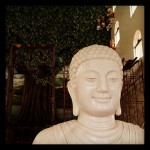
Buddha eye Photo by Timothy Neesam: Flickr C.C.
The Buddha, Siddhartha Gautama said he didn’t teach religion. Maybe he wasn’t trying to start a religion at all. He said he only taught suffering and the way out of suffering.
You see, his childhood, as the story goes, was different from most. He was born in a very wealthy family. His father was told by a fortune teller that his son would either grow up to be a great king or a great spiritual teacher. His father wanted him to inherit the kingdom. So, as a child he was only exposed to all the great things in life.
He had the best toys. He had the best food. All of his needs were met. And, when he was old enough, he had access to the best women too. No part of his life was ever difficult.
But he became curious about the world outside the palace anyway. He knew his life was sheltered and thought that there might be something more out in the world. So one night he sneaked out with a servant and went to a nearby village.
He encountered what’s called the Four Sights. These were things that he hadn’t encountered in his life and they really shocked him. He saw an old man and the servant told him everyone gets old. He saw a sick man (probably a leper) and the servant told him everyone suffers from illness. He saw a dead body and the servant told him that sooner or later everyone dies. No one can escape these things.
But then he saw one more thing. He some spiritual people called wandering ascetics. The servant explained to him that these were men who had given up worldly life to just be spiritual mystics all the time. They spent their days meditating and engaging in different spiritual practices. Their purpose was to transcend the ordinary world, to leave behind the world of suffering and find spiritual truths.
Siddhartha decided this was what he wanted to do.
He left the palace and went to live in the forest and try to find spiritual truths.
And he found them. After six years of searching, while sitting under a tree he attained Enlightenment. He would go on to say, “I don’t teach religion. I teach the cause of suffering and the end of suffering.”
This is important.
He discovered the Four Noble Truths.
The Four Noble Truths are a central teaching in Buddhism. It was the first thing, or one of the first things that the Buddha taught.
The Four Noble Truths are:
1)There is suffering
2)The cause of suffering is attachment
3)There is a way out of suffering
4)The way out is the noble eightfold path.
This fundamental teaching of Buddhism is a teaching that I don’t like very much. When I sit around talking about Buddhism with my friends (like you do) I like to focus on Buddhism as the cultivation of the six perfections, or as a series of practices designed to help us experience oneness or dissolve our delusions.
I don’t often think of it as the way out of suffering. But that’s what it is.
Buddhism is a mystical journey to dwell in our true selves. But it really all started with the Four Noble Truths.
The Buddha is sometimes called The Supreme Physician. That’s what he’s doing here. He’s acting as a doctor. He’s diagnosing a problem (suffering), explaining the cause of the problem (attachment), telling us there is a treatment (a way out), and telling us what the treatment is (The Eightfold Path).
It sounds pretty good, right? So, why don’t I like it?
People struggle to understand this teaching, I think. People ask all sorts of questions about it.
Life is Suffering.
We all experience things like not getting what we want, or worrying we will lose what we have. We all get stubbed toes. We all get sick. We all grow old. We all lose the people we love. That’s why life is suffering.
But, to some this sounds negative.
I can remember goth kids from my high school, the kids who were mad when movies had happy endings, the ones who went on and on talking about how miserable their lives were (okay, I wasn’t much different). Sometimes that’s what I tend to think of when I think of the First Noble Truth—angst-ridden teenagers in all black who say, “Life is pain.”
And, also, one could say, “Life isn’t suffering. Sure, there are bad parts, but I ate a burrito yesterday. And I had sex this morning. There’s plenty of good things going on too.” And that’s true. There are awful things in life, but there are things to celebrate too.
But, you see:
The Cause of Suffering is Attachment.
That burrito will be gone soon. And the sex will be over (hopefully not as fast as the burrito). We want things we don’t have. And when we do have them, we want them to last forever. But nothing ever does.
Happiness is one delicious cup of coffee. We drink it and it feels good. And then it’s gone.
There’s a Way Out of Suffering.
This is where I can say, “See, Buddhism isn’t negative.” It’s a prescription. The Buddha didn’t save us. He told us how to save ourselves. There’s a way out, and he’s an ordinary human (like us), so we can do what he did.
The Way Out is the Eightfold Path.
If we can cultivate and strengthen these virtues, we can dwell in Enlightenment.
Right Understanding
Right Thought
Right Speech
Right Action
Right Livelihood
Right Effort
Right Mindfulness
Right Concentration
We can spend our lives trying to know how to cultivate these. This is how we save ourselves. This is the Buddha’s path.
I’m going to unpack the Noble Eightfold Path a little bit here.
Right Understanding: Understanding how the world works and our place in it. Understanding what it means to be Buddhist.
Right Thought: Cultivating our ability to control our minds. To think about things we want to and stop thinking about things we don’t want to.
Right Speech: Use only kind words and don’t tell lies.
Right Action: Be kind to others. Don’t harm people and animals.
Right Livelihood: Work on learning how to do things that help the world instead of things that cause harm.
Right Effort: Always try your best. This is what keeps us motivated on the path. If we don’t put effort into it, we probably won’t get very far.
Right Mindfulness: Pay attention to the world around you. Don’t miss important things that are going on because of distraction.
Right Concentration: Learn how to meditate and put it into practice.
Previous Post
April 11, 2016
Kensho
Next Post

May 2, 2016 Why Did You Become A Buddhist?
Browse Our Archives
Select a Category 37 Practices blog bodhisattva book review boundless heart buddha buddhism buddhism for beginners compass of zen compassion dhammapada dharma emptiness Faith in Mind fearless heart han shan impermanence inspiration interfaith koans life Lojong mahayana meditation mind training mirror of zen movie review nagarjuna news questions recording song of mind steps to the great perfection suffering sutras suttas Uncategorized vajrayana video videos zen
Select a Month July 2024 June 2024 May 2024 February 2024 January 2024 December 2023 October 2023 September 2023 August 2023 July 2023 June 2023 December 2022 November 2022 October 2022 September 2022 August 2022 July 2022 June 2022 May 2022 March 2022 February 2022 January 2022 September 2021 August 2021 May 2021 April 2021 March 2021 February 2021 January 2021 December 2020 November 2020 August 2020 June 2020 May 2020 August 2019 March 2019 December 2018 November 2018 October 2018 September 2018 August 2018 July 2018 June 2018 May 2018 April 2018 March 2018 February 2018 January 2018 December 2017 November 2017 October 2017 September 2017 August 2017 July 2017 June 2017 May 2017 April 2017 March 2017 February 2017 January 2017 December 2016 October 2016 August 2016 July 2016 June 2016 May 2016 April 2016 March 2016
Follow Us!
TAKE THE
Religious Wisdom Quiz
What book contains the "Suffering Servant" prophecy?
Select your answer to see how you score.
Isaiah Zechariah Jeremiah Lamentations
Support this
Column


Related posts from Bodhisattva Road

The Questions of Naga King Sagara

When Life Punches You In The Face (recorded...

TRENDING AT PATHEOS Buddhist
On Taking Refuge in the Dharma
(Here I continue the feature of sharing talks and essays by teachers...
(Continuing my intention to share talks and essays by other members of Empty...
The Subtle Art of Bowing: A Dharma Discourse
(This presentation was first offered by my dear friend Dharma Holder Tom...

Internal Family Systems Can Heal you Mentally &...
How IFS Helped Me Stop Fighting Myself Internal Family Systems (IFS) is...

The Bible No One Spoke About: A Family’s...
A mysterious family Bible, unspoken faith, and a journey from curiosity to...

How Uncertainty Can Transform Your Life in 2025
Embracing Uncertainty: A New Year’s Resolution for the Brave As 2025 approaches,...
view all Buddhist blogs
Ad-Free & Subscriber Log-In Subscription Support
- About Us
- 2026 Calendar
- Videos
- Podcasts
- Library of World Religions
- Faith In Media Tracker
- Advertise With Us
- Write for Us
- Privacy Policy
- Terms of Service
- Do Not Sell My Data
- Contact Us
- Radiant Digital
- Manage Newsletter Subscriptions
- Unsubscribe From Notifications
- Sitemap
Copyright 2008-2026, Patheos, part of the Radiant Digital network of media brands. All rights reserved.
Subscription Support Ad-Free & Subscriber Log-In
Follow Patheos