
BuddhistCatholicContemplativeEvangelicalGeneral ChristianHinduJewishLatter-day SaintMuslimNew VisionsProgressive Christian
Beliefs
- Buddhist
- Catholic
- Contemplative
- Evangelical
- General Christian
- Hindu
- Jewish
- Latter-day Saint
- More Voices
- Muslim
- New Visions
- Pagan
- Progressive Christian
Topics
- Religion News
- Food and Religion
- Sports and Religion
- Religious Art
- Religious Music and Entertainment
- Religious Events
- History and Religion
- Style and Religion
- Politics and Religion
- Women in Religion
- Recreation Outdoors and Religion
- Business Finance and Religion
- Careers Workplace and Religion
- Education and Religion
- Family Parenting and Religion
- Health Fitness and Religion
- Home and Religion
- Relationships and Religion
- Technology and Religion
- Travel and Religion
Columnists
- Buddhist Columnists
- Business Finance and Religion Columnists
- Careers Workplace and Religion Columnists
- Catholic Columnists
- Contemplative Columnists
- Education and Religion Columnists
- Evangelists Columnists
- Family Parenting and Religion Columnists
- General Christian Columnists
- Health Fitness and Religion Columnists
- Hindu Columnists
- History and Religion Columnists
- Home and Religion Columnists
- Jewish Columnists
- More Voices Columnists
- Latter Day Columnists
- Muslim Columnists
- New Visions Columnists
- Nonreligious Columnists
- Pagan Columnists
- Politics and Religion Columnists
- Progressive Columnists
- Recreation Outdoors and Religion Columnists
- Relationships and Religion Columnists
- Religion News Columnists
- Religious Art Columnists
- Religious Events Columnists
- Religious Music and Entertainment Columnists
- Sports and Religion Columnists
- Style and Religion Columnists
- Technology and Religion Columnists
- Travel and Religion Columnists
- Women in Religion Columnists
Resource Library
- 2026 Calendar
- Library of World Religions
- The 100 Most Holy Places on Earth
- Patheos Answers
- Podcasts
- Videos
- Faith Leaders Database
- Anglican Episcopalian
- Bahai
- Baptist
- Buddhism
- Christianity
- Confucianism
- Eastern Orthodoxy
- Hinduism
- Holiness and Pentecostal
- ISKCON
- Islam
- Judaism
- Lutheran
- Methodist
- The Church of Jesus Christ of Latter-day Saints
- New Age
- Paganism
- Presbytarian and Reformed
- Protestantism
- Religion Behind the Scenes
- Roman Catholic
- Scientology
- Shia Islam
- Sikhism
- Sufism
- Sunni Islam
- Taoism
- Zen
- See all religions
Research Tools
 Ad-Free & Subscriber Log-In Subscription Support
Ad-Free & Subscriber Log-In Subscription Support
Follow Patheos 

- Trending:
- Forgiveness
- |
- Marriage
- |
- Consciousness
- |
- Death Penalty
- |
- Election
- |
- Halloween
 Black, White and Gray
-
About the Authors
- Home
- Evangelical
- Loneliness and Our Social Brain
Loneliness and Our Social Brain
Last updated on: April 6, 2014 at 9:07 pm by Margarita A. Mooney
Loneliness and Our Social Brain 2014-04-06T21:07:51-05:00 Margarita A. Mooney
Patheos Explore the world's faith through different perspectives on religion and spirituality! Patheos has the views of the prevalent religions and spiritualities of the world.
How is your happiness project at Yale going? a friend recently asked. It’s going great! I’m reading the best book ever, I replied. It’s on loneliness. Huh?

John Cacioppo
Loneliness and happiness may seem like strange bedfellows, but the University of Chicago psychologist and social neuroscientist John Cacioppo does an excellent job of defining loneliness as a basic human drive for social connection. In his book called Loneliness: Human Nature and the Need for Social Connection, he writes:
“Feeling lonely at any particular moment simply means that you are human. In fact, a sizeable portion of this book is devoted to demonstrating that the need for meaningful social connection, and the pain we feel without it, are defining characteristics of our species,” (p. 7).
Although there is a biological or a neurological basis to feeling lonely–i.e., some people are more prone to feel lonely–Cacioppo insists that we all have “the ability to self-regulate the emotions associated with feeling isolated,” (p. 14). We should not confuse the experience of feeling lonely with our response to that loneliness. The trickiest parts about loneliness is that it affects our social cognition. Feeling lonely can lead us to perceive negative signals from other people, triggering a negative feedback loop of more loneliness and worse health. Although “having to cope with loneliness when your persistence is impaired by loneliness seems awfully unfair,” (p. 46) Cacioppo gives numerous examples of how we can alter daily routines to try to build up social connection. Learning self-regulation and thinking ahead about our daily plans are key to fighting loneliness.
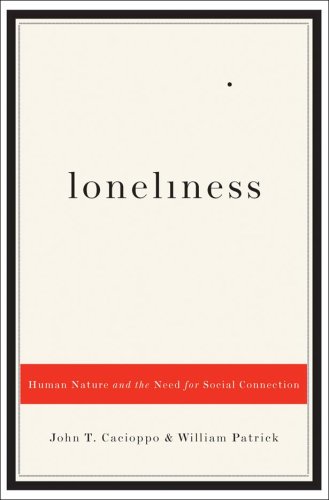 Throughout the book, Cacioppo does an excellent job of describing the biological and environmental factors that lead to loneliness without falling into a simplistic genetic or environmental determinism. For example, he writes:
“Like any number of other characteristics, the genetic propensity for desiring social connection and the propensity for feeling social pain in its absence are transmitted though bits of genetic information in our cells, coded as instructions for making proteins. The expression of those genes is dependent on environmental circumstances, whether real or merely perceived. Some of the proteins take the form of the hormones that carry messages in the blood. These messages serve to integrate different organ systems and to coordinate behavioral responses. One of the hormones is epinephrine, which can flood us with the cluster of sensations we know as arousal. Another small protein—the hormone oxytocin—promotes breastfeeding, soothing calm, and close connection. Other genetically orchestrated proteins give rise to neurotransmitters such as serotonin, which can elevate our mood or send us into despair, depending on the concentration in the brain. The genes provide the chemical carrots and sticks that guide behavior, but they depend on the sensory systems to actually interact with the environment. Signals that the senses receive from the environment trigger changes in the concentration and flow of these hormones and neurotransmitters. These chemicals serve as internal messages to prompt specific behavior—and this is when the genetic instructions at long last appear as individual differences in levels of anxiety, or agreeableness, or sensitivity to feelings of social isolation,” (p. 66).
The next time you hear a genetic or environmental explanation of behavior, I hope you remember that paragraph and pause to ponder how the social, environmental and genetic all interact. Genes establish a propensity. We experience our genetic propensity to connect with others or isolate ourselves through all kinds of micro activities in the brain. Our environment—both what is really in our environment and how we perceive that environment—influences how our genes express themselves. Our social connections (or lack thereof) influence how our blood stream registers emotional or physical arousal. For example, we can produce hormones like oxytocin that help us feel a bond with others. Other proteins can profoundly elevate or destroy our mood. All these micro responses are carrots and sticks. This multitude of little responses interact with our environment, or at least how we perceive the environment. It’s the combination of all these bodily messages that lead to states we call anxiety, sensitivity, or feeling agreeable.
Somebody recently commented that studying human biology is easier to measure than human sociality or the human environment. But if our responses to environmental and social stimuli have real effects on our biology, shouldn’t we follow Cacioppo’s lead and put those responses into a the complex environmental and social contexts we all live in? Too often we quickly jump from identifying a biological basis for a particular behavior or emotional to a biological solution to whatever problem we associate with that behavior or emotion. But understanding our biology as elastic helps us understand Cacioppo’s concluding chapters, which focus on how we can influence of social and environmental context to decrease loneliness.
Cacioppo recommends you EASE your way to social connection.
E: Extend yourself. Volunteer. Reach out. Give to others.
A: Action plan. We can’t change everything about our situation. But we can change our thoughts, behaviors, and expectation. Those small changes can have big ripple effects.
S: Selection. The antidote to loneliness is high quality relationships. You may have few or many relationships, but it’s quality not quantity that matters.
E: Expect the best. Let go of self-protective, isolating behaviors.
My quickest fix to loneliness is to play with kids. Kids are not embarrassed by their need for connection. Even if they are timid at first, if you play with a kid, pay attention to them, and make eye contact, you will likely be rewarded with big hugs, kisses, and giggles. Those are the small things that add up to big neurological responses. After reading about loneliness, I know why a big hug and wet kiss from young child makes my heart pound. Holding a newborn baby turns my brain into such mush that I instinctively babble gibberish while bouncing the baby in my arms, something we both seem to enjoy it. It almost brings me to tears to put the baby down, especially if the baby himself sheds tears when I let go of him. I love Cacioppo’s suggestion that loneliness among the elderly can be reduced by increasing their contact with children. That seems like a win-win situation.
Cacioppo also points out how our built environment contributes to isolation. We live in smaller and smaller familes in bigger and bigger houses further and further away from other people. Our jobs require us to move once, twice or even more than that. Each time we move we rupture those social connections that feed our social brains. Can we sacrifice square footage in our homes order to live in more dense communities? Can we go out of our way to make new connections when we move?
You are not the only one feeling lonely out there. If you reach out, I suspect your invitation to volunteer together, start a neighborhood association, or a book club will be met with enthusiasm. And you will all be happier and healthier because of your greater social connections.
Previous Post

February 24, 2014
Academic Bias? - Does it Affect Business Professors?
Next Post
March 16, 2014 Media Matters but Not as Much as Propaganda
Browse Our Archives
Select a Category Amy Reynolds Becky Hsu Brad Wright critical realism George Yancey Gerardo Marti Jeremy Rhodes Jerry Park John Schmalzbauer Margarita Mooney Mark Regnerus Nicolette Manglos positive sociology Richard Flory Robert Woodberry Uncategorized
Select a Month April 2017 August 2016 April 2016 March 2016 February 2016 January 2016 December 2015 November 2015 October 2015 September 2015 August 2015 July 2015 June 2015 May 2015 April 2015 March 2015 February 2015 January 2015 December 2014 November 2014 October 2014 September 2014 August 2014 July 2014 June 2014 May 2014 April 2014 March 2014 February 2014 January 2014 December 2013 November 2013 October 2013 September 2013 August 2013 July 2013 June 2013 May 2013 April 2013 March 2013 February 2013 January 2013 December 2012 November 2012 October 2012 September 2012 August 2012 July 2012 June 2012 May 2012 April 2012 March 2012 February 2012 January 2012 December 2011 November 2011 October 2011
Follow Us!
TAKE THE
Religious Wisdom Quiz
Who killed Goliath?
Select your answer to see how you score.
David Jonathan Saul Samson
Related posts from Black, White and Gray

Using Critical Realism to Teach the Fundamentals of...

Incorporating Critical Realism into Research Methods Classes

5 Great Articles Using Critical Realism in Social...

Books on Critical Realism and Sociological Research Methods
TRENDING AT PATHEOS Evangelical

The REST of Your Life: A Creative Wrestles...
This week I had a conversation with a good friend from church....

How the author of the world's best hymn...
I've been working with John Newton for a while now. This makes...

Long before this Lectio Divina, Psalm 130 - the song - started...

What About the Trees? Another Living Parable
After I finished writing the last article about falling leaves as a...

Why Classical Education Is a Conversation, Not a...
Come and Read: Joy in Classical Education When I was a little...

Cornell University has received a great deal of negative publicity and intense...
view all Evangelical blogs
Ad-Free & Subscriber Log-In Subscription Support
- About Us
- 2026 Calendar
- Videos
- Podcasts
- Library of World Religions
- Faith In Media Tracker
- Advertise With Us
- Write for Us
- Privacy Policy
- Terms of Service
- Do Not Sell My Data
- Contact Us
- Radiant Digital
- Manage Newsletter Subscriptions
- Unsubscribe From Notifications
- Sitemap
Copyright 2008-2026, Patheos. All rights reserved.
Subscription Support Ad-Free & Subscriber Log-In
Follow Patheos