
BuddhistCatholicContemplativeEvangelicalGeneral ChristianHinduJewishLatter-day SaintMuslimNew VisionsProgressive Christian
Beliefs
- Buddhist
- Catholic
- Contemplative
- Evangelical
- General Christian
- Hindu
- Jewish
- Latter-day Saint
- More Voices
- Muslim
- New Visions
- Pagan
- Progressive Christian
Topics
- Religion News
- Food and Religion
- Sports and Religion
- Religious Art
- Religious Music and Entertainment
- Religious Events
- History and Religion
- Style and Religion
- Politics and Religion
- Women in Religion
- Recreation Outdoors and Religion
- Business Finance and Religion
- Careers Workplace and Religion
- Education and Religion
- Family Parenting and Religion
- Health Fitness and Religion
- Home and Religion
- Relationships and Religion
- Technology and Religion
- Travel and Religion
Columnists
- Buddhist Columnists
- Business Finance and Religion Columnists
- Careers Workplace and Religion Columnists
- Catholic Columnists
- Contemplative Columnists
- Education and Religion Columnists
- Evangelists Columnists
- Family Parenting and Religion Columnists
- General Christian Columnists
- Health Fitness and Religion Columnists
- Hindu Columnists
- History and Religion Columnists
- Home and Religion Columnists
- Jewish Columnists
- More Voices Columnists
- Latter Day Columnists
- Muslim Columnists
- New Visions Columnists
- Nonreligious Columnists
- Pagan Columnists
- Politics and Religion Columnists
- Progressive Columnists
- Recreation Outdoors and Religion Columnists
- Relationships and Religion Columnists
- Religion News Columnists
- Religious Art Columnists
- Religious Events Columnists
- Religious Music and Entertainment Columnists
- Sports and Religion Columnists
- Style and Religion Columnists
- Technology and Religion Columnists
- Travel and Religion Columnists
- Women in Religion Columnists
Resource Library
- 2026 Calendar
- Library of World Religions
- The 100 Most Holy Places on Earth
- Patheos Answers
- Podcasts
- Videos
- Faith Leaders Database
- Anglican Episcopalian
- Bahai
- Baptist
- Buddhism
- Christianity
- Confucianism
- Eastern Orthodoxy
- Hinduism
- Holiness and Pentecostal
- ISKCON
- Islam
- Judaism
- Lutheran
- Methodist
- The Church of Jesus Christ of Latter-day Saints
- New Age
- Paganism
- Presbytarian and Reformed
- Protestantism
- Religion Behind the Scenes
- Roman Catholic
- Scientology
- Shia Islam
- Sikhism
- Sufism
- Sunni Islam
- Taoism
- Zen
- See all religions
Research Tools
 Ad-Free & Subscriber Log-In Subscription Support
Ad-Free & Subscriber Log-In Subscription Support
Follow Patheos 

- Trending:
- Forgiveness
- |
- Marriage
- |
- Consciousness
- |
- Death Penalty
- |
- Election
- |
- Halloween
 Black, White and Gray
-
About the Authors
- Home
- Evangelical
- Googling Tradition
Googling Tradition
Last updated on: January 17, 2014 at 8:46 am by Margarita A. Mooney
Googling Tradition 2014-01-17T08:46:01-05:00 Margarita A. Mooney
Patheos Explore the world's faith through different perspectives on religion and spirituality! Patheos has the views of the prevalent religions and spiritualities of the world.
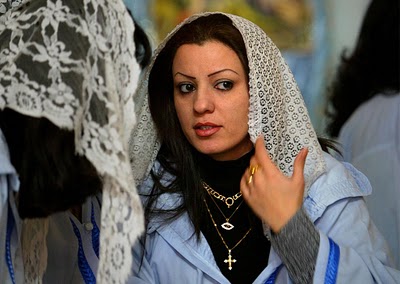
Instructions on mantillas can be found at wearyourmantilla.blogspot.com
Dear Google: Can you tell me how to put on a mantilla? My stifled laugh turned into a snort when the young woman standing behind me in front of St. Peter’s Basilica in Rome desperately asked Google about an old-fashioned Catholic tradition. After Vatican II, lay women mostly stopped covering their heads before going into Catholic Churches. Even many religious sisters abandoned the habit. In the swarm of thousands of people waiting to get into St. Peter’s for Christmas Vigil Mass in 2012, women’s hair flowed abundantly.
The elegantly dressed Latin American woman behind me spent 30 minutes trying to cover her hair with a lace mantilla. Every time she thought she had succeeded, her mantilla slid down the side of her head or the front of her face. Clearly she was trying on a tradition she didn’t normally practice. Her last resort was to turn to Google for help. Her struggle with the mantilla reminded me of the book “Tradition in a Rootless World,” in which Lynn Davidman describes how Jewish women in New York embraced an orthodox Judaism. Free to choose whatever they want, young Jewish women chose traditions their elders spurned. Similarly, it is mostly younger Catholic women today who wear a mantilla to Mass.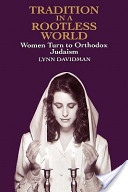
I like to practice old traditions, too. One time I even wore a saree to the baptism of an Indian-American Catholic baby. Would you like the Gujarati wrap? my Indian hostesses asked me. Apparently it’s different from the Malayalee wrap. I had no idea that different ethncities in India wrapped sarees differently, but since I had a choice, I requested the Burrito Wrap.
What’s the Burrito Wrap? When I make burritos, I lay the tortilla flat and add the beef, cheese, and assorted condiments. Then I wrap, wrap, wrap, wrap and finally flip! You have a perfect burrito: nothing sticking out.
Not so with the Gujariti saree wrap. First I tried on the petticoat and walked into the living room to show everyone. As I twirled around showing off my Indian clothes, one Indian man gave me a puzzled look, took me by the arm, and led me upstairs. That’s an under-garment! You don’t go out in that! he explained. I thought petticoat was a fancy word for skirt. But upon closer look, I realized I was wearing a transparent, lace-covered slip meant to protect the exquisite saree, not my purity.
Already beet red, next I put on the “blouse.” That’s a funny name for basically a sports bra with short sleeves! Pull, pinch, pin those sleeves tight! Your torso can hang loose but not your arms!
On top of that sports bra with tight sleeves plus a slip, two Indian ladies wrapped me in six yards of sequined saree material. Flip, twirl, wrap; flip, twirl, wrap; flip, twirl, wrap. The saree was finally on me, but my mid-riff was still exposed! Sarees are carefully designed so that you can wear the same one your whole life, so all the extra material got crammed into my waist. I looked pregnant.
How can I go to a Catholic Church with my torso exposed and carrying four yards of material on my belly? Could you wrap me up like a burrito, I pleaded? You know, use all that material to support my flab rather than accentuate it?
You look great, they reassured me. You don’t need a Burrito Wrap! Wanting to please my hosts, I smiled and posed for some pictures. The wrapping ceremony took so long we were late for Mass and parked far away. Rushing across the parking lot and up a big hill, I didn’t want to get the bottom of the saree dirty or trip on it. So I bent over, picked up the saree, and carried the bottom of it by my waist.
What are you doing?!?!? Two Indian men chided me. Huh? I queried them. You can’t pick up your saree like that!!!! We can see your ankles! It made no sense that my torso could be bare but I could not show my ankles. I was terrified that if I tripped on the hill, the precarious wrap would come undone. I pictured myself rolling down the hill with all my juicy cheese sliding out of the wrap, just like when I mess up my burritos. I stared defiantly at those gentlemen who spent the morning confused about how to wear their own traditional garments. I kept the saree by my waist until I was safe on level ground.
Once inside the church, I kept twirling around, trying to use all that flowy material to create my own Burrito Wrap. I never succeeded, and was quite relieved to take the saree off that evening. Comfortably back in their own Western clothes, my Indian friends confessed that they had only worn sarees three times in their whole lives—and mostly since they left India.
Why does a woman outside St. Peter’s ask Google to instruct her on a Catholic tradition she was never taught? Why do migrants in the diaspora adopt traditions they barely observed back home? Traditions are an important part of our collective identity. Special events like a trip to Rome or a baby’s baptism are occasions where we want to symbolize our religious or ethnic group belonging.
 We mostly take our traditions for granted; so much so that many youth today feel rootless and search for traditions. One freshman I taught could not relate to Victor Frankl’s inspiring book Man’s Search for Meaning because he felt like he belonged to no meaningful tradition. The survivors of the Holocaust camp Frankl described found meaning in their families and Jewish faith. But this student had been told his whole life to define meaning for himself. I was stunned to hear an 18-year old complain that he is tired of being told to define the purpose of his life. How can his life have meaning if he doesn’t belong to a group that teaches him about meaning? he asked. He didn’t have a religious identity, an ethnic identity, or any group identity. Consequently, his life lacked one core element of meaning. The next year, he joined a fraternity. He reassured me that his desire to join a fraternity was not to have drinking buddies but to belong to a group that gave his life meaning.
In After Virtue, Alasdair MacIntyre argues that personal narratives need to be embedded in traditions and institutions that give our lives collective meaning. Religions, nationalities, ethnicities and universities with their many fraternities, sororities and sports teams all remind us that our lives have meaning as part of a narrative that is bigger than ourselves. Wearing a mantilla, a saree, a fraternity shirt or a college baseball cap links us to a group.
Embracing someone else’s tradition is a symbol of respect for their group. So despite my nervous debut wearing a saree, when I was invited to an Indian-American wedding, I bravely asked my Indian-American friend to help wrap me in my saree. Google didn’t have instructions for a saree Burrito Wrap, but we found a pretty cool You Tube video where an Indian woman teaches an Indian-American woman to be a “good Indian girl” by putting on a saree. We laughed and acted out the scene. When I walked outside, my neighbors stopped to take pictures of me in my gorgeous saree. You too can turn to YouTube to learn how to be a good Indian girl. Check it out right here.
Previous generations rejected traditions in favor of individuality. But for many young people raised in today’s society that exalts individual autonomy, where our personal identity is malleable, and where our closest relationships change frequently, there is something very appealing about traditions. Even when you have to Google a particular tradition, even when a tradition is not from your own ethnicity, and even when others hardly practice those traditions anymore, traditions link us to other people. Traditions link us to a past and to a future. Traditions look good in Facebook pictures.
Can an individual life be meaningful without any tradition? Perhaps no more than a baby can survive on his own. Traditions help fulfill man’s search for meaning, a quest that is essential to being a person, and a quest that must be fulfilled in relation to others. What are the traditions that give your life meaning? What social practices tie you to others?
Next Post

January 29, 2014 Let’s Boycott - Not
Browse Our Archives
Select a Category Amy Reynolds Becky Hsu Brad Wright critical realism George Yancey Gerardo Marti Jeremy Rhodes Jerry Park John Schmalzbauer Margarita Mooney Mark Regnerus Nicolette Manglos positive sociology Richard Flory Robert Woodberry Uncategorized
Select a Month April 2017 August 2016 April 2016 March 2016 February 2016 January 2016 December 2015 November 2015 October 2015 September 2015 August 2015 July 2015 June 2015 May 2015 April 2015 March 2015 February 2015 January 2015 December 2014 November 2014 October 2014 September 2014 August 2014 July 2014 June 2014 May 2014 April 2014 March 2014 February 2014 January 2014 December 2013 November 2013 October 2013 September 2013 August 2013 July 2013 June 2013 May 2013 April 2013 March 2013 February 2013 January 2013 December 2012 November 2012 October 2012 September 2012 August 2012 July 2012 June 2012 May 2012 April 2012 March 2012 February 2012 January 2012 December 2011 November 2011 October 2011
Follow Us!
TAKE THE
Religious Wisdom Quiz
Who touched Jesus' cloak and was healed of bleeding?
Select your answer to see how you score.
A woman in the crowd Martha Jairus' daughter A centurion
Related posts from Black, White and Gray

Using Critical Realism to Teach the Fundamentals of...

Incorporating Critical Realism into Research Methods Classes

5 Great Articles Using Critical Realism in Social...

Books on Critical Realism and Sociological Research Methods
TRENDING AT PATHEOS Evangelical

The REST of Your Life: A Creative Wrestles...
This week I had a conversation with a good friend from church....

How the author of the world's best hymn...
I've been working with John Newton for a while now. This makes...

Long before this Lectio Divina, Psalm 130 - the song - started...

What About the Trees? Another Living Parable
After I finished writing the last article about falling leaves as a...

Why Classical Education Is a Conversation, Not a...
Come and Read: Joy in Classical Education When I was a little...

Cornell University has received a great deal of negative publicity and intense...
view all Evangelical blogs
Ad-Free & Subscriber Log-In Subscription Support
- About Us
- 2026 Calendar
- Videos
- Podcasts
- Library of World Religions
- Faith In Media Tracker
- Advertise With Us
- Write for Us
- Privacy Policy
- Terms of Service
- Do Not Sell My Data
- Contact Us
- Radiant Digital
- Manage Newsletter Subscriptions
- Unsubscribe From Notifications
- Sitemap
Copyright 2008-2026, Patheos. All rights reserved.
Subscription Support Ad-Free & Subscriber Log-In
Follow Patheos