
BuddhistCatholicContemplativeEvangelicalGeneral ChristianHinduJewishLatter-day SaintMuslimNew VisionsProgressive Christian
Beliefs
- Buddhist
- Catholic
- Contemplative
- Evangelical
- General Christian
- Hindu
- Jewish
- Latter-day Saint
- More Voices
- Muslim
- New Visions
- Pagan
- Progressive Christian
Topics
- Religion News
- Food and Religion
- Sports and Religion
- Religious Art
- Religious Music and Entertainment
- Religious Events
- History and Religion
- Style and Religion
- Politics and Religion
- Women in Religion
- Recreation Outdoors and Religion
- Business Finance and Religion
- Careers Workplace and Religion
- Education and Religion
- Family Parenting and Religion
- Health Fitness and Religion
- Home and Religion
- Relationships and Religion
- Technology and Religion
- Travel and Religion
Columnists
- Buddhist Columnists
- Business Finance and Religion Columnists
- Careers Workplace and Religion Columnists
- Catholic Columnists
- Contemplative Columnists
- Education and Religion Columnists
- Evangelists Columnists
- Family Parenting and Religion Columnists
- General Christian Columnists
- Health Fitness and Religion Columnists
- Hindu Columnists
- History and Religion Columnists
- Home and Religion Columnists
- Jewish Columnists
- More Voices Columnists
- Latter Day Columnists
- Muslim Columnists
- New Visions Columnists
- Nonreligious Columnists
- Pagan Columnists
- Politics and Religion Columnists
- Progressive Columnists
- Recreation Outdoors and Religion Columnists
- Relationships and Religion Columnists
- Religion News Columnists
- Religious Art Columnists
- Religious Events Columnists
- Religious Music and Entertainment Columnists
- Sports and Religion Columnists
- Style and Religion Columnists
- Technology and Religion Columnists
- Travel and Religion Columnists
- Women in Religion Columnists
Resource Library
- 2026 Calendar
- Library of World Religions
- The 100 Most Holy Places on Earth
- Patheos Answers
- Podcasts
- Videos
- Faith Leaders Database
- Anglican Episcopalian
- Bahai
- Baptist
- Buddhism
- Christianity
- Confucianism
- Eastern Orthodoxy
- Hinduism
- Holiness and Pentecostal
- ISKCON
- Islam
- Judaism
- Lutheran
- Methodist
- The Church of Jesus Christ of Latter-day Saints
- New Age
- Paganism
- Presbytarian and Reformed
- Protestantism
- Religion Behind the Scenes
- Roman Catholic
- Scientology
- Shia Islam
- Sikhism
- Sufism
- Sunni Islam
- Taoism
- Zen
- See all religions
Research Tools
 Ad-Free & Subscriber Log-In Subscription Support
Ad-Free & Subscriber Log-In Subscription Support
Follow Patheos 

- Trending:
- Forgiveness
- |
- Marriage
- |
- Consciousness
- |
- Death Penalty
- |
- Election
- |
- Halloween
 Black, White and Gray
-
About the Authors
- Home
- Evangelical
- Flow: Order in Consciousness
Flow: Order in Consciousness
Last updated on: May 29, 2013 at 8:48 am by Margarita A. Mooney
Flow: Order in Consciousness 2013-05-29T08:48:19-05:00 Margarita A. Mooney
Patheos Explore the world's faith through different perspectives on religion and spirituality! Patheos has the views of the prevalent religions and spiritualities of the world.
Did you know that you can actually increase your ability to enjoy the things in life that produce the greatest satisfaction?
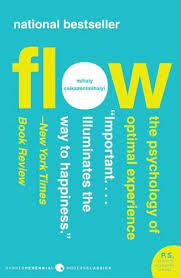 When I read Martin Seligman’s PERMA concept of human flourishing (Positive Emotions, Engagement, Relationships, Meaning and Achievement) I simply presumed that Type-A, achievement oriented people like me are too busy doing our work to get into flow (another word for engagement). “Flow must be what creative types, like artists or actors, experience,” I naively thought. To learn more about flow, I recently perused one of the books from the reading list I developed for my positive sociology class, Flow: The Psychology of Optimal Experience, by Mihaly Czikszentmihaly. To my delight, I learned from Czikszentmihaly that the reason I can dedicate so many hours of solitary reading and writing is because learning new things is the primary way I experience flow.
What exactly is flow? According to Czikszentmihaly, flow is “joy, creativity, the process of total involvement with life” (Flow, p. xi). How do we achieve flow? By fighting against psychic entropy (or chaos in our thoughts) by striving for order in our consciouness. When we have order in consciousness, “the information that keeps coming into awareness is congruent with goals, psychic energy flows effortlessly” (Flow, p. 39).
As Czikszentmihaly describes in this TED lecture, he and his colleagues have interviewed thousands of people from business leaders, to Benedictine monks, to star athletes in order to understand what conditions lead to flow. But experiencing flow is by no means limited to extraordinary people or unusual circumstances, it’s something we can all attain if we understand what flow is and how to experience it.
Why is flow important to well-being? In modern societies, we have nearly unlimited choices and autonomy, which, as I’ve written about before on this blog, can paradoxically lead to boredom and wasted opportunities. To make the most of our freedom, Czikszentmihaly argues that we must learn to find purpose in our daily activities and how to experience enjoyment while doing those activities. Whereas I thought only certain activities like music or sports create flow, Czikszentmihaly points out that flow is not inherent to any particular activity; rather, we achieve flow as a result of our attitude towards that activity.
We need flow to be happy because a disordered, wandering mind is the opposite of a virtuous and happy life.
“When a person is able to organize his or her consciousness so as to experience flow as often as possible, the quality of life is inevitably going to improve…even the usually boring routines of work become purposeful and enjoyable…Flow helps to integrate the self because in that state of deep concentration consciousness is unusually well ordered… The self becomes more complex as a result of experiencing flow” (Flow, pp. 40-42).
One of my favorite saints, St. Ignatius of Loyola (who Czikszentmihaly discusses), taught about internal order of our consciousness through prayer and discipline. One place I most easily find flow is the Catholic Mass. The progression of the liturgy helps my wandering brain to get into flow, and in that flow, I experience internal order and peace. Every aspect of the sacred liturgy—my bodily motions, singing, vocal prayers, and receiving the Eucharist—does exactly what Czikszentmihaly says it should—focus my attention on something else and order all of my senses towards one goal–union with God through prayer.
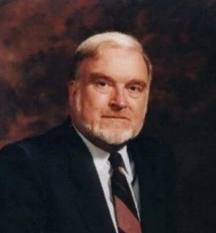
Mihaly Czikszentmihaly
I was relieved to be corrected in my mistake of thinking that my work is only about achievement. Part of the reason I have persevered in academia is that I experience flow in my work, which Czikszentmihaly says is crucial to a high quality of life. For academics, mastering a subject we are studying is not not unlike what others experience from climbing Mount Everest or surfing the Big Eddy—writing a dissertation, a book, or even a short (but awesome) blog is hard to do, but when it’s over, you feel like a champ.
Wait a minute, you might wonder, isn’t flow something we get through leisure? if you ask people what they want to expand their enjoyment in life, especially when it comes to something mushy like flow, they would probably say “more time off from work!”
More time off from work for leisure in theory could increase our flow, but Czikszentmihaly argues that “one of the most ironic paradoxes of our time is this great availability of leisure that somehow fails to be translated into enjoyment,” (Flow, p. 83). is also very clear that most of us use our leisure time very unwisely. Perhaps the worst thing with leisure time is to vegetate brainlessly in front of the TV or mindlessly read everyone’s Facebook posts. But Czikszentmihaly is also skeptical about only engaging in sports as a spectator rather than as a participant.
Why? Our leisure time, according to Czikszentmihaly, produces flow when we are a) challenged but also rewarded; b) feel like we have expanded our skills, our ability to experience new things. When was the last time when watching a TV show, a movie, or even watching the finals of some sporting event, made you think, “Gee, I just grew as a person!” The entertainment of TV and watching sports is appealing because it provides immediate sensory excitement and feedback, but does little to expand our ability for optimal experiences. The same goes for for casual sex, Czikszentmihaly says. Having sex with a relative stranger or watching pornography may indeed stimulate our sexual appetite and satisfy the momentary sexual urge, but only committed love of a whole person (which can encompass the sexual dimension) expands our capacity to love.
In other words, when it comes to pleasures, it’s not just “use it or lose it” it’s “expand it or waste it.” Czikszentmihaly’s concept of flow challenges us because simply using some capacity we have without trying to deepen the experience from that activity will lead to entropy—the gradual loss of our ability to enjoy that activity at all. Our approach to any leisurely pastime or pleasurable activity should be one of expanding our capacities for experiencing flow.
So, instead of watching movies, TV or sports, this week I’m increasing my flow in various ways. In my leisure time, I turned attention away from the TV and towards Scrabble—a game that requires creating words out of letters, learning the rules of the game board, and competing with another person. I also invited some friends over to eat pizza and for a friendly match of wiffle ball—a game that is easy to master (hence people of all abilities can flow while playing) but nonetheless requires coordination, competition, and a good sense of humor.
If you want to increase your well-being through flow, I have two suggestions. First, you must see your work—whether your do manual labor, intellectual labor or household labor—as a chance to expand your consciousness. (If you are barking at me saying your work doesn’t allow for flow, please read Czikszentmihaly’s chapter on the factory worker who experiences flow. It’s not your professional work or your vocation to homemaking that is getting in the way of your flow—he says it is your attitude towards your daily work). Second, you should pay careful attention to how you use your leisure time. Don’t unwittingly dampen your consciousness by watching mindless TV shows or talking about your neighbors, but expand your ability to enjoy things like theater, music, sports, and liturgy. You may even want to pick up a great book like Flow and discuss it with your friends and family.
Previous Post

May 19, 2013
Atheists in America - Part 4
Next Post

May 31, 2013 Dialect Maps, Race and Immigration
Browse Our Archives
Select a Category Amy Reynolds Becky Hsu Brad Wright critical realism George Yancey Gerardo Marti Jeremy Rhodes Jerry Park John Schmalzbauer Margarita Mooney Mark Regnerus Nicolette Manglos positive sociology Richard Flory Robert Woodberry Uncategorized
Select a Month April 2017 August 2016 April 2016 March 2016 February 2016 January 2016 December 2015 November 2015 October 2015 September 2015 August 2015 July 2015 June 2015 May 2015 April 2015 March 2015 February 2015 January 2015 December 2014 November 2014 October 2014 September 2014 August 2014 July 2014 June 2014 May 2014 April 2014 March 2014 February 2014 January 2014 December 2013 November 2013 October 2013 September 2013 August 2013 July 2013 June 2013 May 2013 April 2013 March 2013 February 2013 January 2013 December 2012 November 2012 October 2012 September 2012 August 2012 July 2012 June 2012 May 2012 April 2012 March 2012 February 2012 January 2012 December 2011 November 2011 October 2011
Follow Us!
TAKE THE
Religious Wisdom Quiz
I lift my eyes to the _________, where does my help come from? My help comes from the LORD.
Select your answer to see how you score.
Heavens Sky Hills Seas
Related posts from Black, White and Gray

Using Critical Realism to Teach the Fundamentals of...

Incorporating Critical Realism into Research Methods Classes

5 Great Articles Using Critical Realism in Social...

Books on Critical Realism and Sociological Research Methods
TRENDING AT PATHEOS Evangelical

The REST of Your Life: A Creative Wrestles...
This week I had a conversation with a good friend from church....

How the author of the world's best hymn...
I've been working with John Newton for a while now. This makes...

Long before this Lectio Divina, Psalm 130 - the song - started...

What About the Trees? Another Living Parable
After I finished writing the last article about falling leaves as a...

Why Classical Education Is a Conversation, Not a...
Come and Read: Joy in Classical Education When I was a little...

Cornell University has received a great deal of negative publicity and intense...
view all Evangelical blogs
Ad-Free & Subscriber Log-In Subscription Support
- About Us
- 2026 Calendar
- Videos
- Podcasts
- Library of World Religions
- Faith In Media Tracker
- Advertise With Us
- Write for Us
- Privacy Policy
- Terms of Service
- Do Not Sell My Data
- Contact Us
- Radiant Digital
- Manage Newsletter Subscriptions
- Unsubscribe From Notifications
- Sitemap
Copyright 2008-2026, Patheos. All rights reserved.
Subscription Support Ad-Free & Subscriber Log-In
Follow Patheos