
BuddhistCatholicContemplativeEvangelicalGeneral ChristianHinduJewishLatter-day SaintMuslimNew VisionsProgressive Christian
Beliefs
- Buddhist
- Catholic
- Contemplative
- Evangelical
- General Christian
- Hindu
- Jewish
- Latter-day Saint
- More Voices
- Muslim
- New Visions
- Pagan
- Progressive Christian
Topics
- Religion News
- Food and Religion
- Sports and Religion
- Religious Art
- Religious Music and Entertainment
- Religious Events
- History and Religion
- Style and Religion
- Politics and Religion
- Women in Religion
- Recreation Outdoors and Religion
- Business Finance and Religion
- Careers Workplace and Religion
- Education and Religion
- Family Parenting and Religion
- Health Fitness and Religion
- Home and Religion
- Relationships and Religion
- Technology and Religion
- Travel and Religion
Columnists
- Buddhist Columnists
- Business Finance and Religion Columnists
- Careers Workplace and Religion Columnists
- Catholic Columnists
- Contemplative Columnists
- Education and Religion Columnists
- Evangelists Columnists
- Family Parenting and Religion Columnists
- General Christian Columnists
- Health Fitness and Religion Columnists
- Hindu Columnists
- History and Religion Columnists
- Home and Religion Columnists
- Jewish Columnists
- More Voices Columnists
- Latter Day Columnists
- Muslim Columnists
- New Visions Columnists
- Nonreligious Columnists
- Pagan Columnists
- Politics and Religion Columnists
- Progressive Columnists
- Recreation Outdoors and Religion Columnists
- Relationships and Religion Columnists
- Religion News Columnists
- Religious Art Columnists
- Religious Events Columnists
- Religious Music and Entertainment Columnists
- Sports and Religion Columnists
- Style and Religion Columnists
- Technology and Religion Columnists
- Travel and Religion Columnists
- Women in Religion Columnists
Resource Library
- 2026 Calendar
- Library of World Religions
- The 100 Most Holy Places on Earth
- Patheos Answers
- Podcasts
- Videos
- Faith Leaders Database
- Anglican Episcopalian
- Bahai
- Baptist
- Buddhism
- Christianity
- Confucianism
- Eastern Orthodoxy
- Hinduism
- Holiness and Pentecostal
- ISKCON
- Islam
- Judaism
- Lutheran
- Methodist
- The Church of Jesus Christ of Latter-day Saints
- New Age
- Paganism
- Presbytarian and Reformed
- Protestantism
- Religion Behind the Scenes
- Roman Catholic
- Scientology
- Shia Islam
- Sikhism
- Sufism
- Sunni Islam
- Taoism
- Zen
- See all religions
Research Tools
 Ad-Free & Subscriber Log-In Subscription Support
Ad-Free & Subscriber Log-In Subscription Support
Follow Patheos 

- Trending:
- Forgiveness
- |
- Marriage
- |
- Consciousness
- |
- Death Penalty
- |
- Election
- |
- Halloween
 Black, White and Gray
-
About the Authors
- Home
- Evangelical
- Egalitarian Men and Working Fathers
Egalitarian Men and Working Fathers
Last updated on: April 9, 2013 at 7:34 am by Amy Reynolds
Egalitarian Men and Working Fathers 2013-04-09T07:34:30-05:00 Amy Reynolds
Patheos Explore the world's faith through different perspectives on religion and spirituality! Patheos has the views of the prevalent religions and spiritualities of the world.
In my last post, I suggested that as a society, we should be more encouraging of men who are trying to combine work and family. The problem that women confront in the workplace is about both about gender and a principle of devotion to work. Many of the challenges that women face in balancing family and work are those also faced by men.
I am especially concerned with the working fathers who are serving as equal co-parents in their children’s lives, and fathers who are involved in relatively equivalent amounts (or more) of domestic work as their partners. I’m not talking about fathers who make sure to make it home for dinner—I’m talking about fathers who are often making dinner. I recognize that there are a number of men without children who still struggle to balance work/family demands, but will focus this post more on working fathers. I also refer to these men as egalitarian men; this is not meant to be a theological statement regarding their beliefs about women in the church, but rather, a statement about their family practices and beliefs that reveal relatively equal roles in their families with their partners. A blog by Dr. Scott Behson on Fathers, Work, and Family, provides an example of this population I’m considering (and also raises many of the same concerns addressed here – I suggest checking it out).
This population of working fathers is significant. Just last month, Pew Research Center released a report on the roles of moms and dads, with attention to how they spend their time and think about issues of work and family. While 56% of working mothers note it is very or somewhat difficult to balance work/family, 50% of men report the same thing. Fathers are also more likely than mothers to feel that they spend too little time with their children (46% to 23%). But perhaps most important for the topic of this post, I was interested in this chart reflecting who does more at home.
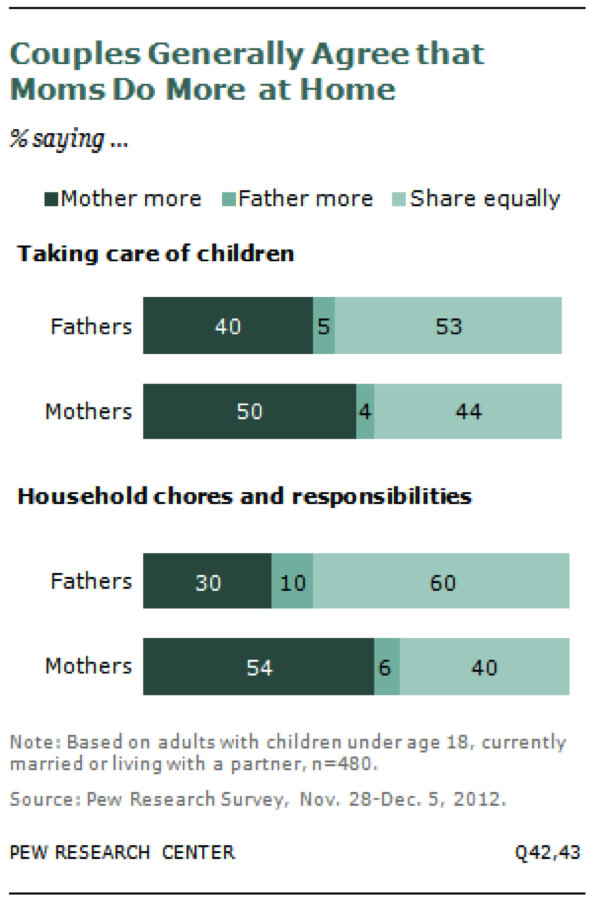
About 5% of women and men argue that men do more childcare; while close to half report that men and women are equally involved in childcare. Further, when it comes to household chores, a majority of men (and almost half of women) say that fathers do as much or more than mothers. While fathers and mothers both tend to see themselves as working more than their partners might, a large percentage of men are doing a lot at home. Yes, there is a gender gap. But when we concentrate on the median and mean, we can fail to recognize than in many families, this gender gap may not exist, while in others, it’s actually larger than the macro-level data reveals.
Challenges for Men
(1) In the last blog, I highlighted that these men are often paid less than men with traditional attitudes. Compared to more traditional men, egalitarian men with significant commitments to family can both face significant obstacles in being hired and promoted. Gillian Ranson, a sociologist at the University of Calgary, profiles a number of these working fathers in his article, “Men, Paid Employment, and Family Responsibilities: Conceptualizing the ‘Working Father.’” These men often need to leave the office early, or desire not to work every day. They are not always on call, and rarely have a partner at home who manages domestic responsibilities. The study from Cornell University (by Judge and Livingston) also suggested than egalitarian men may also be less aggressive in wage negotiations than more traditional men, and so suffer further economic penalties.
Such men may also be restricted (compared with traditional men) in the jobs that they are able to take. Families cannot easily move to support men in their careers. Egalitarian men are more likely than other men to prioritize their spouse’s career; this may sometimes entail moving for their partner, which could accompany a downward career move. They are often being compared with men who have a spouse who is dedicated primarily to the family; this is rarely something noted on their CV. While I have not seen longitudinal data, I would hypothesize that these men have less successful career trajectories than men with similar demographics and more traditional gender role attitudes.
(2) For fathers who are trying to be invested in their families, we often find that there are fewer supports for them than women. This is both an institutional and a cultural problem. In some places, women are offered more flexibility than men when it comes to balancing work and family. Second, even when paternity leave may technically be available for men, it may be discouraged. Ranson finds, for example, that mothers are still much more likely to take advantage of family-friendly initiatives.
(3) These men are also often lumped together as being ‘men’ who do not deal with the same challenges as women. Increasingly in sociology we talk about intersectionality: the idea that gender cannot be understood outside its dynamics with class and race. A recent article in the Journal of Marriage and Family by sociologists Rebecca Glauber and Kristi Gozjolko looks precisely at how issues of intersectionality can shed light on how men deal with work-family tensions.
We found that fatherhood was associated with an increase in married White men’s time spent in paid work. The increase was more than twice as strong for traditional White men than for egalitarian White men. In contrast, both egalitarian and traditional African American men did not work more when they became fathers. These findings suggest that African American men may express gender traditionalism but adopt more egalitarian work-family arrangements (“Do Traditional Fathers Always Work More? Gender, Ideology, Race, and Parenthood,” p.1133)
What I find interesting about their study is two-fold. One, the story of working fathers cannot be separated from race, as the ‘traditional’ model often heralded is one predominantly adopted by whites. Although not tested, this would lead me to suspect that some part of the wage gap between white and black men is in part due to their different family dynamics and work-family balance. Second, it suggests that just as race is important in understanding the wages men receive, so are the attitudes that men have towards gender roles and family.
At the end of the day, I found more scholars investigating these issues than I had previously known about; however, I also found a real lack of empirical data regarding the challenges and costs that these fathers face. And in our pursuits to decrease gender inequality and break down gendered stereotypes, it’s vital that such working fathers are supported.
Previous Post

April 6, 2013
Atheists in America - Part 1
Next Post

April 12, 2013 A new look at the second-generation Korean American and Canadian experience
Browse Our Archives
Select a Category Amy Reynolds Becky Hsu Brad Wright critical realism George Yancey Gerardo Marti Jeremy Rhodes Jerry Park John Schmalzbauer Margarita Mooney Mark Regnerus Nicolette Manglos positive sociology Richard Flory Robert Woodberry Uncategorized
Select a Month April 2017 August 2016 April 2016 March 2016 February 2016 January 2016 December 2015 November 2015 October 2015 September 2015 August 2015 July 2015 June 2015 May 2015 April 2015 March 2015 February 2015 January 2015 December 2014 November 2014 October 2014 September 2014 August 2014 July 2014 June 2014 May 2014 April 2014 March 2014 February 2014 January 2014 December 2013 November 2013 October 2013 September 2013 August 2013 July 2013 June 2013 May 2013 April 2013 March 2013 February 2013 January 2013 December 2012 November 2012 October 2012 September 2012 August 2012 July 2012 June 2012 May 2012 April 2012 March 2012 February 2012 January 2012 December 2011 November 2011 October 2011
Follow Us!
TAKE THE
Religious Wisdom Quiz
What miracle did Elisha perform for a widow?
Select your answer to see how you score.
Fed 5,000 Raised her son Made fire fall Multiplied oil
Related posts from Black, White and Gray

Saving the Market: Harry Potter, Churches, and Globalization

The Personal and the Political: Violence in our...

Women in Leadership National Study: A First Glance

Economic Choices, the Media, and Racism
TRENDING AT PATHEOS Evangelical

The REST of Your Life: A Creative Wrestles...
This week I had a conversation with a good friend from church....

How the author of the world's best hymn...
I've been working with John Newton for a while now. This makes...

Long before this Lectio Divina, Psalm 130 - the song - started...

What About the Trees? Another Living Parable
After I finished writing the last article about falling leaves as a...

Why Classical Education Is a Conversation, Not a...
Come and Read: Joy in Classical Education When I was a little...

Cornell University has received a great deal of negative publicity and intense...
view all Evangelical blogs
Ad-Free & Subscriber Log-In Subscription Support
- About Us
- 2026 Calendar
- Videos
- Podcasts
- Library of World Religions
- Faith In Media Tracker
- Advertise With Us
- Write for Us
- Privacy Policy
- Terms of Service
- Do Not Sell My Data
- Contact Us
- Radiant Digital
- Manage Newsletter Subscriptions
- Unsubscribe From Notifications
- Sitemap
Copyright 2008-2026, Patheos. All rights reserved.
Subscription Support Ad-Free & Subscriber Log-In
Follow Patheos