
BuddhistCatholicContemplativeEvangelicalGeneral ChristianHinduJewishLatter-day SaintMuslimNew VisionsProgressive Christian
Beliefs
- Buddhist
- Catholic
- Contemplative
- Evangelical
- General Christian
- Hindu
- Jewish
- Latter-day Saint
- More Voices
- Muslim
- New Visions
- Pagan
- Progressive Christian
Topics
- Religion News
- Food and Religion
- Sports and Religion
- Religious Art
- Religious Music and Entertainment
- Religious Events
- History and Religion
- Style and Religion
- Politics and Religion
- Women in Religion
- Recreation Outdoors and Religion
- Business Finance and Religion
- Careers Workplace and Religion
- Education and Religion
- Family Parenting and Religion
- Health Fitness and Religion
- Home and Religion
- Relationships and Religion
- Technology and Religion
- Travel and Religion
Columnists
- Buddhist Columnists
- Business Finance and Religion Columnists
- Careers Workplace and Religion Columnists
- Catholic Columnists
- Contemplative Columnists
- Education and Religion Columnists
- Evangelists Columnists
- Family Parenting and Religion Columnists
- General Christian Columnists
- Health Fitness and Religion Columnists
- Hindu Columnists
- History and Religion Columnists
- Home and Religion Columnists
- Jewish Columnists
- More Voices Columnists
- Latter Day Columnists
- Muslim Columnists
- New Visions Columnists
- Nonreligious Columnists
- Pagan Columnists
- Politics and Religion Columnists
- Progressive Columnists
- Recreation Outdoors and Religion Columnists
- Relationships and Religion Columnists
- Religion News Columnists
- Religious Art Columnists
- Religious Events Columnists
- Religious Music and Entertainment Columnists
- Sports and Religion Columnists
- Style and Religion Columnists
- Technology and Religion Columnists
- Travel and Religion Columnists
- Women in Religion Columnists
Resource Library
- 2026 Calendar
- Library of World Religions
- The 100 Most Holy Places on Earth
- Patheos Answers
- Podcasts
- Videos
- Faith Leaders Database
- Anglican Episcopalian
- Bahai
- Baptist
- Buddhism
- Christianity
- Confucianism
- Eastern Orthodoxy
- Hinduism
- Holiness and Pentecostal
- ISKCON
- Islam
- Judaism
- Lutheran
- Methodist
- The Church of Jesus Christ of Latter-day Saints
- New Age
- Paganism
- Presbytarian and Reformed
- Protestantism
- Religion Behind the Scenes
- Roman Catholic
- Scientology
- Shia Islam
- Sikhism
- Sufism
- Sunni Islam
- Taoism
- Zen
- See all religions
Research Tools
 Ad-Free & Subscriber Log-In Subscription Support
Ad-Free & Subscriber Log-In Subscription Support
Follow Patheos 

- Trending:
- Forgiveness
- |
- Marriage
- |
- Consciousness
- |
- Death Penalty
- |
- Election
- |
- Halloween
 Black, White and Gray
-
About the Authors
- Home
- Evangelical
- Is Tocqueville Still Relevant?
Is Tocqueville Still Relevant?
Last updated on: March 20, 2013 at 11:29 am by Margarita A. Mooney
Is Tocqueville Still Relevant? 2013-03-20T11:29:51-05:00 Margarita A. Mooney
Patheos Explore the world's faith through different perspectives on religion and spirituality! Patheos has the views of the prevalent religions and spiritualities of the world.
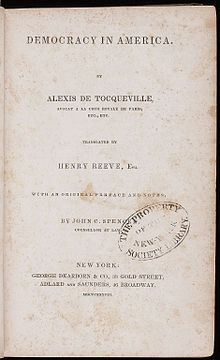 It is with a bit of trepidation that I begin discussing with my students in positive sociology this week Alexis de Tocqueville’s Democracy in America. Is a work written in the 1830s relevant nearly 200 years later? When I assign readings from 1985 my students say, “Gee, this is old and out of context,” so how will they respond to a book from 1835? Will they dismiss Tocqueville’s insights or writing style as irrelevant to their everyday concerns and the concerns of our nation?
As the book’s title suggests, Tocqueville ventured to the U.S. from France to find out: what makes American democracy work? The 600-page volume he produced is quite likely still the best assessment of American culture that has ever been written. In this masterpiece that has now become a foundational piece for cultural literacy, Tocqueville writes as a foreigner (he was a Frenchman) and to foreigners (his book was originally published in French for a French audience) about what cultural and social forms distinctly American, and how those distinct American social and cultural traits uphold the great American experiment in democracy.
Today, most Americans take our democracy for granted and hardly realizing, as my graduate school instructor from Princeton University Paul Starr put it, what a bunch of radicals the American revolutionaries were and how most of the world at the time flat-out rejected the idea that the masses were deserving of liberty or capable of self-rule. Today, the word democracy gets thrown around in our domestic policy debates and most certain in our foreign policy debates.
As I chatted with Beau Weston, the Van Winkle Professor of Sociology and Centre College (Kentucky), we talked about how Tocqueville was trying to persuade French aristocrats that democracy can really work. Liberty, many European aristocrats at the time thought, could only be entrusted to the educated, the landed, well, to other aristocrats like them who had been given their liberty and their superior social position by their God. Aristocrats believed that society had to be organized top down, with the church, kings and aristocrats exercising special rights and abilities to make society cohere. The needs or rights of individuals didn’t matter too much; the masses needed order, not liberty, to thrive.
 At around the same time as the American Revolution, the Scottish moral philosopher (who is better remembered as an economist) Adam Smith wrote two extraordinarily influential works: The Theory of Moral Sentiments (1759) and The Wealth of Nations (1776). The noted economic history Jacob Viner points out how in these two works Smith argues that humans are all endowed with natural liberty, and that such natural liberty gives rise to social order (Journal of Political Economy, Vol. 35, No. 2, April 1927, pp. 198-232).
It’s overly simplistic to say that Smith wrote that the pursuit of self-interest produces the common good; Smith saw very clearly the dangers of self-deceit and corruption. But Smith’s enduring insight was that that social order can arise from the free cooperation of individuals, that competition in the economic realm could lead to cooperation. This ideal of upholding natural liberty as a path to social cooperation is deeply embedded in American culture, history and institutions.
Tocqueville set out to demonstrate to Frenchmen that political liberty could really work, that you can make a great nation out of people who are pursuing their self-interest. Hence, I assigned sections of Tocqueville to my students in order to get them to reflect on questions such as: How do we develop a society that finds a working balance between self interest and group interest? How do we get people to care about the common good beyond their own self-interest or even their own group interest? How do we get group competition to be good for the common good rather than bad for the common good?
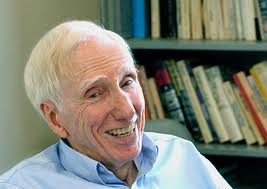
Robert Bellah
Thus far in my positive sociology class, we have discussed the many useful insights from positive psychology. But, as Martin Seligman admitted when I met him, positive psychology remains profoundly individualistic. We have also read Jonathan Haidt’s important book The Righteous Mind. As Robert Bellah and I discussed last week, the narrative of American individualism is so deeply ingrained that it’s hard to get students to see themselves as shaped by collectivities and to see that their actions contribute (or detract from) collective goods. Haidt’s beautiful writing, poignant examples and mass of empirical evidence convince students that society is both made of up people who are fiercely self-interested and groups that are just as fiercely loyal, cohesive and competitive.
Haidt leaves us off, however, with a weak vision of the common good. As noted Stanford moral psychologist William Damon points out in his review of The Righteous Mind, Haidt largely concludes his work by calling for tolerance among competing moral matrices. But he fails to explain, according to Damon, why tolerance should be a universal moral standard or how tolerance will get us to desired outcomes.
“Except for short-lived interludes during periods of national consensus, American politics typically has been fiercely partisan. The genius of our democracy has been its capacity to regain a sense of solidarity, even reconciliation, after a resolution of divisive contentions among interest groups with opposing views. The struggles have not always been harmless, and they are almost always unpleasant to live through. But who is to say that noisy struggles have not been needed for steering the nation on the right course over the long haul? Sometimes a nation’s citizens must take oppositional stands in pursuit of a better way.”
Robert Bellah also insisted to me last week that contesting moral claims made by our leaders is a central purpose of living in a democracy. I never appreciated the freedoms we have in the U.S. until I spent long amounts of time in my mother’s homeland of Cuba, which has been communist for more than 50 years. Seeing people trapped under totalitarianism in Cuba, I learned a hard lesson about the U.S.: we are either active creators of our social and political systems, or we become passive takers of liberty and prosperity that so much of the world would give anything just to taste. People risk their lives to come to the U.S. on rickety boats from Cuba and through the dangerous deserts of the Rio Grande to seek freedom and prosperity.
Today, American democracy needs to not just assert but to demonstrate its superiority to other political systems, such as theocracy in Iran, military dictatorships in Africa, and limited democracies in much of East Asia. I worry that many of our students are taught to criticize our system rather than both criticize and praise it. Please note: I am not saying students should not criticize American political and social systems, but I am saying that criticism without some view of a positive solutions is of limited use. We must know our nation’s strengths if we want to engage in the type of informed criticism and civil contestation that eminent scholars like Robert Bellah or William Damon are calling for.
I’m hoping that my students embrace Tocqueville as a way to analyze their own experiments in pursuing self-interest and collective goods on the university campus. If college is just about credentials or knowledge, why do American universities relentlessly encourage group activities like sports, theater, newspapers, debate clubs, and dorm associations. Why are intramural sports at UNC, Princeton or Yale so competitive, so conducive to bonding and so much fun (even if the athleticism leaves much to be desired)?
With regards to religion, today’s generation has been called a generation of seekers. They are willing to try on new religious communities like trying on new shoes. Loyalty to one’s religious denomination has never been as low as it is today in the U.S. But I dare say that this generation is a generation of seekers not just in religion but also in groups more generally.
Today’s college generation is not just seeking for groups, they are groping for groups. As one of my freshmen said, “Gee, positive psychology tells me that my life will be meaningful if I have a purpose in life, but how do I find purpose on my own? I don’t belong to any religious tradition, I don’t really believe strongly in anything, and I don’t belong to any groups on campus. I feel lost, like I’m just following some roles with no purpose. I would love to just follow a group. I don’t want to have to figure out the meaning of my life all on my own.”
Today’s obsession with competitive college sports is clearly a sign of group seeking. As one of my students discovered when she attended a basketball game in her hometown of Miami, some people call themselves “bandwagon fans” and show up painted in the colors and symbols of whatever college basketball team is on a currently winning all its games. The University of Miami has had an unusually strong season in 2013, so the game she attended was full of these bandwagon fans that have no ties to the city of Miami nor to the University of Miami. They simply want to associate with a winning team and participate most actively in all the rituals that comprise college basketball.
One of the main things I hope my students get out of Tocqueville is an ability to see their group seeking as a fundamental tendency of human nature, and when channeled properly, that group participation–even fierce loyalties to groups and inter-group competition–is one of the features that makes American democracy work. If Tocqueville can convince students that self-interest and group interest can build towards the common good, the next question then becomes: under what conditions do self-interest and group interest contribute to the common good rather than becoming destructive? This is the question Tocqueville set out to answer, and a question we must be ready to take up again today.
Previous Post

March 16, 2013
Video Madness
Next Post

March 21, 2013 What, Exactly, Is Evangelical Christianity?
Browse Our Archives
Select a Category Amy Reynolds Becky Hsu Brad Wright critical realism George Yancey Gerardo Marti Jeremy Rhodes Jerry Park John Schmalzbauer Margarita Mooney Mark Regnerus Nicolette Manglos positive sociology Richard Flory Robert Woodberry Uncategorized
Select a Month April 2017 August 2016 April 2016 March 2016 February 2016 January 2016 December 2015 November 2015 October 2015 September 2015 August 2015 July 2015 June 2015 May 2015 April 2015 March 2015 February 2015 January 2015 December 2014 November 2014 October 2014 September 2014 August 2014 July 2014 June 2014 May 2014 April 2014 March 2014 February 2014 January 2014 December 2013 November 2013 October 2013 September 2013 August 2013 July 2013 June 2013 May 2013 April 2013 March 2013 February 2013 January 2013 December 2012 November 2012 October 2012 September 2012 August 2012 July 2012 June 2012 May 2012 April 2012 March 2012 February 2012 January 2012 December 2011 November 2011 October 2011
Follow Us!
TAKE THE
Religious Wisdom Quiz
Who said, "Before I formed you in the womb I knew you"?
Select your answer to see how you score.
God Isaiah David Paul
Related posts from Black, White and Gray

Using Critical Realism to Teach the Fundamentals of...

Incorporating Critical Realism into Research Methods Classes

5 Great Articles Using Critical Realism in Social...

Books on Critical Realism and Sociological Research Methods
TRENDING AT PATHEOS Evangelical

The REST of Your Life: A Creative Wrestles...
This week I had a conversation with a good friend from church....

How the author of the world's best hymn...
I've been working with John Newton for a while now. This makes...

Long before this Lectio Divina, Psalm 130 - the song - started...

What About the Trees? Another Living Parable
After I finished writing the last article about falling leaves as a...

Why Classical Education Is a Conversation, Not a...
Come and Read: Joy in Classical Education When I was a little...

Cornell University has received a great deal of negative publicity and intense...
view all Evangelical blogs
Ad-Free & Subscriber Log-In Subscription Support
- About Us
- 2026 Calendar
- Videos
- Podcasts
- Library of World Religions
- Faith In Media Tracker
- Advertise With Us
- Write for Us
- Privacy Policy
- Terms of Service
- Do Not Sell My Data
- Contact Us
- Radiant Digital
- Manage Newsletter Subscriptions
- Unsubscribe From Notifications
- Sitemap
Copyright 2008-2026, Patheos. All rights reserved.
Subscription Support Ad-Free & Subscriber Log-In
Follow Patheos