
BuddhistCatholicContemplativeEvangelicalGeneral ChristianHinduJewishLatter-day SaintMuslimNew VisionsProgressive Christian
Beliefs
- Buddhist
- Catholic
- Contemplative
- Evangelical
- General Christian
- Hindu
- Jewish
- Latter-day Saint
- More Voices
- Muslim
- New Visions
- Pagan
- Progressive Christian
Topics
- Religion News
- Food and Religion
- Sports and Religion
- Religious Art
- Religious Music and Entertainment
- Religious Events
- History and Religion
- Style and Religion
- Politics and Religion
- Women in Religion
- Recreation Outdoors and Religion
- Business Finance and Religion
- Careers Workplace and Religion
- Education and Religion
- Family Parenting and Religion
- Health Fitness and Religion
- Home and Religion
- Relationships and Religion
- Technology and Religion
- Travel and Religion
Columnists
- Buddhist Columnists
- Business Finance and Religion Columnists
- Careers Workplace and Religion Columnists
- Catholic Columnists
- Contemplative Columnists
- Education and Religion Columnists
- Evangelists Columnists
- Family Parenting and Religion Columnists
- General Christian Columnists
- Health Fitness and Religion Columnists
- Hindu Columnists
- History and Religion Columnists
- Home and Religion Columnists
- Jewish Columnists
- More Voices Columnists
- Latter Day Columnists
- Muslim Columnists
- New Visions Columnists
- Nonreligious Columnists
- Pagan Columnists
- Politics and Religion Columnists
- Progressive Columnists
- Recreation Outdoors and Religion Columnists
- Relationships and Religion Columnists
- Religion News Columnists
- Religious Art Columnists
- Religious Events Columnists
- Religious Music and Entertainment Columnists
- Sports and Religion Columnists
- Style and Religion Columnists
- Technology and Religion Columnists
- Travel and Religion Columnists
- Women in Religion Columnists
Resource Library
- 2026 Calendar
- Library of World Religions
- The 100 Most Holy Places on Earth
- Patheos Answers
- Podcasts
- Videos
- Faith Leaders Database
- Anglican Episcopalian
- Bahai
- Baptist
- Buddhism
- Christianity
- Confucianism
- Eastern Orthodoxy
- Hinduism
- Holiness and Pentecostal
- ISKCON
- Islam
- Judaism
- Lutheran
- Methodist
- The Church of Jesus Christ of Latter-day Saints
- New Age
- Paganism
- Presbytarian and Reformed
- Protestantism
- Religion Behind the Scenes
- Roman Catholic
- Scientology
- Shia Islam
- Sikhism
- Sufism
- Sunni Islam
- Taoism
- Zen
- See all religions
Research Tools
 Ad-Free & Subscriber Log-In Subscription Support
Ad-Free & Subscriber Log-In Subscription Support
Follow Patheos 

- Trending:
- Forgiveness
- |
- Marriage
- |
- Consciousness
- |
- Death Penalty
- |
- Election
- |
- Halloween
 Black, White and Gray
-
About the Authors
- Home
- Evangelical
- Being Honest about Inequality
Being Honest about Inequality
Last updated on: February 26, 2013 at 6:30 am by Amy Reynolds
Being Honest about Inequality 2013-02-26T00:46:10-05:00 Amy Reynolds
Patheos Explore the world's faith through different perspectives on religion and spirituality! Patheos has the views of the prevalent religions and spiritualities of the world.
Last week, my daughter brought home a class worksheet where she had noted that Barack Obama was colorblind. “What does that mean?” I asked her, only to be informed that it meant he thought people were equal, regardless of the color of their skin. I told her that’s not exactly what being colorblind meant: that seeing people as equal does not mean ignoring race. The topic then shifted to soccer and birthday parties.
Yesterday morning we had another interesting exchange before school, continuing on with this idea of people being treated equally, regardless of gender or race. She was making a statement regarding the past when people were not treated equally.
“People are still not treated equally. Many people still treat boys better than girls, and white people better than black people.” I decided to limit some of the specifics, such as differential conviction rates, job call-backs, media portrayals, or pay inequality.
“But in North America, we treat one another equally?”
I shook my head no.
“In Illinois?” No.
“In Wheaton?” No.
“On our street?” Sad laugh.
I suspect this moment was similar to those that many sociologists (and others) have had with their children, where they feel a responsibility to discuss things as they really are, despite a sort of innocence that seems to be destroyed. But we have to admit and teach our children that in the United States, people are not treated equally. Not simply in spite of the fact that such a reality is awful, but precisely because it is awful. Pretending that we are viewing and treating each other equally only makes the situation worse.
As a Christian, I yearn to see the Church standing out for our opposition to the sexism and racism in our society. However, given the fact I study issues of gender and religion, I’m almost reminded daily that my hopes don’t match reality.
Let me just note two recent statistics on gendered realities in the Christian community, recognizing that it’s not a monolithic community.
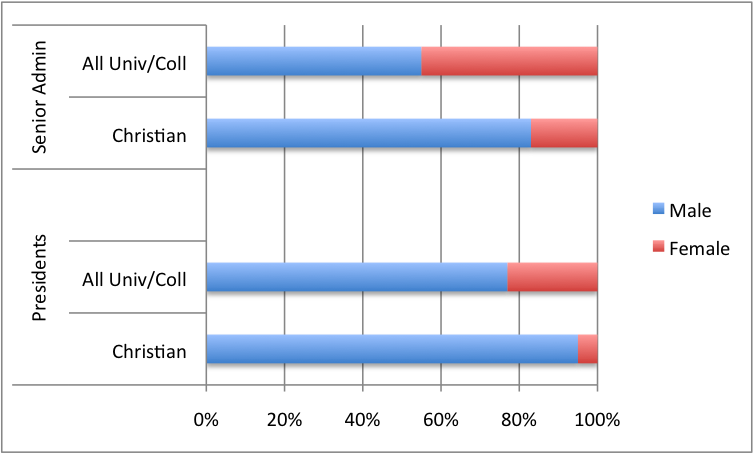
- Within colleges that are members of the CCCU (Christian Coalition of Colleges and Universities), 6 out of 111 college presidents are female. The data for this chart comes from recent efforts & research of the CCCU examining these gender discrepancies.
- A blog post yesterday on Patheos listed the top 50 influential pastors on twitter. While I won’t argue it should be the key measure of who holds influence in the Christian community, it’s still an interesting list. (Impossible) Challenge: Find one female on the list. (The author, Adrian Warnock, followed up the list with the top 20 female Christian bloggers, but none of these were senior pastors).
If we aren’t honest with our children, we do more harm than good. When my daughter (or someone’s son) sees the chart above, or hears her friends talking about those influential blogging pastors, it communicates something. She sees that those with the most power, those leading and making decisions, and those heralded for their wisdom are predominantly male and white. If she and other children believe in a meritocracy, such information suggests that men must be smarter or better at these things that women, or that white people are more competent and qualified than non-whites. That’s not true.
Some days it’s hard to move from one disappointing fact to another. This morning, I followed the discussion with my daughter to one where we talked about abuse in families during my morning class, and the failure of churches to engage in structural justice efforts in my afternoon class. Students probably left both of those feeling a bit deflated, much like my daughter appeared as she ate her cheerios. I agree with Margarita Mooney’s blog post noting that sociologists can often concentrate on the negative, and that “describing social problems is not the equivalent of describing the conditions that promote human flourishing or foster the common good.” Clearly, most of my day was not engaged in such a project.
But to move towards change, we have to be aware of what’s wrong. And it’s never too early to help kids to see it. I believe that many in the world, and within the evangelical community, can often undervalue women for the ways that they might be involved in God’s radical mission for the world. But this is not the end of the story. As my daughter looked at me sadly when I explained the prevalence of inequality today, I did engage in some positive perspective. I reminded her that God doesn’t view us that way. Thanks to a class I took as an undergraduate with Dr. Robert Kiely on early Christian literature, I was also able to tell her that some of the earliest Christians drew the attention of others as they broke gendered norms in worship, following messages of gender equality that Christ preached. As I saw her eyes twinkle, I smiled. I witnessed her hope for a broken world, a hope much more valuable than a childish innocence of sin.
Previous Post

February 22, 2013
Gender, Culture and Suicide in Asia and Asian America
Next Post
February 28, 2013 The Rise of the Unaffiliated--The Religious Nones
Browse Our Archives
Select a Category Amy Reynolds Becky Hsu Brad Wright critical realism George Yancey Gerardo Marti Jeremy Rhodes Jerry Park John Schmalzbauer Margarita Mooney Mark Regnerus Nicolette Manglos positive sociology Richard Flory Robert Woodberry Uncategorized
Select a Month April 2017 August 2016 April 2016 March 2016 February 2016 January 2016 December 2015 November 2015 October 2015 September 2015 August 2015 July 2015 June 2015 May 2015 April 2015 March 2015 February 2015 January 2015 December 2014 November 2014 October 2014 September 2014 August 2014 July 2014 June 2014 May 2014 April 2014 March 2014 February 2014 January 2014 December 2013 November 2013 October 2013 September 2013 August 2013 July 2013 June 2013 May 2013 April 2013 March 2013 February 2013 January 2013 December 2012 November 2012 October 2012 September 2012 August 2012 July 2012 June 2012 May 2012 April 2012 March 2012 February 2012 January 2012 December 2011 November 2011 October 2011
Follow Us!
TAKE THE
Religious Wisdom Quiz
How many Beatitudes are in the Sermon on the Mount?
Select your answer to see how you score.
10 7 8 12
Related posts from Black, White and Gray

Saving the Market: Harry Potter, Churches, and Globalization

The Personal and the Political: Violence in our...

Women in Leadership National Study: A First Glance
Economic Choices, the Media, and Racism
TRENDING AT PATHEOS Evangelical

The REST of Your Life: A Creative Wrestles...
This week I had a conversation with a good friend from church....

How the author of the world's best hymn...
I've been working with John Newton for a while now. This makes...

Long before this Lectio Divina, Psalm 130 - the song - started...

What About the Trees? Another Living Parable
After I finished writing the last article about falling leaves as a...

Why Classical Education Is a Conversation, Not a...
Come and Read: Joy in Classical Education When I was a little...

Cornell University has received a great deal of negative publicity and intense...
view all Evangelical blogs
Ad-Free & Subscriber Log-In Subscription Support
- About Us
- 2026 Calendar
- Videos
- Podcasts
- Library of World Religions
- Faith In Media Tracker
- Advertise With Us
- Write for Us
- Privacy Policy
- Terms of Service
- Do Not Sell My Data
- Contact Us
- Radiant Digital
- Manage Newsletter Subscriptions
- Unsubscribe From Notifications
- Sitemap
Copyright 2008-2026, Patheos. All rights reserved.
Subscription Support Ad-Free & Subscriber Log-In
Follow Patheos