
BuddhistCatholicContemplativeEvangelicalGeneral ChristianHinduJewishLatter-day SaintMuslimNew VisionsProgressive Christian
Beliefs
- Buddhist
- Catholic
- Contemplative
- Evangelical
- General Christian
- Hindu
- Jewish
- Latter-day Saint
- More Voices
- Muslim
- New Visions
- Pagan
- Progressive Christian
Topics
- Religion News
- Food and Religion
- Sports and Religion
- Religious Art
- Religious Music and Entertainment
- Religious Events
- History and Religion
- Style and Religion
- Politics and Religion
- Women in Religion
- Recreation Outdoors and Religion
- Business Finance and Religion
- Careers Workplace and Religion
- Education and Religion
- Family Parenting and Religion
- Health Fitness and Religion
- Home and Religion
- Relationships and Religion
- Technology and Religion
- Travel and Religion
Columnists
- Buddhist Columnists
- Business Finance and Religion Columnists
- Careers Workplace and Religion Columnists
- Catholic Columnists
- Contemplative Columnists
- Education and Religion Columnists
- Evangelists Columnists
- Family Parenting and Religion Columnists
- General Christian Columnists
- Health Fitness and Religion Columnists
- Hindu Columnists
- History and Religion Columnists
- Home and Religion Columnists
- Jewish Columnists
- More Voices Columnists
- Latter Day Columnists
- Muslim Columnists
- New Visions Columnists
- Nonreligious Columnists
- Pagan Columnists
- Politics and Religion Columnists
- Progressive Columnists
- Recreation Outdoors and Religion Columnists
- Relationships and Religion Columnists
- Religion News Columnists
- Religious Art Columnists
- Religious Events Columnists
- Religious Music and Entertainment Columnists
- Sports and Religion Columnists
- Style and Religion Columnists
- Technology and Religion Columnists
- Travel and Religion Columnists
- Women in Religion Columnists
Resource Library
- 2026 Calendar
- Library of World Religions
- The 100 Most Holy Places on Earth
- Patheos Answers
- Podcasts
- Videos
- Faith Leaders Database
- Anglican Episcopalian
- Bahai
- Baptist
- Buddhism
- Christianity
- Confucianism
- Eastern Orthodoxy
- Hinduism
- Holiness and Pentecostal
- ISKCON
- Islam
- Judaism
- Lutheran
- Methodist
- The Church of Jesus Christ of Latter-day Saints
- New Age
- Paganism
- Presbytarian and Reformed
- Protestantism
- Religion Behind the Scenes
- Roman Catholic
- Scientology
- Shia Islam
- Sikhism
- Sufism
- Sunni Islam
- Taoism
- Zen
- See all religions
Research Tools
 Ad-Free & Subscriber Log-In Subscription Support
Ad-Free & Subscriber Log-In Subscription Support
Follow Patheos 

- Trending:
- Forgiveness
- |
- Marriage
- |
- Consciousness
- |
- Death Penalty
- |
- Election
- |
- Halloween
 Black, White and Gray
-
About the Authors
- Home
- Evangelical
- Christmas Liturgy from the Vatican
Christmas Liturgy from the Vatican
Last updated on: December 25, 2012 at 5:47 pm by Margarita A. Mooney
Christmas Liturgy from the Vatican 2012-12-25T17:47:55-05:00 Margarita A. Mooney
Patheos Explore the world's faith through different perspectives on religion and spirituality! Patheos has the views of the prevalent religions and spiritualities of the world.
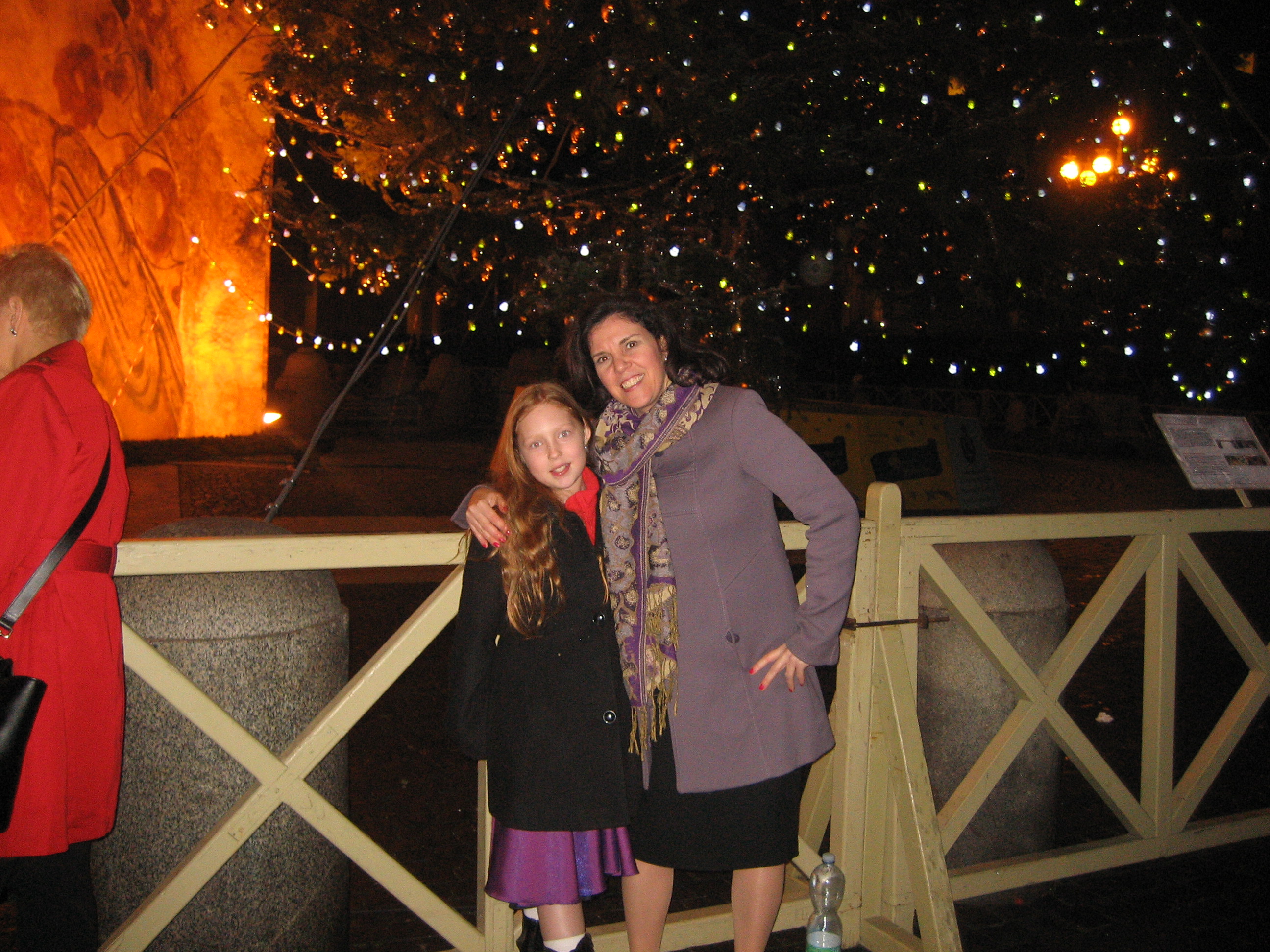
My niece Selena and kept each other warm outside St. Peter’s in Rome
From Rome, December 25th, 2012
Have you ever wondered what Christmas liturgy at the St. Peter’s Basilica in the Vatican might be like? It follows the exact same structure as any other Mass, but nearly all the prayers are said in Latin, a breathtaking Schola of boys and men leads the singing, and the thousands of faithful who have traveled over many miles and waited many hours in line to get in maintain a reverent silence in the most grand piece of religious architecture you could ever imagine. The result is a breathtaking, deeply reverent liturgy that unites people from every corner of the world and produces profound joy–a foretaste of heaven on earth.
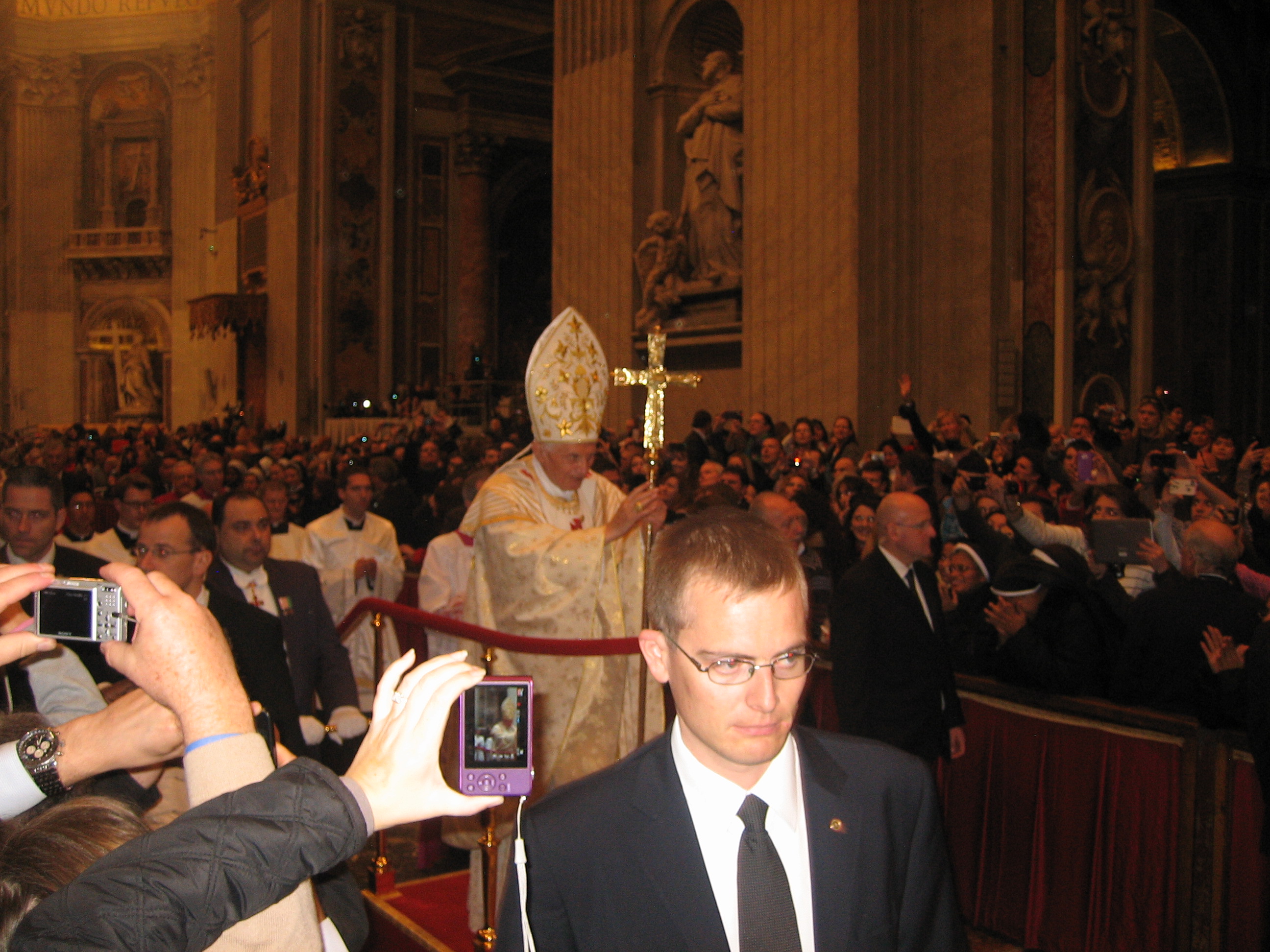
Pope Benedict XVI leaving St. Peter’s Basilica
Of course one big draw to Mass at the Vatican is you get to see and hear the Pope; in fact, Pope Benedict XVI passed about 5 feet from us twice. He had a warm smile, but looks older in person than on camera. His voice was strong and clear throughout the Mass, especially during the homily. His homily was long (by Catholic standards) and all in Italian, but the crowd of thousands sat silently, reverently listening to their Holy Father. As I speak French and Spanish fluently, and I had been practicing Italian in the previous weekly during my “monastic vacation” at a 13th century convent with 80 sisters from 20 different countries, I understood the main points of the Pope’s homily (and read it in English as soon as I got back to my hotel in Rome).
Christ came to bring peace to earth, Pope Benedict said, but if Mary and Joseph knocked at our doors and asked for a place to stay the night, would we have room for them? If religion has been responsible for violence in some instances, the Pope said, the 20th century showed us that eradicating religion won’t eradicate violence. The way to peace is by discovering the splendor of the truth and relying on God’s grace; that is, if in our materialistic and individualistic culture we can make the time to know God and open our hearts to God’s love.
Pope Benedict XVI concluded his homily thus:
“The shepherds made haste. Holy curiosity and holy joy impelled them. In our case, it is probably not very often that we make haste for the things of God. God does not feature among the things that require haste. The things of God can wait, we think and we say. And yet he is the most important thing, ultimately the one truly important thing. Why should we not also be moved by curiosity to see more closely and to know what God has said to us? At this hour, let us ask him to touch our hearts with the holy curiosity and the holy joy of the shepherds, and thus let us go over joyfully to Bethlehem, to the Lord who today once more comes to meet us. Amen.”
The reverence continued throughout the liturgy of the Eucharist. I even saw an old friend from Princeton University walk past me in line for communion and we quickly exchanged a quiet handshake and Merry Christmas. I also made new friends who stood in line with me outside for five hours–a family from Mexico and another from Denver. We exchanged warm embraces with the nuns from Brazil behind us, the Italians next to us, and the African-Americans in front of us.
The most moving part of the Mass for me was after everyone had received communion and returned to their seats, a peaceful quiet came over the basilica. Suddenly, trumpets blared announcing the birth of the Christ. After one minute of stunning trumpets, the Schola burst out singing:
“Adeste, fideles, laeti triumphantes, venite, venite in Bethlehem, natum videte, regem angelorum. Venite adoremus, venite adoremus Dominum.” (O come, all ye faithful, joyful and triumphant. Come ye, o come ye, to Bethlehem, come and behold him, born the king of angels; O come let us adore him, Christ the Lord.)
The singing is so crystal clear that I would have sworn I heard a single boy’s voice–just listen to the “venite adoremus” and tell me that doesn’t sound like just one single voice! But watching the performance of “Adeste, Fideles” on YouTube (which I’ve seen at least 10 times in the last 24 hours) I concluded that the entire boys’ choir is so perfectly united they sound like they are one voice. The men’s voices sound like the background chorus to the real stars.
When one of the nuns from Brazil behind me joined in her with own angelic voice singing “venite adoremus”, I then joined in with the crowed. We sang 4 verses in Latin (with the English translations in the booklet we got as we entered). Tears rolled down my face during this stunning musical performance, one that stimulates both active partcipation and deep contemplation of the mysteries contained in words like,
“En grege relicto, humiles ad cunas, vocati pastores adproperant, et nos ovanti, gradu festinemus. Venite adoremus, venite adoremus Dominum.” (See how the sheperds, summonded to his cradle, leaving their flocks, draw nigh to gaze; we too will thither bend our joyful footsteps; O come, let us adore him, O Come, let us adore him, Christ the Lord.)
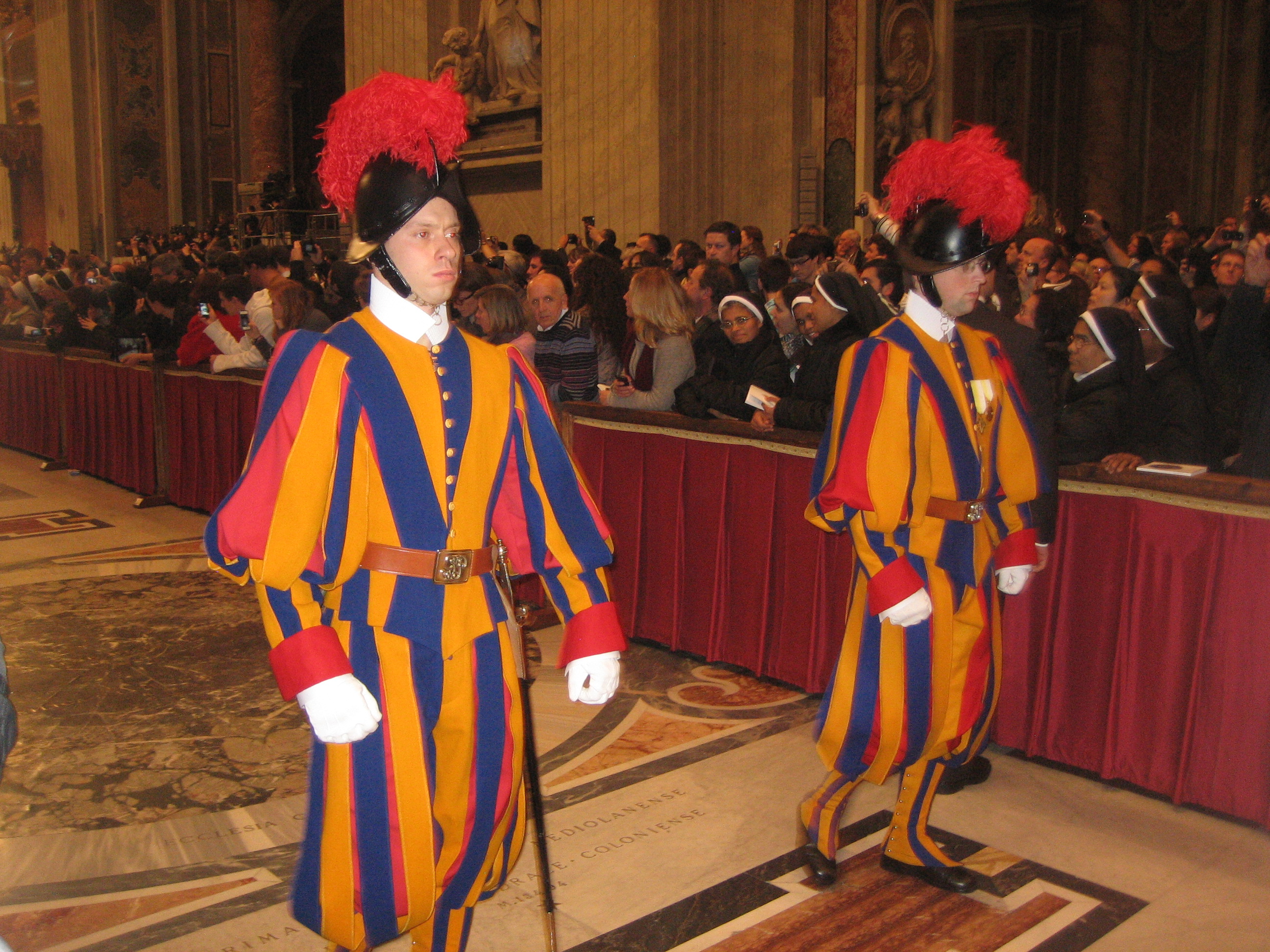
The Swiss Guards proceeding out of St. Peter’s Basilica
The closing procession featured the unforgettable Swiss guards–who must have the most creative uniforms in the whole world, and “Il Bambino Gesu” (Baby
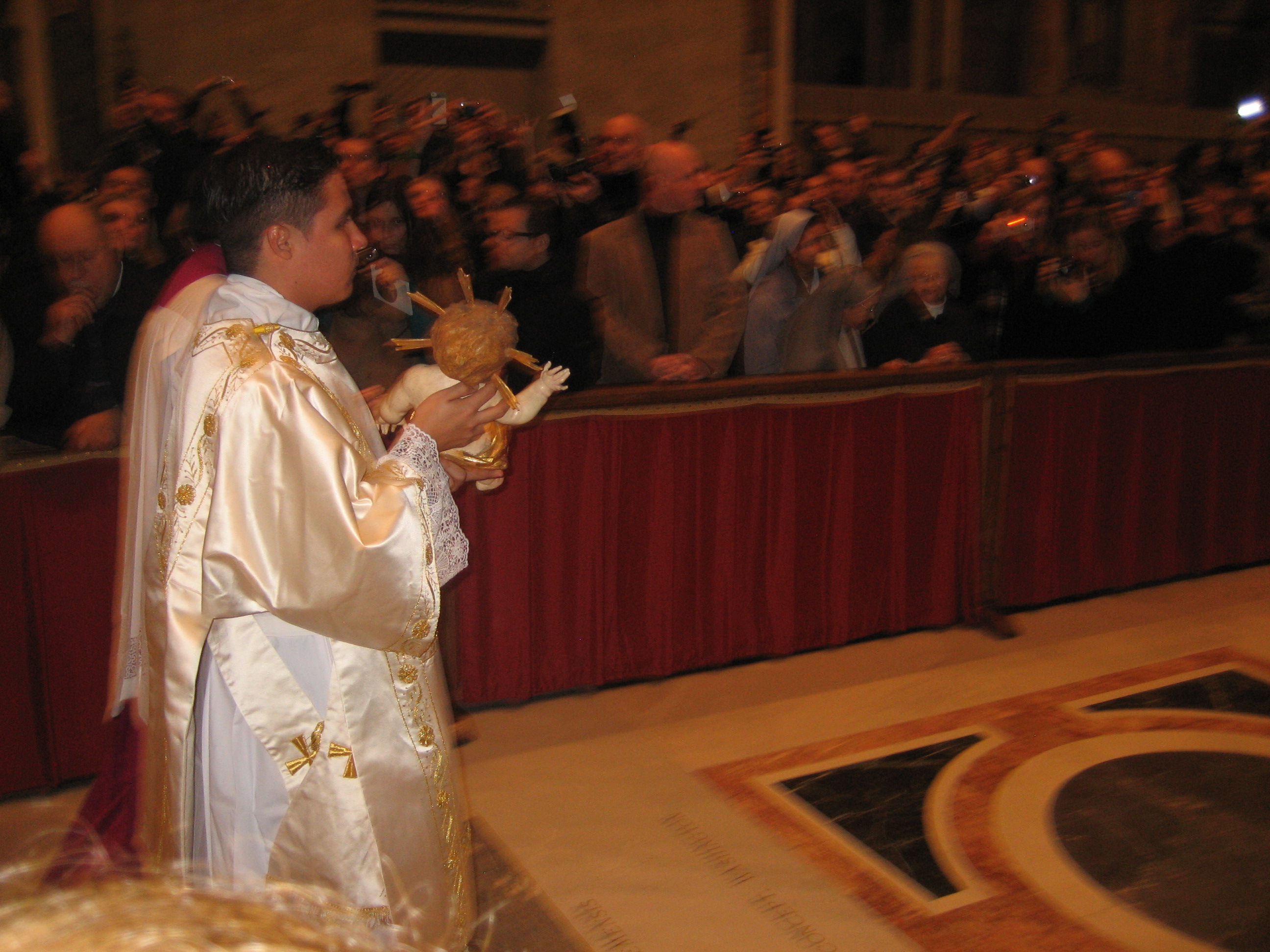
The Baby Jesus (with a crown) being carried to the Vatican Nativity scene
Jesus) being laid in the Vatican “crèche” (Nativity). At the end of the service, one nun from Brazil said, “People from every nation can sing Adeste Fideles!” But her words express a deeper sense I had on Christmas eve in Rome: despite our different languages and nationalities, the Catholic faithful joined together in one voice in prayer and song, and many moments of collective silence to welcome the birth of our Lord.
Although many other people do not share the Catholic or Christian faith, the peace Christians long for is a deep human longing most people share. Furthermore, ritual is a universal language–which is why nearly all religious communities have rituals and many secular events, such as national parades, are highly ritualistic. In the best of cases, rituals both elicit social solidarity and incite personal transformation. As sociologist Emile Durkheim pointed out long ago, the effects of rituals stay with us long after the ritual itself ends. When I feel personally weak or wonder how the world can overcome the encroaching darkness, I will recall the trumpet blast in St. Peter’s Basilica on Christmas Eve 2012 and my own hopeful singing “Venite adoremus Dominum!” and be taken back to that jubilant liturgy.
Previous Post

December 22, 2012
Still Retreating from Race: Asian Americans in the Ivy League
Next Post

December 27, 2012 Should Parents Force Their Children to Attend Church?
Browse Our Archives
Select a Category Amy Reynolds Becky Hsu Brad Wright critical realism George Yancey Gerardo Marti Jeremy Rhodes Jerry Park John Schmalzbauer Margarita Mooney Mark Regnerus Nicolette Manglos positive sociology Richard Flory Robert Woodberry Uncategorized
Select a Month April 2017 August 2016 April 2016 March 2016 February 2016 January 2016 December 2015 November 2015 October 2015 September 2015 August 2015 July 2015 June 2015 May 2015 April 2015 March 2015 February 2015 January 2015 December 2014 November 2014 October 2014 September 2014 August 2014 July 2014 June 2014 May 2014 April 2014 March 2014 February 2014 January 2014 December 2013 November 2013 October 2013 September 2013 August 2013 July 2013 June 2013 May 2013 April 2013 March 2013 February 2013 January 2013 December 2012 November 2012 October 2012 September 2012 August 2012 July 2012 June 2012 May 2012 April 2012 March 2012 February 2012 January 2012 December 2011 November 2011 October 2011
Follow Us!
TAKE THE
Religious Wisdom Quiz
Which Christian festival celebrates the coming of the Holy Spirit?
Select your answer to see how you score.
Lent Trinity Sunday Advent Pentecost
Related posts from Black, White and Gray

Using Critical Realism to Teach the Fundamentals of...

Incorporating Critical Realism into Research Methods Classes

5 Great Articles Using Critical Realism in Social...

Books on Critical Realism and Sociological Research Methods
TRENDING AT PATHEOS Evangelical

The REST of Your Life: A Creative Wrestles...
This week I had a conversation with a good friend from church....

How the author of the world's best hymn...
I've been working with John Newton for a while now. This makes...

Long before this Lectio Divina, Psalm 130 - the song - started...

What About the Trees? Another Living Parable
After I finished writing the last article about falling leaves as a...

Why Classical Education Is a Conversation, Not a...
Come and Read: Joy in Classical Education When I was a little...

Cornell University has received a great deal of negative publicity and intense...
view all Evangelical blogs
Ad-Free & Subscriber Log-In Subscription Support
- About Us
- 2026 Calendar
- Videos
- Podcasts
- Library of World Religions
- Faith In Media Tracker
- Advertise With Us
- Write for Us
- Privacy Policy
- Terms of Service
- Do Not Sell My Data
- Contact Us
- Radiant Digital
- Manage Newsletter Subscriptions
- Unsubscribe From Notifications
- Sitemap
Copyright 2008-2026, Patheos. All rights reserved.
Subscription Support Ad-Free & Subscriber Log-In
Follow Patheos