
BuddhistCatholicContemplativeEvangelicalGeneral ChristianHinduJewishLatter-day SaintMuslimNew VisionsProgressive Christian
Beliefs
- Buddhist
- Catholic
- Contemplative
- Evangelical
- General Christian
- Hindu
- Jewish
- Latter-day Saint
- More Voices
- Muslim
- New Visions
- Pagan
- Progressive Christian
Topics
- Religion News
- Food and Religion
- Sports and Religion
- Religious Art
- Religious Music and Entertainment
- Religious Events
- History and Religion
- Style and Religion
- Politics and Religion
- Women in Religion
- Recreation Outdoors and Religion
- Business Finance and Religion
- Careers Workplace and Religion
- Education and Religion
- Family Parenting and Religion
- Health Fitness and Religion
- Home and Religion
- Relationships and Religion
- Technology and Religion
- Travel and Religion
Columnists
- Buddhist Columnists
- Business Finance and Religion Columnists
- Careers Workplace and Religion Columnists
- Catholic Columnists
- Contemplative Columnists
- Education and Religion Columnists
- Evangelists Columnists
- Family Parenting and Religion Columnists
- General Christian Columnists
- Health Fitness and Religion Columnists
- Hindu Columnists
- History and Religion Columnists
- Home and Religion Columnists
- Jewish Columnists
- More Voices Columnists
- Latter Day Columnists
- Muslim Columnists
- New Visions Columnists
- Nonreligious Columnists
- Pagan Columnists
- Politics and Religion Columnists
- Progressive Columnists
- Recreation Outdoors and Religion Columnists
- Relationships and Religion Columnists
- Religion News Columnists
- Religious Art Columnists
- Religious Events Columnists
- Religious Music and Entertainment Columnists
- Sports and Religion Columnists
- Style and Religion Columnists
- Technology and Religion Columnists
- Travel and Religion Columnists
- Women in Religion Columnists
Resource Library
- 2026 Calendar
- Library of World Religions
- The 100 Most Holy Places on Earth
- Patheos Answers
- Podcasts
- Videos
- Faith Leaders Database
- Anglican Episcopalian
- Bahai
- Baptist
- Buddhism
- Christianity
- Confucianism
- Eastern Orthodoxy
- Hinduism
- Holiness and Pentecostal
- ISKCON
- Islam
- Judaism
- Lutheran
- Methodist
- The Church of Jesus Christ of Latter-day Saints
- New Age
- Paganism
- Presbytarian and Reformed
- Protestantism
- Religion Behind the Scenes
- Roman Catholic
- Scientology
- Shia Islam
- Sikhism
- Sufism
- Sunni Islam
- Taoism
- Zen
- See all religions
Research Tools
 Ad-Free & Subscriber Log-In Subscription Support
Ad-Free & Subscriber Log-In Subscription Support
Follow Patheos 

- Trending:
- Forgiveness
- |
- Marriage
- |
- Consciousness
- |
- Death Penalty
- |
- Election
- |
- Halloween
 Black, White and Gray
-
About the Authors
- Home
- Evangelical
- When is Suffering Transformative? Sullivan’s “Living Faith: Everyday Religion and Mothers in Poverty”
When is Suffering Transformative? Sullivan’s “Living Faith: Everyday Religion and Mothers in Poverty”
Last updated on: November 14, 2012 at 8:39 am by Margarita A. Mooney
When is Suffering Transformative? Sullivan’s “Living Faith: Everyday Religion and Mothers in Poverty” 2012-11-14T08:39:04-05:00 Margarita A. Mooney
Patheos Explore the world's faith through different perspectives on religion and spirituality! Patheos has the views of the prevalent religions and spiritualities of the world.
 According to the women Susan Crawford Sullivan interviewed for Living Faith: Everyday Religion and Mothers in Poverty, what do homelessness, drug addiction, jail time, unplanned pregnancy and domestic abuse all have in common? They are all part of God’s plan to teach poor, young, single mothers that they are sinners in need of repentance. If a narrative of a judgmental God coming down hard on women who suffered due to their lack of personal responsibility strikes you as a problematic narrative, Sullivan and I’m sure most of the readers of this blog would agree with you.
On November 9th, 2012, I convened an author-meets-critics panel at the Society for the Scientific Study of Religion in which we discussed Susan’s book, which has won two awards from major associations in the sociology of religion, and in my comments, I argued that her book is so important to understand when suffering can be transformative among the poor, a topic I also dealt with in my book, Faith Makes Us Live: Surviving and Thriving in the Haitian Diaspora.
 I want to congratulate Susan for one of the many accomplishments of her work: she is able to suspend her own judgments—at least temporarily—about what has caused these women’s sufferings to at least give the many poor women in Boston she spoke with a chance to express their own narratives. Don’t worry, if you read the whole book, which I strongly encourage you to do, you will find how Sullivan critiques the cultural narrative of the prosperity Gospel— which says if you do good you will be rich, the converse of which says if you are poor you must be a bad person (sadly, what many Americans think whether they are religious or not). You will also hear her critique the womanist liberation theology that people from oppressed situations are never responsible for what they do; it is the environment, or men, or the church, (but most certainly not the devil), that made them do it.
I want to focus my comments on what is my favorite chapter of the book, Chapter 5, “God has a Plan: Making Meaning.” Chapter 5 is a revised draft of an earlier chapter on narratives of suffering that Sullivan shared with me after we first met. In fact, I first met Susan right after my author meets critics session at the SSSR in 2009 for my book Faith Makes Us Live: Surviving and Thriving in the Haitian Diaspora. At that time, Sullivan was struggling to make sense of these very similar narratives she encountered: women told her things like an unwanted pregnancy ended up being a blessing from God; that going to jail for dealing drugs had taught them how to beg for God’s grace and mercy; that being homeless for a short time was a way God taught them to be strong. Many of them blamed themselves for their circumstances; they felt guilt for their own personal failings that brought them to the brink of survival, living in shelters and eating off food stamps and often unable to do what mattered most to them—be good mothers.

Susan Crawford Sullivan
So Susan and I discussed this view of suffering as redemptive, suffering as sent or allowed by God. Was this view good for these women, as they seemed to think, or was it bad for these women as the sociologists inside of us wanted to say? Susan and I exchanged emails and ideas for a few months, and we both read some of Ken Pargament’s excellent work on adult resilience, which talks about the power of suffering to produce the inner transformations these women said they experienced.
I then assigned Susan’s earlier version of this chapter about suffering as redemptive along with sections of Marie Griffith’s ethnography of women submitting to their husbands—even husbands who are not kind to them—and along with Pargament’s work on resilience and suffering. I wanted to see how my students would react to these women’s narratives.
Let’s listen to one such narrative from an exuberant woman, Latoya, who eloquently describes her self-image as a sinner in need of forgiveness and inner transformation. On p. 152, Susan describes how Latoya said:
“I feel that I need God in my life, you know. Maybe by going to church and praying, and praying more to have Section 8 [government-subsidized vouchers for private housing], maybe I’ll get an apartment. Maybe, you know, God will forgive me for my sins. I just got out of jail and all, some things that I did I am not proud of, and I need to go back to church and ask God for forgiveness. I went to jail for selling drugs, and I am not proud of it… I want to get saved, you know, and just ask God for forgiveness. For hurting other people and my kids… I think if I give myself to God, and I turn my life over to God, that things will get better…. Being saved means take away all of your sins, that I would be clean again… I want to turn my life over to God, I want to change my way of life. I want to be a better person. Because I never want to go back to jail. I never want to hurt anybody anymore… Because my soul would be clean, and I know that God would have forgiven me for all my wrongdoings. And I know I would never do no wrong anymore.” (Living Faith, p. 152)
The vast majority of my students rejected the whole notion that suffering is redemptive. Rather, the vast majority of students in my sociology of religion class vehemently argued that a good God does not punish people with bad things. “She thinks that if she is homeless she can pray for a subsidized apartment and get it? C’mon!” They thought Susan’s interviewees confirmed Marx’s ideas—people turn to religion to alleviate their pain, which then alienates them from the true cause of their problems—the material poverty that made them so vulnerable to begin with. I think many of us struggle to accept these narratives as they are: isn’t there something wrong with women thinking God allows them to suffer because he wants them to be responsible?
But when my students had this overwhelmingly negative response to the idea of suffering as redemptive, I pleaded for someone in that class to offer an alternative understanding of these women. I was frustrated because not only are these women poor, on welfare, often separated from their children and maybe recently homeless, but now my students are saying they are delusional in their narratives of personal failings for causing their problems and wrong to expect prayer to be effective in solving their problems. Further, my students thought these women should be chided for being so dumb as to believe their own mistakes got them to where they are. They seemed to be shouting, “Will someone please go really save these women from themselves and their religion!”
Then one quiet voice emerged. A bright African-American woman raised her hand and said gently, “Well, maybe these women believe they are responsible for where they are because if they didn’t believe they were responsible for their problems, how would they have hope that they could take control of their lives and have a better future? I mean, people who are already beaten down in this world don’t just want to go to a church that is going to tell them they are not in control of their lives. They do want someone to tell them that they can have a better life if they do things they can control, and that they can pray to God for help and he will hear them.”
I asked Susan two questions. First, she did an excellent job of providing both a faithful rendition of how these women understand their own lives along with an often poignant critique of the social and structural circumstances that got them there, and she describes both helpful and harmful effects of religious narratives and religious institutions in these women’s lives. So this raises a question: what is our job as sociologists? To critique what we see? Or to represent people’s narratives as they see it? Or both? (She replied that it is both.)
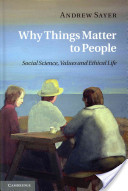 I asked because lately I’ve been reading Andrew Sayer’s book Why Things Matter to People in which he says that the type of work Susan has done is the best of what sociology can do: a) enter in people’s lives, homes, and understand their narratives, even if don’t agree; b) then, using our sociological toolkit, describe the context, circumstances that contributed to these social problems; and c) offer some possible solutions or better ways. All of these of these things Susan does in Living Faith.
Too often, sociologists want to offer some possible solutions but we hardly stop to think about people’s own narratives; we so easily discard the narratives of people we interview if they don’t match own narratives. This is what Thomas Kuhn called normal science—we are just confirming what we already think. But this is not what Susan has done. These women’s narratives challenged Susan, and she struggled to understand them, and she struggled with how to write about these women while being faithful to their self-understanding and yet also offering alternative religious narratives and structural solutions.
 My second question was more personal. I asked Susan, “How did you respond as a person to these narratives?” I asked because when I did interviews for my book Faith Makes Us Live, I had no idea how to respond to the deep trauma people told me about. I remember a beautiful young woman who I call in my book Stephanie telling me about how in Haiti a group of men had broken into her house, took turns raping her, and burned her car—all for refusing to mobilize her community development group to support a particular presidential candidate.
She had has tears running down her cheeks when she told, “But I forgive them for what they did. They know in their heart that what they did to me is wrong and they have to ask God to forgive them. But the nuns told me not to hold on to my anger; so I left the country because I wasn’t safe, but I forgive them.” I said nothing—just like in most of my interviews when trauma came up, I was silent, and so terribly conflicted inside about what to do.
Only one time did I response as a fully human being to someone’s narrative of suffering. It was when a vibrant young leader named Karl asked me one day to drive him to college because his car had broken down. I had previously interviewed Karl—he was trained as a lawyer in Haiti and had worked in politics but finally sought exile after being shot during a campaign. He was in his 30s and had to start all over again—his degrees in law and political science from Haiti were in French and held no weight in the US. I had seen Karl energetically organizing political rallies; I had also seen him mobilizing prayer troops to go to the home of seriously ill people and singing to them praying for healing of cancer.
As we drove in the car, Karl looked at me and said with tears in his eyes, “You know, Margarita, I just don’t think I can do this anymore. I’ve had to give up everything, everything, to start my life over in the US and it is just so hard. I have no job, I have no degree, every day is such a struggle. I feel like I’m never going to make it!” He looked so sad that I had a very emotional and very spontaneous outburst and I yelled at him while pounding the steering wheel, “No Karl! Not you! You cannot give up hope! I see how the youth look up to you. I see how you lead people to fight for better social and political conditions. I see you leading prayer groups. People follow you! God has a plan for your life, he is letting you go through these tough times but God will see you through this. You must have hope! You must promise me you won’t give up!” He thanked me profusely and promised me to keep fighting and leading his community.
Frankly, I was stunned at my own reaction. I had kept quiet in interviews for so long, but after months of interviews and observations, I had internalized this narrative of hope, of suffering as redemptive, and I basically gave Karl a mini-sermon that I had heard over and over again and initially wanted to reject as useless if not harmful. My sermon still expressed the sociologist in me. I had reacted so strongly precisely because I had come to see how this desperately poor and largely traumatized refugee community of Haitians really, really needed leaders like Karl with the good education, the strong faith and the enduring hope and the leadership skills to lead them out of their misery. The passionate human being in me could not let Karl give up.
So I asked Susan: how did you respond to these terribly sad and often disturbing narratives? Do we as sociologists have an obligation to engage with people’s suffering and their narratives that trouble us? If so, how? My quick answer to that is that yes, we do have obligations to enter into the lives of the people we study, even if their narratives and behaviors trouble us, but that does not mean we have to accept or endorse everything about their narratives in our personal interactions or our writing. Susan agreed, saying that when people spoke of trauma, she practiced empathic listening. At the end of interviews, she often offered to pray for people. She is going to donate part of the proceeds of her book to the shelters that help these women.
If you read this book, you will most certainly see that in many ways society and organized religion has failed these women. But you will hear their own heart-wrenching words about their experiences and failures, their hope in the midst of drug addiction, homeless, jail and abuse. You will come to sympathize and at least partially understand why they so long for an inner transformation, a meaningful relationship with God to provide them some guidance, some hope in otherwise dead-end circumstances.
Previous Post

November 12, 2012
When Data Go Bad
Next Post
November 15, 2012 Mastery Goals and Working Out Our Salvation
Browse Our Archives
Select a Category Amy Reynolds Becky Hsu Brad Wright critical realism George Yancey Gerardo Marti Jeremy Rhodes Jerry Park John Schmalzbauer Margarita Mooney Mark Regnerus Nicolette Manglos positive sociology Richard Flory Robert Woodberry Uncategorized
Select a Month April 2017 August 2016 April 2016 March 2016 February 2016 January 2016 December 2015 November 2015 October 2015 September 2015 August 2015 July 2015 June 2015 May 2015 April 2015 March 2015 February 2015 January 2015 December 2014 November 2014 October 2014 September 2014 August 2014 July 2014 June 2014 May 2014 April 2014 March 2014 February 2014 January 2014 December 2013 November 2013 October 2013 September 2013 August 2013 July 2013 June 2013 May 2013 April 2013 March 2013 February 2013 January 2013 December 2012 November 2012 October 2012 September 2012 August 2012 July 2012 June 2012 May 2012 April 2012 March 2012 February 2012 January 2012 December 2011 November 2011 October 2011
Follow Us!
TAKE THE
Religious Wisdom Quiz
She is more precious than rubies, and nothing you desire compares to her. Her ways are pleasant and all her paths are peace. Who is she?
Select your answer to see how you score.
Understanding Knowledge Wisdom A virtuous woman
Related posts from Black, White and Gray

Using Critical Realism to Teach the Fundamentals of...

Incorporating Critical Realism into Research Methods Classes

5 Great Articles Using Critical Realism in Social...

Books on Critical Realism and Sociological Research Methods
TRENDING AT PATHEOS Evangelical

The REST of Your Life: A Creative Wrestles...
This week I had a conversation with a good friend from church....

How the author of the world's best hymn...
I've been working with John Newton for a while now. This makes...

Long before this Lectio Divina, Psalm 130 - the song - started...

What About the Trees? Another Living Parable
After I finished writing the last article about falling leaves as a...

Why Classical Education Is a Conversation, Not a...
Come and Read: Joy in Classical Education When I was a little...

Cornell University has received a great deal of negative publicity and intense...
view all Evangelical blogs
Ad-Free & Subscriber Log-In Subscription Support
- About Us
- 2026 Calendar
- Videos
- Podcasts
- Library of World Religions
- Faith In Media Tracker
- Advertise With Us
- Write for Us
- Privacy Policy
- Terms of Service
- Do Not Sell My Data
- Contact Us
- Radiant Digital
- Manage Newsletter Subscriptions
- Unsubscribe From Notifications
- Sitemap
Copyright 2008-2026, Patheos. All rights reserved.
Subscription Support Ad-Free & Subscriber Log-In
Follow Patheos