
BuddhistCatholicContemplativeEvangelicalGeneral ChristianHinduJewishLatter-day SaintMuslimNew VisionsProgressive Christian
Beliefs
- Buddhist
- Catholic
- Contemplative
- Evangelical
- General Christian
- Hindu
- Jewish
- Latter-day Saint
- More Voices
- Muslim
- New Visions
- Pagan
- Progressive Christian
Topics
- Religion News
- Food and Religion
- Sports and Religion
- Religious Art
- Religious Music and Entertainment
- Religious Events
- History and Religion
- Style and Religion
- Politics and Religion
- Women in Religion
- Recreation Outdoors and Religion
- Business Finance and Religion
- Careers Workplace and Religion
- Education and Religion
- Family Parenting and Religion
- Health Fitness and Religion
- Home and Religion
- Relationships and Religion
- Technology and Religion
- Travel and Religion
Columnists
- Buddhist Columnists
- Business Finance and Religion Columnists
- Careers Workplace and Religion Columnists
- Catholic Columnists
- Contemplative Columnists
- Education and Religion Columnists
- Evangelists Columnists
- Family Parenting and Religion Columnists
- General Christian Columnists
- Health Fitness and Religion Columnists
- Hindu Columnists
- History and Religion Columnists
- Home and Religion Columnists
- Jewish Columnists
- More Voices Columnists
- Latter Day Columnists
- Muslim Columnists
- New Visions Columnists
- Nonreligious Columnists
- Pagan Columnists
- Politics and Religion Columnists
- Progressive Columnists
- Recreation Outdoors and Religion Columnists
- Relationships and Religion Columnists
- Religion News Columnists
- Religious Art Columnists
- Religious Events Columnists
- Religious Music and Entertainment Columnists
- Sports and Religion Columnists
- Style and Religion Columnists
- Technology and Religion Columnists
- Travel and Religion Columnists
- Women in Religion Columnists
Resource Library
- 2026 Calendar
- Library of World Religions
- The 100 Most Holy Places on Earth
- Patheos Answers
- Podcasts
- Videos
- Faith Leaders Database
- Anglican Episcopalian
- Bahai
- Baptist
- Buddhism
- Christianity
- Confucianism
- Eastern Orthodoxy
- Hinduism
- Holiness and Pentecostal
- ISKCON
- Islam
- Judaism
- Lutheran
- Methodist
- The Church of Jesus Christ of Latter-day Saints
- New Age
- Paganism
- Presbytarian and Reformed
- Protestantism
- Religion Behind the Scenes
- Roman Catholic
- Scientology
- Shia Islam
- Sikhism
- Sufism
- Sunni Islam
- Taoism
- Zen
- See all religions
Research Tools
 Ad-Free & Subscriber Log-In Subscription Support
Ad-Free & Subscriber Log-In Subscription Support
Follow Patheos 

- Trending:
- Forgiveness
- |
- Marriage
- |
- Consciousness
- |
- Death Penalty
- |
- Election
- |
- Halloween
 Black, White and Gray
-
About the Authors
- Home
- Evangelical
- Sayer’s “Why Things Matter to People”
Sayer’s “Why Things Matter to People”
Last updated on: October 24, 2012 at 9:43 am by Margarita A. Mooney
Sayer’s “Why Things Matter to People” 2012-10-24T09:43:41-05:00 Margarita A. Mooney
Patheos Explore the world's faith through different perspectives on religion and spirituality! Patheos has the views of the prevalent religions and spiritualities of the world.
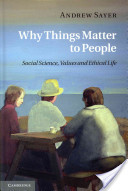 Recently, while reading Andrew Sayer’s book “Why Things Matter to People: Social Science, Values and Ethical Life,” I was captivated by the question of which of these two sentences sounds like a more accurate description of reality:
1) Thousands of people died in the Nazi concentration camps.
2) Thousands of people were systematically exterminated in Nazi concentration camps.
Most people probably pick #2. Just saying people died in Nazi concentration camps could imply they died a natural death, but saying people were systematically exterminated more accurately represents the Nazi goal of “purifying” the human race.

Mooney watching the NLCS while reading Sayer’s book in between innings
If I told you that I was so enthralled by Sayer’s book that I took it with me to a bar to watch game 7 of the National League Championship Series, would you believe me? If you believe me, do you think I’m really cool or really dorky? Just in case you just don’t think anybody is that dorky, I took a picture of me holding Sayer’s book in front of a giant screen TV where you can see the San Francisco Giants player Angel Pagan staring out of the screen.
In fact, I’ve been made fun of many times for taking philosophy books with me on airplanes, to the doctor’s office, and yes, even bars on occasion. I’m indebted to Martin Seligman, whose theories of positive psychology I’ve been writing about lately on BW&G, for helping me pinpoint why I take dense reading with me to so many places. When Seligman talks about engagement or flow (one of the 5 elements of human flourishing), he describes a sense of inner joy or fulfillment that comes from being totally absorbed in what you are. You see, when I’m really intellectually engaged, when I’ve found a new book full of great ideas that I love (like Sayer’s book), I get into the flow.
But wait a minute, how does being engaged, in the flow, go with watching the NLCS at a bar? Well, in addition to philosophy, beer and baseball are other things I enjoy. Once I’ve recognized that my intellectual work is something I truly enjoy, why can’t I mix it with other things I enjoy, like baseball? You know, baseball has a lot of breaks in it, there are breaks in between innings and in between pitches. That gives me plenty of time to read a few pages, take notes, reflect, watch another half inning, and go back to my book.
So what about the other people at the bar? No, they were not reading philosophy books. They were watching baseball and making small talk with the bartender and other patrons. Since I wholeheartedly agree with Seligman that relationships are another element of flourishing, I decided I could mix philosophy, beer, baseball and small talk at a bar with strangers. In fact, Sayer argues that three things that weaken social theory are a) rigid disciplinary boundaries that lock us into particular ways of thinking that go unchecked; b) too much emphasis on “observation” of society rather than full participation; and c) failure to check the accounts provided by social scientists with those of ordinary people.
So when inevitably, first the bartender and then the others around me said, “What’s that book you are reading?” I first said, “Well, I’m a sociologist and I write on a blog where I try to make abstract ideas interesting,” but that wasn’t a conversation starter. So then, rather than telling them the subject of the book, I just asked them the question I started this blog with: which of the two descriptions of the Nazi concentration camp is a more accurate picture of reality? Without hesitation, everyone picked #2, and they gave very good reasons for their choice.

Andrew Sayer
What does this example have to do with my work as a sociologist? Sayer’s book also could be called “Philosophy of Social Science for Beginners.” Through all my years studying first psychology as an undergraduate and then sociology in graduate school, I’m still a beginner in philosophy of social science. I’ve read a few things from philosophy here and there, but until recently I’ve never sat down to study philosophy of social science and articulate why the things I study matter to me, and hence why they should matter to you.
A recently conversation with another sociology professor accurately expresses the state of our discipline. He said, “You know, I was taught that we are scientists, we don’t take stands, we are neutral about what we study. But when I read Sayer’s book I couldn’t find any holes in his argument.”
Sayer’s book is a thorough and persuasive argument that social scientists should not be afraid to use reasoned judgment about the social events they describe. In fact, not evaluating in some fashion the events social scientists describe would lead to statements like #1, statements that just don’t accurately describe reality.
Why do I care so much about Sayer’s argument that the goal of social science is to evaluate what we study? Most undergraduate students I teach seem convinced that they cannot evaluate or judge any person’s actions or any other culture’s ways of organizing society. So are human rights a universal standard by which to judge societies, I ask? Sure, my students answer, because human rights are universally recognized. When I then point out how many places in the world ignore (or wouldn’t systematically violate be a more accurate, albeit less neutral term?) basic human rights, my students think those leaders violating human rights would surely be persuaded to change their minds and respect human rights if we could all just engage in rational, fair dialogue. But what if you’ve tried dialogue and it doesn’t work and a genocide is occurring? Then what do you do?
College students are terribly idealistic about the world, which has its strengths and weaknesses. The strength is that they do have ideals about what the world should look like. The weakness is that they have no philosophical basis on which to reason through their ideals and values and evaluate the ideals and values of other people and other cultures. Addressing this mismatch is precisely Sayer’s objective. Not only are empirical observations subject to rational evaluation, values can also be subject to reasoned debate. It is not values that are dangerous to social science, but dogmatically held values. The solution is not to jettison values but to subject them to reasoned evaluation.
In our everyday lives, Sayer argues, we are evaluative beings. As one bar patron said to me, “It seems important that the title of the book is why things matter to people, not do they matter.” Yes, exactly! Sayer argues that we need to use reason and philosophy to articulate why things matter to us. Furthermore, if we want sociology to promote well-being, Sayer says, we have to think normatively.
Hence, the purpose of Sayer’s book is to rescue social science from the fact/value dichotomy that reigns in the profession and leaves so many undergraduates tongue-tied and unable to reason why their values just might be right, or in fact could be wrong. It’s my job not only to make abstract ideas less boring to students and readers of this blog, but to reflect on abstract ideas in order to make the world a better place.
Does this argument that facts and values are not so easy to separate make you uncomfortable? Join the club. Better yet, join the book club and read some philosophy of social science. Social science has long been divorced from philosophy and it’s only by reading and engaging with philosophy of social science that we can rescue ourselves form logical contradictions and the inability to express why things matter to us, or why anyone else should care about what matters to us.
Previous Post

October 22, 2012
The Closing Gender Gap in Infidelity
Next Post
October 28, 2012 Happiness versus Life Satisfaction: What’s the Difference?
Browse Our Archives
Select a Category Amy Reynolds Becky Hsu Brad Wright critical realism George Yancey Gerardo Marti Jeremy Rhodes Jerry Park John Schmalzbauer Margarita Mooney Mark Regnerus Nicolette Manglos positive sociology Richard Flory Robert Woodberry Uncategorized
Select a Month April 2017 August 2016 April 2016 March 2016 February 2016 January 2016 December 2015 November 2015 October 2015 September 2015 August 2015 July 2015 June 2015 May 2015 April 2015 March 2015 February 2015 January 2015 December 2014 November 2014 October 2014 September 2014 August 2014 July 2014 June 2014 May 2014 April 2014 March 2014 February 2014 January 2014 December 2013 November 2013 October 2013 September 2013 August 2013 July 2013 June 2013 May 2013 April 2013 March 2013 February 2013 January 2013 December 2012 November 2012 October 2012 September 2012 August 2012 July 2012 June 2012 May 2012 April 2012 March 2012 February 2012 January 2012 December 2011 November 2011 October 2011
Follow Us!
TAKE THE
Religious Wisdom Quiz
What does Hebrews say is sharper than any double-edged sword?
Select your answer to see how you score.
The tongue Faith A righteous man's prayer The word of God
Related posts from Black, White and Gray

Using Critical Realism to Teach the Fundamentals of...

Incorporating Critical Realism into Research Methods Classes

5 Great Articles Using Critical Realism in Social...

Books on Critical Realism and Sociological Research Methods
TRENDING AT PATHEOS Evangelical

The REST of Your Life: A Creative Wrestles...
This week I had a conversation with a good friend from church....

How the author of the world's best hymn...
I've been working with John Newton for a while now. This makes...

Long before this Lectio Divina, Psalm 130 - the song - started...

What About the Trees? Another Living Parable
After I finished writing the last article about falling leaves as a...

Why Classical Education Is a Conversation, Not a...
Come and Read: Joy in Classical Education When I was a little...

Cornell University has received a great deal of negative publicity and intense...
view all Evangelical blogs
Ad-Free & Subscriber Log-In Subscription Support
- About Us
- 2026 Calendar
- Videos
- Podcasts
- Library of World Religions
- Faith In Media Tracker
- Advertise With Us
- Write for Us
- Privacy Policy
- Terms of Service
- Do Not Sell My Data
- Contact Us
- Radiant Digital
- Manage Newsletter Subscriptions
- Unsubscribe From Notifications
- Sitemap
Copyright 2008-2026, Patheos. All rights reserved.
Subscription Support Ad-Free & Subscriber Log-In
Follow Patheos