
BuddhistCatholicContemplativeEvangelicalGeneral ChristianHinduJewishLatter-day SaintMuslimNew VisionsProgressive Christian
Beliefs
- Buddhist
- Catholic
- Contemplative
- Evangelical
- General Christian
- Hindu
- Jewish
- Latter-day Saint
- More Voices
- Muslim
- New Visions
- Pagan
- Progressive Christian
Topics
- Religion News
- Food and Religion
- Sports and Religion
- Religious Art
- Religious Music and Entertainment
- Religious Events
- History and Religion
- Style and Religion
- Politics and Religion
- Women in Religion
- Recreation Outdoors and Religion
- Business Finance and Religion
- Careers Workplace and Religion
- Education and Religion
- Family Parenting and Religion
- Health Fitness and Religion
- Home and Religion
- Relationships and Religion
- Technology and Religion
- Travel and Religion
Columnists
- Buddhist Columnists
- Business Finance and Religion Columnists
- Careers Workplace and Religion Columnists
- Catholic Columnists
- Contemplative Columnists
- Education and Religion Columnists
- Evangelists Columnists
- Family Parenting and Religion Columnists
- General Christian Columnists
- Health Fitness and Religion Columnists
- Hindu Columnists
- History and Religion Columnists
- Home and Religion Columnists
- Jewish Columnists
- More Voices Columnists
- Latter Day Columnists
- Muslim Columnists
- New Visions Columnists
- Nonreligious Columnists
- Pagan Columnists
- Politics and Religion Columnists
- Progressive Columnists
- Recreation Outdoors and Religion Columnists
- Relationships and Religion Columnists
- Religion News Columnists
- Religious Art Columnists
- Religious Events Columnists
- Religious Music and Entertainment Columnists
- Sports and Religion Columnists
- Style and Religion Columnists
- Technology and Religion Columnists
- Travel and Religion Columnists
- Women in Religion Columnists
Resource Library
- 2026 Calendar
- Library of World Religions
- The 100 Most Holy Places on Earth
- Patheos Answers
- Podcasts
- Videos
- Faith Leaders Database
- Anglican Episcopalian
- Bahai
- Baptist
- Buddhism
- Christianity
- Confucianism
- Eastern Orthodoxy
- Hinduism
- Holiness and Pentecostal
- ISKCON
- Islam
- Judaism
- Lutheran
- Methodist
- The Church of Jesus Christ of Latter-day Saints
- New Age
- Paganism
- Presbytarian and Reformed
- Protestantism
- Religion Behind the Scenes
- Roman Catholic
- Scientology
- Shia Islam
- Sikhism
- Sufism
- Sunni Islam
- Taoism
- Zen
- See all religions
Research Tools
 Ad-Free & Subscriber Log-In Subscription Support
Ad-Free & Subscriber Log-In Subscription Support
Follow Patheos 

- Trending:
- Forgiveness
- |
- Marriage
- |
- Consciousness
- |
- Death Penalty
- |
- Election
- |
- Halloween
 Black, White and Gray
-
About the Authors
- Home
- Evangelical
- Racial-Religious Patterns in the 2012 Elections
Racial-Religious Patterns in the 2012 Elections
Last updated on: December 9, 2012 at 6:13 pm by Jerry Park
Racial-Religious Patterns in the 2012 Elections 2012-12-09T18:13:39-05:00 Jerry Park
Patheos Explore the world's faith through different perspectives on religion and spirituality! Patheos has the views of the prevalent religions and spiritualities of the world.
I received a news alert from the Pew Forum on Religion and Public Life where they ran a slide show of religious affiliations and political party, and given that they ran one of the few Asian American surveys ever, I thought surely they would add in the Asian Americans this time. Alas no. So I found the numbers from both the July report and from the recent slideshow to put together a few figures that help us put race and religion in a more comprehensive picture of where a lot of religiously-identified voters stand:
Figure 1: Protestantism and Race
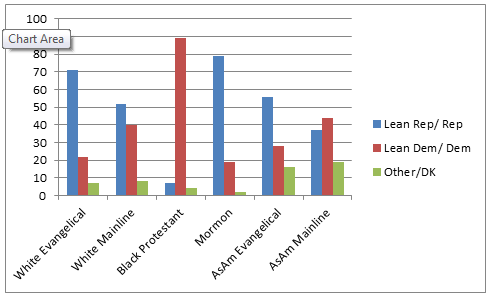
Pardon the color switching, it’s just the default on Excel and I didn’t have time to figure out how to change it. The main takeaway I see here is that white Protestant affiliates and Asian American evangelicals lean Republican more so than lean Democrat. Black Protestants and Asian American Mainline Protestants lean Democrat more than Republican. I couldn’t find recent data for the Latino Protestant party preference which would have really been comprehensive. Unlike white and black Protestants, Asian American Protestants seem to be divided on political party preference.
Figure 2: Catholicism and Race
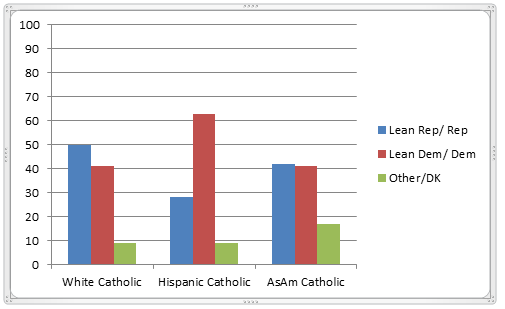
Here we have data on the Hispanic Catholic case which we can then compare Asian American and white Catholics. In similar fashion to the Protestant analysis, I couldn’t find current data on black Catholic party preference. The main observations here are that Catholics are somewhat more moderate (admittedly based on only 3 groups). Hispanic Catholics follow Black Protestants and Asian American Mainliners as more pro-Democrat Christian, while white Catholics tilt slightly in favor of Republican identification. The Asian American Catholic case is very interesting as it is the only instance in which there is some parity in party preference. This would be a religious swing vote group for sure. But to be clear, Asian American Catholics form 19% of the 6% of the US population that identifies as Asian American.
Figure 3: Minority Religions and Race
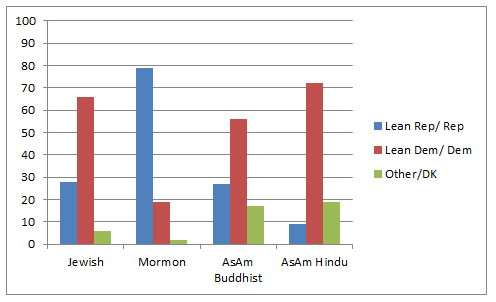
Mormons are reintroduced here for comparison since they constitute less than 3% of the population. Again we have no current data on American Muslim and Sikh voter preference. That said, we see that 3 of these 4 minority religious groups lean Democrat whereas Mormons lean Republican. American Jews and Mormons usually identify racially as white so these two groups reflect interesting contrasts in the political orientations of two predominantly white minority religious groups. Among the two predominantly Asian minority religious groups the patterns of political preference are somewhat parallel.
Figure 4: Unaffiliated by Race
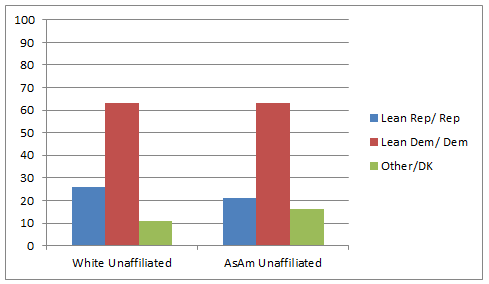
We lack data on African American and Latino unaffiliated political party preference so we can examine the largest racial group of the nonaffiliated along with the minority group with the largest proportional presence of nonaffiliated Americans. We see here a very similar pattern in party preference, with a clear Democrat leaning by white non-Hispanic nonaffiliates and Asian American nonaffiliates.
Overall these figures suggest that the religious composition of both parties is quite different from one another. The Republicans might well be considered a very Christian party. Larger proportions of white Protestants (including Mormons), white Catholics and Asian American evangelicals are represented in their ranks. The Democrats would be like a religious salad bowl consisting of larger proportions of many religious constituencies including African American Protestants, Hispanic Catholics, Asian American Mainline, Jewish, Buddhist and Hindu Americans. Given that 5 of these 6 religious groups are predominantly racial minority in composition, these religious groups also make Democrats more racially diverse. We also have a sizable presence of religious nones as well and both white and Asian Americans mirror one another. Given the religious diversity of the Democratic party, it makes sense that they will struggle with presenting a religious sensibility that is inclusive of so many perspectives. The Republicans can more easily reference a Christian narrative that is accessible to most in their party.
The other observation I see here is the remarkably higher rates of non-mainstream party preference by Asian Americans regardless of religious group. Asian Americans who said they had some other party preference or could not identify one ranged from 16-19% across religious groups. Non-Asian Americans at most are 11% non-mainstream in their party preference.
It’s important to remember also the general racial composition and religious composition of the US. White non-Hispanics take up 63% of the population, followed by Latinos at 16%, African Americans at 12% and Asian Americans at 6%. Protestantism still dominates at around 60% (or a little lower) followed by Catholicism at 25% and the remaining 15% are a combination of Buddhists, Hindus, Jews, Muslims, Sikhs and other religious groups.
As a sociologist interested in Asian America, the availability of comparable data between Americans of Asian descent and other Americans is a welcome step forward in getting a better idea of the big picture that includes a group that is often sidelined or invisible in public discussion over matters like politics. Hopefully with improved survey tools that can pick up more representations of our major racial groups in the US we’ll have a more clearer picture of the role that religion and race play in the political sphere.
Note: new update here
Next Post

October 6, 2012 What Motivates Cultural Progressives - Part 3
Browse Our Archives
Select a Category Amy Reynolds Becky Hsu Brad Wright critical realism George Yancey Gerardo Marti Jeremy Rhodes Jerry Park John Schmalzbauer Margarita Mooney Mark Regnerus Nicolette Manglos positive sociology Richard Flory Robert Woodberry Uncategorized
Select a Month April 2017 August 2016 April 2016 March 2016 February 2016 January 2016 December 2015 November 2015 October 2015 September 2015 August 2015 July 2015 June 2015 May 2015 April 2015 March 2015 February 2015 January 2015 December 2014 November 2014 October 2014 September 2014 August 2014 July 2014 June 2014 May 2014 April 2014 March 2014 February 2014 January 2014 December 2013 November 2013 October 2013 September 2013 August 2013 July 2013 June 2013 May 2013 April 2013 March 2013 February 2013 January 2013 December 2012 November 2012 October 2012 September 2012 August 2012 July 2012 June 2012 May 2012 April 2012 March 2012 February 2012 January 2012 December 2011 November 2011 October 2011
Follow Us!
TAKE THE
Religious Wisdom Quiz
What did Jesus cast into a herd of pigs?
Select your answer to see how you score.
Leprosy Coins Demons Water
Related posts from Black, White and Gray

One Step Forward, but Now What?

Saving the Market: Harry Potter, Churches, and Globalization

The Personal and the Political: Violence in our...

Greater Acceptance, Persisting Antipathy: 50 Years of Religious...
TRENDING AT PATHEOS Evangelical

The REST of Your Life: A Creative Wrestles...
This week I had a conversation with a good friend from church....

How the author of the world's best hymn...
I've been working with John Newton for a while now. This makes...

Long before this Lectio Divina, Psalm 130 - the song - started...

What About the Trees? Another Living Parable
After I finished writing the last article about falling leaves as a...

Why Classical Education Is a Conversation, Not a...
Come and Read: Joy in Classical Education When I was a little...

Cornell University has received a great deal of negative publicity and intense...
view all Evangelical blogs
Ad-Free & Subscriber Log-In Subscription Support
- About Us
- 2026 Calendar
- Videos
- Podcasts
- Library of World Religions
- Faith In Media Tracker
- Advertise With Us
- Write for Us
- Privacy Policy
- Terms of Service
- Do Not Sell My Data
- Contact Us
- Radiant Digital
- Manage Newsletter Subscriptions
- Unsubscribe From Notifications
- Sitemap
Copyright 2008-2026, Patheos. All rights reserved.
Subscription Support Ad-Free & Subscriber Log-In
Follow Patheos