
BuddhistCatholicContemplativeEvangelicalGeneral ChristianHinduJewishLatter-day SaintMuslimNew VisionsProgressive Christian
Beliefs
- Buddhist
- Catholic
- Contemplative
- Evangelical
- General Christian
- Hindu
- Jewish
- Latter-day Saint
- More Voices
- Muslim
- New Visions
- Pagan
- Progressive Christian
Topics
- Religion News
- Food and Religion
- Sports and Religion
- Religious Art
- Religious Music and Entertainment
- Religious Events
- History and Religion
- Style and Religion
- Politics and Religion
- Women in Religion
- Recreation Outdoors and Religion
- Business Finance and Religion
- Careers Workplace and Religion
- Education and Religion
- Family Parenting and Religion
- Health Fitness and Religion
- Home and Religion
- Relationships and Religion
- Technology and Religion
- Travel and Religion
Columnists
- Buddhist Columnists
- Business Finance and Religion Columnists
- Careers Workplace and Religion Columnists
- Catholic Columnists
- Contemplative Columnists
- Education and Religion Columnists
- Evangelists Columnists
- Family Parenting and Religion Columnists
- General Christian Columnists
- Health Fitness and Religion Columnists
- Hindu Columnists
- History and Religion Columnists
- Home and Religion Columnists
- Jewish Columnists
- More Voices Columnists
- Latter Day Columnists
- Muslim Columnists
- New Visions Columnists
- Nonreligious Columnists
- Pagan Columnists
- Politics and Religion Columnists
- Progressive Columnists
- Recreation Outdoors and Religion Columnists
- Relationships and Religion Columnists
- Religion News Columnists
- Religious Art Columnists
- Religious Events Columnists
- Religious Music and Entertainment Columnists
- Sports and Religion Columnists
- Style and Religion Columnists
- Technology and Religion Columnists
- Travel and Religion Columnists
- Women in Religion Columnists
Resource Library
- 2026 Calendar
- Library of World Religions
- The 100 Most Holy Places on Earth
- Patheos Answers
- Podcasts
- Videos
- Faith Leaders Database
- Anglican Episcopalian
- Bahai
- Baptist
- Buddhism
- Christianity
- Confucianism
- Eastern Orthodoxy
- Hinduism
- Holiness and Pentecostal
- ISKCON
- Islam
- Judaism
- Lutheran
- Methodist
- The Church of Jesus Christ of Latter-day Saints
- New Age
- Paganism
- Presbytarian and Reformed
- Protestantism
- Religion Behind the Scenes
- Roman Catholic
- Scientology
- Shia Islam
- Sikhism
- Sufism
- Sunni Islam
- Taoism
- Zen
- See all religions
Research Tools
 Ad-Free & Subscriber Log-In Subscription Support
Ad-Free & Subscriber Log-In Subscription Support
Follow Patheos 

- Trending:
- Forgiveness
- |
- Marriage
- |
- Consciousness
- |
- Death Penalty
- |
- Election
- |
- Halloween
 Black, White and Gray
-
About the Authors
- Home
- Evangelical
- Parades and Protests
Parades and Protests
Last updated on: September 4, 2012 at 10:28 am by Amy Reynolds
Parades and Protests 2012-09-04T10:28:07-05:00 Amy Reynolds
Patheos Explore the world's faith through different perspectives on religion and spirituality! Patheos has the views of the prevalent religions and spiritualities of the world.
In cities across America, people marched in parades to celebrate Labor Day yesterday. At the first Labor Day in 1882 (occurring a few years before Labor Day became an official holiday in 1894), a number of people marched through the streets of New York City. The march 130 years ago would not have been confused with the marches yesterday, either in purpose or passion.
Walking through various neighborhoods yesterday, I saw flags hanging in front of people’s houses. I smelled hamburgers and hotdogs cooking. Online, I read a number of articles and other postings celebrating American workers. For example, the US Census Bureau released this list of facts to celebrate the 155.2 million people currently participating the labor force.
For many, Labor Day is an important event, but the reasons are often very different than the reasons prompting its inclusion in the register of federal holidays. For some it marks the last day of summer before going back to school. Many celebrate local workers (such as the fireman and police), and are thankful for the opportunities they personally have to labor in their own lives. People often come together with family and friends. Without bemoaning these reasons for celebration, we have lost something by not remembering why Labor Day became an official American holiday.
Labor Day was originally founded in part because of class struggle. Early organizers were concerned with two central goals: building and inspiring the organized labor movement, and rallying the public to its cause. In the 1930s, a number of workers were joining labor movements. As Kazin and Ross argue (in their 1992 overview of the history of Labor Day in the United States), even with the variation across the nation in how the day was celebrated, since the 1950s, Labor Day has largely failed to evoke the raw emotions surrounding the contentious issues it once did.
It would be hard to argue that the environment towards organized labor today is a positive one. Most will recall the events of Wisconsin in 2011, when the state—which was, ironically, the first to recognize the collective bargaining rights of workers back in 1959—scaled back such collective bargaining possibilities. Labor movements do not have the strength they once did, although scholars of labor movements recognize the new ways that labor are involved in social movements today.
Organized labor has fewer numbers and fewer allies than it has had in the past. Of the labor force, currently just under 12% are now affiliated with organized labor. This chart, produced by the Bureau of Labor Statistics based on 2011 data, shows how union membership varies by occupation.
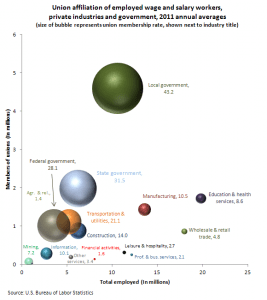
Bureau of Labor Statistics, 2012
What is it that we have lost, as parades down Main Street replace labor protests?
First, recent research by political scientists at Notre Dame and Texas A&M suggests that labor unions increase the “life satisfaction” of members—and non-members in areas where unions are present. Perhaps especially important, they find that the impact of unions matters more for those with low incomes. While I know readers of this blog will disagree about some of the current tactics and strategies used by unions, it is hard to deny the real effects that collective bargaining has had over the years. They have been critically involved in championing changes to unemployment laws, fighting against discrimination of workers, and changing the working conditions and remuneration of members.
Second, Labor Day was not just a day where laborers worked for their goals and rallied members, but also a time when the general public was made aware of these voices (a point highlighted by Kazin and Ross). Currently, many of those working in parallel jobs to the industries where unions abounded—many of the working poor and working middle class—do not have the same chances to have their voices heard. Workers without economic capital and wealth are often absent from political debates about the economy (as witnessed by the current public rhetoric between democrats and republicans).
I believe that most of us want to be part of a society that provides a chance for all to participate in dignified work. It is imperative that we not just recognize and celebrate all who labor, even as such an act is important. We must also recognize the changes that organized labor have helped to bring about for many Americans, and the lack of power that many laborers continue to feel in our economy.
Previous Post

September 1, 2012
What Motivates Cultural Progressives - Part 1
Next Post
September 5, 2012 Why do Americans Celebrate Labor Day in September and Not May?
Browse Our Archives
Select a Category Amy Reynolds Becky Hsu Brad Wright critical realism George Yancey Gerardo Marti Jeremy Rhodes Jerry Park John Schmalzbauer Margarita Mooney Mark Regnerus Nicolette Manglos positive sociology Richard Flory Robert Woodberry Uncategorized
Select a Month April 2017 August 2016 April 2016 March 2016 February 2016 January 2016 December 2015 November 2015 October 2015 September 2015 August 2015 July 2015 June 2015 May 2015 April 2015 March 2015 February 2015 January 2015 December 2014 November 2014 October 2014 September 2014 August 2014 July 2014 June 2014 May 2014 April 2014 March 2014 February 2014 January 2014 December 2013 November 2013 October 2013 September 2013 August 2013 July 2013 June 2013 May 2013 April 2013 March 2013 February 2013 January 2013 December 2012 November 2012 October 2012 September 2012 August 2012 July 2012 June 2012 May 2012 April 2012 March 2012 February 2012 January 2012 December 2011 November 2011 October 2011
Follow Us!
TAKE THE
Religious Wisdom Quiz
Who was the strongest man mentioned in the Bible?
Select your answer to see how you score.
Goliath Samson Saul David
Related posts from Black, White and Gray

Saving the Market: Harry Potter, Churches, and Globalization

The Personal and the Political: Violence in our...

Women in Leadership National Study: A First Glance

Economic Choices, the Media, and Racism
TRENDING AT PATHEOS Evangelical

The REST of Your Life: A Creative Wrestles...
This week I had a conversation with a good friend from church....

How the author of the world's best hymn...
I've been working with John Newton for a while now. This makes...

Long before this Lectio Divina, Psalm 130 - the song - started...

What About the Trees? Another Living Parable
After I finished writing the last article about falling leaves as a...

Why Classical Education Is a Conversation, Not a...
Come and Read: Joy in Classical Education When I was a little...

Cornell University has received a great deal of negative publicity and intense...
view all Evangelical blogs
Ad-Free & Subscriber Log-In Subscription Support
- About Us
- 2026 Calendar
- Videos
- Podcasts
- Library of World Religions
- Faith In Media Tracker
- Advertise With Us
- Write for Us
- Privacy Policy
- Terms of Service
- Do Not Sell My Data
- Contact Us
- Radiant Digital
- Manage Newsletter Subscriptions
- Unsubscribe From Notifications
- Sitemap
Copyright 2008-2026, Patheos. All rights reserved.
Subscription Support Ad-Free & Subscriber Log-In
Follow Patheos