
BuddhistCatholicContemplativeEvangelicalGeneral ChristianHinduJewishLatter-day SaintMuslimNew VisionsProgressive Christian
Beliefs
- Buddhist
- Catholic
- Contemplative
- Evangelical
- General Christian
- Hindu
- Jewish
- Latter-day Saint
- More Voices
- Muslim
- New Visions
- Pagan
- Progressive Christian
Topics
- Religion News
- Food and Religion
- Sports and Religion
- Religious Art
- Religious Music and Entertainment
- Religious Events
- History and Religion
- Style and Religion
- Politics and Religion
- Women in Religion
- Recreation Outdoors and Religion
- Business Finance and Religion
- Careers Workplace and Religion
- Education and Religion
- Family Parenting and Religion
- Health Fitness and Religion
- Home and Religion
- Relationships and Religion
- Technology and Religion
- Travel and Religion
Columnists
- Buddhist Columnists
- Business Finance and Religion Columnists
- Careers Workplace and Religion Columnists
- Catholic Columnists
- Contemplative Columnists
- Education and Religion Columnists
- Evangelists Columnists
- Family Parenting and Religion Columnists
- General Christian Columnists
- Health Fitness and Religion Columnists
- Hindu Columnists
- History and Religion Columnists
- Home and Religion Columnists
- Jewish Columnists
- More Voices Columnists
- Latter Day Columnists
- Muslim Columnists
- New Visions Columnists
- Nonreligious Columnists
- Pagan Columnists
- Politics and Religion Columnists
- Progressive Columnists
- Recreation Outdoors and Religion Columnists
- Relationships and Religion Columnists
- Religion News Columnists
- Religious Art Columnists
- Religious Events Columnists
- Religious Music and Entertainment Columnists
- Sports and Religion Columnists
- Style and Religion Columnists
- Technology and Religion Columnists
- Travel and Religion Columnists
- Women in Religion Columnists
Resource Library
- 2026 Calendar
- Library of World Religions
- The 100 Most Holy Places on Earth
- Patheos Answers
- Podcasts
- Videos
- Faith Leaders Database
- Anglican Episcopalian
- Bahai
- Baptist
- Buddhism
- Christianity
- Confucianism
- Eastern Orthodoxy
- Hinduism
- Holiness and Pentecostal
- ISKCON
- Islam
- Judaism
- Lutheran
- Methodist
- The Church of Jesus Christ of Latter-day Saints
- New Age
- Paganism
- Presbytarian and Reformed
- Protestantism
- Religion Behind the Scenes
- Roman Catholic
- Scientology
- Shia Islam
- Sikhism
- Sufism
- Sunni Islam
- Taoism
- Zen
- See all religions
Research Tools
 Ad-Free & Subscriber Log-In Subscription Support
Ad-Free & Subscriber Log-In Subscription Support
Follow Patheos 

- Trending:
- Forgiveness
- |
- Marriage
- |
- Consciousness
- |
- Death Penalty
- |
- Election
- |
- Halloween
 Black, White and Gray
-
About the Authors
- Home
- Evangelical
- Sociological Lessons from the Game of Life
Sociological Lessons from the Game of Life
Last updated on: August 29, 2012 at 9:41 am by Margarita A. Mooney
Sociological Lessons from the Game of Life 2012-08-29T09:41:54-05:00 Margarita A. Mooney
Patheos Explore the world's faith through different perspectives on religion and spirituality! Patheos has the views of the prevalent religions and spiritualities of the world.
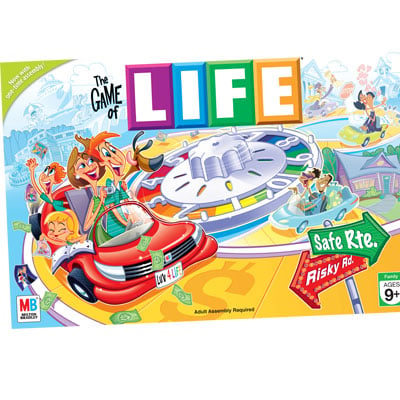 Recently, while on vacation at the beach with my family, I encountered my sister-in-law, niece and nephew in the middle of the Game of Life.” I cracked up when I found out that my 9-year old nephew was a doctor living in a mansion who had made extra money by finding buried treasure and suing someone, but my 7-year old niece was a hairdresser who lived in a double-wide trailer, had a large family (including several grandchildren) but practically no money to retire on. What inequalities, I thought!
Throughout the week, as we played the Game of Life several more times and I realized that the Game of Life must have been designed by a sociologist (or at least someone who majored in sociology in college). Why? Because we teach our students that choices you make early in the Game of Life shape the rest of your life. To illustrate, in the Game of Life the first thing each player does is choose either to start a career (and start earning money) or go to college (you delay earning money now but will earn more later). After a few rounds of the Game of Life, my nephew exclaimed, “Gee if I go to college I finish the Game of Life with a lot more money!”
Here is how Hasbro advertises the Game of Life:
“Where will your choices take you? You made it through high school, so now what’s next? Go to college or start a career -it’s your choice. Think the family life is for you? Take that path and see how many kids you’ll have! Will you venture down the risky road where fortunes can be won… and lost? Do whatever it takes to retire in style with the most wealth at the end of the game. Spin the wheel of fate and take a drive along the twisting roads families have enjoyed for more than 50 years! Do good deeds as you go through the game to earn Life Tiles and more money down the road!”
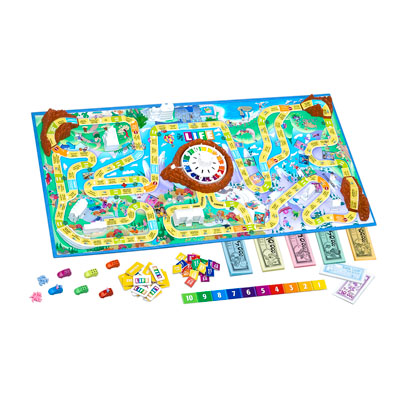 The Game of Life is also very sociological because it has spots on the game board where everyone must stop no matter what they roll. Therefore, all players must go through several key life course transitions: everyone must get married, buy a house, and have at least one child.
In real life, however, kids don’t always come before marriage, people with jobs still struggle to buy a home, and some people won’t every marry or have kids. Interestingly, despite the fact that half of marriages in real life end in divorce, no one in the Game of Life ever gets divorced. The Game of Life doesn’t tell us what happens to people who follow these different tracks, but sociologists will tell you that real life is much messier than the Game of Life.
The Game of Life does a good job of countering much of the individualist America ethos that says everyone gets what they deserve or what they work for. In the Game of Life, as in real life, your long-term economic position depends only partly on choices you make, but depends more heavily on random rolls of the dice. For example, if you roll the dice well, you find buried treasure worth $100,000. If you roll the dice poorly, you have a major car accident and lose $50,000. As my 9-year old nephew said, “You know, this game of life has a lot of chance!” Well put.
The Game of Life makes certain aspects of real life quite funny. During one game, my brother got a career as a mechanic. When his roll of the dice landed him on the block that says “job relocation, spend $20,000,” he said, “I only make $30,000 a year as a mechanic and I have to spend $20,000 to relocate?!?” I told him he was an airplane mechanic who worked for Boeing; they had closed their plant in Washington State and relocated to South Carolina. That’s a big, costly move.
Much like in real life, as I played the game of Life again and again, I kept thinking I could beat the game. That is, if I did things right, I could get the job I wanted, the kind of house I wanted, and accrue lots of money for a nice retirement. Sadly, no matter how many times I played, my life came up short.
No one at the table was really happy with their Game of Life. In one Game of Life, my 7-year old niece decided she wanted a large family. With each roll of the dice, she begged the Game of Life, “I want kids. More kids! Grandkids! Give me kids!!!!!!” In real life, many people want kids, or want more kids, but are just as frustrated as my niece. Finishing her Game of Life with just one child and quite poor, my 7-year old niece pouted on her bed said, “This game of life is so unfair!! The person with the most money always wins at the end! I just want kids!”
What does the Game of Life teach our children us about real life? That you are not in control of your destiny, that having more than others makes you feel good about yourself, and that all you have can be lost in one day due to a lawsuit or car accident.
Is that what I want to teach our children about real life? Although, as a sociologist, I know that Game of Life has much truth in it, I also want to teach children and my students to be prepared for the real life—you may not get what you want, but you can make the best with what you have.
As I have written before, it is sometimes in not “having it all” that we come to see how much we do have. The Game of Life doesn’t tell you what to value, but if you know what you value in real life, you will be satisfied with what you have. Real life is messy and much is out of your control. So before rolling the dice, ask yourself: what do you value in life?
Previous Post

August 25, 2012
Panda Express(ions): Commodifying and Constructing Pan-Asian-ness
Next Post
August 30, 2012 Update on the Regnerus situation
Browse Our Archives
Select a Category Amy Reynolds Becky Hsu Brad Wright critical realism George Yancey Gerardo Marti Jeremy Rhodes Jerry Park John Schmalzbauer Margarita Mooney Mark Regnerus Nicolette Manglos positive sociology Richard Flory Robert Woodberry Uncategorized
Select a Month April 2017 August 2016 April 2016 March 2016 February 2016 January 2016 December 2015 November 2015 October 2015 September 2015 August 2015 July 2015 June 2015 May 2015 April 2015 March 2015 February 2015 January 2015 December 2014 November 2014 October 2014 September 2014 August 2014 July 2014 June 2014 May 2014 April 2014 March 2014 February 2014 January 2014 December 2013 November 2013 October 2013 September 2013 August 2013 July 2013 June 2013 May 2013 April 2013 March 2013 February 2013 January 2013 December 2012 November 2012 October 2012 September 2012 August 2012 July 2012 June 2012 May 2012 April 2012 March 2012 February 2012 January 2012 December 2011 November 2011 October 2011
Follow Us!
TAKE THE
Religious Wisdom Quiz
The heavens declare God's glory without speech or words. Which psalm proclaims creation's silent testimony?
Select your answer to see how you score.
Psalm 104 Psalm 148 Psalm 8 Psalm 19
Related posts from Black, White and Gray

Using Critical Realism to Teach the Fundamentals of...

Incorporating Critical Realism into Research Methods Classes

5 Great Articles Using Critical Realism in Social...

Books on Critical Realism and Sociological Research Methods
TRENDING AT PATHEOS Evangelical

The REST of Your Life: A Creative Wrestles...
This week I had a conversation with a good friend from church....

How the author of the world's best hymn...
I've been working with John Newton for a while now. This makes...

Long before this Lectio Divina, Psalm 130 - the song - started...

What About the Trees? Another Living Parable
After I finished writing the last article about falling leaves as a...

Why Classical Education Is a Conversation, Not a...
Come and Read: Joy in Classical Education When I was a little...

Cornell University has received a great deal of negative publicity and intense...
view all Evangelical blogs
Ad-Free & Subscriber Log-In Subscription Support
- About Us
- 2026 Calendar
- Videos
- Podcasts
- Library of World Religions
- Faith In Media Tracker
- Advertise With Us
- Write for Us
- Privacy Policy
- Terms of Service
- Do Not Sell My Data
- Contact Us
- Radiant Digital
- Manage Newsletter Subscriptions
- Unsubscribe From Notifications
- Sitemap
Copyright 2008-2026, Patheos. All rights reserved.
Subscription Support Ad-Free & Subscriber Log-In
Follow Patheos